

Feedback loops are a simple way to improve continuously. They work by taking results from a system – customer or employee feedback – analyzing them, making changes, and repeating. The cycle helps businesses refine strategies, fix problems, and build stronger connections with customers and staff.
Key Takeaways:
- Two Types of Feedback Loops: Positive loops reinforce what works; negative loops address problems.
- Why They Matter: the effect on engagement and profitability is measurable, and Gallup’s meta-analysis is the best evidence for it.
- Real-World Examples: Microsoft has published a detailed, checkable account of one. Most companies have not.
- Steps to Implement: Define goals, choose feedback channels, use tools to analyze data, and communicate changes back.
Feedback loops aren’t about collecting opinions. They are about acting on them and closing the loop by showing customers and employees their input mattered.
A note on the statistics we removed. This article previously opened with six percentages: 85% of companies with feedback loops seeing higher satisfaction, 90% of executives calling them essential, 95% collecting feedback but only 10% acting on it, 83% of customers feeling more loyal after a resolved complaint, a 240% performance uplift, and 74% of businesses increasing customer experience investment. None could be traced to a study. They have been removed rather than softened. Two claims survived checking and are cited below.
What the Evidence Actually Shows
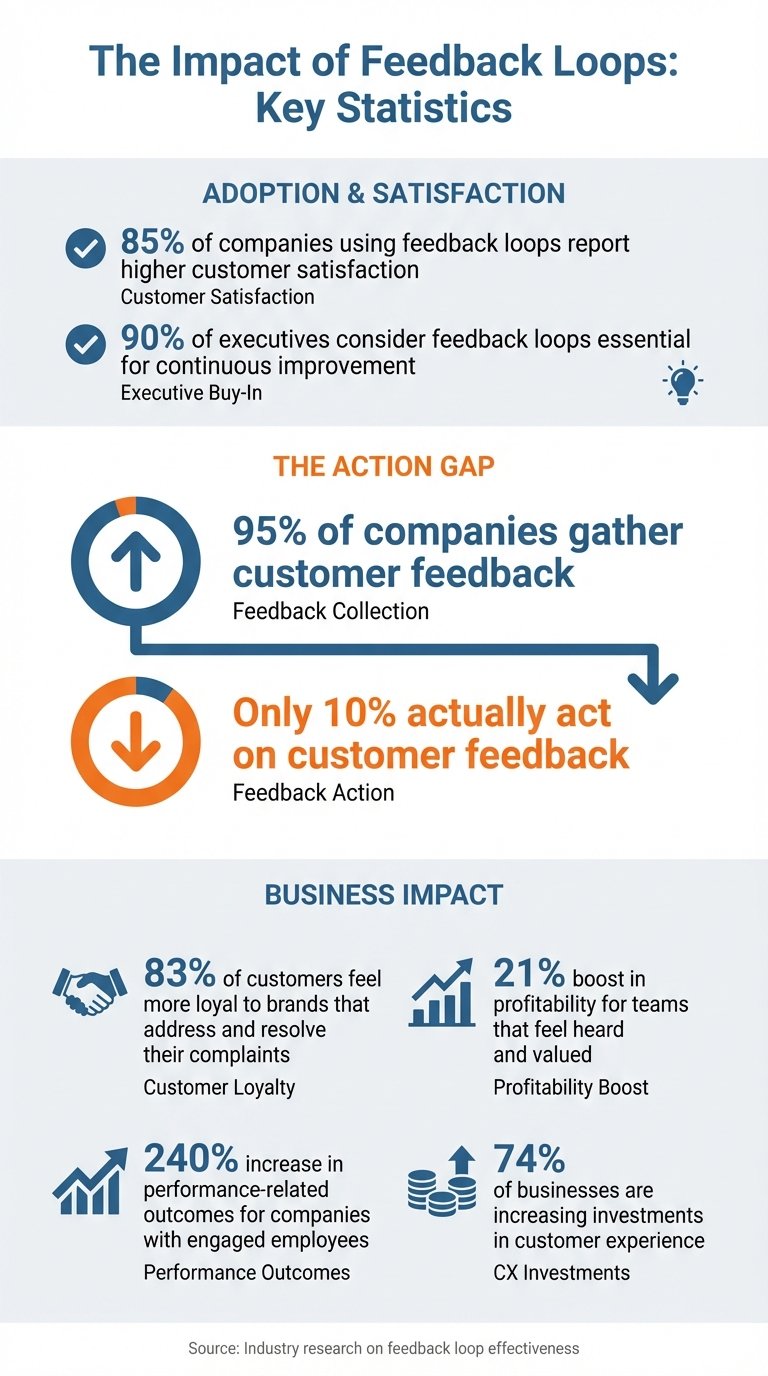
Feedback loops and business performance
The one large body of research worth quoting
Gallup’s Q12 meta-analysis is the strongest published evidence linking employee feedback and engagement to business results. Its 2012 iteration covered 263 studies across 192 organizations in 49 industries and 34 countries, taking in 49,928 work units and nearly 1.4 million employees. Comparing top-quartile to bottom-quartile work units on engagement, it found:
- 22% higher profitability
- 21% higher productivity
- 37% lower absenteeism
- 25% lower turnover in high-turnover organizations, and 65% lower in low-turnover ones
Note the pairing, because an earlier version of this article got it wrong: 21% is the productivity figure, not the profitability one. Note also what the study measures. These are correlations between engagement scores and unit performance, not a controlled test of feedback loops specifically. Engagement is the thing measured; feedback is one of the things that moves it.
Benefits vs. Challenges
Feedback loops offer clear advantages and introduce real costs. Both are worth stating plainly.
| Advantages | Challenges |
|---|---|
| Innovation and Product Development: Customer feedback surfaces problems your roadmap missed | Data Analysis: Extracting meaningful signal from large volumes of free-text feedback is genuinely hard |
| Customer Retention: Resolving concerns raised through feedback reduces churn | Implementation Delays: Feedback arrives faster than you can act on it |
| Proactive Problem-Solving: Identifies issues before they escalate | Information Overload: Volume overwhelms small teams within weeks |
| Trust and Credibility: Shows customers their input changes something | Survey Fatigue: Over-surveying reduces response rates and biases who answers |
| Better Decision-Making: Real-time signal instead of annual retrospectives | Consistency: Maintaining a uniform process across channels |
The failure mode is almost always the same: collecting more than you can process, then quietly ignoring most of it. That is worse than not asking, because people notice.
Case Studies: How Businesses Use Feedback Loops
Microsoft: Continuous Improvement Inside Microsoft Digital
This is the one example on this page with published, checkable numbers. Microsoft Digital, the company’s internal IT organization, described its continuous improvement work on Microsoft’s Inside Track blog. David Laves, director of business programs at Microsoft Digital, is quoted there:
“Continuous improvement is a natural, formal extension of our culture that applies rigor, structure, and methodology to enacting a growth mindset through understanding waste and opportunities for optimization.”
The concrete example is the Smart DRI Agent, an AI tool built to automate status updates for Designated Responsible Individuals handling incidents. Over a 30-day pilot the agent processed 301 incidents and provided useful insight on 101 of them, saved roughly 100 hours of DRI time, and coincided with a 40% improvement in the organization’s key network performance metric.
Two caveats worth holding onto. This is Microsoft publishing about Microsoft, so it is a self-report. And an agent that produced useful output on a third of the incidents it saw is a reasonable pilot result, not a solved problem. The reason to trust the account more than most is that it names the ratio at all.
Slack: Progressive Rollout as a Feedback Mechanism
Slack’s early growth is the standard example of feedback-driven product development. The product started as an internal tool at Tiny Speck and was released to progressively larger groups of outside companies, with each cohort’s problems fixed before the next one arrived. Rather than a conventional closed beta, the company invited users publicly and treated the resulting complaints as the roadmap. It reached a billion-dollar valuation within roughly eight months of its public launch in early 2014.
An earlier version of this article presented a sentence describing that strategy as a direct quotation from co-founder Stewart Butterfield. It is not a quotation from him – it is a summary someone put in quotation marks. It has been removed, along with a specific claim about the number of “champion users” in a shared feedback channel that no source supports.
The transferable part does not need a quote. Releasing to small cohorts and fixing what they hit before widening is a feedback loop with a short cycle time, and short cycle time is the whole mechanism. A survey answered once a quarter cannot do the same job.
Why AI Feedback Analysis Gets Recommended
This article previously carried a section on Atlassian using AI to analyze customer feedback. It contained no results, no source, and conceded in its own text that details were unavailable. It has been removed.
The underlying point stands on its own. Free-text feedback is expensive to read and cheap to collect, so the volume outruns the reading almost immediately. Clustering and classification tools reduce a few thousand comments to a few dozen themes, which is the difference between feedback you act on and feedback you archive. What they cannot do is decide which theme matters, and any vendor implying otherwise is selling. Expect a tool to sort the pile, not to tell you what to build.
How to Implement Feedback Loops in Your Business
Setting Goals and Choosing Feedback Channels
Start with a clear purpose. What are you aiming to improve? Product usability, customer service, employee retention – defining the goal is what stops you collecting data nobody will use.
Then choose channels that suit the question. Quantitative measures like NPS, CSAT and CES give you a trend line; live chats, interviews and focus groups tell you why the line moved. Social listening, in-app prompts and feedback widgets catch reactions in the moment. Beta testing with varied user groups catches usability problems before launch.
Timing matters. Ask right after a purchase or a support interaction, when the experience is fresh. Incentives raise response rates but also skew who responds, so weigh that. Say how the feedback will be used; people answer more honestly when they believe something happens next.
Tools and Platforms for Managing Feedback
Dashboards and reports help you spot trends and prioritize by frequency, impact, and fit with your goals. Automation handles the routine parts – follow-up surveys, response summaries – and leaves the judgement calls to people.
Platforms like BizBot list tools for feedback collection and analysis, from HR software for employee input to subscription tools that track customer satisfaction.
Performance management tools can link feedback to goals and reviews, which is what stops feedback becoming a separate chore nobody has time for.
Tracking Results and Refining Your Process
The value of feedback is in turning it into action. Track whether feedback correlates with retention, engagement, or adoption. Segment responses so you can see which groups react differently. Then tell people what you changed.
Close the loop by acknowledging feedback and sharing updates through email, blog posts, or in-product notices. This is the step most companies skip, and skipping it is why the second survey gets a lower response rate than the first.
Improvement is ongoing. Gather fresh feedback, refine based on what worked, and keep the process light enough that it survives a busy quarter. Build a culture where feedback is a route to improvement rather than an occasion for blame – which mostly means managers not reacting badly the first time someone tells them something unwelcome.
Conclusion: Key Points About Feedback Loops for Business Success
Feedback loops are a cycle of listening, analyzing, acting, and communicating. The organizations that do it well treat feedback as an ongoing dialogue rather than an annual survey.
The honest summary of the evidence is narrower than the marketing version. Gallup’s meta-analysis shows a solid association between engagement and unit performance, with 22% higher profitability and 21% higher productivity in top-quartile units. Microsoft has published one worked internal example with real numbers attached. Beyond that, most of the statistics circulating on this subject are vendor-published and untraceable, which is why six of them are no longer on this page.
What matters more than any benchmark is cycle time and follow-through. Feedback collected quickly and acted on visibly changes behaviour. Feedback collected thoroughly and filed changes nothing, and costs you the goodwill of everyone who filled in the form.
Creating a culture of listening takes transparency, accountability, and open communication, including giving employees a real say in decisions. Companies that build feedback into everyday operations adapt faster than those that survey once a year and read the results in March.
FAQs
How can businesses use feedback to continuously improve customer satisfaction?
Treat it as a process, not a project. Start by defining clear, measurable goals – raise NPS by 5 points, cut support ticket volume by 10%.
Then gather feedback from several sources: post-purchase surveys, social media, support interactions. One channel gives you one kind of complainer.
Analyze for patterns and pain points. Look for the small changes that remove the most friction, and prioritize those. After you make a change, tell customers about it.
Finally, evaluate against your original goal and adjust for the next cycle. Tools listed on BizBot can help with collection and analysis, though the judgement about what to fix stays with you.
What challenges do businesses face with feedback loops, and how can they address them?
The common failure is a slow, reactive process that produces insight too late to matter. Feedback can also be ambiguous, making the action unclear. And workplace dynamics – fear of criticism, no visible follow-through – quietly kill feedback systems within a year.
Fixes: gather feedback early and often, in small quantities you can actually read. Test prototypes before committing budget. Focus on examining assumptions rather than polishing finished work. Build feedback into regular check-ins rather than special exercises. Platforms like BizBot list tools that automate collection and routing so insight reaches the person who can act on it.
How do companies like Microsoft and Slack use feedback loops to foster innovation and improvement?
Both shorten the gap between shipping something and hearing about it.
Microsoft combines telemetry, user testing, and analytics tooling with small-scale internal experiments, as its published account of the Smart DRI Agent pilot shows: run it on real incidents for 30 days, count what it actually handled, then decide.
Slack released to progressively larger cohorts and fixed each group’s problems before widening access. Neither approach requires sophisticated tooling. Both require someone whose job is to read the feedback and change something.
More on this topic
Browse all 86 articles on Business Operations, or jump straight to our buying guide: Best Productivity Tools for Small Teams.