

Managing equity can make or break your startup. Here’s what you need to know:
- Equity management tools help track ownership, meet legal requirements, and make smart decisions
- Key features: cap table management, compliance reporting, and scenario modeling
- Top 5 tools: Carta, Pulley, Ledgy, Shareworks, and BizBot
Quick comparison:
| Tool | Best For | Standout Feature | Starting Price |
|---|---|---|---|
| Carta | Scaling companies | Comprehensive compliance tools | Contact sales |
| Pulley | Fast-growing startups | Quick onboarding | $1,200/year (Startup, first 25 stakeholders) |
| Ledgy | European startups | Multi-country support | Free up to 25 stakeholders; paid rates not published |
| Shareworks (Morgan Stanley at Work) | Larger, later-stage plans | Payroll integration | Not published |
| BizBot | Finding and comparing tools | Directory, not an equity platform | Not applicable |
Prices in this article were checked against each vendor’s own pricing page in August 2026. Equity platforms price per stakeholder and re-quote often — confirm with the vendor before you budget.
Choose based on your current needs, growth plans, and budget. Consider ease of use, integrations, and compliance features. Most offer free trials – test before you commit.
Remember: the right tool can streamline equity management, saving time and headaches as your company grows.
What Are Equity Management Tools?
Equity management tools are digital platforms that help startups and SMEs track company ownership. But they’re more than just ownership trackers.
These tools are like a Swiss Army knife for your equity. They help you:
- Manage your cap table
- Handle stock options and vesting schedules
- Automate dividend distributions
- Stay compliant with regulations
In short: they’re your one-stop shop for all things equity.
Why should you care? Simple. As your company grows, managing equity without the right tools becomes a nightmare. Imagine tracking hundreds of shareholders, different share classes, and complex vesting schedules on a spreadsheet. Not fun.
Equity management tools turn that nightmare into a walk in the park.
Here are the key features to look for:
1. Cap Table Management
This is the core of equity management tools. You get a real-time view of your company’s ownership structure.
2. Scenario Modeling
Want to see what happens if you raise a new round? Or issue more stock options? The best tools let you play out these “what-if” scenarios.
3. Compliance Reporting
Staying legal is crucial. Look for tools that help with 409A valuations and Rule 701 compliance.
4. Stakeholder Communication
Your investors and employees want to know what’s going on. Good tools provide portals for stakeholders to view their equity info.
5. Integration Capabilities
The ability to connect with other software (like your accounting system) can save you tons of time.
One thing worth planning for: employees often do not understand what their grant is worth, when it vests, or what exercising it will cost them. A statistic on that point previously appeared here credited to a “Shareworks study”; we could not find the study, so it has been removed. The practical fix is the same either way — pick a tool with a decent employee portal and explain the plan in writing.
Here’s a quick comparison of what to look for in these tools:
| Feature | Why It Matters |
|---|---|
| User-Friendly Interface | Makes it easy for non-finance folks to understand |
| Real-Time Updates | Ensures everyone’s working with the latest info |
| Automated Workflows | Saves time and reduces human error |
| Customizable Reporting | Helps you get the exact insights you need |
| Security Measures | Protects your sensitive ownership data |
As your company scales, your equity management needs will grow too. That’s why it’s smart to start using these tools early. They’ll grow with you, saving you headaches down the road.
Bottom line: For startups and SMEs aiming for growth, equity management tools aren’t just nice-to-have. They’re essential. They help you stay organized, compliant, and ready for whatever comes next – be it a new funding round or an exit.
When picking a tool, think about where your company is now and where you want it to be. The right equity management tool can help you get there faster and smoother.
How to Choose the Right Tool
Picking an equity management tool for your startup isn’t just about features. It’s about finding a partner that’ll grow with you. Here’s what matters:
Scalability: Room to Grow
Think big. You need a tool that can handle more shareholders, complex equity structures, and future funding rounds.
Carta, for example, offers free plans for early-stage startups and scales up to enterprise solutions for public companies. That’s the kind of growth potential you want.
Security: Protecting Your Cap Table
Your equity data is sensitive. Look for bank-level encryption, different access levels, and regular security audits.
Pulley, for instance, has SOC 2 Type II compliance. That’s top-notch security.
Integration: Playing Nice with Others
Your equity tool should connect with accounting software, HR systems, and payroll platforms. This isn’t just convenient – it’s crucial for accuracy.
Imagine manually reconciling equity data across different systems. Nightmare, right?
User Experience: Easy Does It
A tool that’s a pain to use is a tool that won’t get used. Look for intuitive interfaces, clear reporting, and easy onboarding for new users.
It’s not just you using this – your team and investors need to understand it too.
Compliance: Staying on the Right Side of the Law
Equity management comes with legal requirements. Your tool should help with 409A valuations, Rule 701 compliance, and ASC 718 reporting.
Carta, for example, offers automated 409A valuations. That’s a time-saver and a legal headache-avoider.
Cost: Bang for Your Buck
Price matters, especially for startups. But don’t just go for the cheapest option. Consider:
- Free tiers for early-stage startups
- Transparent pricing as you scale
- Value-added features that justify higher costs
Here’s a quick comparison:
| Tool | Free Tier | Paid Plans Start At | Best For |
|---|---|---|---|
| Carta | Yes (Launch: up to 25 stakeholders and $1M raised) | Contact sales | Comprehensive features |
| Pulley | No free plan | $1,200/year (Startup, first 25 stakeholders included) | Flexibility and customization |
| Ledgy | Yes (up to 25 stakeholders) | Not published | European cap tables |
Carta’s and Ledgy’s free tiers and Pulley’s $1,200/year Startup plan were taken from the vendors’ own pricing pages in August 2026. Pulley has no free plan, whatever older comparison articles say.
Support: A Lifeline When You Need It
Equity management can get complex fast. You want a tool with responsive customer support, comprehensive training resources, and access to equity experts.
Pulley, for instance, offers personalized onboarding to get you up and running quickly.
The Bottom Line
Choosing the right equity management tool is about balancing current needs and future growth. Don’t just focus on features – think about how the tool will support your business as it evolves.
This isn’t just about managing numbers. It’s about keeping your team motivated, attracting investors, and making smart decisions about your company’s future.
Take your time, do your homework, and pick a tool that’ll be a true partner in your startup journey. Your future self (and your investors) will thank you.
1. BizBot
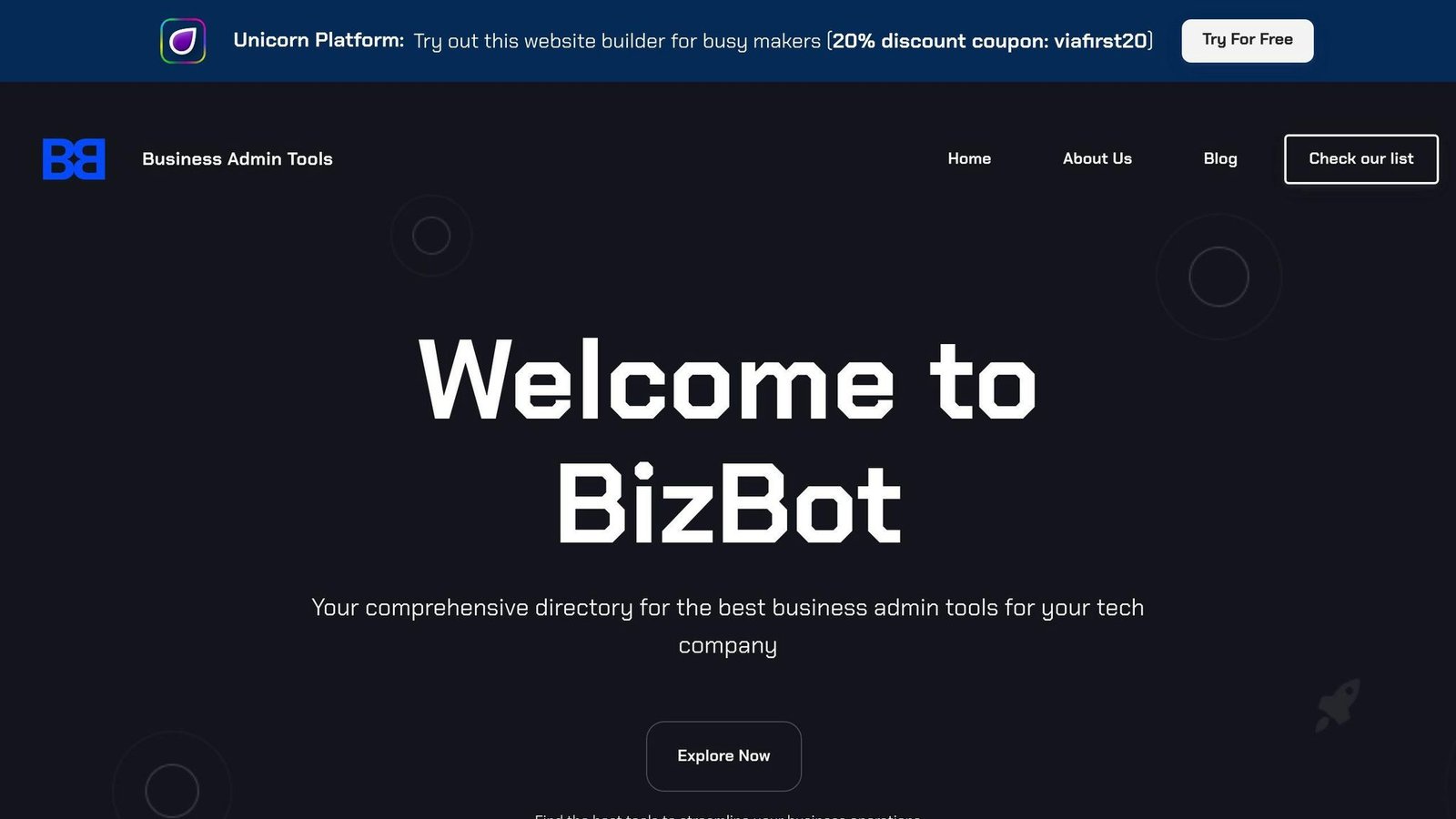
Fair warning before the list proper: BizBot is a directory of business software, not an equity management platform. It is included here because it is where this comparison lives, not because it competes with the four tools below. If you want a cap table, skip to Carta.
BizBot isn’t your typical equity management platform. Instead, it’s a one-stop shop for business admin tools, including equity management solutions. It’s perfect for startups and small businesses looking to get their ducks in a row.
Here’s what makes BizBot stand out:
Hand-picked tools: BizBot does the heavy lifting for you. They’ve sifted through countless business tools to bring you the cream of the crop. This includes equity management options that won’t give you a headache.
Easy to use: BizBot knows you’re busy. That’s why they focus on tools that don’t require a PhD to operate. It’s great for:
- Freelancers just dipping their toes in the business world
- Small business owners who’d rather focus on their product than tech
- Growing companies that need tools that can keep up
Big picture thinking: Unlike tools that only do equity management, BizBot sees the forest and the trees. It connects equity management with other crucial business areas like accounting, HR, legal stuff, and board management. This is gold for startups juggling multiple balls.
Subscription smarts: Here’s a cool feature – BizBot helps you manage your subscriptions. This can save you a bundle on all those tools you need, including equity management software.
Now, BizBot doesn’t have its own equity management tool. But it can point you in the right direction. Here’s a taste of what you might find:
| Feature | Why Startups Love It |
|---|---|
| Easy accounting integration | Makes tracking equity finances a breeze |
| Digital CFO services | Like having a financial wizard in your pocket |
| Ownership management tools | Keeps your cap table tidy |
| Legal service connections | Helps you stay on the right side of equity laws |
Remember, BizBot is more of a matchmaker than a direct service provider. How well it works for equity management depends on the tools it recommends.
If you’re a startup looking for a Swiss Army knife of business tools, including equity management, BizBot could be your new best friend. But if you’ve got complex equity structures or need super advanced features, you might need to look beyond BizBot’s suggestions.
2. Carta
Carta is the big dog in equity management tools. It’s not just a tool – it’s a whole world for startups and SMEs juggling cap tables, valuations, and compliance.
Why Carta’s a standout:
It’s Got Everything (And Then Some)
Carta’s toolkit is packed:
- Digital cap table management
- 409A valuations
- Scenario modeling
- Compliance reporting
- Employee equity management
It’s like the Swiss Army knife of financial tools.
Grows With You
From tiny startup to IPO-bound, Carta’s got plans:
| Plan | For | What You Get |
|---|---|---|
| Launch | New startups | Cap table management, SAFE financings |
| Build | Growing companies | Launch stuff + 409A valuations |
| Grow | Scaling businesses | Build stuff + GAAP/IFRS reporting |
Scale and the 2024 trust problem
Carta’s own site claims more than 50,000 companies and over 1.7 million equity holders on the platform (its figures, read in August 2026). In January 2024 a customer accused Carta of using cap table data to solicit share sales without permission. Carta announced days later that it was exiting the secondaries business.
What it costs
- Launch: free, up to 25 stakeholders and $1M raised
- Build, Grow, Scale: no published rates. Carta says each package has a price per stakeholder with a minimum annual fee, so the bill depends on your cap table size and the package you pick
A figure of “$2,800/year” for Carta appeared in an earlier version of this article. Carta publishes no such number and it has been removed rather than guessed at. Tiers and the free-tier limits above were read from Carta’s pricing page in August 2026.
Karri Saarinen, Linear’s CEO, didn’t hold back: “This might be the end of Carta as the trusted platform for startups.” Ouch.
The Good and The Not-So-Good
| Thumbs Up | Thumbs Down |
|---|---|
| Does it all | Can get pricey |
| Solid rep (mostly) | Recent trust hiccup |
| Top-notch 409A valuations | Setup can be tricky |
| Great support | Extra costs for some services |
Real Talk
Carta’s not perfect. Some find it pricey post-fundraising. Matt Mireles, Oasis founder, jumped to AngelList, saying, “It was expensive for software.”
Plenty of finance teams stay anyway, mostly for the 409A and reporting work. This article previously carried a favourable quote from an unnamed user; it could not be traced to a real review, so it is gone.
The Bottom Line
Carta’s like that friend who’s good at everything. It does a lot, and does it well. But it’s not flawless. If you want one system that will still fit at pre-IPO and you can absorb the cost, Carta is worth a look. Just keep those recent trust issues in mind.
3. Pulley
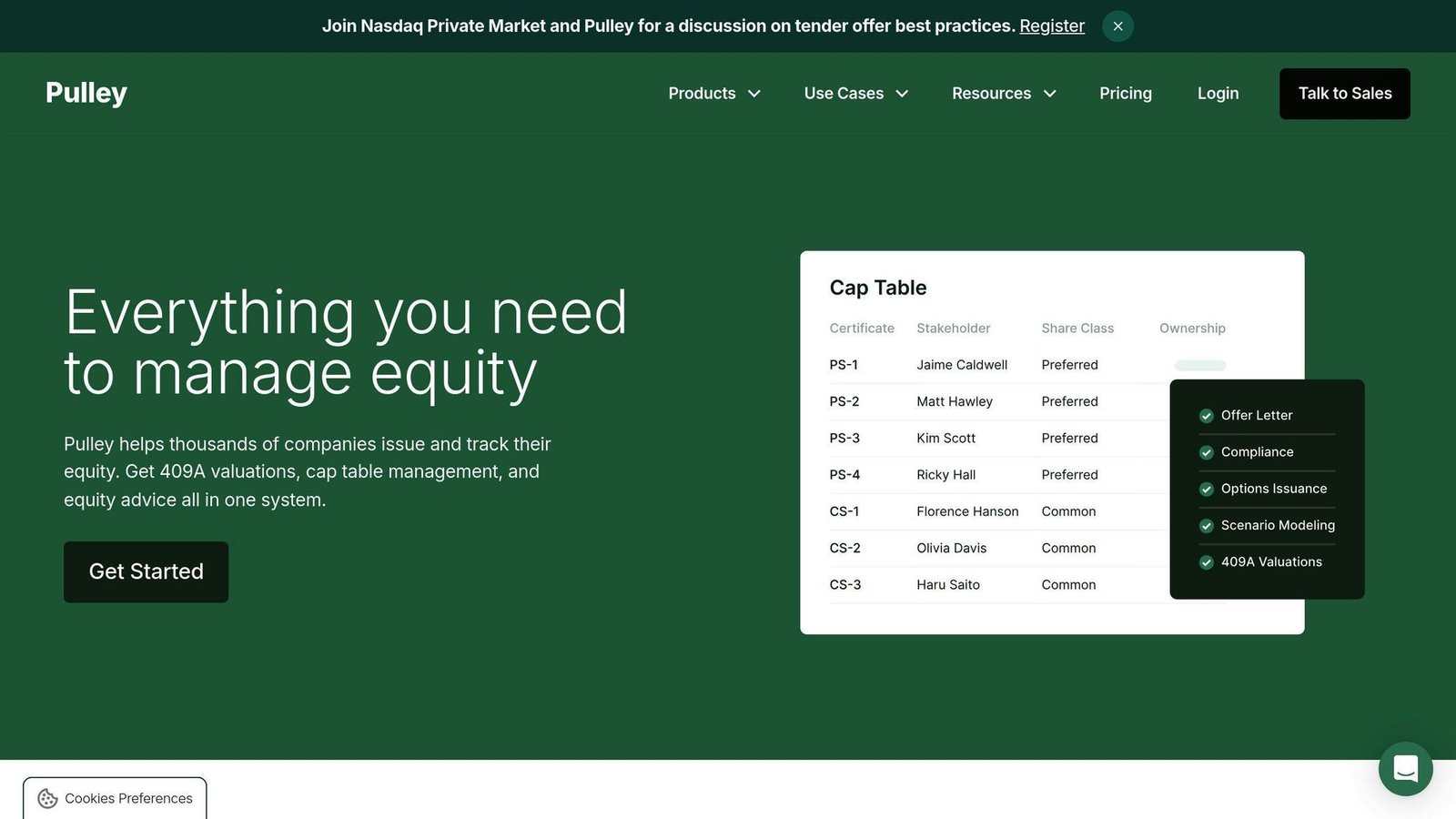
Pulley is an equity and token management platform aimed at startups and growth-stage companies: cap tables, 409A valuations, RSU and option issuance, scenario modelling and ASC 718 reporting. Several paragraphs of Pulley’s own marketing copy had been pasted into this section in the first person; that has been rewritten.
What it costs
Pulley publishes its rates. Read from its pricing page in August 2026:
- Startup: $1,200 per year, first 25 stakeholders included
- Growth: $3,500 per year, first 40 stakeholders included, with 409A valuations
- Enterprise: contact sales
There is no free plan. Admin seats are not charged separately; the price is driven by stakeholder count, so the headline figure rises as you hire and issue.
Here’s why Pulley stands out:
Fast Setup
Pulley gets you going quickly:
- Pulley advertises same-day setup with guided onboarding
- An account manager walks you through migration
- Automated document import
Those are Pulley’s claims, not a tested result. The “45 minutes versus Carta’s 90 days” comparison that used to sit here came from marketing material on both sides and has been dropped.
Simple Yet Powerful
Pulley balances features and ease-of-use:
- Real-time ownership insights
- Customizable dashboard
- Easy-to-use interface
Yunlin Z., a Financial Controller, says: “Pulley’s layout is simple and logical. What you need is often just a click away.”
Fundraising Tools
Planning your next round? Pulley helps you:
- See ownership and share distribution
- Model different funding scenarios
- Make smart decisions
Quick 409A Valuations in-house
Pulley says it delivers:
- Valuations in about five business days
- Clear, detailed reports
- Audit-ready results
Employee Equity Management
Keep your team in the loop:
- Send offer letters through the platform
- Calculate equity values quickly
- Allow electronic option exercises
Published plans
The same rates again, for reference:
| Plan | Price | For |
|---|---|---|
| Startup | $1,200/year | First 25 stakeholders included |
| Growth | $3,500/year | First 40 stakeholders included, plus 409A valuations |
| Enterprise | Contact sales | Larger or more complex cap tables |
Pros and Cons
| Pros | Cons |
|---|---|
| Easy to use | Newer company |
| Strong modeling tools | Some features only in higher tiers |
| Fast setup | Fewer integrations than others |
| Flexible pricing | Focused only on equity management |
| Great support |
User feedback
Two anonymous testimonials previously appeared here. Neither could be traced to a named reviewer on any review site, so both were removed and nothing was invented to replace them. If reviews matter to your decision, read Pulley’s current listings on G2 and Capterra yourself — scores move, and a number printed in an article ages badly.
Who Pulley suits
Pulley works well for:
- Fast-growing startups
- Companies focused on equity management
- Teams without deep financial expertise
- Startups wanting a cheaper Carta alternative
Pulley is a smaller company than Carta. That is a real trade-off: fewer integrations, but a published price list and a shorter route to a human.
If you’re a startup or SME looking for a fresh take on equity management, Pulley might be your answer. Its speed, simplicity, and strong features make it a top choice in the equity management world.
4. Ledgy
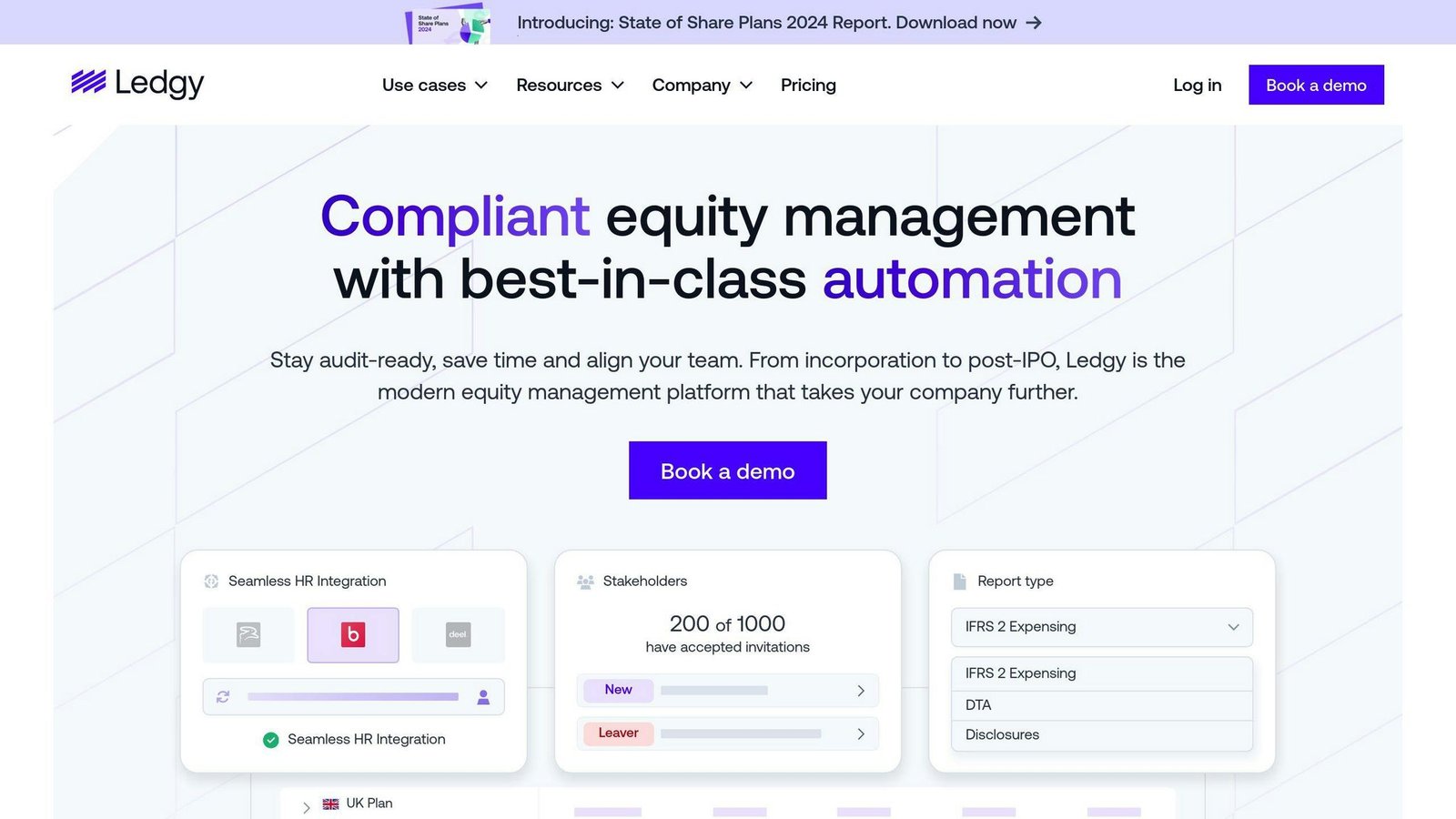
Ledgy is shaking up equity management for European startups and SMEs. This Zurich-born platform tackles the unique challenges of managing equity across multiple European jurisdictions.
Why is Ledgy turning heads? Let’s dive in.
Ledgy speaks European. While many tools cater to the US market, Ledgy’s designed to handle the complexities of different legal structures governing equity in every European country.
Ledgy raised a $22 million Series B in September 2022, led by NEA with Sequoia among the investors. Customer and revenue growth figures that used to appear here came from that funding announcement, are now four years old, and have been removed.
Their client list? It’s a who’s who of European startups. We’re talking unicorns and fast-growing companies like Getir, Gorillas, Alan, and Scalapay.
Ledgy offers a comprehensive suite of tools:
- Real-time cap table management with automated error flags
- Equity plan management, including automated vesting and exercising
- Funding round modeling
- One-click compliance reporting
- Employee dashboards for equity info access
Ledgy has a free plan for up to 25 stakeholders. Above that it sells four tiers — Growth, Scale, Enterprise and Public — and publishes no prices for any of them; you have to ask. The “€3 per user per month” and “€300 per month” figures that used to appear here are not on Ledgy’s pricing page and have been removed rather than carried over. Checked August 2026.
| Plan | Price | Best For |
|---|---|---|
| Free | €0 | Up to 25 stakeholders |
| Growth | Not published | Automated documents, compliance reports, valuations |
| Scale | Not published | Integrations and offboarding workflows |
| Enterprise / Public | Not published | Larger and listed companies |
But don’t just take our word for it. Here’s what users are saying:
“Ledgy takes everything around cap table management and company ownership to the next level. The tedious spreadsheet days are gone.” – Michael N., Managing Partner in Venture Capital & Private Equity
“I have just completed my EMI return. Last year, it took me a day to compile, manually adding data from various sources. This time, I hit a button. A great improvement – thank you Ledgy.” – Stuart Barnard, VP Finance & Business Operations
So, what’s the Ledgy advantage?
First, European expertise. Ledgy gets the nuances of European equity structures. As Hubert Fenwick, Co-founder and CEO of a Ledgy client, puts it:
“Compared to competitors, Ledgy was very strong and catered to more of what we needed from a European and UK-centric angle – like working with growth shares that are quite specific to the UK.”
Second, they make compliance easy. Ledgy automates compliance across jurisdictions – a big deal for companies expanding into new markets.
Third, the interface is aimed at both finance staff and employees who have never held options before. A user rating quoted here previously conflicted with two other ratings elsewhere in this article, so all of them have been removed.
Lastly, they take security seriously, with features like custom role-based access control.
Is Ledgy perfect? Not quite. Some users note restricted reporting functionalities and occasional software hiccups. But for European startups looking for a tailored equity management solution, Ledgy’s a strong contender.
5. Shareworks
Shareworks is now sold as part of Morgan Stanley at Work, following Morgan Stanley’s acquisition of Solium. If you are working from an older shortlist, that is the name to search for. It is aimed further up the market than the others here — later-stage private companies and public issuers rather than five-person startups.
It’s an All-in-One Powerhouse
Imagine having a financial whiz and a compliance guru rolled into one easy-to-use platform. That’s Shareworks. It offers:
- Real-time cap table management
- Employee stock option administration
- Compliance tracking
- Payroll integration
It Grows With You
Whether you’re a tiny startup or a booming SME, Shareworks has your back:
| Company Size | What You Get |
|---|---|
| Small Startups | Basic equity management tools |
| Growing SMEs | Advanced features like scenario modeling |
| Pre-IPO Companies | Heavy-duty compliance and reporting tools |
You won’t outgrow this platform anytime soon.
It’s User-Friendly (Really!)
Equity management can be a maze. Shareworks hands you the map:
- Clean, intuitive dashboard
- Easy-to-grasp analytics
- Simplified employee equity info
What it costs
Morgan Stanley at Work publishes no rates for Shareworks. Pricing is quoted per company after a sales conversation, and for plan administration it usually bundles participant services rather than charging a simple per-seat fee. A “$3 per user, per month” figure appeared in an earlier version of this article; it is not published anywhere by the vendor, so it has been removed. Assume you will need a quote, and ask specifically what is included and what is billed separately. Checked August 2026.
On the testimonials
Three customer quotes here were attributed to a “Satisfied User”, a “Happy Customer” and an unnamed user, each with a precise result. None could be sourced. They have been removed and not replaced. Where administrative time actually goes in equity work is grant issuance, vesting maintenance and year-end reporting; that is what to test in a demo.
The Shareworks Edge
Here’s what sets Shareworks apart:
| Feature | Why It Matters |
|---|---|
| All-in-One Tools | Manage everything equity-related in one spot |
| Easy to Use | Less time learning, more time doing |
| Grows With You | From startup to IPO, it’s got you covered |
| Compliance-Focused | Stay on the right side of regulations |
| Data-Driven | Make smarter decisions about equity |
Who Shareworks suits
Shareworks might be perfect if you’re:
- A startup wanting to simplify equity management
- An SME gearing up for growth or funding
- Focused on engaging employees through equity plans
- In need of solid compliance tools
Tool Comparison
Let’s compare the top 5 equity management tools for startups and SMEs. This breakdown will help you pick the right one for your needs.
| Tool | Key Features | Pricing | Best For |
|---|---|---|---|
| BizBot | – Tool directory – Subscription management
– Digital CFO services |
Not applicable — directory, not an equity platform | Freelancers, small businesses |
| Carta | – Cap table management – 409A valuations
– Scenario modeling |
Launch free (up to 25 stakeholders, $1M raised); Build, Grow and Scale on request | Startups to pre-IPO |
| Pulley | – Real-time ownership insights – Fundraising tools | No free plan. Startup $1,200/year (25 stakeholders)
Growth $3,500/year (40 stakeholders) |
Fast-growing startups |
| Ledgy | – Multi-jurisdiction support – Automated vesting | Free up to 25 stakeholders
Paid tiers not published |
European startups and SMEs |
| Shareworks | – Cap table management – Payroll integration | Not published; quoted per company | Later-stage private and public companies |
Prices in this article were checked against each vendor’s own pricing page in August 2026. Equity platforms price per stakeholder and re-quote often — confirm with the vendor before you budget.
Carta and Pulley are the two most often described as easy to set up. An anonymous testimonial used to sit here; it was unsourceable and has been removed.
For European startups, Ledgy is a top pick. Hubert Fenwick, Co-founder and CEO of a Ledgy client, explains:
“Ledgy was very strong and catered to more of what we needed from a European and UK-centric angle – like working with growth shares that are quite specific to the UK.”
Shareworks is the heavier system of the five, and the one most likely to need a proper implementation project.
Carta is great for scaling. It’s built to grow with you, from startup to pre-IPO.
If setup speed matters, Pulley is the one to trial — it markets fast self-serve onboarding, while Carta and Shareworks lean on guided implementation.
On pricing, only Pulley publishes rates. Carta publishes its tiers but not their prices, and Ledgy and Shareworks publish neither. Budget for a quote.
Your best choice depends on your needs, budget, and growth plans. Think about where your company is based (especially for European firms), how complex your equity structure is, and how big you want to grow.
How to Pick the Best Tool for Your Business
Choosing an equity management tool for your startup or SME isn’t just important – it’s critical. Here’s how to nail the selection process:
Assess Your Current Needs
First, figure out where your company stands:
| Company Stage | What You Need |
|---|---|
| Early Startup | Basic cap table, founder equity tracking |
| Growing SME | Employee stock options, fundraising tools |
| Pre-IPO | Compliance tools, advanced reporting |
Plan for Future Growth
Don’t just think about now – think ahead. Your tool should grow with you:
- Carta can take you from startup to pre-IPO. It’s built for the long haul.
- Pulley starts at $1,200/year for the first 25 stakeholders and $3,500/year for the first 40. There is no free tier.
Consider Ease of Use
If it’s not user-friendly, no one will use it:
- Pulley markets self-serve onboarding and publishes its prices, which makes it the easiest of the four to evaluate without a sales call.
- Shareworks has a clean, simple dashboard that makes complex equity plans easier to manage.
Evaluate Integration Capabilities
Your equity tool needs to play nice with your other systems:
- Look for tools that work with your accounting and HR software.
- Shareworks integrates with payroll systems – a big plus for growing companies.
Prioritize Compliance Features
Stay on the right side of the law:
- Make sure the tool helps with 409A valuations, ISO 100k limits, and Rule 701 compliance.
- Carta is known for its strong compliance tools, including automated 409A valuations.
Compare Pricing Structures
Get the most bang for your buck:
| Tool | Starting Price | Best For |
|---|---|---|
| Carta | Free up to 25 stakeholders; paid tiers on request | Early-stage through pre-IPO |
| Pulley | $1,200/year, first 25 stakeholders | Startups that want a published price |
| Ledgy | Free up to 25 stakeholders; paid tiers on request | European startups |
| Shareworks | Not published | Later-stage companies |
Check User Ratings and Reviews
Learn from other people’s experiences, but check them yourself. This article previously quoted review scores for Ledgy and Carta that contradicted the scores given in its own comparison table. All of them have been removed. Ratings on G2 and Capterra move month to month, so read the current listings and, more usefully, the one-star reviews.
Consider Geographic Needs
If you’re in Europe, tools like Ledgy offer features tailored to European regulations and multi-jurisdiction support.
Test Drive Before Committing
Most tools offer free trials or demos:
- Pulley offers a trial with your own data if you are migrating from Carta. It does not publish a fixed trial length — ask.
- Use these trials to make sure the tool fits your workflow before you commit.
Set Up and Migration Tips
Once you’ve picked your tool:
1. Centralize Your Documents
Get all your equity-related docs in one place:
- Incorporation papers
- Stock option agreements
- Investor term sheets
2. Clean Your Data
Before you move:
- Double-check your existing cap table
- Make sure all stakeholder info is correct
- Fix any issues you find
3. Plan the Transition
If you’re switching from another system:
- Pick a quiet time for the switch
- Let stakeholders know about the change
- Set a clear end date for the old system
4. Use Expert Support
Most tools offer help with setup:
- Pulley gives you an account manager to guide you through
- Take advantage of this help – it’ll make things smoother
5. Train Your Team
Make sure key people know how to use the new system:
- Set up training sessions
- Create guidelines for how to handle equity management
Summary
Picking the right equity management tool can make or break startups and SMEs. Let’s break down what we’ve learned:
Equity management software isn’t just a fancy add-on. It’s a must-have that:
- Makes complex tasks simple
- Cuts down on mistakes
- Keeps everything transparent
You want a tool that can grow with you, from your first funding round all the way to your IPO party.
What should you look for? Cap table management, compliance reporting, and scenario modeling are the big three.
Here’s a quick look at the top tools:
| Tool | Perfect For | Cool Feature | Price Starts At |
|---|---|---|---|
| Carta | Companies on the up | 409A valuations and compliance reporting | Free up to 25 stakeholders; paid on request |
| Pulley | Startups moving fast | Published price list | $1,200/year (first 25 stakeholders) |
| Ledgy | European startups | Handles multiple jurisdictions | Free up to 25 stakeholders; paid on request |
| Shareworks | Later-stage plans | Payroll integration | Not published |
None of this is exotic software. It is a register, a set of vesting rules and a reporting calendar, and the reason to pay for it is that spreadsheets get those wrong quietly. A closing testimonial that used to sit here was anonymous and unsourceable, so it has been removed.
Ready to pick your tool? Here’s what to do:
- Figure out what you need now (and later)
- Look at features and costs
- Try before you buy
- Think about where you’re based (especially if you’re in Europe)
- Make sure it’s easy to use and can grow with you
More on this topic
Browse all 53 articles on Finance & Accounting, or jump straight to our buying guide: Best Accounting Software for Small Businesses.