
Disclosure: This page contains commercial links. BizBot may earn a commission from qualifying purchases. Paid placements do not buy a better ranking. Read our affiliate disclosure.
Healthcare organizations operate in one of the most heavily regulated industries in the United States. Hospitals, clinics, and medical practices must follow strict federal and state regulations designed to protect patient safety and maintain ethical healthcare practices. Failing to meet these standards can lead to serious financial penalties, legal consequences, and reputational damage.
The stakes are very high, and they are specific. Violations of healthcare laws such as the False Claims Act can result in penalties of tens of thousands of dollars per false claim, along with possible criminal liability. As of the Department of Justice’s most recent adjustment, the civil penalty runs from $14,308 to $28,619 for each false claim, and those amounts carried over unchanged into 2026 because the inflation adjustment was not applied. On top of the per-claim penalty sits treble damages, which is the part that turns a billing pattern into an existential number: a hundred routine claims of a few hundred dollars each can produce a seven-figure exposure. In extreme cases, organizations may even face exclusion from federal healthcare programs such as Medicare and Medicaid, which can severely impact revenue and operations.
Because of these risks, healthcare organizations must maintain strong compliance programs and monitor potential vulnerabilities continuously. That said, here are some key compliance risks healthcare providers should closely monitor to avoid penalties and operational disruptions.
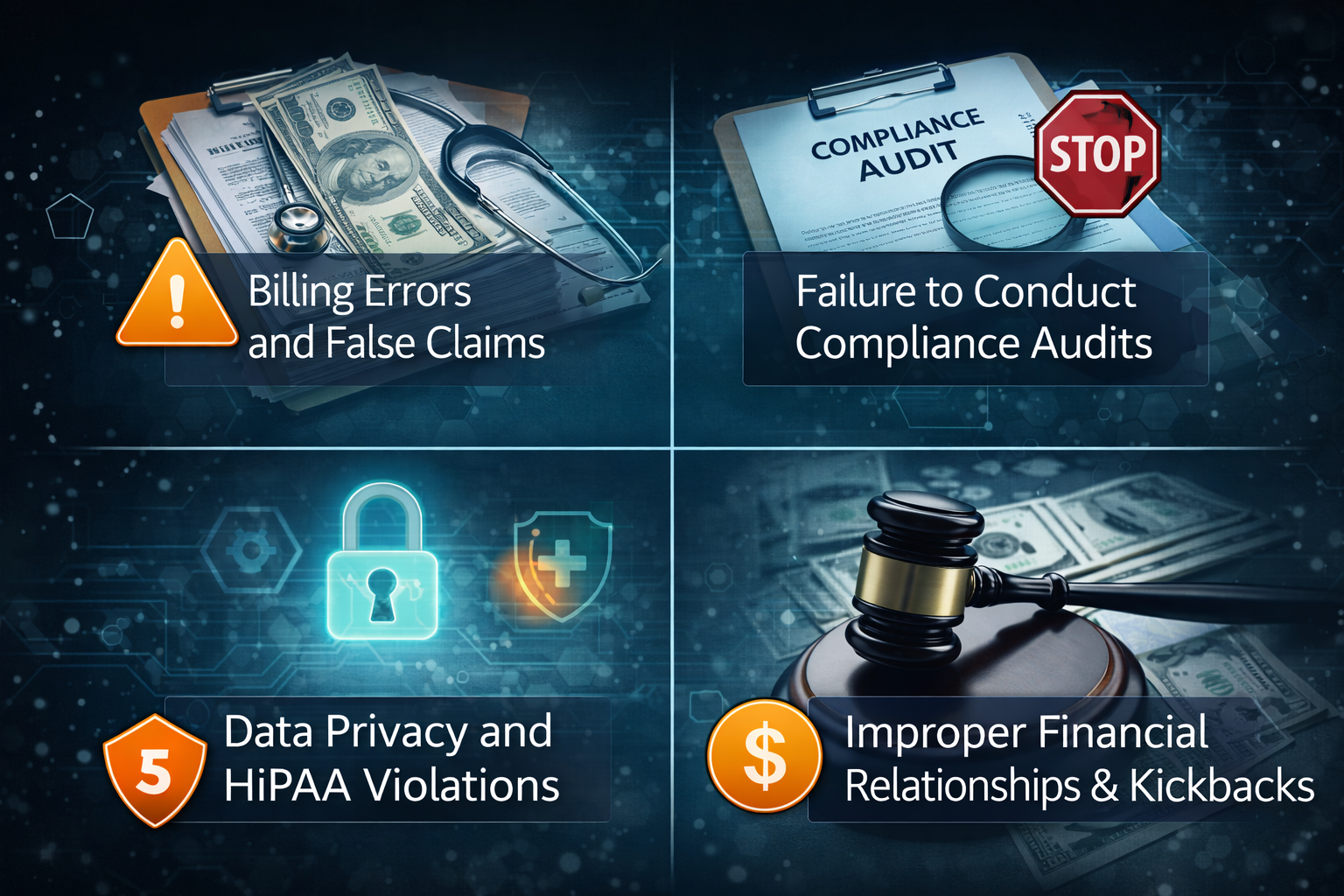
1. Billing Errors and False Claims
One of the most common compliance risks in healthcare involves inaccurate billing or the submission of false claims to government healthcare programs. The False Claims Act makes it illegal to knowingly submit incorrect claims for payment to programs like Medicare or Medicaid.
Billing errors can occur for several reasons, including incorrect coding, documentation mistakes, or misunderstandings about reimbursement rules. In some cases, providers may unknowingly submit claims for services that are not medically necessary or properly documented.
Common billing-related compliance risks include:
- Incorrect medical coding for procedures.
- Duplicate billing for services.
- Charging for services not provided.
- Billing for medically unnecessary procedures.
Three patterns account for a large share of enforcement activity, and each has a name worth knowing:
- Upcoding. Billing a higher-level evaluation and management code than the documentation supports. This is rarely a decision anyone makes deliberately; it is usually a template that defaults to a level and nobody adjusts it.
- Unbundling. Billing components of a procedure separately when a single comprehensive code applies. Edits catch some of this, but not all of it.
- Modifier misuse. Modifiers that override bundling edits are effective and therefore scrutinised. If one clinician’s use of a particular modifier is far out of line with their peers, expect that to be noticed before you notice it.
The deadline most practices underestimate is the overpayment rule. Once an overpayment from Medicare or Medicaid has been identified, it must be reported and returned within 60 days. Miss that window and a simple billing error becomes a retained overpayment, which is itself an obligation under the False Claims Act. The practical consequence is uncomfortable but important to plan for: the moment an internal review turns up a problem, a clock starts. Deciding to “look into it properly next quarter” is not a neutral choice.
The trade-off nobody mentions is that overcorrecting has a cost too. Routinely downcoding to feel safe means undercharging for work actually performed, and a coding pattern well below peer norms is its own kind of outlier. The goal is documentation that supports the code, not the lowest code available.
2. Failure to Conduct Regular Compliance Audits
Even organizations with compliance policies in place can face risks if they do not regularly review their processes. Regulations change frequently, and healthcare providers must ensure their operations stay aligned with updated laws and standards.
Regular compliance audits help organizations identify vulnerabilities before regulators do. These audits typically review areas such as billing practices, documentation accuracy, data security, and employee training.
Benefits of routine compliance audits include:
- Early detection of potential violations.
- Improved regulatory preparedness.
- Stronger internal accountability.
- Reduced risk of financial penalties.
“Regular” needs a definition or it never happens. A workable baseline for a small or mid-sized practice is a modest random sample of claims per billing provider per year, reviewed against the documentation rather than against the claim form, with a larger follow-up sample for anyone whose error rate crosses a threshold you set in advance. The sample size matters less than two other things: that the reviewer is not the person who coded the claim, and that you write down what you found and what you did about it.
This is why many healthcare organizations include structured OIG Compliance reviews as part of their auditing process. This ensures that their policies, billing practices, and internal controls align with federal compliance guidelines.
However, conducting detailed compliance reviews internally can be challenging for many healthcare practices. Because of the complexity of healthcare regulations, organizations often rely on specialized compliance service providers to perform independent assessments and identify potential risks.
One such provider is DoctorsManagement. It offers healthcare compliance audit services designed to help medical practices evaluate their regulatory exposure, strengthen internal compliance programs, and maintain alignment with federal healthcare standards.
Two things to settle before an audit starts, because they are awkward to fix afterwards. First, decide whether the review is being conducted at the direction of counsel. Audit findings are documents, and documents are discoverable; that is not a reason to avoid auditing, but it is a reason to be deliberate about how the engagement is structured. Second, agree in advance what happens if the audit finds a real overpayment, since the 60-day clock does not pause while a practice decides how it feels about the result. Federal self-disclosure routes exist for exactly this situation and generally produce better outcomes than being found.
3. Data Privacy and HIPAA Violations
Protecting patient health information is another major compliance responsibility. The Health Insurance Portability and Accountability Act (HIPAA) requires healthcare providers to safeguard sensitive patient data and ensure it is only accessed by authorized individuals.
However, healthcare data breaches have become increasingly common as medical systems adopt electronic health records and digital platforms. When organizations fail to implement proper safeguards, patient data may be exposed to unauthorized access.
Potential HIPAA compliance risks include:
- Unauthorized access to patient records.
- Weak cybersecurity protections.
- Improper data sharing with third parties.
- Failure to report data breaches in a timely manner.
HIPAA penalties are tiered by culpability, and the tier turns almost entirely on what you knew and whether you fixed it. The inflation-adjusted amounts are:
| Tier | Culpability | Minimum per violation | Maximum per violation | Annual cap |
|---|---|---|---|---|
| 1 | Lack of knowledge | $145 | $73,011 | $2,190,294 |
| 2 | Reasonable cause | $1,461 | $73,011 | $2,190,294 |
| 3 | Willful neglect, corrected | $14,602 | $73,011 | $2,190,294 |
| 4 | Willful neglect, not corrected within 30 days | $73,011 | $2,190,294 | $2,190,294 |
The gap between tier 3 and tier 4 is the single most actionable line in HIPAA enforcement. It is the difference between finding a problem and fixing it, and finding a problem and leaving it. Whatever else a compliance program does, it should make sure that a known gap gets closed inside 30 days and that the closure is documented with a date.
On breach notification, the timeline is 60 days from discovery for notifying affected individuals. A breach affecting 500 or more individuals in a state or jurisdiction must also be reported to HHS and to prominent media within that same 60 days; smaller breaches are logged and reported to HHS annually. “Discovery” means the day the organization knew or reasonably should have known, which is earlier than the day someone escalated it.
One more practical point: the security risk analysis is the requirement most commonly found missing in enforcement actions. It is not a firewall, an antivirus subscription or a vendor certificate. It is a documented assessment of where electronic protected health information lives, what could go wrong, and what you decided to do about each risk, repeated when things change. Organizations that have everything else and not this one are the ones that get caught out.
4. Improper Financial Relationships and Kickbacks
Financial relationships between healthcare providers and referral partners are another major area of regulatory oversight. Laws such as the Anti-Kickback Statute and Stark Law prohibit offering or accepting financial incentives for patient referrals involving federally funded healthcare programs.
Violations may occur when physicians or healthcare providers receive compensation tied to referral volumes or when financial arrangements are not properly disclosed.
Examples of risky financial practices include:
- Offering incentives for patient referrals.
- Paying referral fees to physicians.
- Entering into business arrangements that create conflicts of interest.
The two statutes are frequently spoken about together and behave very differently, which is where organizations get into trouble.
- The Anti-Kickback Statute is criminal and requires intent. The Bipartisan Budget Act of 2018 raised the maximum criminal fine from $25,000 to $100,000 and the maximum prison term from five to ten years. Because it turns on intent, structure and documentation of the arrangement matter enormously.
- Stark Law is civil and effectively strict liability. Intent is not required for the core prohibition. If a physician has a financial relationship with an entity and refers designated health services to it, the arrangement must fit an exception, full stop. Good faith is not a defence to the referral prohibition itself.
The practical consequence of strict liability is that Stark compliance is a paperwork discipline. Arrangements need to be in writing, signed, for fair market value, and not determined in a way that takes into account referral volume or value. The most common failures are administrative rather than corrupt: a lease that lapsed and was never renewed, a medical director agreement whose term expired, an arrangement amended verbally.
Both statutes also connect back to the first risk on this list. A claim submitted as a result of a kickback can be treated as a false claim, which is how a referral arrangement becomes an FCA case with per-claim penalties and treble damages attached. These practices can lead to criminal penalties, significant fines, and even exclusion from Medicare or Medicaid programs. Healthcare organizations must carefully review all financial relationships and ensure they comply with federal regulations.
What to Review, and How Often
A compliance calendar beats a compliance binder. A defensible minimum for a small or mid-sized organization:
| Review | Frequency | What triggers an off-cycle review |
|---|---|---|
| Claim and documentation sample per billing provider | At least annually | New provider, new service line, new EHR template, payer audit letter |
| Security risk analysis | At least annually | New system, new vendor with data access, office move, a suspected incident |
| Financial arrangements register: leases, medical director agreements, service contracts | At least annually, with expiry dates diarised | Any renewal, amendment or change in referral pattern |
| Exclusion screening of staff and contractors | Monthly | Every new hire and every new contracted party |
| Business associate agreements and vendor security posture | Annually | Any new subcontractor handling patient data |
| Workforce training and policy attestation | Annually | Any policy change, any incident |
Monthly exclusion screening deserves its place on that list. Employing or contracting with an excluded individual creates liability for every item or service they touch, and the check itself takes minutes.
Frequently Asked Questions
How large does a practice have to be before it needs a formal compliance program?
Size does not change the obligations. What changes is proportionality. A two-clinician practice does not need a compliance department, but it does need a named person responsible, written policies, an annual claim review, a documented risk analysis, exclusion screening and a way for staff to raise concerns. That is a set of habits, not a headcount.
What should happen the moment a possible overpayment is found?
Stop and date it. Determine the scope, because the obligation attaches to the overpayment that exists rather than the single claim you happened to look at, and remember the 60-day window for reporting and returning it. Get advice before deciding whether the correct route is a straightforward refund or a formal self-disclosure.
Do these rules apply to purely private-pay practices?
Partly. The False Claims Act, the Anti-Kickback Statute and Stark Law are tied to federal healthcare programs, so a practice that bills no federal payer has far less exposure there. HIPAA is not tied to payer mix, and state privacy, consumer protection and fee-splitting laws apply regardless. “We do not take Medicare” is not a general exemption.
Conclusion
Healthcare compliance is essential for protecting patients, maintaining ethical medical practices, and ensuring organizations operate within federal regulations. With increasing regulatory oversight and stricter enforcement actions, healthcare providers must remain vigilant about potential compliance risks.
From billing accuracy and data privacy to financial relationships and internal compliance programs, multiple factors influence whether healthcare organizations remain compliant with federal laws. By identifying risks early, implementing strong compliance policies, and conducting regular audits, healthcare providers can significantly reduce their exposure to penalties. A proactive approach to compliance not only protects organizations financially but also strengthens trust among patients, regulators, and healthcare partners.
Penalty amounts are adjusted for inflation periodically and enforcement guidance changes. Check the current figures with OIG, HHS and the Department of Justice before relying on them, and treat this as background rather than legal advice.
More on this topic
Browse all 79 articles on Security & Compliance.