App security compliance matters most to the businesses least equipped to handle it. Frameworks like GDPR, PCI DSS 4.0, HIPAA, and CCPA carry real penalties, and the deadlines that were looming in earlier versions of this guide have now passed: PCI DSS v4.0’s future-dated requirements became mandatory on 31 March 2025, and the European Accessibility Act applied from 28 June 2025. If you were treating either as future work, you are already late.
Here’s what you need to know:
- Key Regulations: GDPR (EU data privacy), PCI DSS 4.0 (payment security), CCPA (California privacy), HIPAA (US health data), and the European Accessibility Act.
- Why It Matters: Penalties reach up to €20 million or 4% of global turnover under GDPR, alongside lawsuits and loss of customer trust.
- Essential Steps: Conduct a data inventory, identify which regulations actually apply to you, and build automated security testing (SAST, DAST, SCA, IAST, RASP) into your development process.
- Automation: Testing in the CI/CD pipeline catches problems while they are cheap to fix and produces the evidence trail auditors ask for.
A note on figures. An earlier version of this guide claimed that pipeline automation cuts vulnerabilities by 50% and compliance costs by 30%, and described a healthcare provider reducing violation risk by 75%. None of those could be traced to a source, so they have been removed. Penalty amounts below are dated, because most of them are adjusted for inflation every year and go stale quickly. This is a general overview, not legal advice; confirm your own obligations with counsel.
Key Regulatory Compliance Standards
Major Regulatory Frameworks
General Data Protection Regulation (GDPR) applies if your app processes the personal data of people in the EU, whatever country you operate from. It requires a lawful basis for processing, data minimisation, and privacy by design. A small business in Ohio with a handful of German customers is in scope.
Payment Card Industry Data Security Standard (PCI DSS) applies to any app handling payment card data. Version 4.0 replaced 3.2.1 in March 2024, its future-dated requirements became mandatory on 31 March 2025, and the current published revision is v4.0.1. Requirements include web application firewalls or equivalent protection for public-facing applications, stronger authentication, and regular scanning and testing. Non-compliance can cost you the ability to accept cards, which for most businesses matters more than a fine.
The realistic path for a small business is to avoid handling card data at all. Using a hosted payment page or a payment provider’s embedded fields moves most of the burden to them and reduces your assessment scope dramatically. Ask your provider which self-assessment questionnaire your setup qualifies for before you build anything.
California Consumer Privacy Act (CCPA), as amended by the CPRA, applies to businesses meeting its thresholds that handle California residents’ personal information. It requires clear disclosure, opt-out of sale and sharing, and honouring the Global Privacy Control signal. Note that CCPA does not apply to every business: there are revenue and data-volume thresholds, so check whether you are actually in scope before spending money on it.
Health Insurance Portability and Accountability Act (HIPAA) governs protected health information in the US. It requires safeguards, Business Associate Agreements with vendors who touch PHI, and breach notification. A point often missed: a wellness or fitness app is usually not covered by HIPAA, while the same app sold to a covered entity may be. The status depends on your relationships, not on how health-related the data feels.
The European Accessibility Act has applied since 28 June 2025 and requires many consumer-facing digital products and services in the EU to be accessible. In practice conformance is assessed against the harmonised European standard EN 301 549, which incorporates WCAG success criteria; it is EN 301 549 rather than WCAG itself that the law points to. Practical requirements include screen reader compatibility, keyboard navigation, sufficient colour contrast, and text alternatives. Micro-enterprises providing services have some relief, and enforcement is by member state.
Data protection authorities have also been giving mobile apps specific attention. France’s CNIL, for example, made mobile applications a stated investigation priority for 2025.
Compliance Requirements Comparison
| Regulation | Geographic Scope | Primary Focus | Key Security Controls | Penalties |
|---|---|---|---|---|
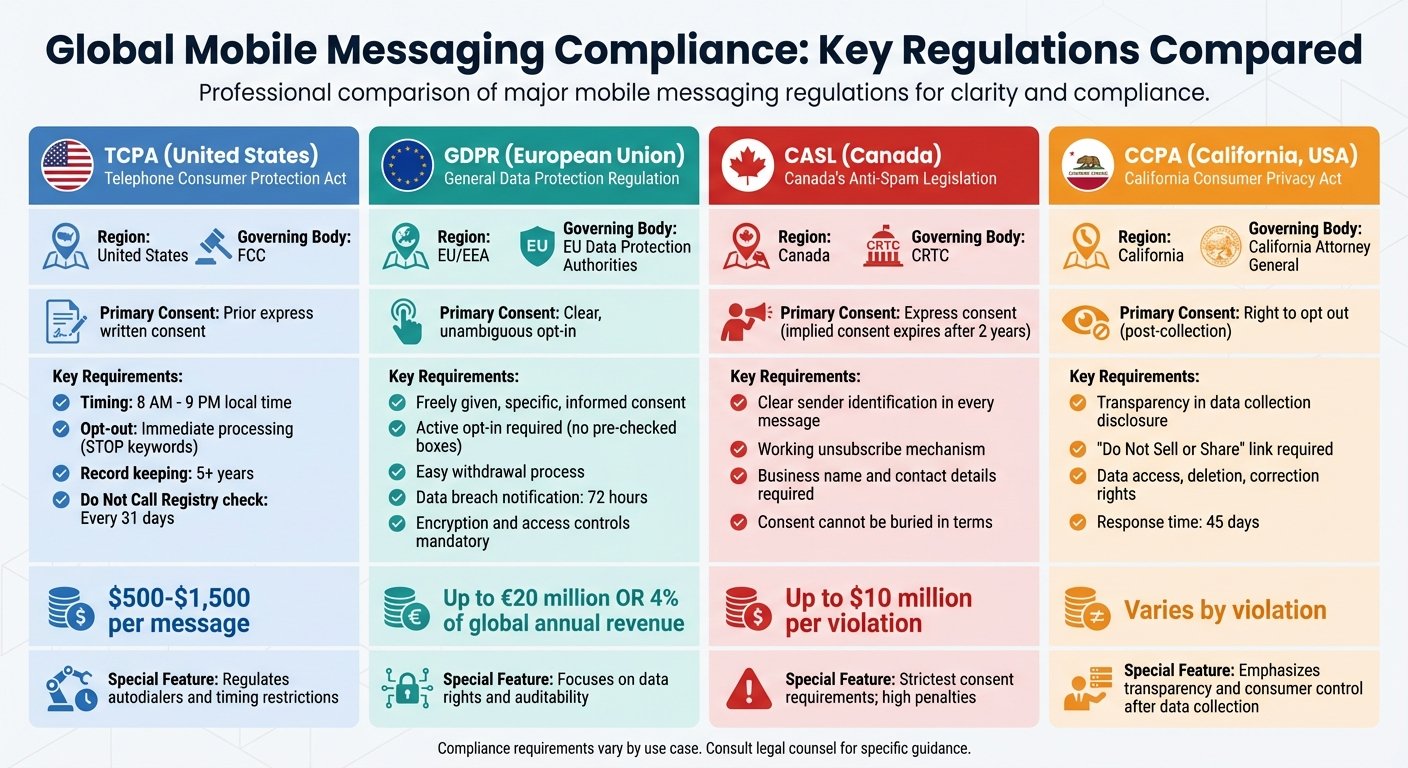
| GDPR | People in the EU (applies globally) | Data protection & privacy | Lawful basis, data minimization, privacy by design, breach notification within 72 hours | Up to €20 million or 4% of global annual turnover, whichever is higher |
| PCI DSS 4.0 | Payment card data (global) | Payment security | WAF or equivalent, strong encryption and authentication, vulnerability scanning, penetration testing | Contractual fines via your acquirer; loss of card processing |
| CCPA / CPRA | California residents, businesses over threshold | Consumer privacy rights | Privacy disclosures, opt-out of sale and sharing, Global Privacy Control | $2,663 per violation, $7,988 per intentional violation or violation involving a minor under 16 (California adjustment effective 1 January 2025; adjusted annually) |
| HIPAA | US protected health information | Health information protection | Administrative, physical and technical safeguards; Business Associate Agreements; breach notification | Tiered by culpability, with per-violation and annual caps that HHS adjusts for inflation each year. Check the current figures with HHS rather than relying on a number in an article. |
| European Accessibility Act | EU consumer-facing digital services | Digital accessibility | Conformance with EN 301 549: screen reader support, keyboard navigation, contrast, text alternatives | Set by each member state; includes fines and market access restrictions |
We have removed the previous HIPAA and CCPA penalty figures, which were out of date. Every US penalty amount in this area is inflation-adjusted annually, so treat any specific number older than a year as wrong by default.
Enforcement in this area is active. The FTC has brought data security actions against consumer technology companies, including its 2022 action against the education technology provider Chegg over security failures that exposed personal data. Earlier versions of this article listed further examples whose sources we could not confirm, and those have been removed.
The frameworks emphasise different things. GDPR requires privacy by design, meaning security decisions belong at the start of development. PCI DSS is largely about technical controls. CCPA is about transparency and user control. They overlap enough that a single well-designed programme can serve several, but the notification, consent, and user-rights requirements differ and each needs checking individually.
Automated Application Security Testing Methods
Types of Automated Security Testing
Static Application Security Testing (SAST) scans source code or binaries for vulnerabilities without running the application. It catches issues like SQL injection and cross-site scripting early, when they are cheapest to fix. Its weaknesses are runtime and configuration problems it cannot see, and a false positive rate that needs human triage.
Dynamic Application Security Testing (DAST) tests the running application from the outside, like an attacker. Good for authentication flaws, insecure configurations, and session handling. It cannot see your code, so it will not tell you which line to fix and will miss business logic flaws.
Software Composition Analysis (SCA) checks your third-party and open-source dependencies against known vulnerability databases.
For most small teams this is the highest-value tool on the list, because most of the code in a modern application was written by someone else. It is also the cheapest to adopt, and it produces the dependency inventory that customers and auditors increasingly ask for.
Interactive Application Security Testing (IAST) instruments the application during testing, combining code visibility with runtime behaviour. Accurate, with fewer false positives, but it needs an instrumented environment and adds overhead.
Runtime Application Self-Protection (RASP) sits inside the running application and blocks attacks as they occur. It is a control rather than a test, and it carries a performance cost.
Realistically, IAST and RASP are enterprise tools. A small business will usually get more security per pound from SCA, SAST, dependency patching, and getting authentication right than from either.
Security Testing Best Practices
Integrate testing into your development workflow rather than running it as an annual event. Fixing a vulnerability at the commit stage is far cheaper than fixing it after release, and the automated record of scans and fixes is itself useful audit evidence.
Start with SAST and SCA early in development. Run them automatically on every commit so developers get feedback immediately. Configure the build to block deployment on critical findings.
A warning from practice: teams that set the threshold too aggressively at the start end up with a permanently red pipeline that everyone learns to override, which is worse than no gate at all. Begin by blocking only on critical, exploitable findings in code you control, and tighten from there.
In staging, use DAST to test under realistic conditions. Automate it after successful builds and surface results where developers will see them.
Set your tools to generate reports in auditor-friendly formats documenting vulnerabilities, remediation, and status. Being able to produce this on request turns an audit from a project into an export.
Testing Methods Comparison
| Testing Method | Primary Benefits | Key Limitations | Worth it for a small team? |
|---|---|---|---|
| SCA | Finds vulnerable dependencies, produces a component inventory | Only finds known issues, not your own code | Yes. Start here. |
| SAST | Identifies code-level flaws early, fits the development workflow | False positives, misses runtime issues | Yes, with tuning |
| DAST | Detects runtime vulnerabilities, simulates attacks | No code visibility, slower | Yes, in staging |
| IAST | Combines static and dynamic views, fewer false positives | Requires runtime instrumentation and overhead | Usually not |
| RASP | Blocks attacks in production in real time | Performance cost, operational complexity | Usually not |
A layered approach — SCA and SAST during development, DAST in staging — aligns with the regular scanning and penetration testing that PCI DSS 4.0 requires and supports continuous monitoring under the other frameworks.
Choose tools that give actionable findings rather than volume. A scanner producing four hundred unranked findings a week will simply be ignored. Platforms like BizBot list options with pricing so you can compare against your budget.
How to Set Up App Security Compliance for Small Businesses
Identify Your Regulatory Requirements
Start with what data you actually hold. Conduct a data inventory documenting every type of data your app collects, processes, and stores, and where it goes.
This step regularly saves money rather than costing it, because it usually reveals data being collected for no current purpose. Deleting that data removes it from scope under several frameworks at once, which is cheaper than protecting it.
From the inventory, work out what applies:
- Card data means PCI DSS, though using a hosted payment page keeps most of it out of your scope
- Protected health information handled for a covered entity means HIPAA and a Business Associate Agreement
- Personal data of people in the EU means GDPR, wherever you are based
- California residents’ personal information means checking the CCPA thresholds, which not every business meets
- Consumer-facing services in the EU means the European Accessibility Act
Then run a gap analysis to find where a single control can satisfy several frameworks. Encryption, access control, logging, and breach response appear in nearly all of them; build to the strictest version once rather than four times.
If you are unsure, take advice. The cost of an hour with a specialist is small next to the cost of building for a regulation that never applied to you, which is a more common small-business error than under-compliance.
Choose the Right Security Tools
Match tools to the standards you identified. When evaluating, consider:
- Coverage of the regulations that actually apply to you
- Compatibility with your existing workflow and languages
- Scalability as you grow
- Ease of use for the team you have, not the team you wish you had
- Total cost of ownership, including the staff time to triage findings
That last point is the one most often underestimated. The licence is rarely the largest cost; the engineering hours spent working through output usually are.
Look for encryption, audit logging, breach detection, and automated compliance reporting. BizBot maintains directories of security and compliance tools aimed at small businesses, with pricing shown so you can rule options out early.
Add Compliance to Your Business Processes
Embed the tools in daily operations. Run security scans on every commit, give developers immediate feedback, and block deployment on critical findings.
Documentation matters as much as tooling. Keep tamper-evident logs of data access, changes, and transfers, and document your consent processes and breach procedures. Write your breach notification runbook before you need it: GDPR’s 72-hour clock starts when you become aware of a breach, and that is not the moment to start deciding who calls whom.
Train your team. GDPR, PCI DSS, HIPAA, and CCPA all expect staff awareness, and training records are among the first things an assessor asks for.
Finally, set up monitoring and automated reporting so evidence accumulates continuously rather than being reconstructed under deadline. Tools like BizBot can help keep track of the compliance subscriptions themselves, which have a habit of multiplying.
Staying Compliant and Secure
Key Points to Keep in Mind
Know which requirements are actually yours. Scope is the highest-leverage decision here. Reducing what you collect and handle reduces obligations across every framework at once.
Automate the evidence, not just the testing. Much of the cost of compliance is producing proof. Tooling that generates that proof as a by-product of normal development is where the saving comes from. We have removed the specific cost-saving percentages an earlier version quoted, because they were unsourced.
Monitor continuously. Real-time alerts catch problems early. Penalties vary widely by framework and jurisdiction and are revised regularly, so check current figures with the relevant regulator rather than relying on a number in an article, this one included.
Keep clear audit trails. Well-organised documentation is what makes an audit survivable and what lets you meet notification deadlines such as GDPR’s 72-hour rule.
Recheck annually. The two deadlines that dominated this guide a year ago have both passed. Requirements move, and so do penalty amounts.
There is an upside beyond avoiding penalties. Enterprise customers increasingly send security questionnaires before they buy, and a business that can answer one quickly wins deals that a business that cannot will lose.
FAQs
How can small businesses identify which regulatory requirements apply to their app?
Work from three things: your industry, the data your app handles, and where your users are. Health information in the US may bring HIPAA into play, depending on who you handle it for. Users in the EU bring GDPR. Card data brings PCI DSS.
Start with a data inventory rather than a regulation checklist. Knowing exactly what you hold answers most of the scope questions on its own, and frequently shows that a framework you were worried about does not apply. Where it is genuinely unclear, ask a professional; being wrong in either direction is expensive.
What are the benefits of automated security testing in a CI/CD pipeline?
Three things. Vulnerabilities are found while they are still cheap to fix, rather than after release. Testing is consistent and repeatable, which is what regulators mean by a controlled process. And the scan history is itself audit evidence, generated automatically rather than assembled by hand the week before an assessment.
The trade-off is tuning. An untuned pipeline produces noise that developers route around, at which point you have the cost without the benefit. Budget time for tuning, not just for licences.
How does the European Accessibility Act differ from GDPR and PCI DSS?
The EAA is about usability for people with disabilities rather than data protection. It requires things like text alternatives for images, keyboard navigation, and screen reader compatibility, assessed in practice against the EN 301 549 standard. GDPR and PCI DSS govern data and payments respectively, so the EAA sits alongside them rather than overlapping.
It has applied since 28 June 2025. Retrofitting accessibility into a finished product is considerably more expensive than building it in, which is the main practical argument for treating it as a design requirement rather than a compliance task.
More on this topic
Browse all 79 articles on Security & Compliance.