Robo-advisors offer low-cost, automated portfolio management. Fees run from 0% to around 0.35% a year, and minimums start at $0. Every fee and minimum below was checked against the provider’s own page in August 2026 and should be confirmed before you open an account – this category re-prices regularly, and several figures previously published here had gone stale.
- Vanguard Digital Advisor: Capped at 0.20% for index portfolios, $100 minimum, suits long-term investors.
- Wealthfront: 0.25% fee, strong tax-loss harvesting and direct indexing for larger accounts.
- Fidelity Go: No advisory fee under $25,000, $10 to start investing, coaching for balances above $25,000.
- Betterment: $5/month or 0.25% annually depending on balance and deposits, $10 to start.
- Schwab Intelligent Portfolios: No advisory fee, $5,000 minimum, but includes a mandatory cash allocation.
- SoFi Robo Investing: 0.25% fee, financial planner access for members.
- Acorns: Flat monthly fee ($4–$12), $5 to start, aimed at micro-investors with automated “Round-Ups.”
Quick Comparison
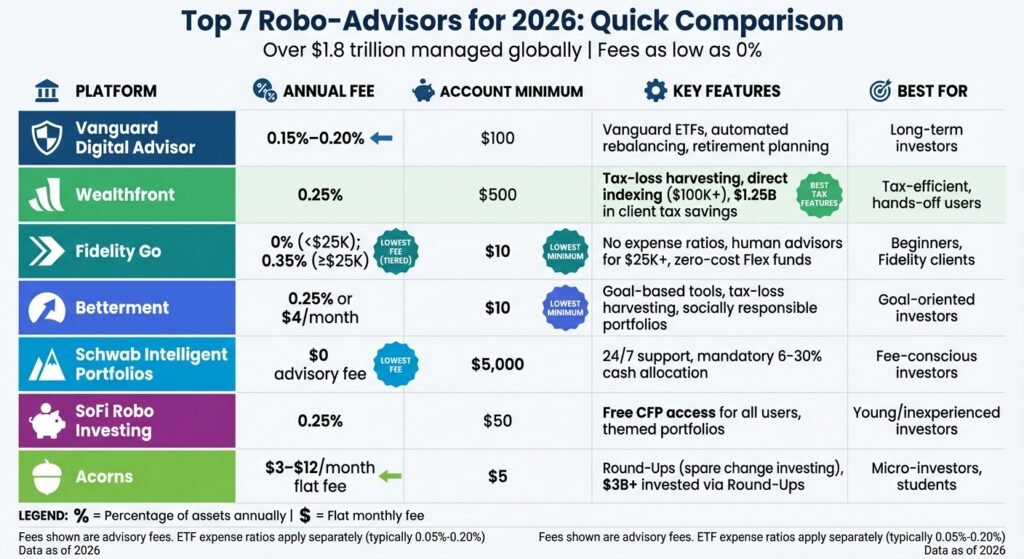
| Platform | Annual Fee | Account Minimum | Key Features | Best For |
|---|---|---|---|---|
| Vanguard Digital Advisor | Capped at 0.20% (index/ESG); 0.25% (active/index) | $100 | Vanguard ETFs, rebalancing, retirement planning | Long-term investors |
| Wealthfront | 0.25% | Not stated on pricing page | Tax-loss harvesting, direct indexing | Tax-efficient, hands-off users |
| Fidelity Go | 0% (<$25K); 0.35% (≥$25K) | $0 to open, $10 to invest | Fidelity Flex funds, coaching for $25K+ | Beginners, Fidelity clients |
| Betterment | $5/month or 0.25% | $10 to invest | Tax-loss harvesting, socially responsible funds | Goal-oriented investors |
| Schwab Intelligent Portfolios | $0 | $5,000 | No advisory fee, 24/7 support | Fee-conscious investors |
| SoFi Robo Investing | 0.25% | Not stated on product page | Financial planner access, themed portfolios | Young/inexperienced investors |
| Acorns | $4–$12/month | $5 to invest | Spare change investing, easy setup | Micro-investors, students |
Each platform suits different needs. Choose based on your goals, balance, and whether you hold taxable accounts.
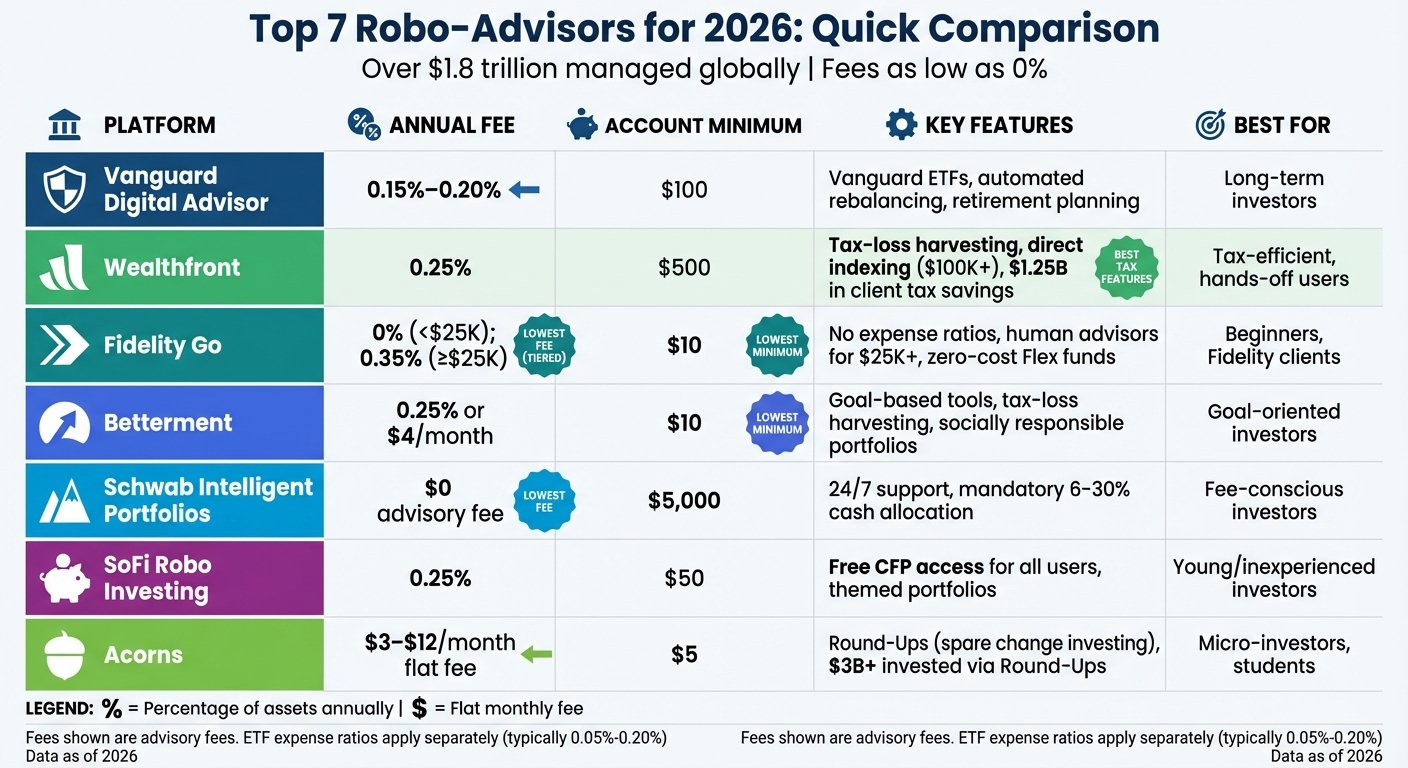
Robo-Advisor Platform Comparison: Fees, Minimums, and Key Features 2026
The Best Robo-Advisors for 2026 (Ranked Best to Worst)
1. Vanguard Digital Advisor
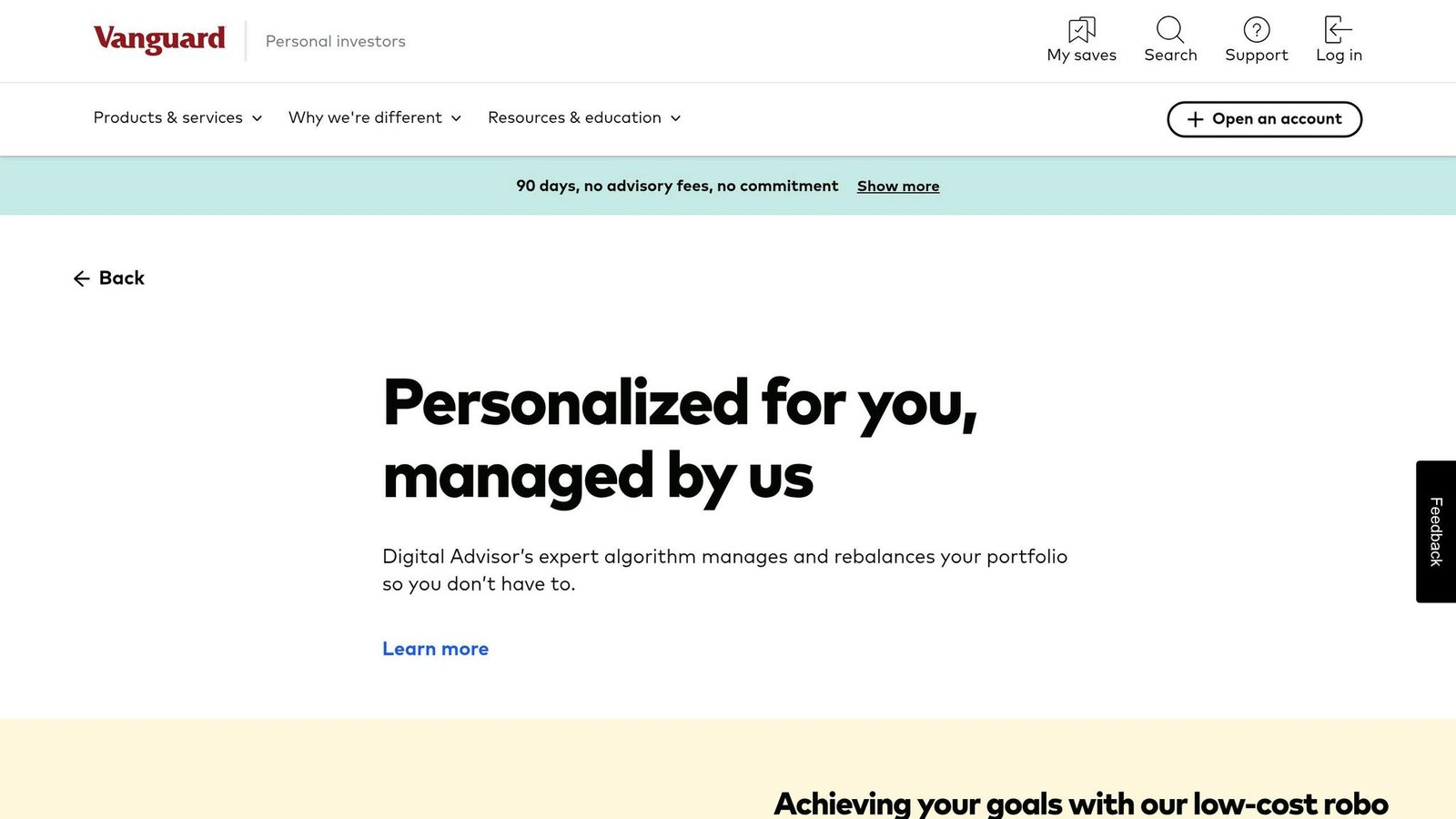
Vanguard Digital Advisor is the cheapest mainstream option here for an all-index portfolio, which is the main reason it leads this list. Awards and league-table placings previously cited in this section could not be verified against a current source, so they have been removed; the fee structure speaks for itself.
Annual Fee
Vanguard states its net advisory fee as a cap rather than a flat rate, because it credits revenue from your underlying holdings against the gross fee. The published caps are:
- All-Index and ESG portfolios: no more than $20 per $10,000 annually (0.20%).
- Active/Index portfolio: no more than $25 per $10,000 annually (0.25%).
Note that these are ceilings. Your actual net fee depends on what you hold, so budget against the cap rather than a lower figure quoted elsewhere. New enrollees pay $0 in advisory fees for their first 90 days, though fund expense ratios still apply.
Account Minimum
The minimum to open is $100 in assets, which makes this one of the more accessible low-fee options.
Tax-Loss Harvesting
The platform includes automated tax-loss harvesting for taxable accounts. If your losses exceed gains, current U.S. rules let you deduct up to $3,000 of net losses against ordinary income annually, with the excess carried forward. That $3,000 cap is a tax rule, not a Vanguard feature – it applies wherever you harvest losses.
Best For
Long-term, buy-and-hold investors who want low-cost access to Vanguard’s ETF range, and existing Vanguard clients for whom enrolling is straightforward.
This tier does not include access to human financial advisors. If that matters to you, Vanguard Personal Advisor is the tier that adds it, at a higher minimum.
2. Wealthfront
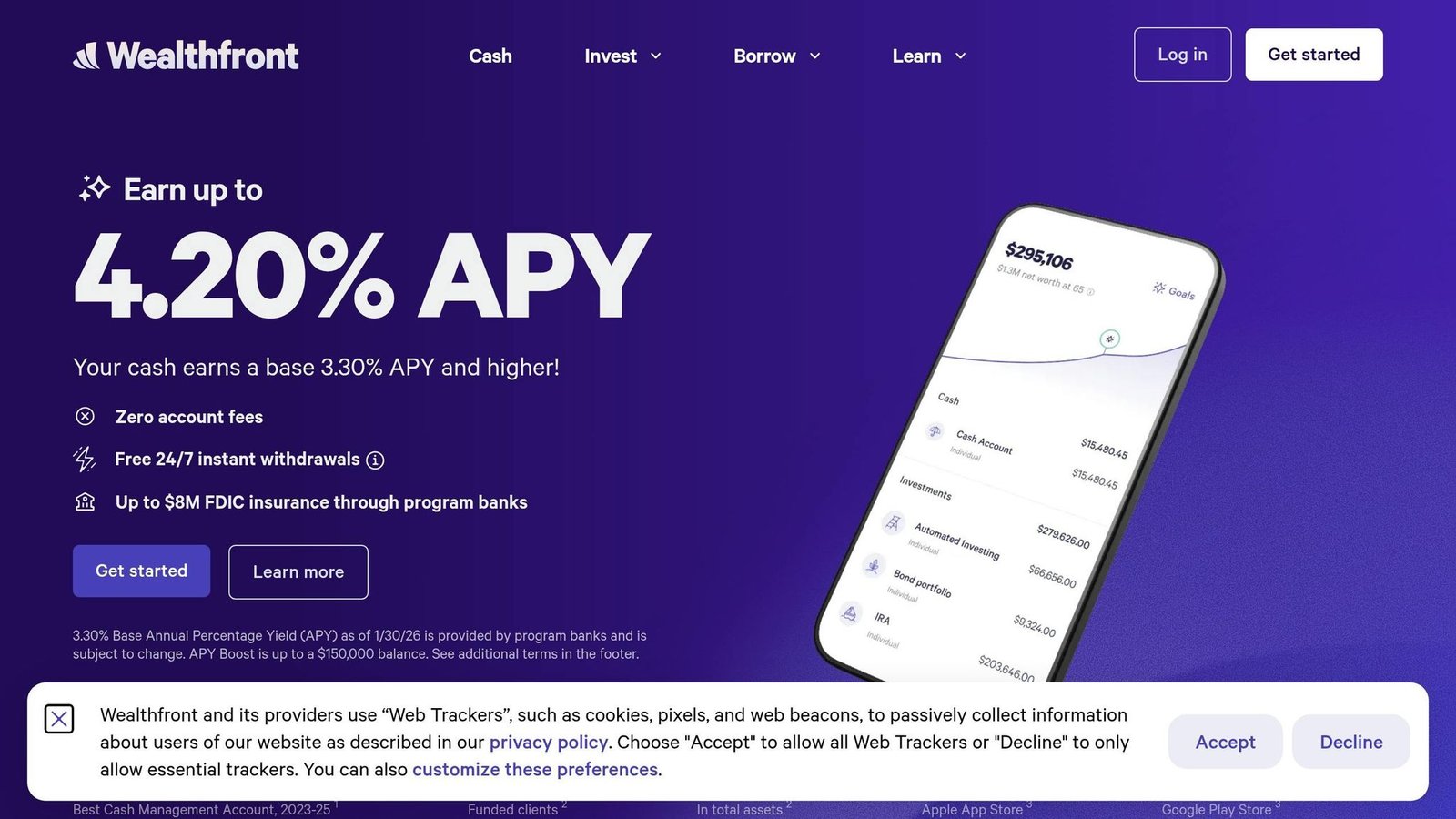
Wealthfront’s pitch is tax optimization and automation rather than human advice.
Annual Fee
Wealthfront charges a flat 0.25% annually on its Automated Investing Account – about $25 per $10,000 invested. Dollar figures for aggregate client tax savings previously quoted in this section were vendor-reported marketing numbers we could not trace to a published source, and have been removed.
Account Minimum
Wealthfront’s pricing page does not state an account minimum. A $500 figure circulates widely, including in earlier versions of this article, but since we could not confirm it on the vendor’s own page we are not repeating it as fact. Check the requirement at signup.
Tax-Loss Harvesting
Wealthfront includes daily automated tax-loss harvesting for taxable accounts at no extra charge. The mechanism: sell a security that has fallen below its purchase price to realise a loss, then buy a similar (but not substantially identical) holding so your market exposure is unchanged.
For larger accounts Wealthfront offers direct indexing, which harvests losses at the level of individual stocks rather than whole ETFs, producing more opportunities to realise losses. Whether that is worth it depends on your marginal tax rate – the benefit is largest for high earners with substantial taxable balances, and close to irrelevant inside an IRA. Earlier versions of this article carried two different and mutually contradictory estimates of the annual value of tax-loss harvesting; neither was sourced, so both have been removed.
Best For
Hands-off investors with taxable accounts who prioritise tax efficiency and do not want a human advisor. Wealthfront supports taxable accounts, IRAs, Roth IRAs, SEP IRAs and 529 plans. It does not offer access to human financial advisors.
3. Fidelity Go
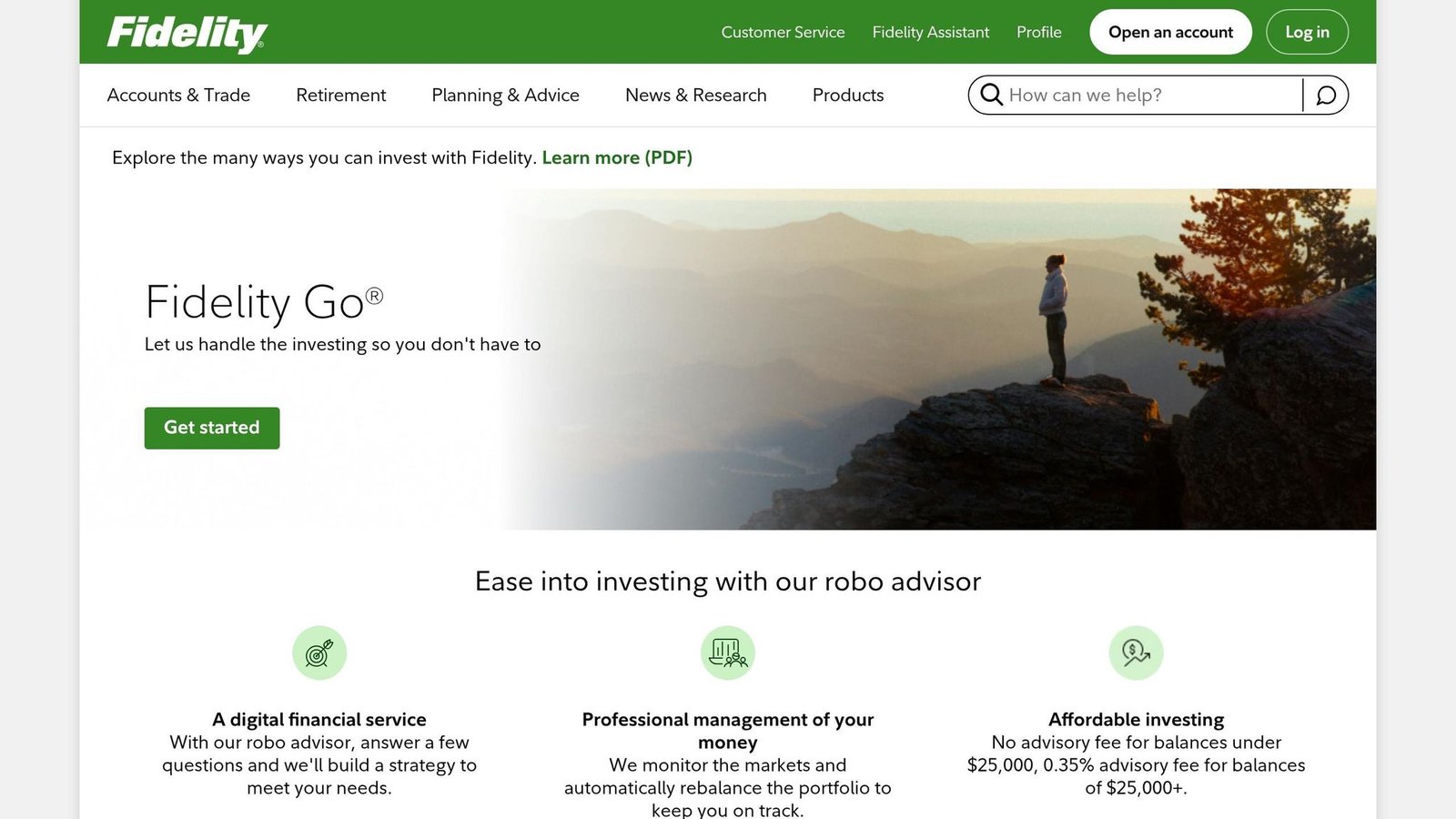
Fidelity Go has the clearest pricing of any platform here, and it is genuinely free at small balances.
Annual Fee
$0 advisory fee under $25,000. At $25,000 and above, 0.35% annually – $35 per $10,000. Fidelity Go uses its zero-expense-ratio Fidelity Flex mutual funds, so there is no fund expense layered on top.
Account Minimum
There is no minimum to open an account, and your balance must reach $10 before Fidelity will invest it according to your chosen strategy.
Tax-Loss Harvesting
Available on taxable accounts at higher balances; accounts below the threshold do not get it. Confirm the current threshold with Fidelity before relying on it.
Best For
Beginners, hands-off investors, and existing Fidelity customers. Once you invest and maintain $25,000 or more in an eligible Fidelity Go account you become eligible for the financial coaching service. Investment options are limited to Fidelity’s proprietary funds, which is the trade-off for the zero expense ratios.
4. Betterment
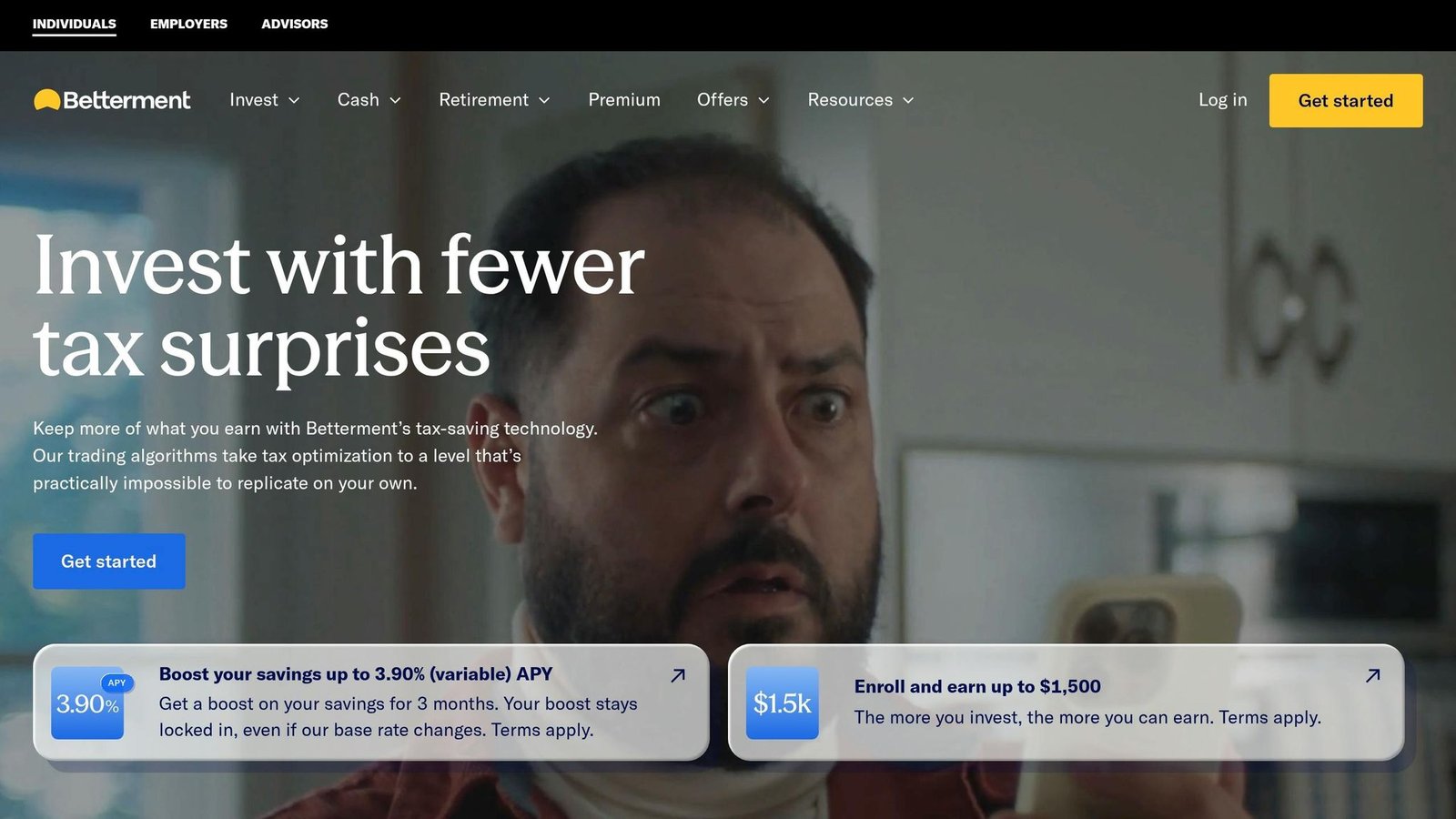
Betterment is built around goal-based planning, with flexible pricing that can work against you at small balances.
Annual Fee
The investing plan has two pricing structures, and which one applies is not your choice:
- $5 per month if your balance is under $24,000 and you have no qualifying recurring deposit.
- 0.25% annually if you have a $200 or larger monthly recurring deposit, or a balance between $24,000 and $1 million.
Two corrections here, because earlier versions of this article got both wrong: the flat fee is $5 a month, not $4, and the qualifying recurring deposit is $200, not $250. The distinction matters most at small balances – $5 a month on a $2,000 account is 3% a year, which is far worse than the headline 0.25% suggests. Setting up a $200 monthly deposit is what moves you onto the percentage fee.
The Premium plan charges 0.65% annually and adds unlimited access to Certified Financial Planners. Balances above $1 million pay less: 0.15% between $1 million and $2 million, and 0.10% above $2 million.
Account Minimum
No minimum balance to open; $10 to start investing.
Tax-Loss Harvesting
Betterment harvests losses in taxable accounts to offset capital gains or up to $3,000 of ordinary income. It also offers a Tax-Coordinated Portfolio strategy and a Tax Impact Preview tool that shows likely tax consequences before you transact.
Best For
Goal-oriented savers and beginners – provided you either clear $24,000 or set up the qualifying recurring deposit. It offers socially responsible portfolio options including Broad Impact, Climate Impact and Social Impact. Premium clients get unlimited phone and video access to CFPs.
5. Schwab Intelligent Portfolios
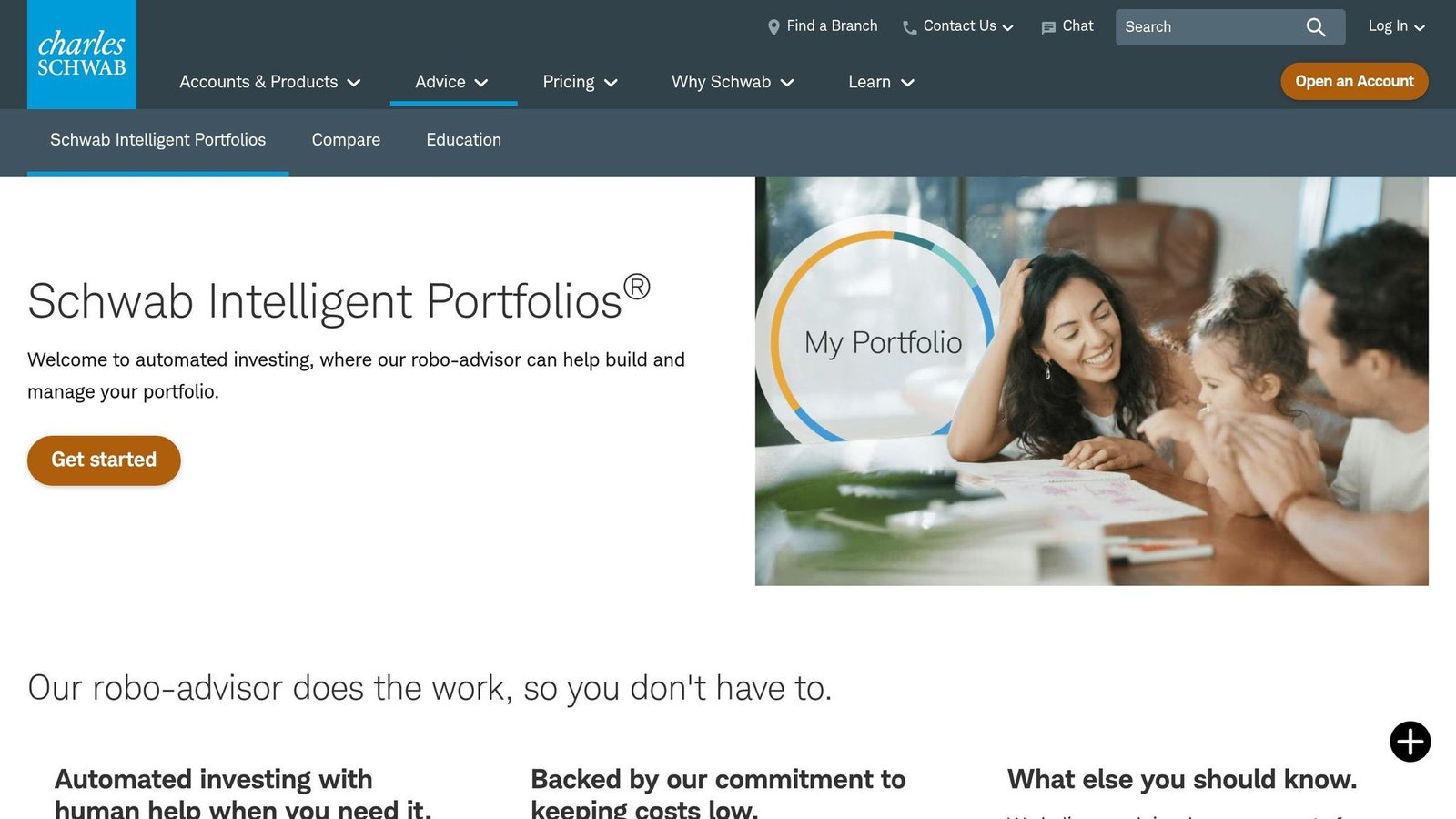
Schwab charges no advisory fee, which sounds unbeatable until you look at how it makes money instead.
Annual Fee
There is no advisory fee. Schwab instead places a portion of your portfolio in an FDIC-insured cash deposit and earns on that spread. Schwab’s own sample allocations show cash holdings varying by risk profile – its published examples range from roughly 6.9% to 15.0%. A wider “6%–30%” range appeared in earlier versions of this article; we could not find that range stated by Schwab, so it has been removed.
The point stands regardless of the exact percentage: money parked in cash is money not invested, and over a long horizon that drag is the real cost of the “free” advisory fee. Beyond that, you pay the expense ratios of the underlying ETFs.
Account Minimum
You need $5,000 to open an account – the highest minimum in this list. Schwab offers 24/7 U.S.-based customer support by phone and live chat.
Tax-Loss Harvesting
Available to clients with invested assets of $50,000 or more. A specific dollar example of losses harvested previously appeared here; it was not sourced and has been removed.
Best For
Cost-sensitive investors who can meet the $5,000 minimum and want 24/7 human support. Weigh the absent advisory fee against the cash allocation before assuming this is the cheapest option – for a long-horizon investor, it may not be.
6. SoFi Robo Investing
SoFi’s draw is access to credentialed financial planners as a member benefit, which is unusual at this price point.
Annual Fee
SoFi charges a 0.25% management fee based on account value under its wrap program. SoFi itself notes the wrap fee may cost more or less than buying brokerage, custodial and recordkeeping services separately – worth reading its Form ADV Part 2 and wrap brochure if you are comparing closely. Underlying ETF expense ratios apply on top and vary by portfolio theme.
Account Minimum
SoFi does not state an account minimum on its automated investing product page. Figures circulate online, but we are not repeating an unconfirmed number for something this easy to check at signup.
Tax-Loss Harvesting
SoFi does not offer tax-loss harvesting. That is the clearest reason to look elsewhere if you are investing a large taxable balance, and it is why SoFi sits below Wealthfront and Betterment here despite the planner access.
Best For
Younger and beginner investors who value access to a financial planner and are investing mainly in tax-advantaged retirement accounts, where the missing tax-loss harvesting costs them nothing.
7. Acorns
Acorns charges a flat monthly subscription, which is the best and worst thing about it.
Annual Fee
Acorns now offers three tiers: Bronze at $4/month, Silver at $8/month and Gold at $12/month – $48 to $144 a year. Earlier versions of this article listed tiers named Personal, Family and Gold at $3, $6 and $12; both the names and two of the three prices had changed, and they have been corrected.
The flat fee is what makes Acorns expensive for small balances. At $4 a month, a $1,000 portfolio pays $48 a year – 4.8%, against roughly 0.25% at most competitors. That is not a rounding difference; it is the single most important fact about Acorns. The maths only starts working in your favour as the balance grows: the same $4 a month is 0.48% on $10,000 and 0.10% on $48,000.
ETF expense ratios apply on top.
Account Minimum
No minimum balance to open; $5 to start investing. Its Round-Ups feature invests spare change by rounding up everyday purchases to the nearest dollar, and a multiplier lets you increase that contribution.
Tax-Loss Harvesting
Acorns does not offer tax-loss harvesting.
Best For
Beginners and micro-investors who struggle to save consistently and value the automatic round-up habit. Be honest with yourself about the balance you will hold: if it stays around $1,000, the fee is doing more damage than the automation is doing good, and a $0-fee alternative such as Fidelity Go would serve you better.
Platform Comparison
The table below compares the seven platforms on verified figures.
| Platform | Annual Fee | Account Minimum | Key Features | Target User |
|---|---|---|---|---|
| Vanguard Digital Advisor | Capped at 0.20% (index/ESG), 0.25% (active/index) | $100 | Vanguard ETFs; automated rebalancing; 90-day fee waiver | Long-term, buy-and-hold investors |
| Wealthfront | 0.25% | Not stated on pricing page | Daily tax-loss harvesting; direct indexing; 529 plans | Hands-off investors seeking tax efficiency |
| Fidelity Go | 0% (<$25,000); 0.35% (≥$25,000) | $0 to open ($10 to invest) | Zero-expense-ratio Flex funds; coaching at $25,000+ | Beginners and existing Fidelity customers |
| Betterment | $5/month, or 0.25% with $24,000+ balance or $200+ monthly deposit | $0 ($10 to invest) | Goal-based tools; tax-loss harvesting; socially responsible portfolios | Goal-oriented investors |
| Schwab Intelligent Portfolios | $0 advisory fee | $5,000 | 24/7 live support; automated rebalancing; mandatory cash allocation | Fee-averse investors with higher balances |
| SoFi Robo Investing | 0.25% | Not stated on product page | Financial planner access; themed portfolios; no tax-loss harvesting | Young investors and SoFi members |
| Acorns | $4–$12/month (Bronze/Silver/Gold) | $0 ($5 to invest) | Round-ups; educational content; no tax-loss harvesting | Micro-investors and beginners |
A few things the table makes obvious.
Flat fees and percentage fees are not comparable at small balances. Acorns at $4 a month and Betterment at $5 a month both look trivial until you divide by a small portfolio. Work out the percentage your own balance would pay before comparing anything to a 0.25% headline.
“No advisory fee” is not the same as no cost. Schwab’s cash allocation is how the service is paid for. Fidelity Go under $25,000 is the closest thing here to genuinely free, because the Flex funds carry no expense ratio either.
Tax-loss harvesting only matters in taxable accounts. If you are investing entirely in an IRA, SoFi’s and Acorns’ lack of it costs you nothing, and you should weight fees and planner access instead.
Conclusion
Match the platform to your balance and account type rather than to a ranking.
If you are starting small, Fidelity Go is hard to beat: no advisory fee under $25,000, no fund expense ratios, $10 to begin. Betterment works at small balances too, but only if you set up the $200 monthly deposit that moves you off the $5 flat fee.
For long-horizon retirement money, Vanguard Digital Advisor caps its advisory fee at 0.20% on index portfolios with a $100 minimum.
For taxable accounts, particularly at higher marginal tax rates, Wealthfront and Betterment are the two with meaningful tax-loss harvesting, and Wealthfront adds direct indexing at larger balances.
Schwab Intelligent Portfolios suits investors who can meet the $5,000 minimum and want live support, so long as they accept the cash allocation. SoFi is a reasonable pick for retirement accounts where planner access matters more than tax-loss harvesting. Acorns earns its keep only if the round-up habit is what gets you investing at all – on cost alone, it is the most expensive option here for a small portfolio.
Market-size and adoption statistics previously closing this article could not be sourced and have been removed. They were not going to help you choose anyway.
FAQs
How do I choose the right robo-advisor for my goals?
Weigh fees, account minimums, user experience, and the features that match your goals. Define the objective first – retirement, a house deposit, general wealth building – then compare on the things that actually differ. Check the minimum balance, whether human advice is included, and crucially whether the fee is charged as a flat monthly amount or a percentage, because that determines which platform is cheaper at your balance.
Do I need tax-loss harvesting for my account?
Only if you hold taxable investments. Inside an IRA or 401(k) it does nothing for you, because those accounts are already tax-sheltered. If you do hold taxable assets, the benefit scales with your marginal tax rate and your balance. Be sceptical of specific percentage estimates of its value – they depend heavily on assumptions about market volatility and your tax situation, and the ones we tried to verify were not sourced.
How much do robo-advisor fees cost over time?
Advisory fees in this category run from 0% to about 0.35% a year, plus underlying fund expenses. Small differences compound over decades, so the honest way to assess it is to model your own expected balance against each fee structure rather than trust a general rule. Pay particular attention to flat monthly fees, which are the most expensive option at low balances and the cheapest at high ones.
More on this topic
Browse all 53 articles on Finance & Accounting, or jump straight to our buying guide: Best Accounting Software for Small Businesses.