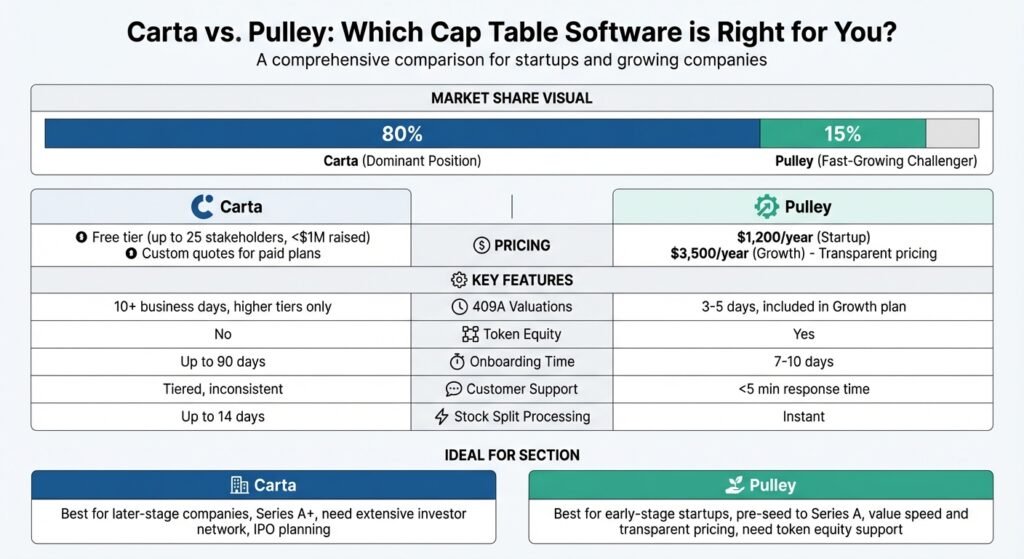
Managing your company’s cap table is essential as you grow. Carta and Pulley are two major platforms designed to simplify this process. Here’s a quick breakdown of their offerings:
- Carta: The incumbent, and the one most investors already have a login for. Offers a free Launch plan for companies with up to 25 stakeholders and under $1M raised. Paid plans (Build, Grow, Scale) are priced per stakeholder with a minimum annual fee and are quote-only, so you cannot compare them on paper.
- Pulley: The challenger, and the one that publishes its prices. Equity plans start at $1,200 per year, 409A valuations are advertised at a 3-5 day turnaround, and it supports token equity, which Carta does not.
Every price below was taken from each vendor’s own pricing page in August 2026. Market-share figures, stakeholder counts and a support rating previously published in this article could not be sourced and have been removed.
Quick Comparison
| Feature | Carta (Launch) | Carta (Paid Plans) | Pulley (Startup) | Pulley (Growth) |
|---|---|---|---|---|
| Annual Price | Free | Quote only: per stakeholder plus a minimum annual fee | $1,200 | $3,500 |
| Stakeholders Included | Up to 25 | Set by quote | 25 | 40 |
| 409A Valuations | Not Included | Included on Grow and Scale | Not Included | Included |
| Token Equity Support | No | No | Separate token plans, $4,500/year | Separate token plans, $4,500/year |
Choose Carta if you are a later-stage company, or if your investors have asked for it. Choose Pulley if you are early-stage and want to know what you will pay before you talk to a salesperson.
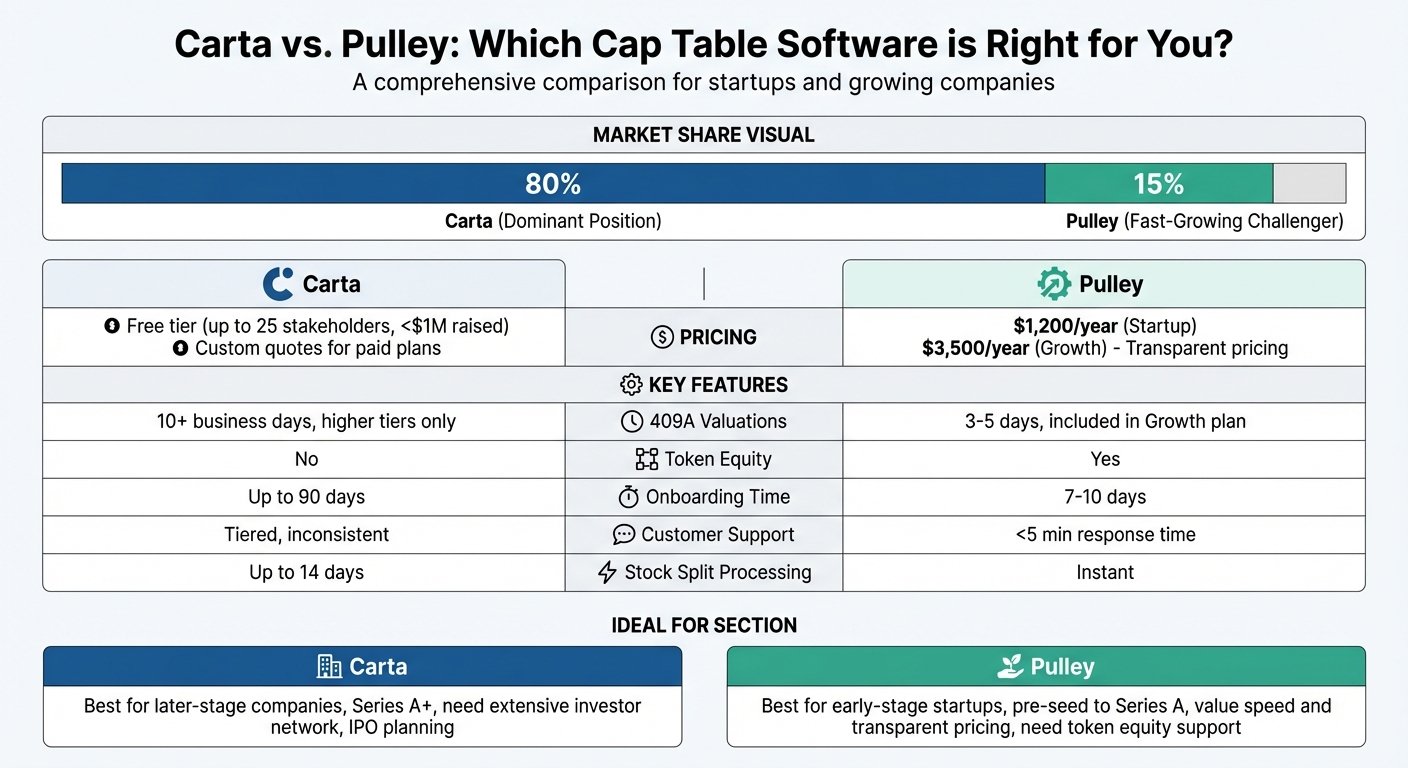
Carta vs Pulley Cap Table Software Comparison Chart
Pricing Comparison
The two platforms take very different approaches. Carta offers a free Launch tier for companies with up to 25 stakeholders and less than $1 million raised. Beyond that, pricing comes from a sales quote for the Build, Grow, or Scale tiers. Carta states plainly that each package has a price per stakeholder with a minimum annual fee, but publishes neither the rate nor the minimum.
Pulley publishes fixed prices. Its Startup plan is $1,200 a year including 25 stakeholders; the Growth plan is $3,500 a year including 40 stakeholders. Angel investors writing cheques of $50,000 or less count as half a stakeholder. Pulley does not publish a per-stakeholder overage rate, so a figure previously printed here has been removed; ask for it before you sign, because it determines what happens at your next round.
The 409A valuation is where the money moves. These are the IRS-required appraisals used to price employee stock options, and buying one standalone is a four-figure expense. With Carta, valuations are bundled into the higher Grow and Scale tiers. Pulley includes them in the $3,500 Growth plan, and advertises a 3-5 day turnaround on its own site. Carta does not publish a turnaround time. Get any promised timeline in writing rather than taking either number from an article, including this one.
For early-stage companies with fewer than 25 stakeholders, Carta’s free tier is a genuinely good deal, and the reason so many companies start there. The complaint you hear from founders is what happens after the thresholds are crossed, when a free product becomes a quoted one with no published anchor. Pulley’s answer to that is simply publishing the number.
Pulley also sells separate crypto plans: Token Cap Table at $4,500 a year for 25 stakeholders, Token Distributions at $4,500 a year, and token valuations starting at $10,000 per valuation. Note that these are additional to the equity plans, not included in them.
Carta Pricing
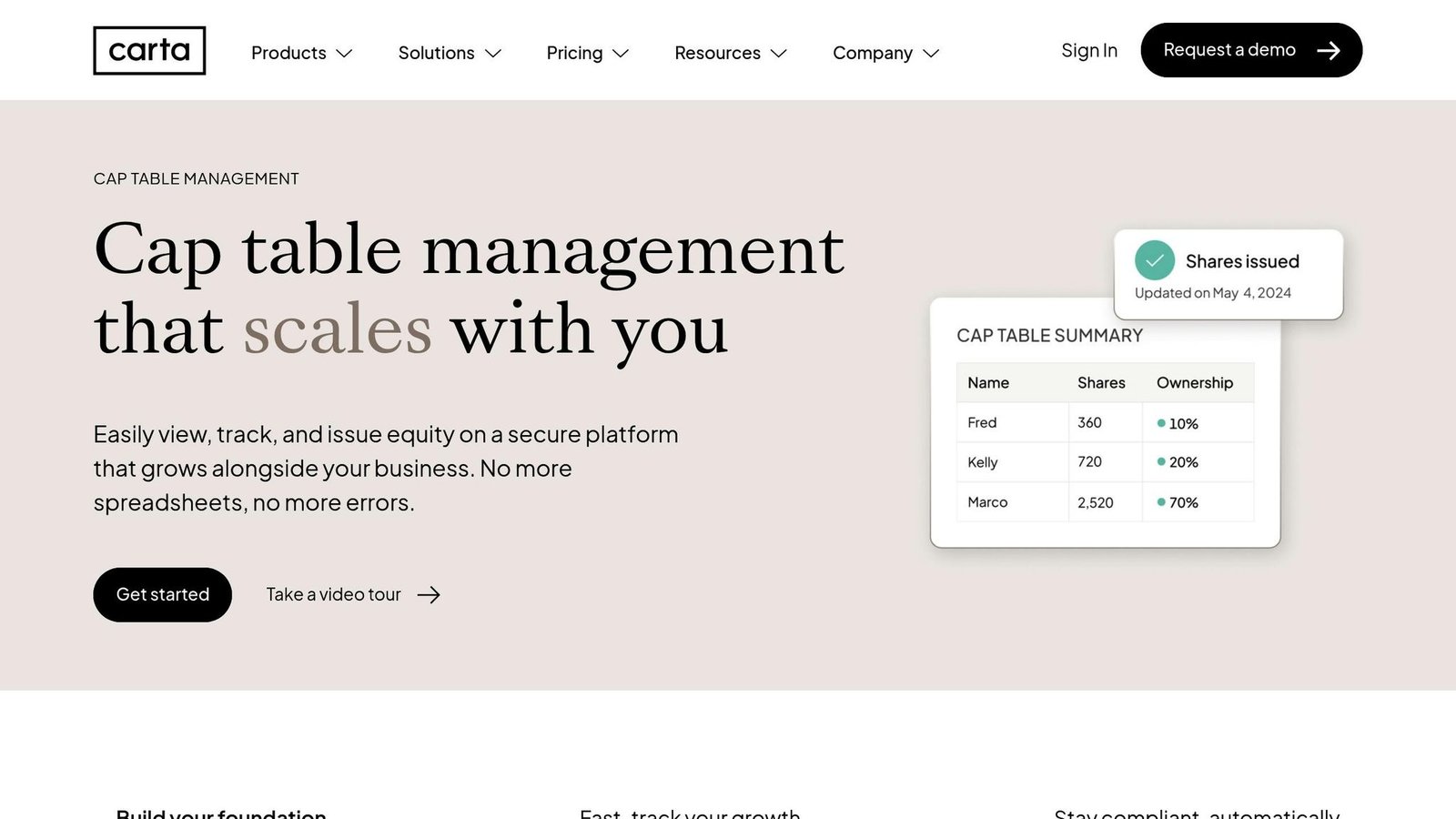
Carta structures its plans into four tiers, and only Launch has a published price, which is zero. That plan is for companies with up to 25 stakeholders and less than $1 million raised. It includes basic cap table management, SAFE modeling, and standard compliance forms like 83(b) elections.
Once those thresholds are exceeded, you move to Build, Grow, or Scale and a custom quote. Build adds onboarding support and priced round modeling. Grow and Scale add 409A valuations, board management, ASC 718/IFRS reporting, and IPO advisory services. A per-stakeholder estimate previously published here was attributed only to “industry estimates” and could not be sourced, so it has been removed. Carta also sells add-ons – Total Compensation, Equity Advisory, Liquidity for tender offers, and QSBS Attestation – each priced separately, and none of which appear in the headline quote.
The practical advice: ask for the per-stakeholder rate and the minimum annual fee as two separate numbers, and model both at your expected stakeholder count after the next round. A quote that looks reasonable at 40 stakeholders behaves differently at 120.
Pulley Pricing
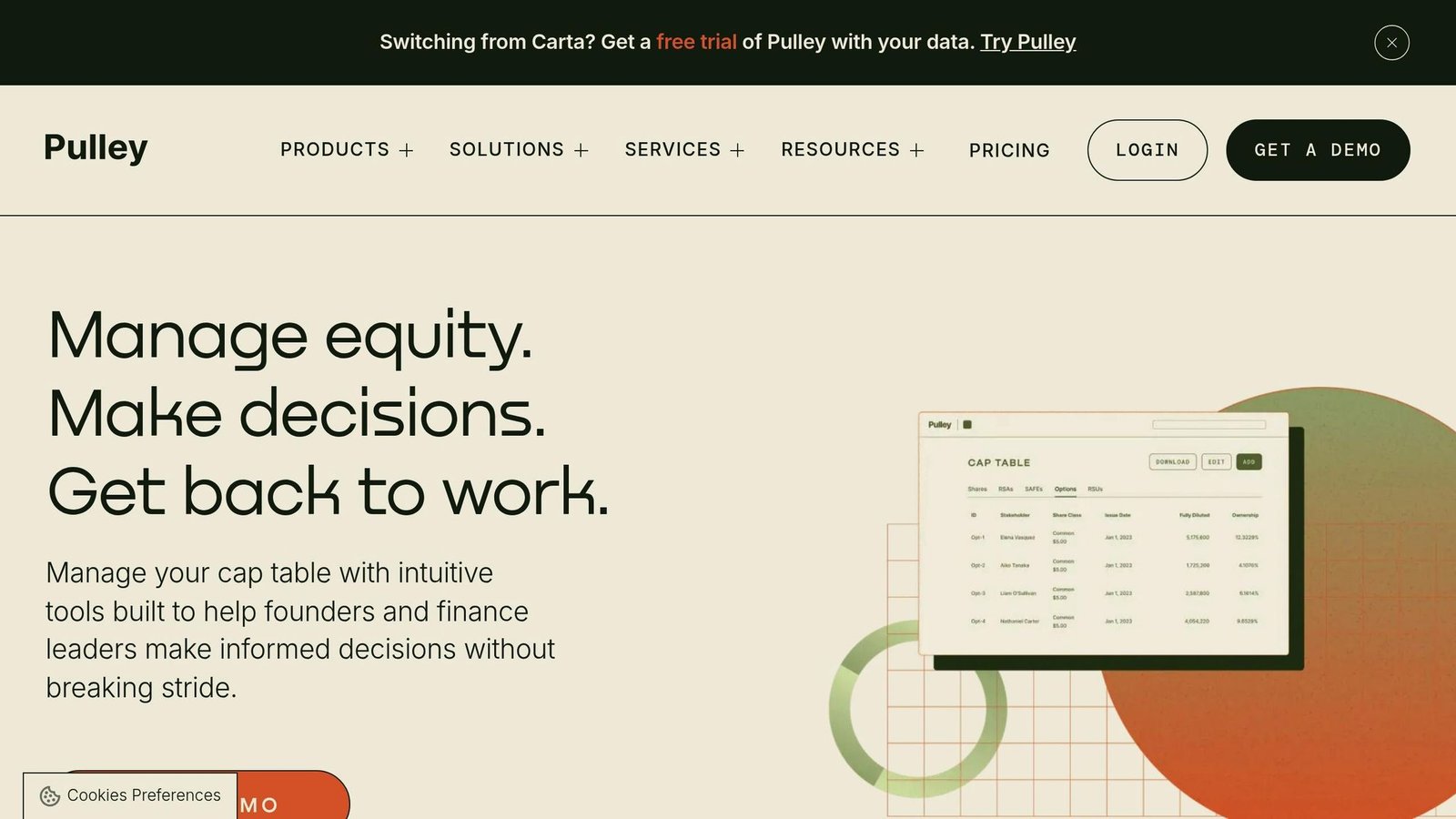
Pulley has three equity tiers. Startup is $1,200 per year for 25 stakeholders and includes cap table management, share certificates, templated agreements for SAFEs, options and RSAs, a fundraise modeler, and concierge onboarding. It does not include 409A valuations.
Growth is $3,500 per year for 40 stakeholders. It adds 409A valuations, custom agreements, option exercises, Rule 701 compliance, Form 3921 reporting, board approvals, and HRIS integrations. Enterprise is quote-only and adds stock-based compensation reporting, custom reporting, managed equity administration, and secondary liquidity.
The crypto plans are separate products: Token Cap Table at $4,500 a year for 25 stakeholders, Token Distributions at $4,500 a year for 25 stakeholders, and Token Valuations from $10,000 per valuation. All prices checked against Pulley’s pricing page in August 2026.
Pricing Comparison Table
Here’s a side-by-side comparison of the published pricing:
| Feature | Carta (Launch) | Carta (Build/Grow/Scale) | Pulley (Startup) | Pulley (Growth) |
|---|---|---|---|---|
| Annual Price | Free | Contact Sales | $1,200 | $3,500 |
| Pricing Model | Free tier | Per stakeholder plus minimum annual fee | Flat, stakeholders included | Flat, stakeholders included |
| Stakeholders Included | Up to 25 | Set by quote | 25 | 40 |
| Fundraising Cap | < $1M raised | No limit | No limit | No limit |
| 409A Valuations | Not Included | Included on Grow and Scale | Not Included | Included |
| Angel Investor Discount | None published | None published | Yes (≤ $50k = 0.5 stakeholder) | Yes (≤ $50k = 0.5 stakeholder) |
| Additional Stakeholder Cost | Not published | Not published | Not published | Not published |
Note what the table cannot tell you. Three of the four columns depend on a number neither vendor publishes, which is exactly why the total cost of these products is so hard to compare before you are in a sales conversation.
Features and Capabilities
Both Carta and Pulley handle cap table management, equity grants, and compliance tracking. They differ in how they handle valuations, reporting, and equity types. Performance claims about processing speeds, onboarding durations and support response times previously appeared throughout this section; none could be verified against either vendor’s published material, and they have been removed.
Carta is the incumbent, and its main advantage is network position rather than features. Investors, law firms and funds already work in it, which removes friction during due diligence and at closing. It offers sophisticated modeling for complex scenarios and a wide add-on catalogue for later-stage needs: tender offers, ASC 718 and IFRS reporting, IPO advisory.
Pulley is built for the founder rather than the investor. It publishes its prices, includes signatures for option grants without a third-party e-signature tool, and supports token-based compensation – vesting schedules, lockups, and distributions – which Carta does not offer at all. Pulley advertises 409A valuations in 3-5 days.
On fundraising modeling, Pulley includes dilution scenarios with pro-rata and Y Combinator rights handling in its published plans. With Carta, what modeling you get depends on which tier you are quoted, which is another reason to pin the quote down in writing.
Feature Comparison Table
| Feature | Carta | Pulley |
|---|---|---|
| 409A Turnaround | Not published | 3-5 days, per Pulley’s site |
| Token Equity Support | No | Yes, on separate token plans |
| Option Grant Signatures | Third-party e-signature | Built in |
| Published Pricing | Free tier only | All equity and token tiers |
| Investor Familiarity | The default in most VC portfolios | Less common, growing |
| Later-Stage Add-ons | Extensive (liquidity, IPO advisory, QSBS) | On Enterprise tier |
The honest summary: Carta wins on ecosystem, Pulley wins on price transparency and token support. Feature-by-feature, for a company under 40 stakeholders, they do the same job.
Ease of Use and User Experience
Carta User Experience
Carta’s practical advantage during a raise is that the people on the other side of the table already know it. Exporting a cap table for due diligence is routine, and nobody has to be talked through the format.
The cost of that breadth is a busier interface. Carta is built for companies that will eventually need tender offers and audit-grade reporting, and an early-stage founder sees all of that machinery whether they need it or not. Customer quotations previously printed in this section could not be attributed to a checkable source and have been removed.
Pulley User Experience
Pulley is designed around the founder doing the work themselves: step-by-step issuance flows, templated agreements, and concierge onboarding included in every published tier rather than sold as a premium service.
A named migration tool previously mentioned here does not appear anywhere in Pulley’s own material, and we could find no evidence it exists, so the reference has been removed. What Pulley does advertise is a free trial with your existing data imported if you are switching from Carta – which is the right way to test a migration, because cap table data is where these transitions actually go wrong.
Scalability and Support
Scalability for Growth
Carta scales further, and that is not marketing. Its catalogue covers 409A valuations, ESOP administration, SPV formation, tender offers and IPO support, so a company can stay on it from incorporation through listing without changing systems. Market share and growth-rate figures previously quoted here could not be sourced and have been removed.
Pulley covers the same core ground for a private company and adds token cap tables, which matters only if you issue tokens – but if you do, Carta is not an option at all.
The scaling question that actually decides this is cost, not capability. Pulley’s published tiers stop at 40 included stakeholders before you are into Enterprise; Carta’s per-stakeholder model has no published ceiling but no published rate either. Model your stakeholder count two rounds out and get both vendors to quote it.
Customer Support
Support response times were previously compared here using specific figures for both vendors. Neither vendor publishes those figures, so they have been removed rather than repeated. If support responsiveness matters to your decision – and during a closing it does – ask each vendor for a written service commitment, and ask specifically whether it covers your lawyers and auditors or only your own staff.
What is verifiable is scope. Pulley’s concierge onboarding is included in its published plans. Carta’s onboarding support sits on the Build tier and above, which is quote-only.
Conclusion and Recommendations
Summary of Key Points
Carta is the default for venture-backed companies heading toward Series A and beyond. The ecosystem, the investor familiarity and the later-stage add-ons are real advantages. The drawback is that everything past the free tier is quote-only, priced per stakeholder against an undisclosed minimum, which makes budgeting a negotiation rather than a calculation.
Pulley publishes its prices, includes 409A valuations at $3,500 a year, and is the only one of the two that handles token equity. A support rating previously quoted here was arithmetically impossible – a score above its own maximum – and has been removed along with the market-share comparisons around it.
Which Tool is Right for You?
Go with Carta if you are later-stage, if you expect a tender offer or an IPO on your roadmap, or if your investors have asked for it. Investor preference is a legitimate reason to choose software here, even when the software is otherwise a tie.
Go with Pulley if you are pre-seed to Series A, if you want a budget line you can write down today, or if you issue tokens. At 25 to 40 stakeholders, $1,200 or $3,500 a year against an unknown quote is a straightforward comparison.
And if you are under 25 stakeholders with less than $1M raised, use Carta’s free plan and revisit the decision when you cross either threshold. Paying for a cap table at that stage is optional.
If you are looking for tools beyond cap table management, check out BizBot‘s curated directory of solutions. It includes options for accounting software, HR services, and ownership management tools tailored for freelancers, small business owners, and growing companies.
FAQs
How do Carta and Pulley differ in their pricing models?
Carta provides a free Launch plan for companies with up to 25 stakeholders and under $1 million raised. Above that, its plans are priced per stakeholder with a minimum annual fee, and neither figure is published, so you need a quote.
Pulley publishes fixed tiers: Startup at $1,200 per year for 25 stakeholders, Growth at $3,500 per year for 40 stakeholders, and a quote-only Enterprise tier. Token plans are separate at $4,500 per year.
One correction to an earlier version of this article: Pulley does not offer a free plan. Carta does. That is the opposite of what the pricing transparency comparison might lead you to expect.
How quickly do Carta and Pulley provide 409A valuations?
Pulley advertises a 3-5 day turnaround on its own website. Carta does not publish a standard timeframe. Earlier versions of this article gave specific day counts for Carta that could not be sourced, and gave two different figures for Pulley in different sections; both problems have been fixed. If turnaround matters, ask for it as a contractual commitment.
Which platform is better for managing token equity: Carta or Pulley?
Pulley, because Carta does not offer it. Pulley sells token cap table management and token distributions as separate products at $4,500 per year each for 25 stakeholders, with token valuations priced from $10,000 per valuation. Budget for those on top of an equity plan rather than instead of one.
More on this topic
Browse all 53 articles on Finance & Accounting, or jump straight to our buying guide: Best Accounting Software for Small Businesses.