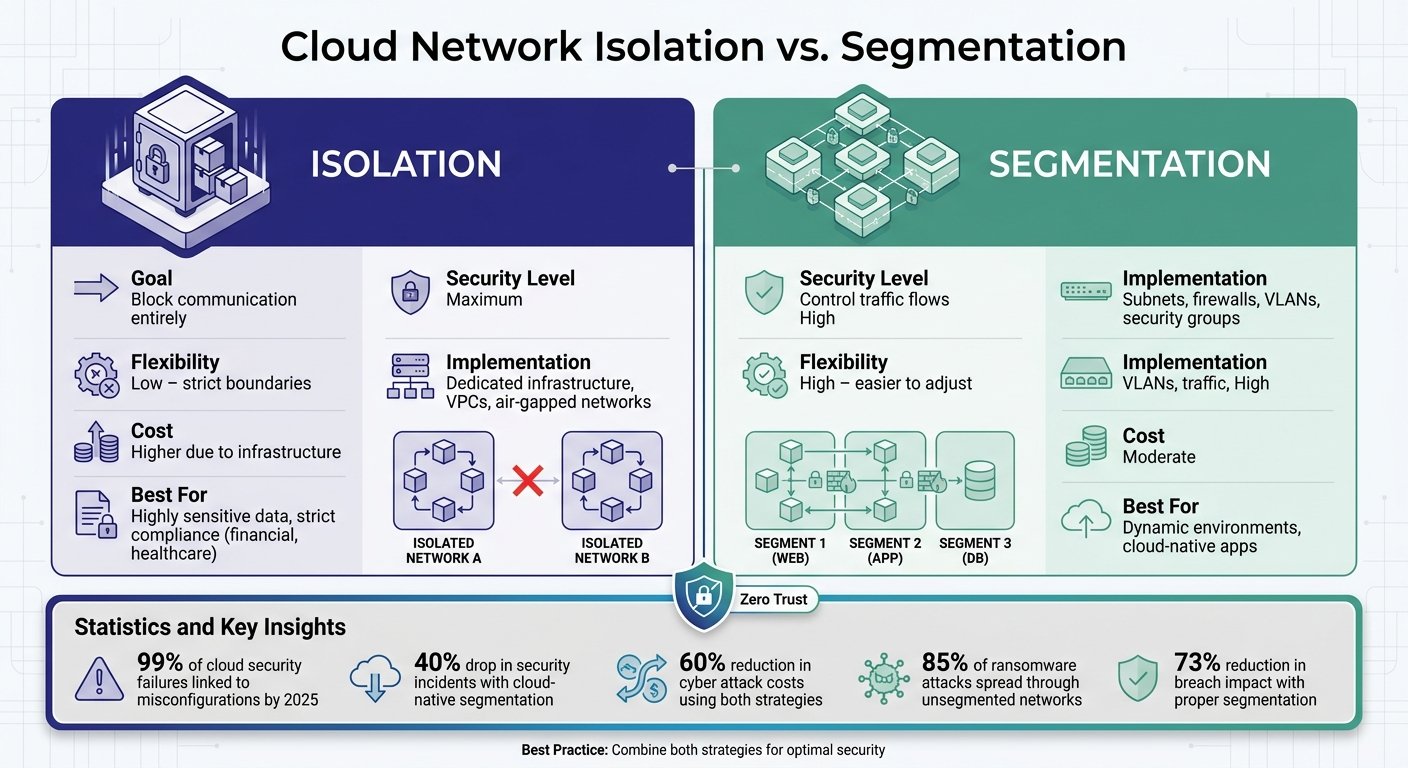
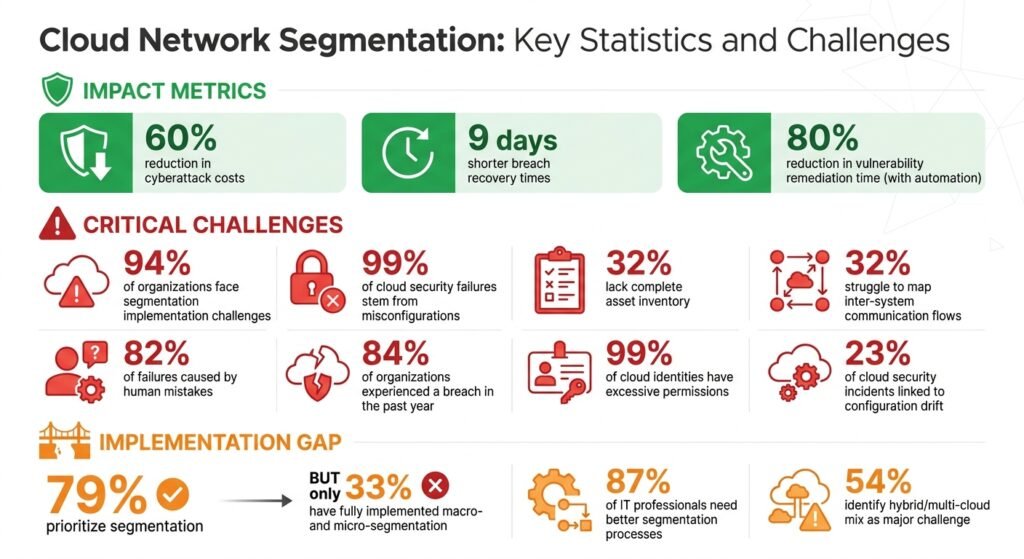
Cloud network segmentation is a method to divide cloud environments into secure zones, limiting lateral movement during breaches. Most organisations agree it matters and most have not finished doing it: in Cisco’s 2025 Segmentation Report, 79% called segmentation a top priority while only 33% had fully implemented both macro- and micro-segmentation, and 94% reported running into challenges doing it.
Key issues include:
- Hybrid Complexity: Managing multiple platforms like AWS, Azure, and GCP increases errors. Cisco’s survey put 54% of organisations in this bucket.
- Visibility Gaps: 32% lack visibility into the resources they need to segment, and another 32% cannot identify legitimate communication flows between systems.
- Access Control Risks: Excessive permissions and configuration drift create vulnerabilities.
- Performance and Compliance: Segmentation can slow networks and complicate regulatory adherence.
Solutions include adopting zero-trust models, automating segmentation with Cloud-Native Application Protection Platforms (CNAPPs), and conducting regular audits.
A note on the numbers in this article. It previously carried around fifteen statistics, none of them sourced. We could trace one cluster to a real, public document – Cisco’s 2025 Segmentation Report, cited throughout below – and could not trace the rest. Removed as unsourceable: a 60% reduction in cyberattack costs, a 99% cloud-failure figure attributed to Gartner and repeated three times, 82% of failures caused by human error, 23% of incidents caused by configuration drift, 84% of organisations breached in the past year, 90% of professionals rating zero-trust as critical, a 72-minute attacker breakout time, 82% of incidents occurring without malware, and “nearly half” of attacks originating in the cloud. Three customer testimonials with percentage results attached have gone the same way, for reasons given in that section.
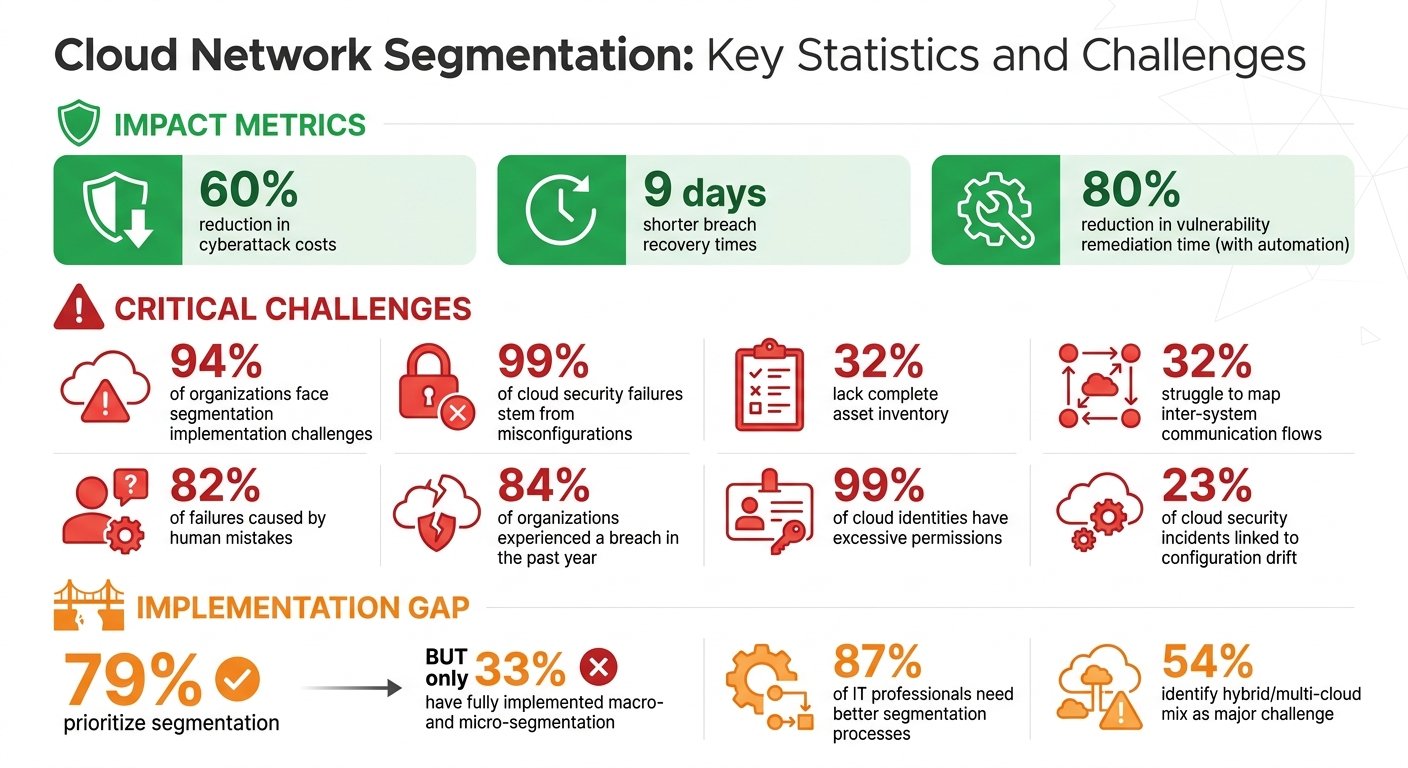
Cloud Network Segmentation: Key Statistics and Challenges
Main Security Challenges in Cloud Network Segmentation
Complexity in Hybrid and Multi-Cloud Environments
Managing security in a hybrid IT setup combining cloud platforms, containers, and legacy systems is no small feat. In Cisco’s survey, 54% of organizations named that mix as a challenge. Each cloud provider – AWS with IAM, Azure with RBAC, and GCP with its resource hierarchy – demands unique configurations. This variety increases the chances of mistakes, especially when security teams have to manually translate the same segmentation policies across multiple platforms.
Dynamic scaling adds another layer of difficulty. Static security measures struggle to keep up without automation, making it harder to maintain consistent protection. Cisco’s respondents flagged this too: 53% said keeping policies current with changing networks and applications was a struggle.
Lack of Asset Visibility and Discovery
Visibility issues are another significant hurdle for effective segmentation. In the same survey, 32% of organizations said they lacked visibility into the resources they needed to segment, and a further 32% could not identify legitimate communication flows between systems. Those two gaps compound: without an inventory you cannot draw a boundary, and without a traffic map you cannot draw one that does not break something.
This section previously carried an aphorism about not being able to secure what you don’t know about, credited to a Cisco product director but linked to one of our own articles rather than to anything he said. We could not find the quotation, so it has been removed. Our own piece on wireless network segmentation is still worth reading, and is now linked as what it is.
The practical consequence of poor visibility is that legacy systems fall off the radar, and security teams become reluctant to enforce controls on applications nobody fully understands. Fear of breaking something critical is a better predictor of an unsegmented network than any budget constraint.
Access Control and Misconfiguration Risks
Misconfigurations are a persistent problem in cloud security. Common issues like excessive permissions, open SSH/RDP ports, and hardcoded API keys create easy entry points for attackers, and they are mundane rather than exotic: a rule opened during an incident and never closed, a default left in place, a key committed to a repository.
On permissions specifically, one figure is worth citing properly. Microsoft’s 2023 State of Cloud Permissions Risks report found that identities use roughly 1% of the permissions granted to them, that more than half of identities have access to every permission and resource available, and that over 60% of identities show no activity at all (as summarised by Infosecurity Magazine). An earlier version of this article rendered that as “99% of cloud users, roles, services and resources are granted more permissions than they need”, which is a different claim dressed in the same number. What Microsoft measured is usage against grant, not a count of over-permissioned identities.
The practical point survives the correction, and is sharper for it. A reporting application given full write access when it only reads is not an unusual case; it is close to the default state of a cloud estate nobody has audited. Every unused permission is an option an attacker inherits along with the credential.
Operational Challenges in Cloud Network Segmentation
Performance Overhead and Management Burden
While segmentation enhances security, it can come at the cost of performance. Traffic moving between segments often passes through firewalls, which can introduce latency. Additionally, processes like deep packet inspection (DPI) require significant processing power, potentially slowing down the network compared to unsegmented setups.
Managing segmentation adds another layer of complexity. As applications evolve, security teams must continuously adjust policies and monitor connectivity. This challenge is even greater with microsegmentation, where policies are applied at the workload level. Tools like Cilium and NSX can help, but they demand specialized expertise.
Note a correction here. This paragraph previously claimed that 87% of IT professionals highlight the need for better segmentation processes. The 87% in Cisco’s report measures something else entirely: it is the share of organisations with full macro- and micro-segmentation that report fully aligned teams, against 52% of those without. That is a finding about organisational alignment following implementation, not about demand for better tooling, and presenting it as the latter was wrong.
On the upside, effective segmentation can prevent resource contention. By isolating traffic, it ensures that unrelated workloads don’t compete for bandwidth, reducing congestion. However, achieving this balance between security and efficiency requires strategies such as:
- Link aggregation (LACP): Boosts bandwidth to handle traffic demands.
- VLAN trunking: Cuts down on physical hardware needs.
- Automation tools: Solutions like Ansible or Terraform simplify configuration management and ensure consistency.
These operational hurdles make it even harder to meet compliance requirements.
Compliance and Validation Gaps
Beyond performance and management, regulatory compliance is another major challenge. Despite 79% of organizations calling segmentation a priority in Cisco’s survey, only 33% had fully implemented both macro- and micro-segmentation. Keeping policies consistent across multiple cloud environments is difficult, especially when traditional validation methods are too resource-intensive.
Cloud abstraction layers often obscure visibility, making it hard to confirm whether segmentation policies are functioning as intended. Manual audits and scans struggle to keep up with the fast pace of cloud changes, leaving organizations uncertain about their security posture. Shadow IT – unsanctioned cloud resources – further complicates matters, creating blind spots where policies can’t be enforced or audited.
Cisco’s report does attach one concrete outcome to finishing the job: organisations with both macro- and micro-segmentation fully implemented reported an average breach recovery of 20 days, against 29 days for those without. That nine-day difference is where this article’s original claim about “shortening breach recovery times by 9 days” came from, though it appeared with no source and no mention of what it was measured against. It is a self-reported survey figure from organisations that had already invested heavily in segmentation, so read it as an association rather than a promise.
A shift from periodic manual reviews to continuous automated validation is what most respondents said they wanted. One, an IT and telecoms respondent in the UK, put it this way in Cisco’s report:
“If I could change one thing about my organization segmentation approach, it would definitely be to further automate and integrate our segmentation tools and processes.”
Automation not only improves efficiency but also ensures compliance with standards like PCI DSS or HIPAA, even in rapidly evolving cloud environments.
Strategies to Address the Challenges
Zero-Trust Security Models
Zero-trust architecture operates on a simple but powerful idea: trust no one by default. Instead of assuming that users or systems within a network are safe, it scrutinizes every access request.
A key component of zero-trust is microsegmentation, which isolates individual workloads and user identities. By doing so, it hides them from unauthorized users and confines attackers to a single segment, limiting potential damage. The principle of least privilege further reduces risks by ensuring users and devices can only access the resources they absolutely need, and the Microsoft permissions figures above are a decent measure of how far most estates are from that. However, effective implementation requires careful preparation: mapping application dependencies and traffic patterns is essential for crafting workable security policies, which is exactly the work a third of Cisco’s respondents said they could not do. Adding Just-in-Time privileged access, which grants elevated permissions only when needed and requires multi-factor authentication, adds a further layer.
Automation and Cloud-Native Application Protection Platforms (CNAPPs)
Manual segmentation often struggles to keep up with the fast-moving nature of cloud environments. Cloud-Native Application Protection Platforms (CNAPPs) combine several security functions – cloud security posture management, workload protection, entitlement management – into a single tool.
This section used to make its case with three customer results: a named security manager at one company reporting a 70 to 80% cut in vulnerability remediation time with one product, a named engineer at another reporting a 20 to 25% cut in manual review time with a second product, and an anonymous “mid-size software company” raising a CIS benchmark score from 72% to 92% in three months. None could be verified, and all three read as vendor review-site testimonials rather than measurements. They have been removed.
What is worth saying without them: the value of a CNAPP is not that it makes anything faster in the abstract, it is that it removes the gap between a misconfiguration being introduced and someone noticing. Tag-based policies let security rules apply to new workloads automatically, so a resource created at 2am is segmented the same way as one created deliberately. Automated scans in CI/CD catch infrastructure-as-code errors before deployment, which is the only point at which fixing them is cheap. If a platform does not do those two things, the consolidation is a licensing convenience rather than a security improvement.
Regular Audits and Continuous Monitoring
Even with a sound segmentation design, regular audits and continuous monitoring are what keep it sound. The rapid pace of cloud changes leads to configuration drift, where unintended exposures accumulate quietly between reviews.
Centralizing flow logs, audit logs, and security events into a single platform can streamline investigations, eliminating the inefficiency of switching between multiple consoles. Real-time alerts for unusual traffic patterns or unauthorized access attempts provide an additional layer of protection. Mapping data flows between services and regions is equally important to identify hidden dependencies and shadow IT workloads.
Regular penetration tests and red team exercises can uncover weaknesses in segmentation controls before attackers exploit them. These audits are more than just a best practice – they’re increasingly required by compliance frameworks like PCI DSS, HIPAA, and GDPR, and some cyber insurers now ask for evidence of them at renewal.
Conclusion: Key Takeaways for Businesses
The gap between intent and implementation is the story here. Cisco’s survey found 79% of organisations calling segmentation a priority and 33% having finished it, with 94% hitting problems on the way. That gap is not caused by disagreement about whether segmentation works. It is caused by not knowing what is on the network, not knowing what talks to what, and not having a way to keep policies current as both change.
Which means the useful order of work is: inventory first, traffic map second, policy third. Buying a segmentation product before the first two exist produces a well-instrumented network that nobody dares enforce rules on.
Zero-trust architecture and automation tooling are how you hold the line once it is drawn. Neither substitutes for the mapping work, and vendors who imply otherwise are selling you the last step of a project as though it were the whole thing.
To complement these efforts, tools like BizBot can help you find software for the rest of the business – accounting, subscriptions, and the operational admin that otherwise eats the time you would rather spend on this.
FAQs
Where should I start with cloud segmentation in a hybrid environment?
To establish a secure and efficient hybrid cloud environment, begin by setting up clear segmentation boundaries. Use tools like virtual private clouds (VPCs), subnets, and security groups to isolate critical assets, which helps reduce potential attack surfaces.
Next, map out your network architecture to pinpoint vulnerabilities and ensure you can enforce traffic flow policies effectively. Incorporate monitoring tools to stay on top of compliance requirements and detect potential threats early.
Make sure to apply least privilege and zero-trust principles, which limit access to only what is necessary and verify every access request. Finally, document your entire strategy thoroughly – this ensures your setup remains secure and manageable over time.
How can I find hidden assets and map service-to-service traffic flows?
To uncover hidden assets and understand service-to-service traffic within a cloud environment, it’s essential to use a mix of approaches. Techniques like policy-based controls, virtual networks, and identity-informed policies can play a key role. Additionally, micro-segmentation is an effective way to isolate workloads, which helps minimize lateral movement if an incident occurs.
Start with flow logs rather than a product. Most cloud platforms will tell you what is actually talking to what if you turn logging on and wait a fortnight, and that record is the input every segmentation tool needs anyway. Automated tools then add continuous monitoring on top, improving visibility and surfacing assets nobody documented.
How do I reduce misconfigurations and permission sprawl without slowing the network?
To keep misconfigurations and permission sprawl in check while maintaining network performance, rely on automation and integrated tools. Automation helps enforce consistency, closing security gaps by addressing potential issues before they escalate. Automated policy enforcement makes it easier to scale operations, cut down on manual mistakes, and keep controls adaptive – without sacrificing speed or adding unnecessary complexity.
On permissions specifically, the cheapest win is usually removing what is demonstrably unused rather than redesigning roles from scratch. Given how little of a typical permission grant is ever exercised, that exercise removes a lot of risk for very little disruption.
More on this topic
Browse all 79 articles on Security & Compliance.