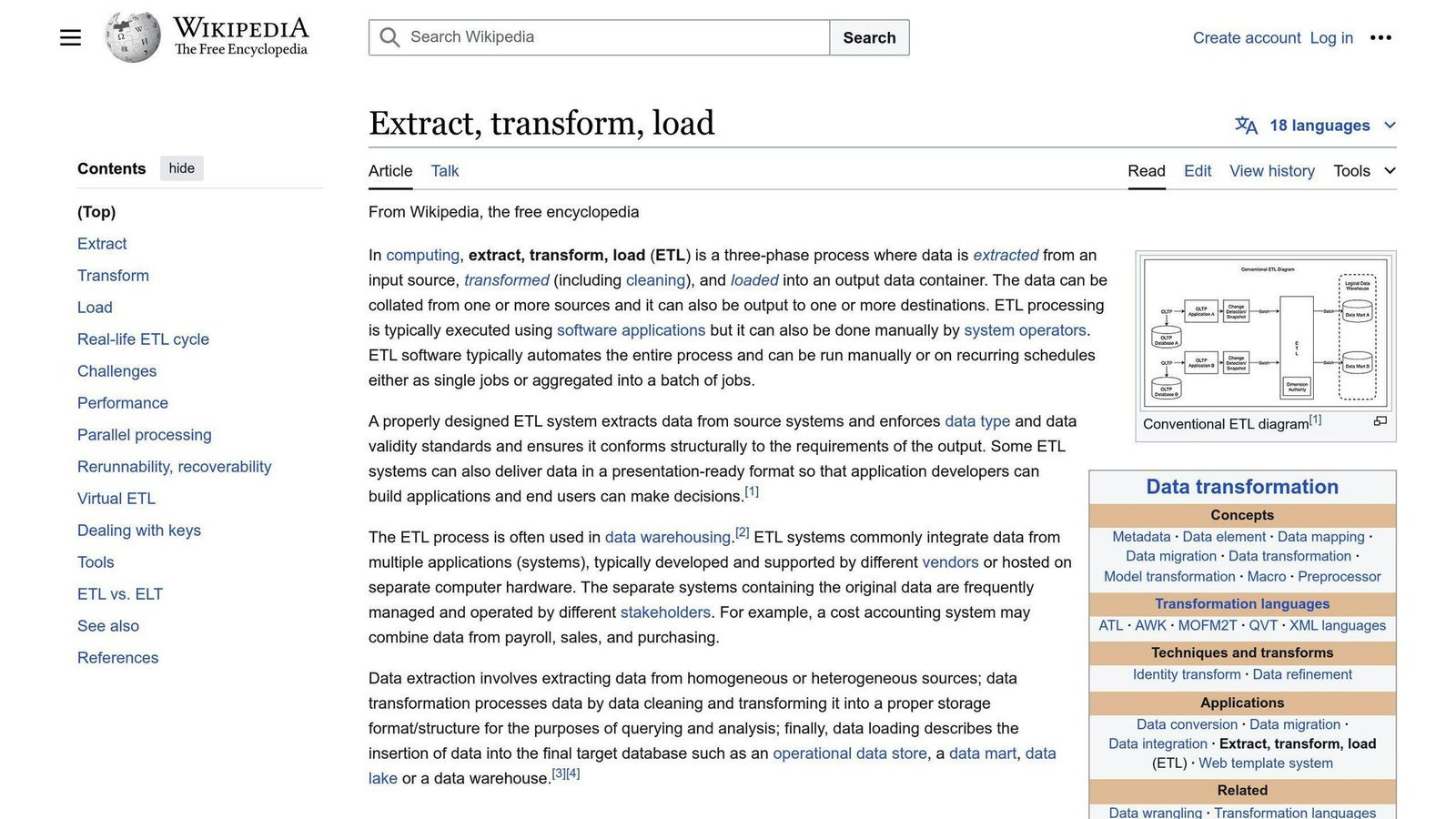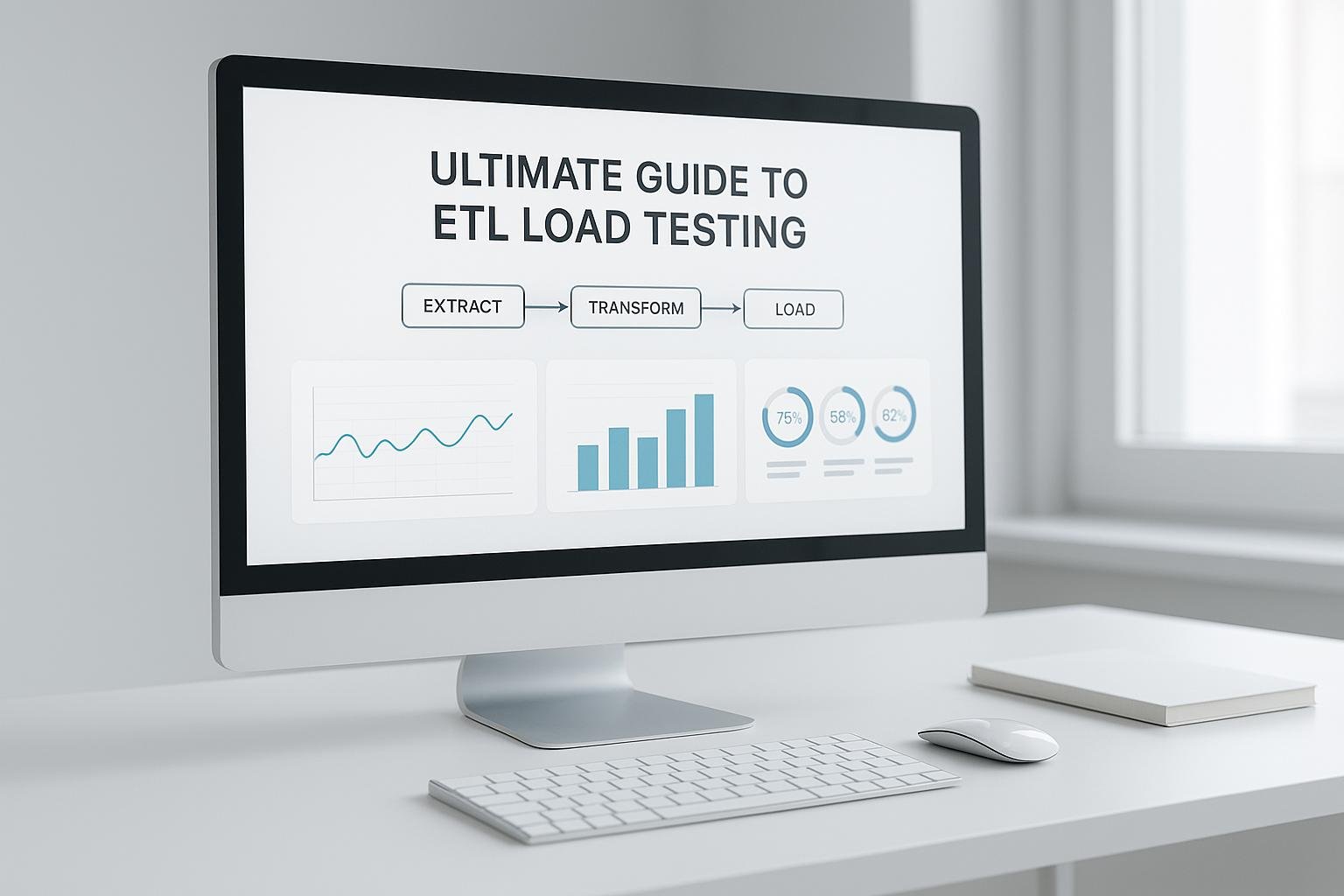
ETL (Extract, Transform, Load) is a process that combines data from multiple sources into a consistent dataset for analysis and decision-making. This guide covers the 5 key steps:
- Planning: Identify data sources, define transformation rules, and choose an ETL tool.
- Extraction: Create a staging area and validate data sources.
- Transformation: Cleanse, normalize, and apply business rules to the data.
- Loading: Load transformed data into the target system, ensuring data integrity.
- Monitoring: Set up monitoring tools and conduct regular audits.
By following ETL best practices, you can ensure efficient, scalable, and secure data integration processes.
ETL Components
| Component | Description |
|---|---|
| Extract | Retrieve raw data from various sources |
| Transform | Clean, standardize, and format data |
| Load | Load transformed data into the target system |
ETL Best Practices
| Best Practice | Description |
|---|---|
| Scalability and Performance | Implement parallel processing, data caching, and optimize storage |
| Data Quality and Compliance | Perform data profiling, validation, and cleansing; ensure regulatory compliance |
A well-implemented ETL system is what makes the rest of your reporting trustworthy. A badly implemented one produces confident numbers that are wrong, which is worse than no numbers at all.
Step 1: ETL Components
In this section, we’ll break down the core components of ETL: extraction, transformation, and loading. We’ll also explore the differences between ETL and ELT, and when to use each method.
ETL Definition
ETL (Extract, Transform, Load) is a process that combines data from multiple sources into a centralized data warehouse. This process provides a single source of truth for businesses, enabling informed decision-making.
Data Extraction
Data extraction is the first stage of the ETL process. During this phase, raw data is retrieved from various sources, such as databases, files, and applications. The extracted data can be structured or unstructured.
Data Transformation
In the transformation phase, raw data is cleaned, standardized, and formatted to match the target system’s requirements. This stage involves applying business rules and performing calculations to transform the data into a usable format.
Data Loading
The final stage of the ETL process is data loading, where the transformed data is migrated into the target system, such as a data warehouse or data lake. This stage involves ensuring data integrity and handling errors.
Here’s a summary of the ETL components:
| Component | Description |
|---|---|
| Extract | Retrieve raw data from various sources |
| Transform | Clean, standardize, and format data to match the target system’s requirements |
| Load | Load transformed data into the target system |
By understanding these core components of ETL, you’ll be better equipped to design and implement an effective ETL process that meets your business needs. In the next section, we’ll explore the planning phase of ETL, including identifying data sources, defining transformation rules, and choosing an ETL tool.
Step 2: Planning ETL
Identifying Data Sources
Before designing an ETL process, you need to identify the data sources that will be used. These sources can include databases, files, applications, and even social media platforms. Understanding the type and volume of data you will be handling is crucial to ensure that your ETL process is efficient and effective.
To identify data sources, follow these steps:
- Analyze business requirements to determine what data is needed
- Identify the systems and applications that generate or store the required data
- Determine the data formats and structures used by each source system
- Evaluate the data quality and integrity of each source system
Defining Transformation Rules
Once you have identified the data sources, you need to define the transformation rules that will be applied to the data. These rules determine how the data will be cleaned, standardized, and formatted to match the target system’s requirements.
To define transformation rules, follow these steps:
- Establish rules for data cleaning and validation
- Determine the data formats and structures required by the target system
- Apply business rules and calculations to transform the data
- Ensure data quality and integrity throughout the transformation process
Choosing an ETL Tool
Selecting the right ETL tool is critical to the success of your ETL process. The tool should be able to handle the volume and complexity of your data, as well as provide the necessary features and functionality to support your transformation rules.
When choosing an ETL tool, consider the following factors:
| Factor | Description |
|---|---|
| Data Volume and Complexity | Can the tool handle the volume and complexity of your data? |
| Data Formats and Structures | Does the tool support the data formats and structures required by your target system? |
| Transformation Rules and Business Requirements | Can the tool apply the necessary transformation rules and meet your business requirements? |
| Scalability and Performance | Is the tool scalable and can it perform efficiently? |
| Ease of Use and Maintenance | Is the tool easy to use and maintain? |
| Product lifecycle | Is the product still being developed, or is it in extended support with a migration deadline attached? |
Where the well-known tools actually stand
This category has consolidated hard, and two of the names most often listed as ETL tools are no longer what a reader would assume. Checked August 2026.
- Informatica PowerCenter is winding down. Standard support for PowerCenter ended on 31 March 2026. Informatica has published extended support running to 31 March 2027 and sustaining support to 2029. Informatica’s current platform is the Intelligent Data Management Cloud (IDMC). If you already run PowerCenter you have a migration project on a clock; do not start a new build on it.
- Talend is now a Qlik product. Qlik acquired Talend and the open-source Talend Open Studio was retired on 31 January 2024 — it is no longer hosted or updated. Talend 7.3 reached end of life on 30 November 2024. The current products are Qlik Talend Cloud and Talend Data Fabric. If a shortlist you inherited says “Talend Open Studio, free”, that option no longer exists.
- Apache Kafka is not an ETL tool. It is a distributed event streaming platform. Kafka Connect moves data in and out of it and Kafka Streams or a stream processor handles transformation, so Kafka can be the backbone of a pipeline. It is not a like-for-like alternative to Informatica or Talend, and listing it as one has misled people into scoping the wrong project.
None of these three publish list prices. Informatica and Qlik both quote on request, typically on a consumption or capacity meter with an annual commitment. Kafka itself is free under the Apache licence, but managed Kafka services bill on throughput, storage and retention, which is where the cost actually lands. Get a written quote against your own expected volumes before budgeting — a figure from someone else’s deployment will not transfer.
By carefully planning your ETL process, including identifying data sources, defining transformation rules, and choosing the right ETL tool, you can ensure that your data is accurately and efficiently transformed into a usable format for analysis and decision-making.
Step 3: Data Extraction
Data extraction is the process of pulling data from various sources and storing it in a staging area for further processing. This step is crucial in the ETL process as it lays the foundation for the transformation and loading of data.
Creating a Staging Area
A staging area is a temporary storage location where data is initially stored after extraction. It acts as a buffer zone between the source systems and the target system, allowing for efficient management of the extract process.
To create a staging area, you need to:
- Define the storage structure
- Allocate sufficient space
- Ensure data security and integrity
A well-designed staging area enables efficient data processing, reduces errors, and improves overall data quality.
Validating Data Sources
Data validation at the point of extraction is essential to ensure accuracy and reliability. It involves checking the data against a set of rules, constraints, and formats to detect errors, inconsistencies, and inaccuracies.
Data validation helps to:
- Identify and correct errors early in the process
- Improve data quality and reduce errors
- Increase confidence in the data
- Reduce the risk of data corruption or loss
Common data validation techniques include:
| Technique | Description |
|---|---|
| Data Profiling | Analyze data to understand its structure and quality |
| Data Cleansing | Remove or correct errors and inconsistencies in the data |
| Data Transformation | Convert data into a consistent format |
By creating a staging area and validating data sources, you can ensure that your data is accurate, complete, and reliable, setting the stage for successful transformation and loading.
Step 4: Data Transformation
Data transformation is a crucial step in the ETL process, where raw data is cleaned, standardized, and restructured to support business analysis needs. This stage is critical in ensuring that the data is accurate, consistent, and reliable for further analysis.
Cleansing and Normalization
Data cleansing involves identifying and correcting errors, inconsistencies, and inaccuracies in the data. This process helps to remove duplicates, fill in missing values, and correct formatting errors. Normalization is the process of standardizing data formats to ensure consistency across the data set.
| Technique | Description |
|---|---|
| Data Profiling | Analyze data to understand its structure and quality |
| Data Cleansing | Remove or correct errors and inconsistencies in the data |
| Data Standardization | Convert data into a consistent format |
Applying Business Rules
Applying business rules and logic to the data ensures that it aligns with organizational objectives and meets the requirements of the target system. This stage involves transforming the data into a format that is suitable for analysis and reporting.
Business rules can include:
- Data aggregations and grouping
- Calculations and derivations
- Data filtering and sorting
- Data validation and verification
Write the rules down somewhere outside the tool. Business logic that exists only inside a vendor’s visual designer is the single biggest reason migrations off that vendor run over — and, as the section above shows, migrations off these tools are now common.
Step 5: Data Loading
Data loading is the final stage of the ETL process, where transformed data is loaded into the target system, such as a data warehouse or a database. This stage is critical in ensuring that the data is accurately and efficiently transferred, and that it meets the requirements of the target system.
Full vs. Incremental Loading
When loading data, there are two primary approaches: full loading and incremental loading.
| Approach | Description |
|---|---|
| Full Loading | Load the entire dataset into the target system |
| Incremental Loading | Load only the changes made to the data since the last load |
Each approach has its advantages and disadvantages.
Advantages and Disadvantages
| Approach | Advantages | Disadvantages |
|---|---|---|
| Full Loading | Ensures data consistency and integrity | Time-consuming and resource-intensive, may lead to data duplication |
| Incremental Loading | Faster and more efficient, reduces data duplication | Requires careful tracking of changes, may lead to data inconsistencies |
Ensuring Data Integrity
Once the data is loaded into the target system, it is essential to ensure that it remains accurate, complete, and consistent. This involves implementing data validation and verification checks, as well as data quality control measures, to detect and correct any errors or inconsistencies.
Additionally, data backup and recovery procedures should be in place to ensure business continuity in the event of data loss or corruption.
By following best practices and using the right tools and techniques, organizations can ensure that their data is loaded efficiently and accurately, and that it remains a valuable asset that supports informed decision-making.
Monitoring ETL
Monitoring ETL processes is crucial to ensure data quality, identify issues, and optimize performance. This involves setting up monitoring tools and conducting regular audits.
Setting Up Monitoring Tools
To monitor ETL processes effectively, you need to set up the right tools. This includes:
| Tool | Description |
|---|---|
| Log Analysis | Collect and analyze log files to identify errors and performance issues. |
| Performance Monitoring | Track key performance indicators (KPIs) such as processing time and resource utilization. |
| Alert Systems | Set up alerts to notify teams of potential issues or errors. |
| Visualization Tools | Use dashboards and reports to provide a clear overview of ETL process performance. |
Regular ETL Audits
Regular ETL audits are essential to ensure that your processes remain efficient and effective. This involves:
| Audit Step | Description |
|---|---|
| Review Data Quality | Verify that data is accurate, complete, and consistent. |
| Optimize Performance | Identify bottlenecks and opportunities to improve processing times and resource utilization. |
| Update Transformation Rules | Ensure that business rules and data transformations are up-to-date and aligned with changing business needs. |
| Check Vendor Lifecycle | Confirm your tool version is still supported. Support dates move, and they move without a sales call to warn you. |
| Identify Areas for Improvement | Document lessons learned and areas for improvement to inform future development and optimization. |
By setting up monitoring tools and conducting regular audits, you can ensure that your ETL processes continue to meet the evolving needs of your organization and support informed decision-making.
ETL Best Practices
To ensure the smooth operation of your data integration processes, follow these ETL best practices.
Scalability and Performance
To improve scalability and performance, consider the following strategies:
| Strategy | Description |
|---|---|
| Parallel processing | Break down large datasets into smaller chunks and process them concurrently to reduce processing time. |
| Data caching | Implement caching mechanisms to store intermediate results, reducing redundant computations and speeding up subsequent runs. |
| Optimize storage | Choose appropriate compression techniques and storage formats tailored to your specific use case to optimize storage efficiency. |
Data Quality and Compliance
To ensure high data quality and compliance, implement the following best practices:
| Best Practice | Description |
|---|---|
| Data profiling | Analyze data characteristics to identify potential issues and opportunities for improvement. |
| Data validation | Validate data against predefined rules and constraints to ensure accuracy and consistency. |
| Data cleansing | Cleanse data to remove duplicates, correct errors, and fill in missing values. |
Additionally, ensure compliance with regulations such as GDPR by implementing strong data security measures, including encryption, access controls, and auditing.
By following these ETL best practices, you can ensure the reliability, efficiency, and security of your data integration processes, ultimately leading to better decision-making and business outcomes.
Conclusion
In this guide, we have walked you through the step-by-step process of implementing an ETL system. From understanding the components of ETL to planning, extracting, transforming, and loading data, we have covered the essential best practices to ensure a smooth and efficient data integration process.
Key Takeaways
By following the guidelines outlined in this article, you can:
- Ensure your ETL system is efficient and secure
- Prioritize data quality and compliance
- Continuously monitor and optimize your ETL process to meet the evolving needs of your organization
- Avoid building on a product that is already in extended support
Implementing a Durable ETL Process
A well-implemented ETL system is critical to any data-driven organization. The work that pays off is the unglamorous part: written transformation rules, a real staging area, monitoring that alerts a human, and a periodic check that your tooling is still supported.
We hope this guide has provided you with a solid foundation for understanding the ETL process and has equipped you with the knowledge and best practices necessary to succeed in your data integration work.
FAQs
What is the ETL design process?
The ETL design process is a series of steps that ensure a smooth and efficient data integration process. It involves identifying data sources, defining transformation rules, and choosing an ETL tool. The process then involves data extraction, transformation, and loading into a target system, followed by monitoring and optimization.
What are the basic ETL tasks?
The basic ETL tasks are:
| Task | Description |
|---|---|
| Extract | Retrieve data from various sources |
| Transform | Clean, standardize, and format data to match the target system’s requirements |
| Load | Load transformed data into a target system, such as a data warehouse or database |
Additionally, ETL tasks may involve data cleansing, data validation, and data quality checks to ensure that the data is accurate and reliable.
Is Talend Open Studio still free to download?
No. Qlik retired the open-source Talend Studio on 31 January 2024 and no longer hosts or updates it. The supported options are Qlik Talend Cloud and Talend Data Fabric, both commercial. Older guides that recommend Talend Open Studio as the free entry point are out of date.
More on this topic
Browse all 53 articles on Data & Analytics.