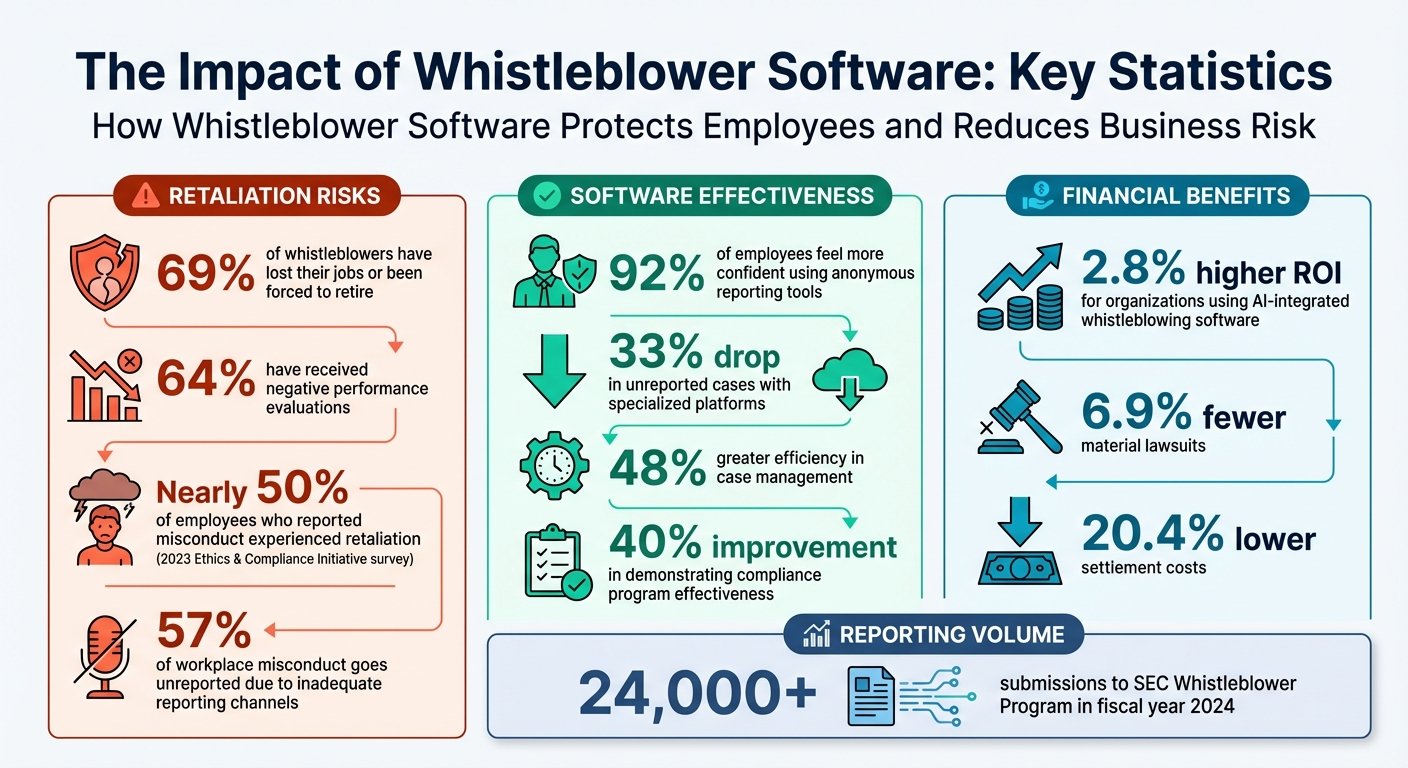
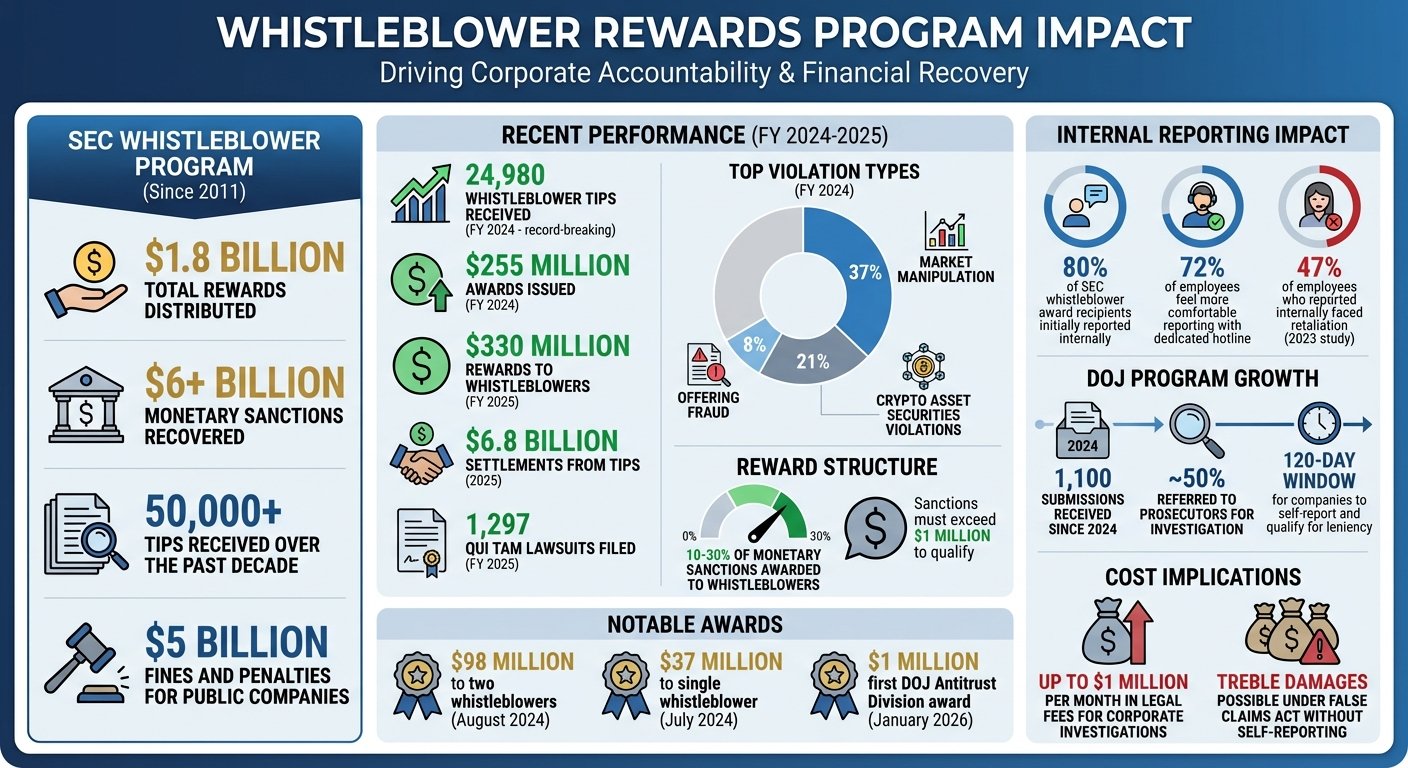
Whistleblower channels are secure systems that let employees report workplace issues anonymously. Here’s what you need to know:
- Purpose: Allow safe reporting of fraud, safety violations, harassment, and other serious problems
- Legal requirement: Many countries now require companies to have whistleblower channels
- Key components:
- Multiple reporting methods (online, phone, in-person)
- Strict confidentiality protections
- Clear process for handling reports
- Training for employees on how to use the system
Benefits:
- Catch problems early before they become major issues
- Improve workplace culture and trust
- Avoid legal and financial risk from unreported violations
Setting up a system:
- Choose secure reporting tools
- Create clear policies
- Train employees thoroughly
- Protect whistleblower identities
- Investigate reports promptly
- Take action on valid concerns
One editorial note. This article previously carried several statistics and quotations that could not be traced to any source, including a quotation attributed to a named attorney at a firm where no such person appears to work. Those have been removed. The claims that survived are linked to their originals below.
Main Parts of Whistleblower Channels
Whistleblower channels are more than a hotline. They are systems that protect both employees and the company. Here is what makes them work.
What Can Be Reported
Think of a whistleblower channel as an inbox for serious matters, not for the broken coffee machine. The usual categories:
- Financial misconduct, such as falsified accounts
- Legal violations, such as insider trading
- Safety breaches
- Harassment and discrimination
- Abuse of managerial authority
Retaliation against people who raise these issues is common enough to be measured. In fiscal year 2019 the U.S. Equal Employment Opportunity Commission received 39,110 retaliation charges under the statutes it enforces, according to its own charge statistics – more than half of all charges filed that year. Retaliation is the single most-alleged basis in EEOC filings, which tells you what employees are actually afraid of.
Laws and Rules
Setting up a whistleblower channel is often a legal requirement, not just good practice:
- Sarbanes-Oxley Act (SOX): U.S. public companies must provide a way to report accounting concerns anonymously.
- EU Whistleblower Directive: EU companies with 250 or more employees needed internal reporting channels by December 2021; those with 50 to 249 employees had until December 2023.
- Dodd-Frank Act: This U.S. law pays awards to whistleblowers who report securities violations to the SEC.
Under Article 9 of the EU Directive, organisations must:
1. Acknowledge receipt of a report within seven days
2. Provide feedback within three months
3. Protect the reporter’s identity
Ways to Report Issues
A whistleblowing programme needs more than one route in. Here is how employees can raise workplace problems:
Online Reporting Tools
Online platforms now handle most corporate reporting. They are secure, available around the clock, and often anonymous:
- Reports can be filed any time, from anywhere
- Anonymity lowers the barrier to speaking up
- Some platforms support anonymous two-way messaging between reporter and investigator, so follow-up questions are possible without unmasking anyone
That last feature matters more than it sounds. An anonymous report with no way to ask a clarifying question is frequently unactionable. AllVoices is one example of a platform built around anonymous two-way conversation.
Phone Lines and Outside Help
Online tools are popular, but the older methods still work. Many companies run a dedicated hotline, and some outsource intake to a specialist provider.
Employees can also go outside the company. In the U.S., safety concerns can be reported to a local OSHA office, part of the Department of Labor, which will discuss the concern and explain the process.
This section previously claimed that hotlines designed by workplace safety specialists generate twelve times more reports than other tools. There was no study behind it and it has been removed. What genuinely drives report volume is more mundane: whether employees believe the channel is confidential, whether they have seen a report acted on, and whether managers have visibly refrained from retaliating.
In-Person and Paper Reports
Some people prefer a conversation or a paper trail:
- Suggestion boxes, still used in some workplaces
- Face-to-face meetings with HR or management
- Written complaints on paper
The U.S. Department of Justice accepts in-person and written reports at local Office of Inspector General locations.
The practical point is to offer several routes. People who will not fill in a web form will sometimes phone, and vice versa.
Keeping Information Safe
Whistleblowing carries real personal risk. Companies need to protect both the reporter’s identity and the data itself.
Protecting Reporter Privacy
Regulators set the tone here. The U.S. Securities and Exchange Commission states:
“The SEC treats all tips, complaints and referrals as confidential and nonpublic, and does not disclose such information to third parties, except in limited circumstances authorized by statute, rule, or other provisions of law.”
The Internal Revenue Service takes the same line:
“The IRS takes the protection of whistleblower identity very seriously. We protect against the disclosure of a whistleblower’s identity, and even the fact that they have provided information, to the maximum extent that the law allows.”
Backing that up in practice comes down to three things.
Encryption. Italy’s data protection authority fined Bologna’s Marconi Airport €40,000 over failings in its whistleblowing platform, including inadequate protection of reporters’ data. Encrypt in transit and at rest, and the consequences of a breach shrink considerably.
Genuine anonymity. Some platforms accept reports with no name and no IP logging at all. Check what your vendor actually retains rather than what the marketing page implies.
Tight access control. Restrict visibility of reports to a named, small group – usually a compliance function – and log every access.
None of this eliminates the risk. A study by Bradley University’s Center for Cybersecurity, conducted with the National Whistleblower Center, found that nearly two-thirds of the whistleblowers surveyed experienced some form of retaliation. Stephen M. Kohn, co-founder of the National Whistleblower Center, sets out the consequence on the centre’s confidentiality page:
“Confidentiality is a critical issue for whistleblowers. It is our experience that most employees will be afraid to blow the whistle unless they know that their identity will be protected.”
His practical advice to individuals: stay anonymous, and take legal advice before speaking.
For companies:
- Encrypt the reporting system end to end. No exceptions.
- Train staff on confidentiality, and make clear that identifying a whistleblower is a disciplinary matter.
- Audit the system regularly, including who has accessed what.
- Consider an external platform that specialises in this, rather than a shared inbox.
How Reports Are Handled
When a report arrives, a defined sequence should follow:
Report Review Steps
1. Initial Assessment
Acknowledge within seven days. In the EU this is a legal deadline, not a courtesy.
A team from HR, legal, or compliance assesses:
- Does this fall within the whistleblowing policy?
- How serious is it?
- Do we need external investigators?
2. Gathering Information
Collect evidence and speak to witnesses, while keeping the reporter’s identity contained. If the allegation touches employment law, senior management, or anything that could become litigation, take legal advice before you start interviewing. A badly run internal investigation can create liability that the original complaint never would have.
3. The Investigation
Work to a written plan covering scope, the questions to be answered, timeline, and budget. Move quickly, before recollections harden.
4. Document Everything
Every interview, every piece of evidence, every decision. If the matter reaches a tribunal or court, the contemporaneous record is what you will be judged on.
5. Reach a Conclusion
Determine whether the allegation is substantiated and how serious it is.
6. Taking Action
Where wrongdoing is found: discipline, policy change, or training, depending on cause.
7. Feedback
The EU Directive gives three months to report back to the whistleblower on what was found and what is being done, within the limits of confidentiality.
8. Learn and Improve
Ask what allowed the problem to occur, whether the intake process worked, and whether employees believe it is safe to use.
Running a Good Reporting System
A whistleblower programme is only as good as employees’ willingness to use it. Here is what that takes.
Rules and Training
Write clear policies. Your whistleblower policy should state:
- What to report
- How to report (phone, email, web)
- Who handles reports
- How investigations work
- How retaliation is prevented and punished
Train properly. Handing out a policy document is not training:
- Work through realistic reporting scenarios
- Teach managers what to do when someone raises a concern directly
- Explain how investigations work
- Be explicit about the no-retaliation rule
Make reporting easy.
1. Multiple channels: phone, web form, in person.
2. Allow anonymous reports: The Association of Certified Fraud Examiners’ 2024 Report to the Nations found that tips were the most common way occupational fraud is detected, accounting for 43% of cases – well ahead of internal audit or management review. Most of those tips come from employees, and anonymity is what makes them possible.
3. Always available: problems do not wait for office hours.
Build trust.
- State plainly that retaliation is not tolerated, then act on it when it happens
- Acknowledge people who raise concerns
- Share anonymised examples of reports that led to change
Measure it. Track report volume and type, investigation outcomes, and – through staff surveys – whether people believe the system is safe to use. A programme that receives no reports is usually a programme nobody trusts, not a clean company.
Setting Up Your System
Choosing the Right Tools
When evaluating whistleblowing software:
- Multiple Reporting Channels: secure web intake, phone hotlines, text, and mobile. Check whether hotline coverage is genuinely 24/7 and whether it uses live operators or voicemail.
- Anonymity and Security: non-negotiable. WeMoral is one option built around anonymous reporting.
- Ease of Use: Whistle Willow is a lightweight option that is quick to set up.
- Compliance: OneTrust covers whistleblowing as part of a broader compliance suite.
- Customization: Vispato allows the reporting portal to be branded.
On implementation:
1. Risk Assessment – establish which whistleblower laws apply to you. Headcount and jurisdiction drive most of the requirements.
2. Documentation – write down how to submit a report and make it genuinely easy to find. A policy filed in an intranet folder nobody visits is not a channel.
3. Training – for employees and, separately, for managers.
4. Vendor Selection – this article previously quoted a benchmark of one dollar per employee per year for hotline services. It had no source and has been removed. Pricing in this category varies widely with headcount, language coverage, whether live operators are included, and whether case management is bundled. Get two or three quotes on your actual employee count rather than working from a rule of thumb.
5. Continuous Improvement – review volume, resolution times, and outcomes, and change the process when they disappoint.
BizBot‘s HR Tools
To be clear about what BizBot is: a directory of business administration software, not a whistleblowing platform. An earlier version of this article said BizBot’s own platform handled anonymous reports and investigations. It does not, and that claim has been removed.
What the directory can help with:
HR management systems: listings including Bizneo HR, for organisations that want the whistleblowing process to sit alongside the rest of their HR stack rather than in isolation.
Comparison by requirement: filtering tools by the compliance obligations that apply to you, so you are not evaluating enterprise platforms when you have sixty staff.
Subscription management: tracking what you spend across compliance and HR tools, which is where duplicate coverage usually hides.
Summary
Whistleblower channels matter for compliance and for finding problems early. The evidence behind that:
Fraud Detection: tips are the leading detection method for occupational fraud, at 43% of cases in the ACFE’s 2024 Report to the Nations.
Legal Compliance: the EU Whistleblower Directive required internal channels for companies over 250 employees by December 2021, and for those with 50 to 249 by December 2023.
Financial Scale: a 2018 study for the Greens/EFA group in the European Parliament put the annual cost of corruption to EU GDP at between €179 billion and €950 billion, with the authors’ own central estimate at around €904 billion. Those are macro estimates with wide error bars, not a figure any single company can claim to reduce.
Retaliation is still the norm: nearly two-thirds of surveyed whistleblowers experienced some form of retaliation, per the Bradley University and National Whistleblower Center research cited above. A channel is necessary but not sufficient; what employees watch is what happens to the first person who uses it.
For a workable system:
- Use multiple reporting channels (online, phone, in-person)
- Keep reports confidential and protect the reporter
- Act on every report within the deadlines
- Train employees on ethics and on how to report
Several quotations from named executives and consultants that used to close this article have been removed because they could not be traced to any original publication. The argument does not need them.
More on this topic
Browse all 79 articles on Security & Compliance.