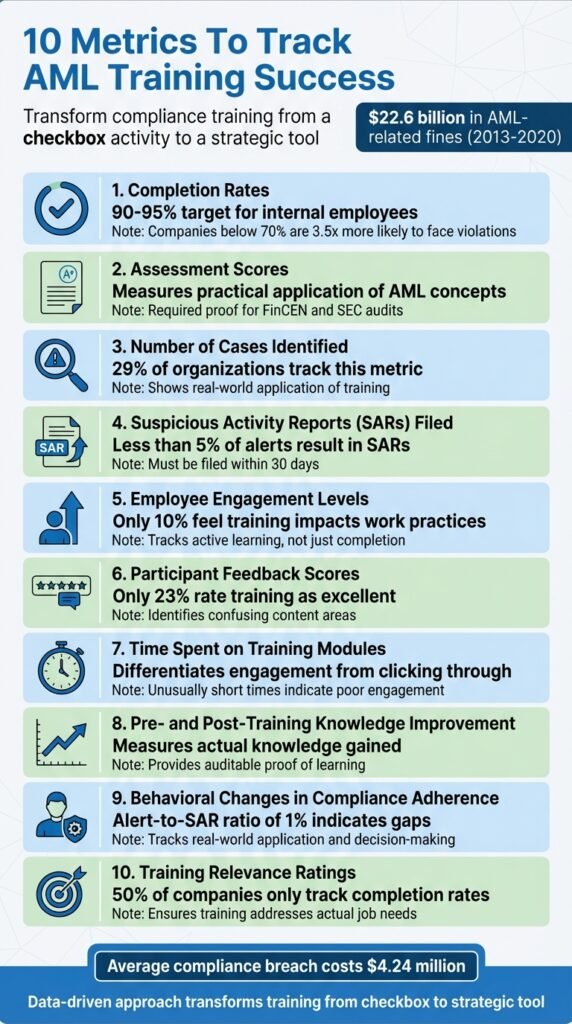
Anti-Money Laundering (AML) training is mandatory for financial institutions, but how do you measure its success? Tracking the right metrics tells you whether your training is working, rather than just whether people clicked through it. Here are the ten metrics worth watching:
- Completion Rates: Measures participation but doesn’t guarantee knowledge retention.
- Assessment Scores: Tests understanding and practical application of AML concepts.
- Number of Cases Identified: Tracks how well employees detect suspicious activities.
- Suspicious Activity Reports (SARs) Filed: Reflects timely and accurate reporting.
- Employee Engagement Levels: Shows how actively employees interact with training.
- Participant Feedback Scores: Gauges clarity and relevance of training content.
- Time Spent on Training Modules: Indicates engagement and potential content issues.
- Pre- and Post-Training Knowledge Improvement: Measures learning progress.
- Behavioral Changes in Compliance Adherence: Observes real-world application of training.
- Training Relevance Ratings: Assesses how useful the content is for employees’ roles.
An editorial note. This article has been substantially corrected. It previously carried around a dozen statistics with no attribution – a total for US AML fines between 2013 and 2020, percentages for how many employees find compliance training useful, a claimed multiplier linking low completion rates to regulatory violations, and a case study about an unnamed company saving $3.7 million. None could be traced to a source, and all have been removed. It also cited a $4.24 million figure as the average cost of a “compliance breach”; that number is IBM’s 2021 average cost of a data breach, which is a different thing entirely and has no bearing on AML penalties. Several quotations attributed to named people at named firms could not be found in any published source and have been removed too. What survives is the framework, which did not depend on the numbers.
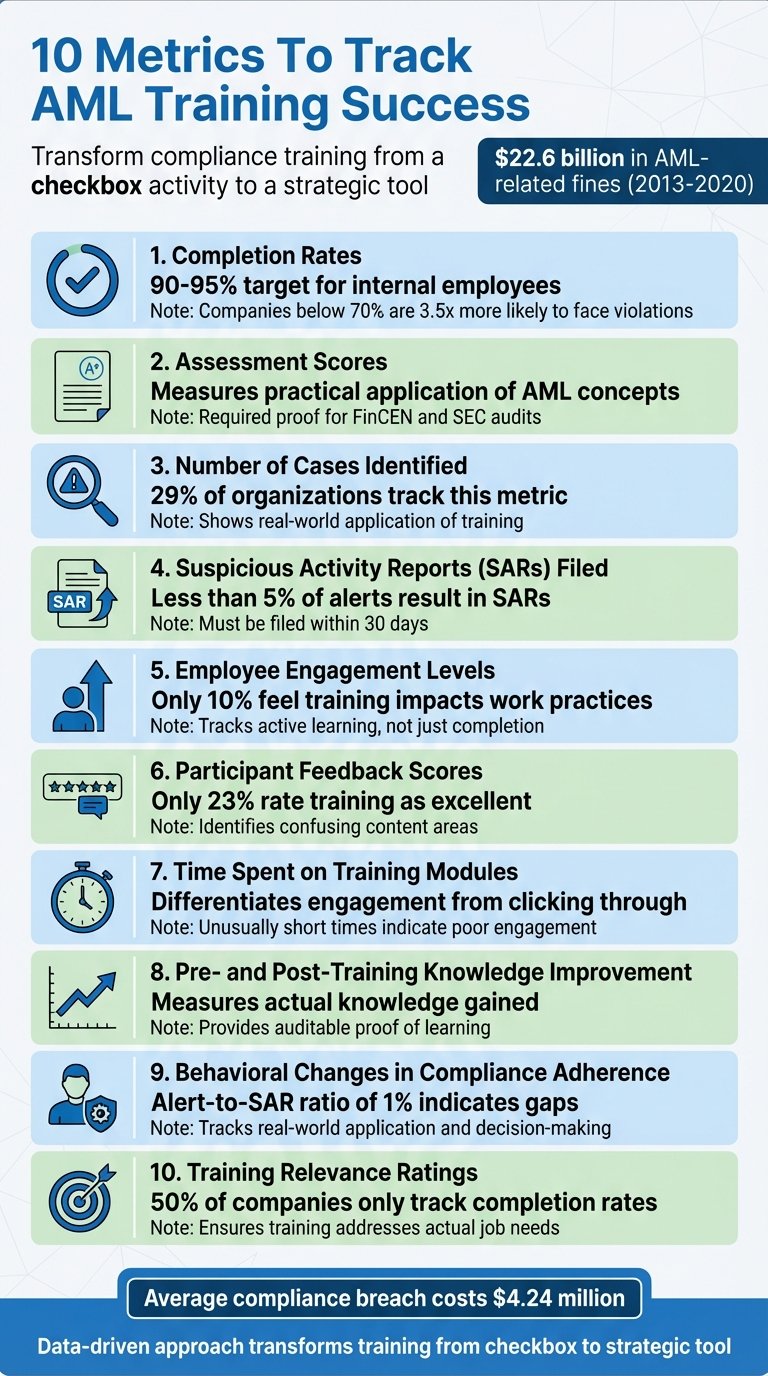
10 Key Metrics to Track AML Training Success
1. Completion Rates
Completion rates represent the percentage of employees who finish AML training. It is the metric most programmes start with, because it is the easiest to collect.
Effectiveness in Measuring Training Outcomes
Completion rates measure attendance, not learning. They tell you nothing about whether anyone retained the material or would recognise a red flag in a live transaction. Treat them as a hygiene check: if completion is low, you have a problem, but high completion does not mean you don’t.
Relevance to AML Compliance Goals
Keeping records of completion matters for regulatory audits regardless of what the number proves about learning. Examiners ask who was trained, on what, and when, and a programme that cannot answer has a finding whatever else it does well.
Set an internal target and investigate the exceptions rather than chasing a headline percentage. Persistent non-completers in high-risk roles are the ones worth a conversation.
Ease of Tracking and Reporting
Any modern learning management system reports this automatically. Single sign-on, automated reminders and mobile access all reduce the administrative chasing, which is usually where completion actually gets won.
Impact on Overall Compliance Performance
Combine completion with assessment results and observed behaviour. On its own it is the compliance equivalent of counting how many people walked into the room.
2. Assessment Scores
Assessment scores indicate whether employees understood the material. Low scores flag either a knowledge gap or a badly written module – and it is worth working out which before you blame the staff.
Effectiveness in Measuring Training Outcomes
Well-designed assessments test application, not recall. Scenario questions – identify the red flags in this transaction, decide whether this warrants a SAR – tell you more than definitions. Mixing question formats makes answer-sharing harder and comprehension easier to see.
Relevance to AML Compliance Goals
Regulators including FinCEN and the SEC expect firms to demonstrate that training is effective, not merely delivered. Assessment data is the most direct evidence available.
This is becoming more pressing for some firms: under FinCEN’s investment adviser AML rule, U.S. Registered Investment Advisers face a compliance date of January 1, 2028 for full Bank Secrecy Act obligations, including staff training and independent testing. Firms in scope should be building the evidence trail now rather than in 2027.
Ease of Tracking and Reporting
Learning management systems report average scores, pass rates, attempts per module and time spent. Real-time data lets compliance officers see which teams need support.
Impact on Overall Compliance Performance
Transaction monitoring systems generate a very high proportion of false positives – the great majority of alerts in most institutions close without a filing. That is exactly why trained analysts matter: the system narrows the field, people decide. Update quizzes as sanctions regimes and beneficial ownership rules change, or the assessment measures last year’s programme.
3. Number of Cases Identified
The number of cases identified shows whether employees are applying training to detect suspicious activity.
Effectiveness in Measuring Training Outcomes
When employees spot and escalate suspicious transactions, training has translated into behaviour. Quantity alone is not the goal, though. If most escalations are false positives, that points to training that has taught alarm rather than judgement, and the fix is more discrimination between genuine risk and unusual-but-innocent activity.
A note on sourcing: this section previously cited a PricewaterhouseCoopers study for a figure on how many organisations track post-training SAR volumes. The citation linked to another BizBot article rather than to PwC, and we could not locate the underlying study. The figure has been removed. Linking a claim to our own coverage is not a citation, and where we have done it, we are correcting it.
Relevance to AML Compliance Goals
Demonstrating that staff identify and escalate cases shows examiners the programme produces outcomes rather than certificates. That argument stands without a fines total attached to it.
Ease of Tracking and Reporting
Case management systems link monitoring alerts to case creation with an audit trail: who flagged what, when, and how it resolved. You can categorise by typology, compare identification rates before and after training, and track how many cases convert to filings.
Impact on Overall Compliance Performance
If employees consistently miss a particular typology – structuring, unusual wire patterns, third-party payments – that is a training target, and a specific one. Generic refreshers rarely fix specific blind spots.
4. Suspicious Activity Reports (SARs) Filed
SAR filings show whether identification turns into reporting. That is the step regulators actually measure.
Effectiveness in Measuring Training Outcomes
The SAR conversion rate – filings as a share of alerts – indicates how well staff separate real concerns from noise. Conversion is low across the industry by design; the question is whether yours is low because the monitoring thresholds are wide or because analysts are missing things.
A rising filing count after training suggests improved awareness. It can also suggest over-reporting, which carries its own costs and dilutes the intelligence value of the filings. Read the number alongside quality review results.
This section previously attributed a statement about SAR volumes to “KyrosAML” with a link pointing at another BizBot article. The link has been removed.
Relevance to AML Compliance Goals
Under the Bank Secrecy Act, SARs must generally be filed within 30 calendar days of initial detection of the facts constituting the basis for filing, with a limited extension where no suspect has been identified. Many firms set an internal target inside that window to leave room for review.
Timeliness is a standard examination point. A programme filing consistently at day 29 will be asked why.
Ease of Tracking and Reporting
Case management dashboards track filing timeliness, conversion rates and alert patterns against your own history.
Impact on Overall Compliance Performance
The alert-to-SAR ratio, read together with quality review scores and assessment results, tells you where training is landing and where it isn’t.
5. Employee Engagement Levels
Engagement reflects how actively employees work through training rather than click through it.
Effectiveness in Measuring Training Outcomes
Measure it with both numbers – time on module, voluntary enrolments, interaction with scenarios – and survey responses. Suspiciously fast completions are the clearest signal of disengagement, and are worth investigating individually rather than in aggregate.
Relevance to AML Compliance Goals
Engaged staff apply AML rules to messy real cases; disengaged staff apply them to the quiz. Regulators including FINRA and FinCEN increasingly want evidence of comprehension, not just delivery. Voluntary uptake of optional advanced modules is a useful signal of a functioning compliance culture.
Ease of Tracking and Reporting
Learning platforms track time on page, completion, and responses to interactive content, which together identify rushed completions. Scenario simulations produce richer engagement data than multiple choice.
Impact on Overall Compliance Performance
Where engagement is low by department, treat it as an operational risk indicator and look at what else is happening in that team.
6. Participant Feedback Scores
Effectiveness in Measuring Training Outcomes
Feedback tells you whether the material was clear, relevant and usable. Post-training surveys asking what employees learned and how they would apply it are more informative than satisfaction ratings.
Surveys are particularly good at finding the confusing parts – Customer Due Diligence procedures are a perennial one – so those sections can be rewritten rather than repeated.
Relevance to AML Compliance Goals
Ask participants to rate how well the training prepared them for specific tasks: identifying suspicious transactions, filing SARs, conducting KYC. Role-specific ratings show where content misses the actual job.
Ease of Tracking and Reporting
Collect feedback twice – immediately after training, and again several weeks later once people have tried to apply it. The second round is the useful one. Keep it anonymous; compliance feedback given under a name is not feedback.
Impact on Overall Compliance Performance
Act on it visibly. Employees who see their comments change the next module keep responding; those who don’t, stop.
7. Time Spent on Training Modules
Time on module adds context to completion. A 30-minute module finished in two minutes was not completed in any meaningful sense. Equally, learners taking twice the expected time usually indicates content that is unclear rather than students who are slow.
Distinguish active engagement from a tab left open. Module-level timing localises the problem better than course-level totals.
Relevance to AML Compliance Goals
Regulators expect evidence that staff engaged with high-risk topics such as SAR filing and Customer Due Diligence. Time data is auditable evidence that training was substantive. It also surfaces integrity problems: very short completion times paired with high scores suggests answers are circulating.
Ease of Tracking and Reporting
Learning platforms log this automatically and can flag unusual patterns by team or individual. Set an expected duration per module so “unusual” has a definition.
Impact on Overall Compliance Performance
Completion is not comprehension, and comprehension is not behaviour. Time metrics move you one step along that chain; assessments and case data carry you the rest of the way.
8. Pre- and Post-Training Knowledge Improvement
A pre-training test establishes a baseline; a post-training test measures the change. The difference is the closest thing to a direct measure of what the training did.
Effectiveness in Measuring Training Outcomes
Score movement by topic pinpoints where the programme works. If staff score well on Customer Due Diligence and poorly on SAR filing, you know what to rebuild. Aggregate scores hide exactly that detail.
Relevance to AML Compliance Goals
Demonstrable knowledge improvement is auditable proof that you are educating staff on detection, risk-based onboarding and internal escalation. In jurisdictions with explicit AML training mandates – the UAE’s Federal Decree-Law No. 20 of 2018 among them – this evidence is part of the legal obligation, not a nice-to-have.
Ease of Tracking and Reporting
Platforms collect the data and report by module, team and individual. Pair it with anonymous surveys asking whether the training felt applicable.
Impact on Overall Compliance Performance
The value comes from linking score improvement to outcomes: better SAR narratives, fewer escalations that go nowhere. Spaced reinforcement – short quizzes weeks later – does more for retention than lengthening the original session.
9. Behavioral Changes in Compliance Adherence
Passing a test does not mean applying the knowledge. What matters is whether people recognise red flags and follow protocol in live work.
Effectiveness in Measuring Training Outcomes
Front-line managers are the best observers here: how staff handle an ambiguous transaction, how thoroughly they run due diligence, whether they escalate when unsure. Scenario assessments and mock audits give you a structured version of the same observation.
Near-miss tracking is underused. Cases that were nearly missed, and caught late, tell you more about training gaps than cases handled correctly.
Relevance to AML Compliance Goals
Behavioural measures connect training directly to programme quality: SAR narrative quality, thoroughness of due diligence, proportion of escalations with substance behind them.
Ease of Tracking and Reporting
This is the hardest metric to collect, because it comes from manager observation, incident reports, peer feedback and near-miss logs rather than a dashboard. A no-blame reporting culture is a precondition; people do not report their own near-misses to a function that punishes them.
Impact on Overall Compliance Performance
Fewer policy violations, better SAR narratives, fewer wasted investigations. Combine the quantitative picture with interviews and focus groups, which surface the reasons behind the numbers.
10. Training Relevance Ratings
Relevance ratings ask whether the content matches what employees actually do. Test scores show what people know; relevance ratings show whether that knowledge fits their job.
Effectiveness in Measuring Training Outcomes
Generic AML training delivered to a retail branch, a correspondent banking team and a compliance analyst will be wrong for at least two of them. Rating relevance by role is how you find out which.
Relevance to AML Compliance Goals
Relevance separates a programme that changes behaviour from one that discharges an obligation. Both satisfy the training record; only one reduces risk.
Ease of Tracking and Reporting
Survey after training and again after employees return to their normal work. Keep it anonymous, and segment results by role and department to expose where content does not match operational risk.
Impact on Overall Compliance Performance
Training tuned to your actual customer base and transaction types produces detection tuned to the same. Refining content on the basis of role-level feedback is the cheapest improvement available to most programmes.
Conclusion
Tracking these metrics turns AML training from an annual obligation into something you can manage. Completion rates tell you who turned up, assessment scores tell you who understood, and behavioural change tells you whether any of it reached the desk. Only the third one matters to a regulator examining whether your programme works, and it is the one most firms do not measure.
Correlating training data with outcomes – cases identified, SAR quality, filing timeliness – produces the auditable evidence that FINRA and FinCEN expect. That correlation is also the honest test of whether the training budget is doing anything.
Practical next steps: tailor content by role, run mock audits rather than only quizzes, and track near-misses. And be sceptical of vendor statistics in this category, including percentages quoting how ineffective everyone else’s compliance training is. As the note at the top of this article records, a good number of them do not survive being looked up.
FAQs
What’s the best mix of metrics to prove AML training works?
Use a combination: completions for participation, knowledge retention for comprehension, behavioral change for application, incident and near-miss data for risk reduction, and compliance outcomes such as SAR timeliness and quality. No single one of these is sufficient, and completion alone is the weakest of the five.
How do I link training results to SAR quality and timeliness?
Score SAR narratives for clarity and completeness, and measure elapsed days from detection to filing. Compare both before and after a training intervention, using the same scoring rubric. If narrative quality improves and filing time falls, you have a defensible link; if only volume rises, you may just have taught over-reporting.
How can I measure real behavior change after AML training?
Combine manager observation of live casework, scenario assessments, incident and near-miss reports, and the quality of escalations. Behaviour is the hardest thing to measure and the only thing that reduces risk, which is an uncomfortable pairing but not one you can avoid.
More on this topic
Browse all 79 articles on Security & Compliance.