Managing security across AWS, Azure, and Google Cloud is complex. Multi-cloud security automation centralizes tools and processes so protection and risk management stay consistent across providers. Here’s what you need to know:
- Why Automation Matters: Manual review does not scale to thousands of resources changing daily. Automation catches misconfigurations before they reach production.
- Key Tools:
- CSPM: Monitors cloud configurations to prevent risks like public storage or unencrypted data.
- CIEM: Manages permissions across clouds, addressing over-privileged accounts.
- CWPP: Protects workloads like containers and VMs with runtime monitoring.
- Centralized Security: Combine native tools with open-source options for unified monitoring.
- Policy Enforcement: Use Policy-as-Code to define rules once and apply them across providers, covering standards like GDPR and HIPAA.
An editorial note on this article. It previously carried roughly two dozen statistics – percentage reductions in misconfigurations, detection-time improvements, adoption forecasts, five-year platform cost ranges, and download counts – with no source attached to any of them. Several appeared to be distorted versions of real research: a well-known Gartner prediction about cloud security failures being the customer’s fault had been restated as a claim about misconfiguration specifically, and a Microsoft finding about identities using a small fraction of their granted permissions had become a claim about permissions never being used at all. None could be verified against a primary source, so they have been removed rather than left with vaguer attribution. Five quotations, including two credited to an “editorial team” and one to a person with no stated employer, have gone for the same reason. The technical guidance is unchanged.
Core Components of Multi-Cloud Security Automation
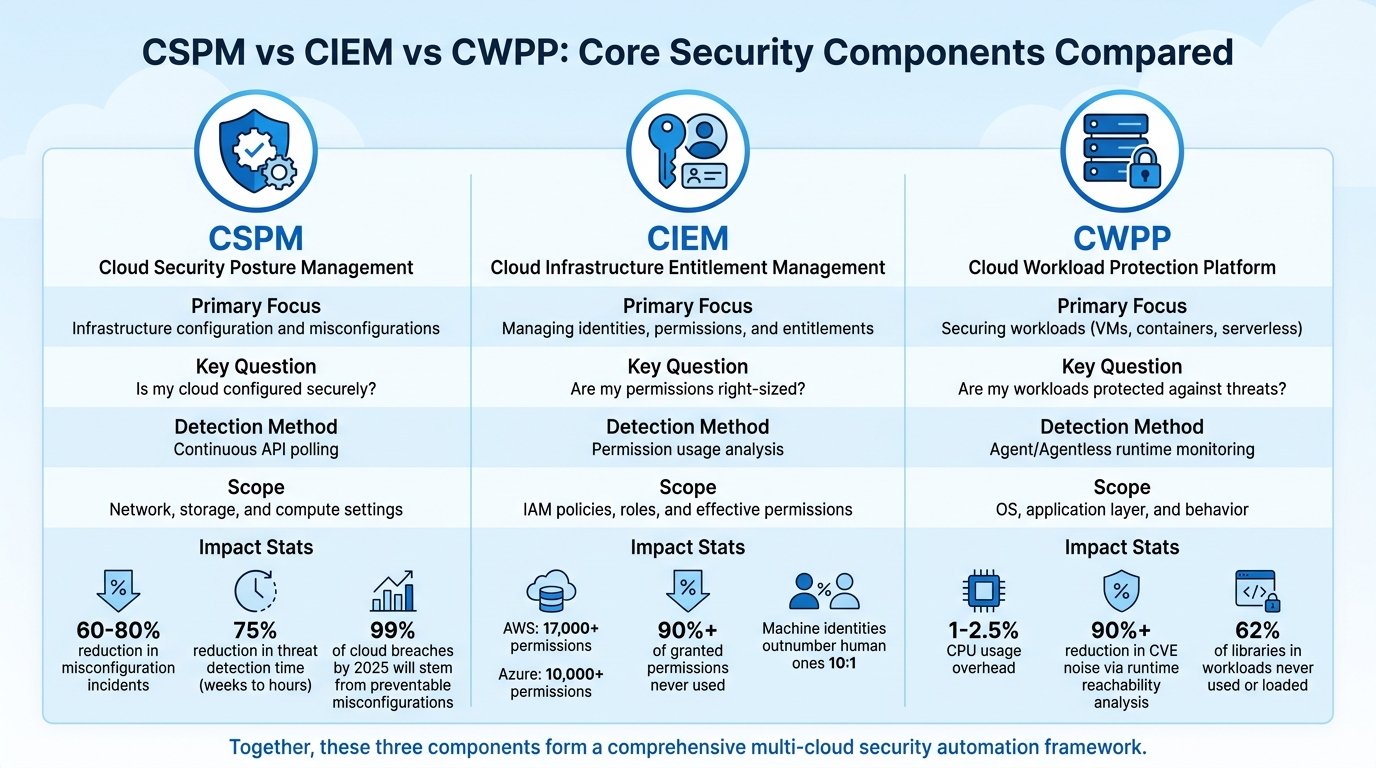
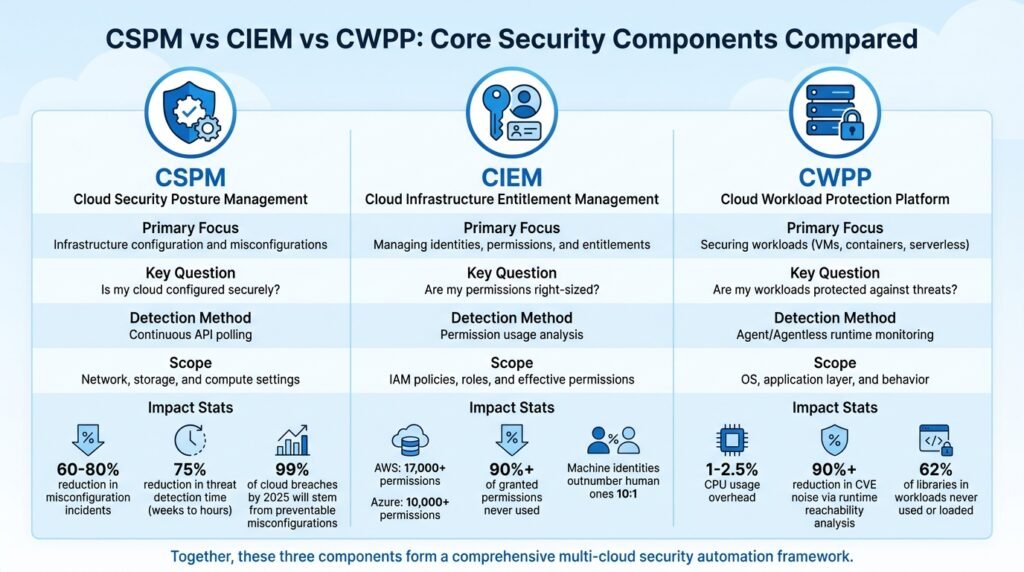
CSPM vs CIEM vs CWPP: Multi-Cloud Security Tools Comparison
A multi-cloud automation framework rests on three components: configurations, identity permissions, and workloads. Centralized monitoring and vulnerability management connect them.
Cloud Security Posture Management (CSPM)
CSPM watches cloud configurations across environments. It gives visibility into resources like S3 buckets, IAM roles, and Kubernetes clusters, including the ones nobody told you about. It scans for risky misconfigurations: unencrypted databases, publicly accessible storage, overly permissive IAM roles.
CSPM also maps your setup to compliance standards like CIS, SOC 2, HIPAA, and PCI DSS. Graph-based tools identify attack paths – a publicly exposed VM combined with an over-privileged IAM role, for instance, is a route to data nobody intended to expose.
The reason this category exists is worth stating plainly: the dominant cause of cloud security incidents is customer-side configuration, not provider compromise. Cloud providers secure the infrastructure; you configure it, and configuration is where things go wrong. CSPM is a tool for finding your own mistakes at machine speed.
To get started, take a phased approach: map your attack surface through discovery and baselining, connect findings to ticketing in Jira or ServiceNow, and automate remediation only for low-risk fixes.
Cloud Infrastructure Entitlement Management (CIEM)
CSPM addresses configuration; CIEM addresses permissions – who can do what. The permission models at AWS and Azure each run to many thousands of individual actions, which is well past the point where anyone can reason about effective access by reading policy documents.
CIEM consolidates provider-specific formats – AWS JSON policies, Azure RBAC, GCP IAM bindings – into one view. It resolves inheritance chains to compute effective permissions and compares them against actual usage from CloudTrail and Azure Activity Log, which is how over-privileged accounts surface.
The general finding across this category, and the reason it is worth doing, is that identities routinely hold far more permission than they exercise. Machine identities are the bigger problem: they outnumber human ones substantially in most estates, they are created by automation, and nobody reviews them.
Run CIEM in observation mode for a full quarter before acting. Permissions used once every three months – quarterly reporting, disaster recovery drills, annual audits – look unused over a 30-day window and revoking them breaks things at the worst possible moment. Start in recommendation-only mode, then enable auto-remediation for genuinely low-risk cases such as deactivating accounts with no authentication events at all.
Cloud Workload Protection Platforms (CWPP)
CWPP secures the workloads themselves – virtual machines, containers, serverless functions, bare metal – by monitoring system calls, network activity, file access, and process execution at runtime.
The argument for it is straightforward: an attacker interacts with your running workloads, not with your posture score. Configuration hygiene reduces the chance of compromise; runtime monitoring is what notices when it happens anyway.
Modern CWPP works at three levels: pre-deployment analysis of container images and IaC templates, runtime monitoring via agents or eBPF sensors, and centralized telemetry for incident response. Runtime agents impose some overhead – measure it on your own workloads rather than trusting the vendor’s figure, which will have been taken on a favourable benchmark.
Reachability analysis is the feature worth asking about. It distinguishes vulnerabilities in code that actually loads at runtime from CVEs in libraries that ship in the image and are never called. Most dependencies in a typical container are never loaded, so this cuts the remediation queue substantially – which matters, because an unprioritised CVE list gets ignored.
Run runtime protection in monitor-only mode for a few weeks to establish a baseline before enabling blocking, or you will block legitimate behaviour on day one and lose the team’s confidence. Integrate image scanning into the build pipeline. Prioritise fixes on workloads that are both publicly exposed and over-privileged.
| Capability | CSPM | CIEM | CWPP |
|---|---|---|---|
| Primary Focus | Infrastructure configuration and misconfigurations | Managing identities, permissions, and entitlements | Securing workloads (VMs, containers, serverless) |
| Key Question | “Is my cloud configured securely?” | “Are my permissions right-sized?” | “Are my workloads protected against threats?” |
| Detection Method | Continuous API polling | Permission usage analysis | Agent/Agentless runtime monitoring |
| Scope | Network, storage, and compute settings | IAM policies, roles, and effective permissions | OS, application layer, and behavior |
Setting Up Centralized Security Management
Running multiple clouds without centralized security management means separate consoles, separate query languages, separate alert formats, and a security team that cannot answer “where are all our unencrypted databases” without three logins and a spreadsheet.
The workable pattern is a correlation layer above the native tools rather than a replacement for them. Keep AWS Security Hub, Microsoft Defender for Cloud and Google Security Command Center for their deep provider integration, add a scheduled validation tool like Prowler, and feed everything into a central SIEM – ELK Stack, Wazuh, or Splunk. Additive, not replacement.
On cost: this article previously quoted five-year price ranges for enterprise CSPM platforms and for open-source alternatives, along with a percentage saving. Those figures had no source and have been removed. The real trade-off is not hard to reason about without them. Commercial CSPM costs licence fees but arrives configured; native-plus-open-source costs engineering time to build and maintain, which is a real cost that does not appear on any invoice. Whichever route you take, avoid paying twice for the same telemetry – the common waste in this area is a third-party platform ingesting data the native service is already collecting and charging for.
Unified Monitoring and Observability
Unified monitoring consolidates AWS, Azure, and GCP into one view. OpenTelemetry (OTel) is the standard framework for it, collecting logs, metrics and traces and shipping them to a central backend over OTLP.
To make it work, standardize instrumentation. Use OpenTelemetry SDKs with consistent naming and W3C Trace Context so a request can be followed across AWS Lambda, Azure Functions and GCP Cloud Run. Services must propagate the traceparent and tracestate headers. With asynchronous messaging – SQS, Pub/Sub – you will often need to inject those headers manually, because auto-instrumentation does not cross the queue boundary.
Tagging is the unglamorous prerequisite. Agree a schema covering environment, team, service, and cost centre, and enforce it with AWS Config or Azure Policy. Consistent tags are what let you query across providers – with CloudQuery, for example, finding every unencrypted database becomes a single SQL statement.
Observability is expensive, and telemetry volume grows faster than the estate does. Filter and sample aggressively; most organisations pay to store debug logs nobody will ever read. Use the OpenTelemetry Collector’s file_storage extension to buffer locally when the central backend is unavailable, or you lose exactly the data you need during an incident.
| Monitoring Category | Key Metrics to Track | Business Impact |
|---|---|---|
| Infrastructure | CPU, Memory, Disk I/O | Prevents resource exhaustion |
| Application | Response time, Error rates | Improves user experience |
| Network | Latency, Bandwidth, Packet loss | Keeps services reachable |
| Security | Misconfigurations, Access violations | Safeguards systems and data |
| Cost | Spend by service, Budget tracking | Helps control cloud expenses |
Policy-as-Code and Identity Management
Maintaining separate security policies per provider guarantees drift between them. Policy-as-Code (PaC) lets you define a rule once – “no public storage” – and apply it across AWS, Azure, and GCP with Open Policy Agent (OPA).
Put PaC in the CI/CD pipeline so checks run before deployment. Catching a public bucket in a pull request costs minutes; catching it in production costs an incident report.
Identity works the same way. Use one identity provider – Okta, Microsoft Entra ID, Google Cloud Identity – across all platforms rather than maintaining users per cloud. Define roles in cloud-agnostic terms and map them with Terraform, so an “admin” role becomes an AWS IAM Role, an Azure Managed Identity, or a GCP Service Account from a single definition.
Workload Identity Federation lets workloads in one cloud authenticate to another using short-lived tokens instead of static credentials. An AWS Lambda can reach GCP resources without a long-lived API key sitting in an environment variable – which is where leaked credentials usually come from.
Keep policies in Git for the audit trail and the ability to roll back. Conftest validates Terraform plans against OPA policies during builds.
Start in recommendation-only mode so policies flag violations without blocking deploys. This builds trust with development teams and lets you find the false positives before they cost someone a release. Then enable enforcement for the strict rules – encryption, public access – and leave softer rules like tagging in audit mode. Pair it with periodic runtime scans to catch changes made by hand in the console, which is how drift actually happens.
| Feature | Traditional Cloud Security | Policy-as-Code (PaC) Security |
|---|---|---|
| Review Process | Manual configuration reviews | Automated, continuous enforcement |
| Assessment | Point-in-time checks | Real-time validation |
| Response | Reactive incident handling | Proactive threat prevention |
| Tooling | Provider-specific tools | Unified, multi-cloud policies |
| Posture | Inconsistent security standards | Consistent security baseline |
Automating Vulnerability and Compliance Management
Manual audits cannot keep pace with multi-cloud environments where resources are created and destroyed by pipelines. Continuous scanning and compliance monitoring across AWS, Azure, and GCP is the alternative.
Automated Vulnerability Scanning
Continuous scanning has to cover ephemeral assets as well as persistent ones. Agent-based tools miss short-lived containers and serverless functions by design – the workload is gone before an agent could be installed. Agentless scanning covers that gap; most estates need both.
Prowler is the open-source workhorse here, running hundreds of checks against AWS and smaller but growing check sets for Azure and GCP. Coverage differs by provider, so verify that the checks you care about exist for the cloud you care about rather than assuming parity.
A shift-left approach scans Infrastructure as Code – Terraform, Bicep – during CI/CD builds, catching misconfigurations before anything is provisioned. Combined with runtime scanning it also detects drift: the manual console change that quietly diverges from the committed state.
Automate remediation for low-risk issues such as adding missing tags or enabling encryption on new storage. For higher-risk changes – security groups, access policies – alert a human. Auto-remediating a security group at 3am can take an application down as effectively as an attacker would.
Compliance Monitoring Across Cloud Providers
Compliance in a multi-cloud estate needs a unified policy layer, because “no public databases” is implemented differently for AWS RDS, Azure SQL Database, and GCP Cloud SQL. OPA enforces the intent uniformly across all three.
Start with detective controls in audit mode. Test new policies in non-production for a couple of weeks before they block anything. Then enforce automatically on the hard requirements – encryption, public access prevention – and keep softer rules in audit mode.
Automating evidence collection is where the time savings genuinely are. Instead of screenshotting consoles before an audit, centralise evidence into an immutable store – S3 with Object Lock, or Azure Blob Storage with retention policies – so there is one source auditors can work from.
Map every automated rule to the specific regulatory requirement it satisfies. Comments in the policy code do this well:
// Enforces PCI DSS Req 3.4
// HIPAA 164.312(a)(2)(iv)
That mapping is what turns a technical control into audit evidence.
| Compliance Requirement | GDPR | HIPAA | SOC 2 | Automation Tool |
|---|---|---|---|---|
| Encryption at Rest | Article 32 | §164.312(a)(2)(iv) | CC6.6 | Prowler / AWS Config |
| Access Logging | Article 30 | §164.308(a)(1)(ii)(D) | CC6.1, CC7.2 | SIEM / CloudTrail |
| MFA Enforcement | Article 32 | §164.312(a)(2)(i) | CC6.1 | Prowler / IAM Analysis |
| Audit Trails | Article 30 | §164.312(b) | CC7.2 | Immutable S3/Blob |
On budget: AWS Security Hub includes a free allowance of findings before charges start, and Oracle Cloud Guard is free with OCI. Check the current free tiers on the providers’ own pricing pages – they change, and the figures previously quoted in this article were undated.
Best Practices for Multi-Cloud Security Automation
Conduct Regular Security Assessments
A layered monitoring system combines three approaches:
- Real-time native services like AWS Security Hub for immediate alerts.
- Scheduled validation tools such as Prowler for deep compliance scans.
- Centralized SIEM like ELK Stack for cross-cloud correlation.
Collect evidence continuously rather than in snapshots. An immutable data lake capturing changes, access logs and policy violations gives you both audit evidence and incident forensics from the same store.
When prioritising vulnerabilities, rank by blast radius – what an attacker could reach from a compromised asset – rather than by CVSS score alone. A medium-severity flaw on a host with production database credentials matters more than a critical one on an isolated build agent.
| Assessment Layer | Tools Example | Primary Function |
|---|---|---|
| Real-Time Native | AWS Security Hub, Microsoft Defender for Cloud, GCP SCC | Detect new misconfigurations quickly |
| Scheduled Validation | Prowler, Scout Suite | Perform compliance scans (CIS, GDPR, HIPAA) |
| Unified Inventory | CloudQuery | Track assets across clouds using SQL |
| Centralized SIEM | ELK Stack, Wazuh | Correlate events and analyze trends across clouds |
Adopt Zero-Trust Security Models
Perimeter-based security does not translate to multi-cloud. Zero-trust treats identity as the control boundary: every request authenticated and authorised regardless of origin.
Start with centralized identity federation through a single identity provider. That removes the fragmented per-cloud user directories and makes joiner-mover-leaver processes actually work. Enforce phishing-resistant MFA – FIDO2 or WebAuthn – for all human accounts, and connect the identity provider to your HR system so leavers lose access on their last day rather than at the next access review.
For workloads, use Workload Identity Federation and short-lived tokens instead of static credentials.
Just-In-Time access through Privileged Identity Management grants admin rights only when needed and for a bounded period. For service-to-service traffic, service meshes like Istio, Linkerd, or Cilium automate mutual TLS and workload identity.
Use Cloud-Agnostic Tools
Cloud-agnostic tools give you one set of controls instead of three. Prowler and Cloud Custodian are the established open-source options. Cloud Custodian uses a YAML rules engine to express policy – no public database access, for instance – and translate it into provider-specific controls. CloudQuery pulls infrastructure metadata into a SQL database so you can query the whole estate at once.
The trade-off is honest to state: open-source tooling has no licence cost and a real engineering cost. Someone has to run it, tune it, and keep it current. Below a certain team size, a commercial platform that arrives working is the cheaper option even though the invoice is larger.
| Tool Category | Recommended Tools | Primary Function |
|---|---|---|
| CSPM / Validation | Prowler, Wiz, Kubescape | Audit configurations and ensure compliance |
| Policy-as-Code | Cloud Custodian, OPA Gatekeeper | Automate policy enforcement and remediation |
| Asset Inventory | CloudQuery | Gain visibility into resources across clouds |
| Vulnerability Scanning | Trivy, Clair, Grype | Scan containers and workloads for vulnerabilities |
| Centralized SIEM | ELK Stack, Wazuh | Aggregate logs and correlate events across clouds |
Conclusion
Identity and permission mismanagement is a leading cause of cloud security incidents, which is why IAM practice deserves more attention than it usually gets. (That link is related BizBot coverage, not a source for the claim – an earlier version of this article presented it as a citation, which it never was.)
CSPM, CIEM, and CWPP cover configuration, identity, and runtime respectively. Together they give consistent enforcement across AWS, Azure, and Google Cloud. None of them is a substitute for the other two, and vendors selling one as a complete answer are selling you a gap.
Start phased. Assess what you actually run, pick tools that work across your providers, and test automation somewhere non-critical. Begin with something simple – encryption on new storage buckets – and expand. Every automated control you add is also a thing that can misfire, so add them one at a time and watch what happens.
FAQs
Which should I implement first: CSPM, CIEM, or CWPP?
Start with CSPM. It gives you visibility into what exists and how it is configured, which is the baseline everything else builds on. You cannot secure an estate you cannot enumerate.
Add CIEM next to right-size permissions and find over-privileged accounts, particularly machine identities.
Add CWPP third for runtime protection of workloads. If you run a lot of containers, you may want to move it up the order.
How can I prevent automation from disrupting production?
Run everything in observation mode first, for long enough to see the periodic workloads – monthly close, quarterly reporting, disaster recovery tests. Define narrowly what auto-remediation may touch, and exclude anything that changes network or access control. Log every automated action, and make rollback a one-step operation. The failure mode to design against is an automation that is correct in principle and catastrophic in a specific case nobody anticipated.
How can I centralize alerts without duplicating costs?
Decide which system is authoritative for each data type and stop the others collecting it. Duplicate ingestion is the main source of waste in this area: native services and a third-party platform both charging you to store the same CloudTrail events.
Correlate and deduplicate at the SIEM layer, and use vendor-neutral collection – OpenTelemetry for telemetry, CloudQuery for inventory – so you can change platforms later without re-instrumenting everything.
More on this topic
Browse all 79 articles on Security & Compliance.