
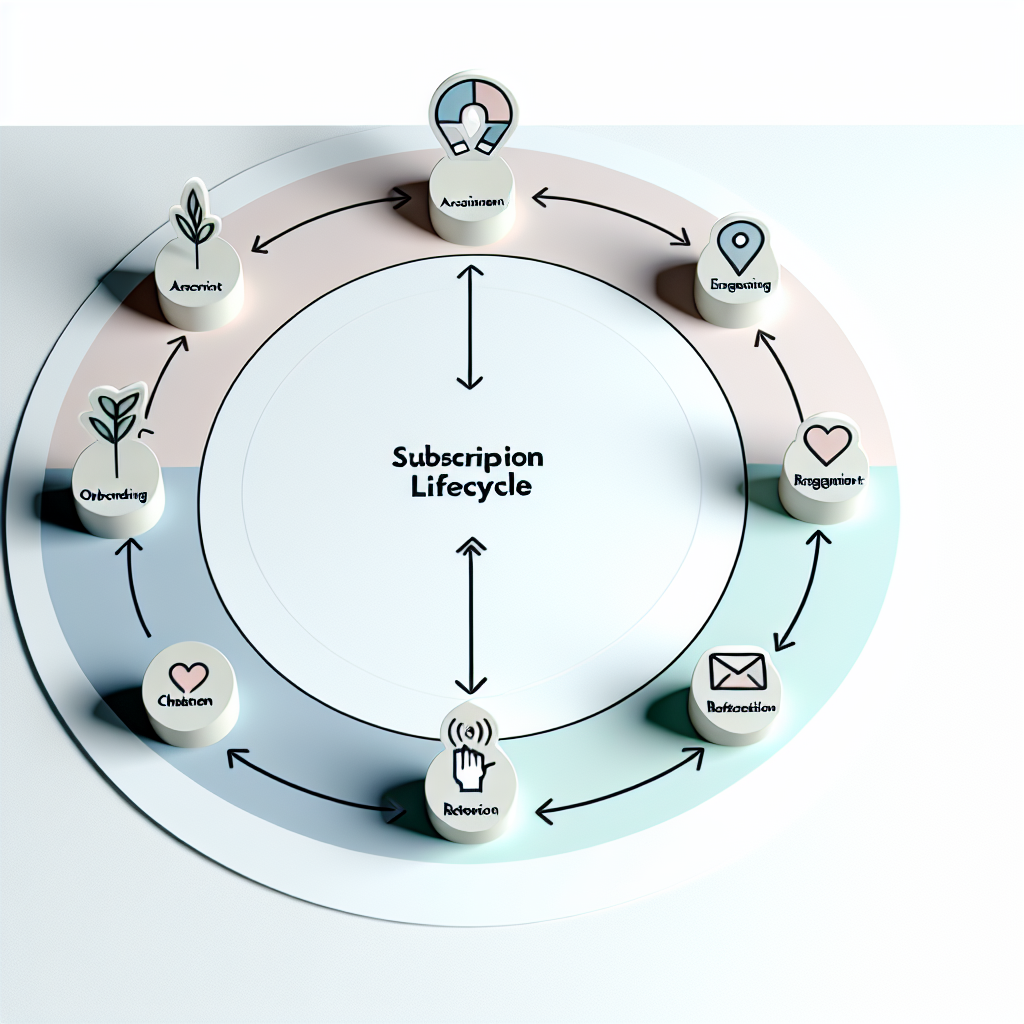
Subscription lifecycle management is the process of managing customer subscriptions from start to finish, including:
- Acquiring new subscribers
- Onboarding new customers
- Keeping subscribers engaged
- Preventing churn and retaining customers
- Encouraging renewals and expansion
- Reactivating former subscribers
The key benefits of effective subscription management are:
- Improved customer retention
- Predictable recurring revenue
- Increased operational efficiency
This guide covers strategies and best practices for each stage of the subscription lifecycle. If you sell subscriptions to US consumers, read the cancellation and compliance section before you read anything else — it is the part with legal consequences attached.
Key Stages of the Subscription Lifecycle
| Stage | Description |
|---|---|
| Customer Acquisition | Attracting new customers to sign up |
| Onboarding | Helping new subscribers get started |
| Engagement | Keeping customers actively using your service |
| Retention | Preventing cancellations and churn |
| Renewals & Expansion | Encouraging renewals and identifying growth opportunities |
| Reactivation | Winning back former subscribers |
The guide also covers subscription management platforms, integrating with business systems, measuring key metrics, and the regulatory position.
1. Getting New Subscribers
Attracting New Subscribers
Gaining new subscribers is the first step in the subscription lifecycle. The goal is to get potential customers to sign up for your service.
Here are some effective strategies:
- Offer Free Trials: Let potential customers try your service for free. This allows them to experience the value before committing. Note that a free trial that rolls into a paid subscription is a negative option offer, and carries specific disclosure and consent obligations — see the compliance section.
- Provide Promotions and Discounts: Offer coupons, deals, or special pricing to drive awareness and adoption. An earlier version of this article cited a coupon redemption figure for US subscribers. It carried no source and has been removed.
- Suggest Upsells and Cross-sells: When customers sign up, suggest additional plan options or add-ons. This can increase the order value and customer satisfaction.
- Offer Gift Subscriptions: Gift subscription plans and cards are popular, especially during holidays. They can expose your company to potential new subscribers. Decide up front whether a gift subscription auto-renews on the recipient’s card; if it does, say so at the point of purchase.
Test different messaging, discount amounts, or terms to understand your audience and optimize your approach.
Optimizing the Sign-up Process
The sign-up process is critical for getting new subscribers. Here are some best practices:
- Keep it Simple: Reduce the number of fields and only ask for essential information. This makes the process less intimidating and faster to complete.
- Use Clear Language: Avoid jargon or technical terms that might confuse potential customers. Use simple language to guide them through the process.
- Provide a Clear Value Proposition: Explain the benefits of subscribing to your service and what they can expect.
- Disclose the recurring charge before you take card details: The amount, the frequency, and how to cancel. This is a legal requirement in the US, not a courtesy.
Using Data for Marketing
Data and analytics play a crucial role in identifying ideal customer profiles, segmenting audiences, and creating targeted marketing campaigns:
- Identify Ideal Customer Profiles: Analyze customer data to identify common characteristics, behaviors, and preferences.
- Segment Audiences: Use data to segment your audience based on demographics, behavior, or preferences.
- Create Targeted Marketing Campaigns: Use data to create campaigns that speak to your audience’s needs and preferences.
2. Onboarding New Subscribers
Welcoming New Subscribers
A warm welcome sets the tone for a subscriber’s experience with your service. A well-crafted welcome email or onboarding guide can improve engagement and retention.
Test different subject lines to see which ones your audience responds to. A/B testing compares two variables — like subject lines — to determine which performs better. Judge the test on downstream activation rather than on opens, which are unreliable.
Personalizing the Onboarding
Personalized onboarding is key for SaaS companies. It creates a strong first impression, encourages immediate product use, and builds value perceptions. A poor onboarding process can leave subscribers confused or underwhelmed.
To personalize the onboarding:
- Gather customer information during sign-up
- Provide a welcome kit or personalized onboarding guide
- Offer self-service options for setting preferences, customizing experiences, and accessing support resources
Ensuring Successful Activation
Demonstrating your subscription’s value early on is critical for successful activation. You can achieve this by:
| Approach | Description |
|---|---|
| Clear Value Proposition | Explain the benefits of subscribing to your service |
| Free Trial or Demo | Let customers experience the value before committing |
| Upsells and Cross-sells | Suggest additional plan options or add-ons to increase order value and satisfaction |
| Smooth Sign-up Process | Reduce friction and encourage completion with a user-friendly experience |
3. Keeping Subscribers Engaged
Personalizing the Experience
Keeping subscribers engaged is key for your subscription business. One way to do this is by personalizing their experience. Offer tailored content, product suggestions, or exclusive deals based on their preferences and behavior.
You can also educate customers on your product’s benefits and features. This helps them get the most out of their subscription and see its full value.
Loyalty Programs
Loyalty programs are useful for long-term engagement. By rewarding subscribers for their loyalty, you build a stronger relationship. For example, offer points or discounts for every purchase, which they can redeem for rewards or exclusive content.
Preventing Churn
Churn prevention is crucial. To prevent churn, identify at-risk customers early and take action. Offer incentives like discounts to customers who seem disengaged.
Address common issues that may cause customers to cancel. If customers are struggling with your product, offer extra support or training to help them.
One thing not to do: make cancelling difficult in order to hold on to people. Aside from the legal exposure covered below, it converts a churned customer into a chargeback, a complaint and a review.
Using Customer Feedback
Customer feedback is valuable for improving the subscription experience and reducing churn. Collect and analyze feedback to identify areas for improvement. Then, make changes to your product or service based on this feedback.
The cancellation survey is the highest-signal feedback you will ever collect, and the one most companies ignore because the answers are unflattering. Read it.
| Approach | Description |
|---|---|
| Personalized Experience | Offer tailored content, product recommendations, or exclusive offers based on preferences and behavior. |
| Educational Resources | Educate customers on product benefits and features to help them get the most value. |
| Loyalty Programs | Reward loyal subscribers with points, discounts, or exclusive content to foster long-term engagement. |
| Churn Prevention | Identify at-risk customers early and offer incentives or address common pain points to retain them. |
| Customer Feedback | Collect and analyze feedback to identify areas for improvement and make data-driven changes. |
4. Billing and Payment Management
Subscription Billing Models
Subscription businesses can choose from various billing models, each with its own advantages and drawbacks. Here are some common models:
| Model | How It Works | Advantages | Drawbacks |
|---|---|---|---|
| Fixed | Customers pay a set fee for a product or service | Predictable revenue, simple to implement | Limited flexibility, may not reflect actual usage |
| Usage-based | Customers pay based on their consumption | Pricing aligns with actual usage, encourages efficient use | Complex to implement, revenue can be uncertain |
| Tiered | Different service levels at varying price points | Allows for price differentiation, encourages upselling | Complex to implement, may confuse customers |
| Hybrid | Combines different billing models | Offers flexibility and customization, accommodates complex pricing | Complex to implement, may confuse customers |
Whichever you pick, display the price with its unit and its billing period. “$29” means nothing. “$29 per user per month, billed annually” means something, and it is the difference between a customer who renews and one who calls their bank.
Streamlining Billing Processes
Accurate and efficient billing processes can improve customer satisfaction, reduce errors, and increase revenue. Here are some best practices:
- Automate billing processes to reduce manual errors and increase efficiency
- Use a billing system that can handle your actual pricing rules, including mid-cycle upgrades and proration
- Provide clear and transparent billing information to customers
- Offer flexible payment options to accommodate different customer needs
- Implement a process to manage failed payments and retries
Managing Failed Payments
Failed payments are the largest single cause of involuntary churn, and the cheapest to fix. Here are strategies for managing them:
- Send reminders and notifications to customers with failed payments
- Prompt customers to update expiring cards before they expire, not after
- Offer more than one payment method
- Analyze failed payment data to identify trends and patterns
- Retry on a schedule rather than immediately, and stop after a defined number of attempts
Repeated retries against a declining card can trigger card network penalties on your merchant account. Set a retry limit and stick to it.
5. Renewals and Expansion
Encouraging Renewals
Keeping customers renewing their subscriptions is key for steady revenue and strong relationships. Here are some strategies:
- Renewal reminders: Send notifications before subscriptions expire so customers don’t forget to renew. For annual auto-renewing plans this may be legally required depending on where your customer is.
- Loyalty rewards: Offer discounts, exclusive content, or premium support to renewing customers.
- Upsell/cross-sell: Identify opportunities to offer relevant additional products or services, increasing value.
- Personalized outreach: Engage customers through personalized emails, surveys, or calls to understand their needs.
Identifying Expansion Opportunities
Finding ways to grow revenue from existing subscribers is usually cheaper than acquiring new ones. Here is where to look:
| Approach | Description |
|---|---|
| Customer Feedback | Collect and analyze feedback to pinpoint areas for improvement or new offerings |
| Product Usage Data | Analyze how customers use your products to spot trends and upsell or cross-sell opportunities |
| Market Research | Study the market to find gaps where you can expand your offerings |
| Competitor Analysis | Examine competitors to find areas where you can differentiate and expand |
An earlier version of this article contained this table as raw markup inside a bullet point, where it rendered as a line of pipe characters. It has been rebuilt as a table.
Personalizing Renewal and Expansion
Personalizing renewal and expansion efforts strengthens customer relationships. Here’s how:
- Customer segmentation: Group customers by behavior, preferences, and needs to tailor renewal and expansion efforts.
- Data insights: Use data and analytics to understand customer behavior and preferences.
- Personalized communication: Engage customers through personalized emails, surveys, or calls.
- Dynamic content: Tailor messaging and offers to individual customers.
6. Managing Churn and Reactivation
Understanding Why Subscribers Leave
Churn, or customer attrition, is a crucial aspect of subscription lifecycle management. Analyzing customer data and feedback can help identify common reasons for churn, such as:
- Poor customer experience
- Lack of value or relevance
- Technical issues or bugs
- Pricing or billing concerns
- Changes in customer needs or preferences
Separate voluntary churn (they chose to leave) from involuntary churn (the card failed). They have completely different fixes, and reporting them as one number hides which problem you actually have.
Reducing Customer Churn
Reducing churn requires a proactive approach to customer retention. Here are some strategies:
| Strategy | Description |
|---|---|
| Regular Communication | Keep customers informed about new features, updates, and improvements. |
| Personalization | Tailor your communication and offerings to individual customer needs and preferences. |
| Value-added Services | Offer additional services or benefits that enhance the customer experience. |
| Proactive Issue Resolution | Anticipate and resolve potential issues before they become major problems. |
| Card Updater Services | Use network account updater services so expired or reissued cards keep working. |
| Data-driven Insights | Analyze customer data to identify early warning signs of churn and take corrective action. |
Reactivating Former Subscribers
Reactivating former subscribers requires a thoughtful and personalized approach. Here are some tactics:
1. Re-engagement Campaigns
Design targeted campaigns to re-engage former subscribers, such as special offers, discounts, or exclusive content.
2. Personalized Outreach
Reach out to individual customers to understand their reasons for leaving and address their concerns.
3. Win-back Incentives
Offer incentives to encourage customers to reactivate their subscriptions.
4. Data-driven Segmentation
Segment former subscribers based on their behavior and preferences to create targeted reactivation efforts.
Respect the unsubscribe. A cancelled customer who opted out of marketing is not a reactivation target, and treating them as one is a compliance problem as well as an annoyance.
7. Advanced Subscription Management
Subscription Management Platforms
Subscription management platforms automate billing, payment processing, customer records and reporting for recurring-revenue businesses, and integrate with CRM, ERP and marketing tools.
Three vendors previously listed here as “popular platforms” are described below as they actually position themselves. Checked August 2026.
- Zuora: An enterprise quote-to-cash and subscription management platform covering billing, payments, revenue recognition and receivables. This is the closest of the three to a pure subscription management product.
- Conga: Primarily contract lifecycle management, document automation and CPQ, with billing as one module in a wider revenue suite. Listing it as a subscription management platform, as an earlier version of this article did, oversells the fit. Consider it if contracts and quoting are your bottleneck, not if you simply need recurring billing.
- Straal: A payments provider with a subscription engine covering custom payment plans, billing cycles, trial periods and retry logic. Narrower than the other two and oriented around getting payments through.
None of these three publishes list pricing. All three quote on request. Ask specifically what the meter is: platform fees in this category are commonly charged as a percentage of the billings that pass through the system, sometimes with a floor and an annual commitment. That model scales your cost with your revenue whether or not your margin scales with it, so model it at three times your current volume before signing. There are smaller, cheaper products aimed at businesses billing modest volumes; none of the three above is one of them.
Integrating with Business Systems
Integrating subscription management with other business systems reduces manual re-entry and reconciliation. Key systems to integrate include:
| System | Purpose |
|---|---|
| CRM (Customer Relationship Management) | Manage customer interactions and data |
| ERP (Enterprise Resource Planning) | Manage financials, inventory, and supply chain |
| Marketing Automation | Personalize customer engagement and retention |
| Accounting / revenue recognition | Recognise subscription revenue over the service period rather than at invoice |
Measuring Key Metrics
Tracking key metrics is essential for optimizing subscription management. Important metrics include:
| Metric | Description |
|---|---|
| MRR (Monthly Recurring Revenue) | Total revenue from recurring subscriptions each month. Annual contracts count as one twelfth per month, not as a lump. |
| ARR (Annual Recurring Revenue) | Total revenue from recurring subscriptions each year |
| Churn Rate | Percentage of subscribers who cancel within a given period. Report customer churn and revenue churn separately. |
| LTV (Lifetime Value) | Total revenue generated from a subscriber over their lifetime. Apply gross margin to get something usable. |
The most common error in this category is booking an annual payment as a single month’s MRR, which produces a spike that looks like growth and is not. Whatever your billing system reports, check how it treats annual plans.
8. Cancellation Rules and Compliance
This is the section with real consequences, and it changed recently. What follows was checked in August 2026 and is a summary, not legal advice — take advice on your own offer.
The FTC “click-to-cancel” rule and what replaced it
- The FTC’s amended Negative Option Rule, widely called the click-to-cancel rule, was vacated by the Eighth Circuit in July 2025, days before its compliance deadline, on procedural grounds.
- The FTC restarted the rulemaking. It announced an Advance Notice of Proposed Rulemaking on 11 March 2026, with public comment closing on 13 April 2026. A replacement rule is in progress and its final scope is not yet settled.
- The Restore Online Shoppers’ Confidence Act (ROSCA) remains fully in force, and the FTC continues to bring enforcement actions under it and under Section 5 of the FTC Act. Recent settlements against negative-option sellers have run into the tens of millions of dollars.
The practical reading: the vacated rule did not make anything legal. ROSCA already requires you to disclose the terms clearly before taking billing information, obtain express informed consent, and provide a simple mechanism to stop recurring charges. A cancellation flow that requires a phone call to a line that is open four hours a day is the thing being enforced against, rule or no rule. Several US states also have their own automatic renewal statutes with their own notice requirements.
Data protection
| Regulation | Description |
|---|---|
| GDPR (EU/UK) | Requires a lawful basis for processing, transparency about what you collect, and honouring access and deletion requests. |
| CCPA as amended by CPRA (California) | Gives consumers rights to access, delete, correct and limit use of personal information, and to opt out of sale or sharing. Enforced by the California Privacy Protection Agency as well as the Attorney General. |
| Other US state laws | A growing number of states have comprehensive privacy laws with similar but not identical requirements. Check the states your subscribers are actually in. |
Conclusion
Key Points
Effective subscription management is vital for retaining customers, boosting revenue, and staying competitive. Three things matter more than the rest:
- Fix involuntary churn first. Failed payments are the cheapest customers you will ever save.
- Make cancellation easy. It is the law where it counts, and the retention gained by making it hard is not real.
- Define your metrics once, especially how annual plans hit MRR, and never quietly change the definition.
Where to Read Next
An earlier version of this article listed four “additional resources” that were titles with nothing behind them — no links, no authors, no publications. They have been removed. For sourced material, go to the FTC’s own guidance on negative option marketing and ROSCA, and to each platform vendor’s own documentation for how their billing rules actually behave.
FAQs
What is subscription lifecycle management?
Subscription lifecycle management refers to the process of managing customer subscriptions from start to finish. It involves understanding customer needs and behavior to provide personalized experiences, prevent cancellations, and increase revenue.
The subscription lifecycle includes several stages:
-
Acquiring New Subscribers
- Attracting potential customers to sign up for your subscription service.
-
Onboarding
- Helping new subscribers get started and understand the value of your service.
-
Engagement
- Keeping subscribers actively using and benefiting from your service.
-
Retention
- Preventing subscribers from canceling their subscriptions.
-
Reactivation
- Encouraging former subscribers to rejoin your service.
Managing subscriptions effectively can:
| Benefit | Description |
|---|---|
| Improve Customer Retention | By understanding customer behavior, you can offer targeted promotions, personalized services, and optimized pricing to increase customer loyalty and reduce cancellations. |
| Provide Predictable Revenue | Subscription models provide a steady stream of recurring revenue. |
| Increase Operational Efficiency | Automating billing, dunning and renewals removes manual work that scales with subscriber count. |
Is the FTC click-to-cancel rule still in effect?
No. The Eighth Circuit vacated it in July 2025. But ROSCA still requires clear disclosure, express informed consent, and a simple way to cancel, and the FTC is actively enforcing it. The FTC opened new rulemaking on 11 March 2026, so a replacement rule is likely. Do not treat the vacatur as permission to make cancelling hard.
More on this topic
Browse all 53 articles on Finance & Accounting, or jump straight to our buying guide: Best Accounting Software for Small Businesses.