
Real-time supply chain visibility software helps businesses track goods, spot risks earlier, and reduce the amount of chasing people do by phone. These tools combine IoT, GPS, and AI to offer real-time tracking, predictive analytics, and multi-tier supplier insight.
Key benefits include better inventory management, earlier warning of disruption, compliance support, and cost savings. Modern platforms add AI-driven forecasting, blockchain for traceability, and mobile-first designs. Established providers such as project44, FourKites, and SAP IBP serve different segments, with cloud deployment and ERP integration.
A caveat before the feature list. This category is heavily marketed and thinly evidenced. Vendors publish ROI figures from their own customer engagements, and independent measurement of what visibility software saves is close to non-existent. We have deliberately not quoted any percentage improvements in this guide, because we could not find any we would stand behind. Judge these tools on whether they solve a problem you can currently name, not on a number in a brochure.
When selecting software, prioritize real-time tracking, predictive analytics, and ease of integration. Consider your business size, industry-specific needs, and geographic reach. Tools like BizBot simplify comparisons.
Benefits and Features of Supply Chain Visibility Software
Main Benefits
Improved transparency gives oversight from raw material sourcing to final delivery. This reduces guesswork and lets managers decide on current data rather than assumptions.
Operational efficiency comes from identifying bottlenecks before they become incidents. Addressing problems early cuts downtime and waste.
Risk reduction comes from early alerts about disruption, which buys time to activate a contingency plan. The alert only helps if you have a plan; the software will not make one for you.
Regulatory compliance is simpler with automated tracking and reporting. The system keeps records of supply chain activity, which makes proving adherence during an audit a matter of running a report rather than reconstructing history.
Customer satisfaction improves with accurate delivery estimates and order tracking, which also cuts “where is my order” contacts to support.
Cost savings come from better inventory management, less expedited shipping, and fewer compliance penalties.
Important Features to Consider
Real-time shipment tracking is the core. Using GPS, RFID, and IoT sensors, it monitors location and condition in transit, including temperature and humidity where those matter to the product.
Predictive analytics forecasts demand, flags likely disruption, and suggests inventory levels from historical data and current conditions. Ask what the model was trained on; forecasts for lanes and commodities the vendor has little data for are guesses with a confidence interval attached.
ERP and TMS integration connects visibility software to enterprise resource planning and transportation management systems, removing data silos and manual re-entry. This is where most implementations succeed or fail.
Multi-tier supplier visibility extends past direct suppliers to sub-suppliers. It is the feature most often oversold: your visibility into tier three depends on tier two agreeing to share data, which is a commercial negotiation rather than a software capability.
User-friendly dashboards present data through charts and colour-coded alerts, with customizable views by role.
Alert and notification systems warn when thresholds are crossed. Tune these carefully. An alerting system that fires constantly gets ignored, and then it is worse than nothing because everyone believes it is working.
Reporting and analytics tools track trends, measure metrics, and generate reports for stakeholders.
Current Trends
AI-driven predictive modeling now processes weather, economic indicators and other external signals alongside shipment data to refine forecasts and risk scores.
Blockchain for traceability creates an append-only record of transactions and movements, which makes falsifying product history difficult. Worth noting what it does not do: it guarantees that a record was not altered after entry, not that the record was true when entered. Provenance still depends on whoever typed it in.
Advanced IoT integrations add sensors for shock, vibration, light exposure and air quality alongside location and temperature, which helps identify where in a journey damage occurred.
Sustainability tracking monitors emissions, energy use and waste across the chain, increasingly required for reporting rather than optional.
Mobile-first design lets managers receive alerts and approve exceptions away from a desk.
Cloud deployment is now the default, offering scalability, less infrastructure, faster implementation, and automatic updates.
How to Choose Supply Chain Visibility Software
Evaluating Your Business Needs
Start with what you actually need. Smaller businesses often need only basic tracking and reporting. Mid-sized companies usually need integration. Large enterprises with multi-tier chains need high transaction volumes and complex workflows.
Industry matters. Manufacturers need production tracking and quality control; retailers focus on inventory and demand forecasting. Regulated industries need compliance and audit features from the start rather than bolted on.
Let your current problems set the priorities. Late deliveries point to real-time tracking and predictive analytics. Stock problems point to automated reordering and forecasting. Audit pain points to documentation and audit trails. If you cannot name the problem, you are not ready to buy.
Geography matters too. Domestic operations need less than international ones, which require multiple currencies, languages and regulatory regimes. Consider whether you use one transport mode or several.
Finally, audit your existing technology. Cloud systems integrate more easily than older on-premise ones. Inventory what you run – TMS, WMS, ERP, CRM, accounting – before you shortlist.
Software Evaluation Criteria
Start with integration. Pre-built connectors or documented APIs are what stop the project turning into a data-entry job.
Scalability matters if you are growing. Cloud platforms make it easier to add users, transactions and markets. Check the software handles new product lines, suppliers and volumes without a re-implementation.
Security is not negotiable. Look at encryption, backup, disaster recovery and access controls, and ask specifically who at the vendor can see your shipment data.
User experience decides adoption. Get demo accounts and let the people who will use it daily try it. A platform your operations team dislikes will be worked around within a month.
Real-time tracking must cover your actual transport modes and regions, including international lanes. Ask about carrier coverage on your specific routes, not in general.
Advanced features – demand forecasting, route optimisation, automated exception handling – move you from reactive to proactive, when they work. Ask for a trial on your own historical data.
Reporting should be customisable by role: high-level KPIs for executives, detailed metrics for operations.
Check support channels, response times and training resources.
Making Your Final Decision
Calculate total cost of ownership, not licence cost: implementation, training, upgrades and ongoing support. Subscription pricing tied to users or transaction volume gives flexibility but scales with your success, which is worth modelling before you sign.
Estimate return by looking at order accuracy, inventory carrying cost, fill rates and lead times. Ask vendors for case studies, then ask which customer you can speak to directly. A vendor who will not connect you with a reference of similar size and industry has told you something.
Pilot on one product line or region with defined objectives before rolling out.
Build a scoring framework covering features, usability, integration, vendor reliability and total cost, and fill it in before the sales process makes you enthusiastic.
Check the contract for data ownership, termination conditions and migration support. Data portability is the clause that matters most and the one buyers most often skip.
Supply Chain Visibility Software Providers
Leading Market Providers
- project44: real-time tracking across road, rail, ocean, and air freight, with an API-first design that suits companies doing their own integration work.
- FourKites: predictive analytics and machine learning aimed at anticipating delays, with a strength in ground transportation and exception management.
- Oracle Supply Chain Management Cloud: visibility combined with planning inside a larger enterprise suite. Makes sense if you are already an Oracle shop and much less otherwise.
- SAP Integrated Business Planning (IBP): built for organisations on SAP ERP, connecting operational data with planning. Same caveat as Oracle.
- Blue Yonder: formerly JDA Software, using AI to combine visibility with planning and execution, aimed at retailers and manufacturers.
- Manhattan Associates: visibility within a broader supply chain execution suite, strongest on warehouse and distribution operations.
- Kinaxis RapidResponse: planning plus real-time visibility with scenario simulation, useful when the question is “what happens if this supplier fails”.
Feature and Pricing Comparison
Pricing in this category is almost entirely quote-based, which is why you will not find a price table here. Some vendors price per transaction, some per user, some on enterprise licence. Deployment ranges from cloud to on-premise and hybrid.
When comparing, weigh:
- Pricing model: does it scale in proportion to the value you get, or to your shipment volume regardless of value?
- Deployment speed: cloud is faster; heavy ERP integration is not.
- Integration and support: compatibility with your ERP, WMS or TMS, plus training.
- Geographic and carrier coverage: test against your own top ten lanes.
Business Tools Directory and Resources
How BizBot Helps with Software Selection
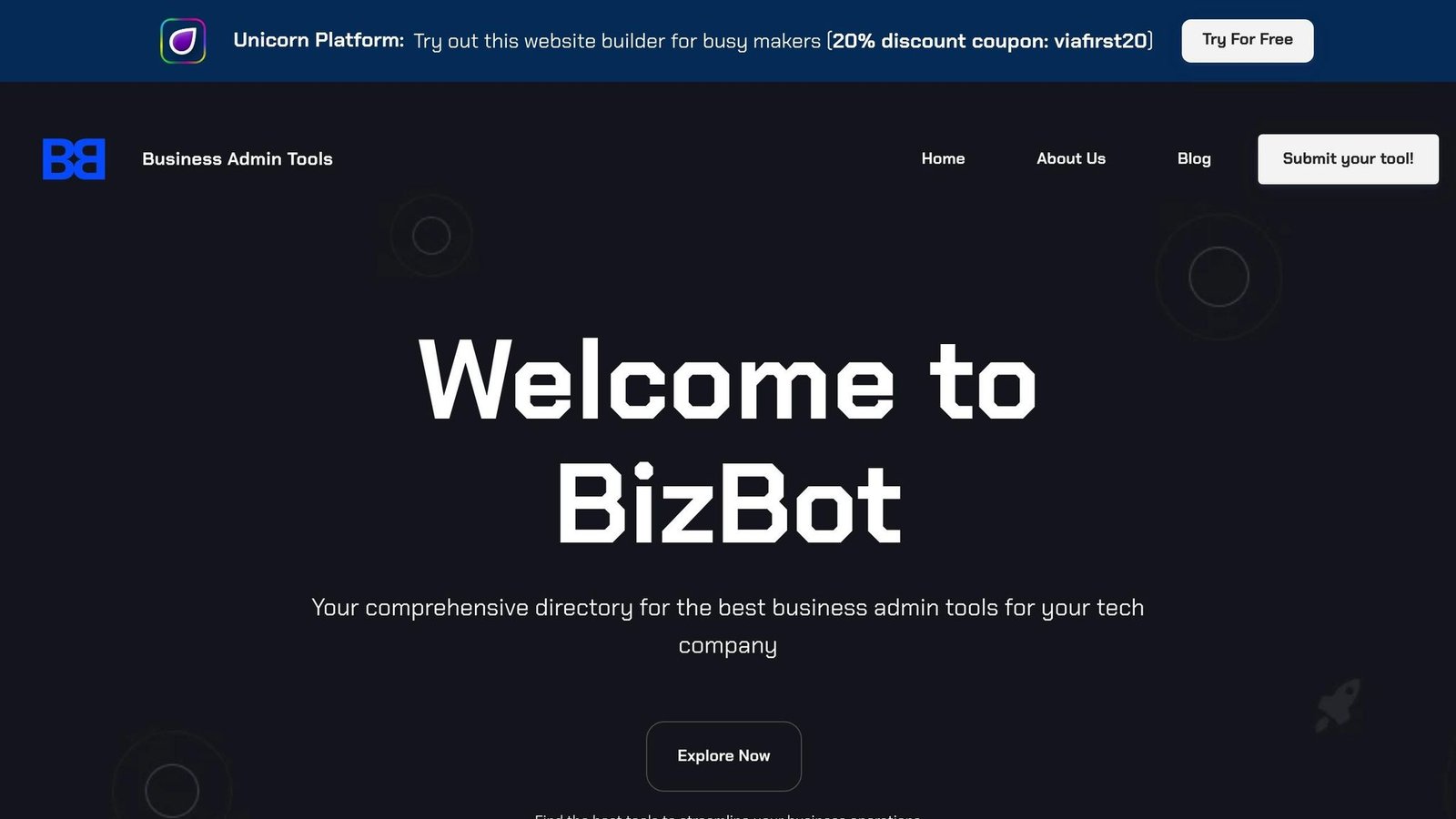
BizBot keeps a directory of business administration tools, categorised so you can compare options side by side rather than working through vendor sites one at a time.
It is aimed at freelancers, small businesses and growing companies. For genuinely large-scale supply chain deployments you will end up in a formal procurement process regardless, and a directory is only the first hour of that.
The subscription management tool tracks what you are spending across software subscriptions, which is useful when visibility platforms sit alongside a TMS and a WMS on separate contracts with separate renewal dates.
You can also compare supply chain tools alongside accounting, HR and legal software, which helps when checking that a new platform fits the stack you already run.
Additional Business Growth Resources
BizBot’s directory extends beyond supply chain to board management and shareholder register tools, which matter more as governance requirements grow.
The platform also lists digital CFO services, useful when weighing the financial case for a large software commitment.
Ownership management tools are there for businesses exploring partnerships or equity arrangements with suppliers or logistics providers.
Conclusion
Supply chain visibility software earns its place when you have a specific, recurring problem: shipments you cannot locate, disruption you learn about from a customer, or audits that take weeks to prepare for. It is expensive and disruptive to implement, and it will not fix a supply chain whose real problem is a single-source supplier or a contract with no penalty clauses.
Prioritise your actual operational needs, integration with what you already run, and whether the thing scales. The most expensive option is frequently not the best fit, particularly for small and medium businesses that need something their team will use.
If you want to compare options, BizBot maintains a directory of business tools with a subscription management feature for keeping track of what you are spending.
FAQs
How does AI-powered predictive modeling improve visibility and risk management?
It enables real-time data analysis, earlier risk identification, and automated exception handling, so supplier delays and disruptions surface before they hit your customers.
The limit is data. Predictive models are good on high-volume lanes with years of history and much weaker on the unusual routes and one-off suppliers where a surprise would hurt most. Ask any vendor how their model performs on your least-travelled lanes.
What matters when integrating with ERP and TMS systems?
Compatibility first. Check for open APIs so data moves between platforms without manual export.
Then data security, since integration means shipment and supplier data crossing system boundaries, and real-time synchronisation, since a visibility tool showing yesterday’s position is a report, not visibility.
The integration must fit your existing workflow. Assign someone to own it; integrations without a named owner drift out of sync and quietly stop being trusted.
How does blockchain help traceability?
It provides a tamper-resistant record of transactions. Each step is recorded as a block, producing a ledger that is hard to alter after the fact.
That supports authenticity checks and proof of origin, which matters for ethical sourcing and quality claims. Be precise about the guarantee, though: blockchain makes records hard to change afterwards. It does nothing about whether the original entry was accurate, which is where most provenance fraud actually happens.
More on this topic
Browse all 86 articles on Business Operations, or jump straight to our buying guide: Best Productivity Tools for Small Teams.