
Disclosure: This article links to a third-party programme, and BizBot may have been compensated for that placement. We would rather flag it than leave you guessing. How we evaluate software.
Search is no longer limited to typing a few words into Google and choosing from ten blue links.
People can now ask detailed questions through AI-powered search experiences and receive direct, synthesized answers. They can compare products, research local businesses, understand complicated services, narrow down providers, and ask follow-up questions without repeating their search from the beginning.
For small businesses, that changes what it means to be visible online.
Ranking well in traditional search results remains important, but businesses increasingly need to consider another question: when AI systems generate answers about your industry, products, services, or local market, is your business easy to understand and recognize as a credible source?
That question is at the heart of AI Search Optimization (AISO).
Also referred to as AI SEO or Generative Engine Optimization (GEO), AI Search Optimization focuses on making a business and its content easier for AI-powered search systems to understand, evaluate, and potentially reference.
Despite the new terminology, this isn’t a replacement for SEO. Technical performance, useful content, authority, clear website structure, and local relevance still matter. What is changing is the search environment in which those signals are being interpreted.
This guide explains what AI Search Optimization actually means, how it differs from traditional SEO, what influences AI visibility, how small and local businesses can prepare, and which practices are likely to matter as search continues evolving.
What Is AI Search Optimization?
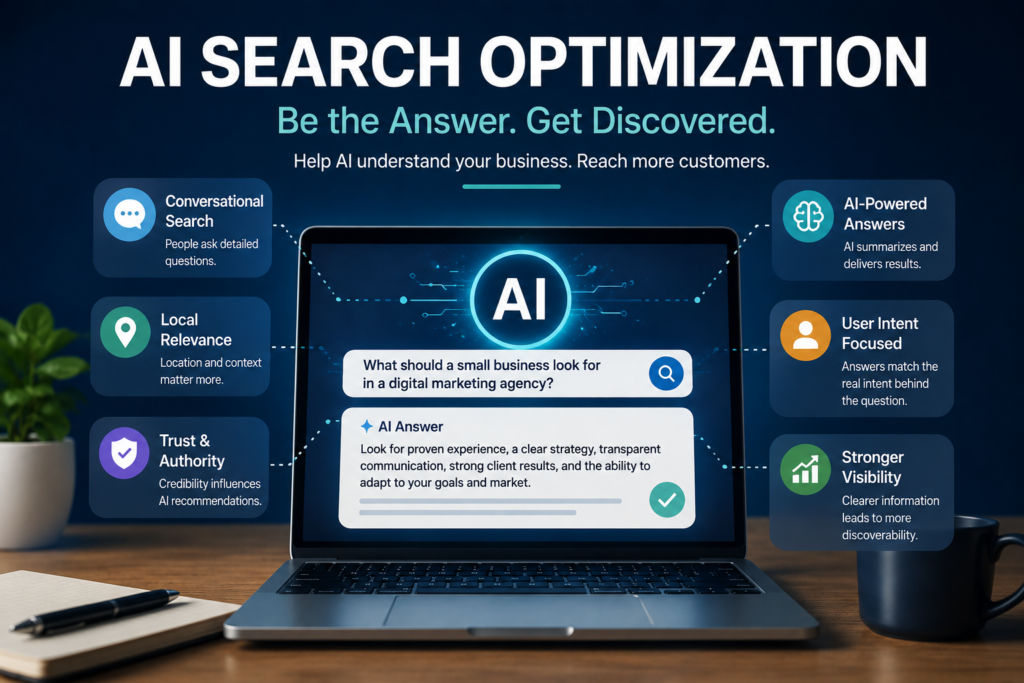
AI Search Optimization is the process of improving the content, structure, authority, and overall digital presence of a business so that AI-powered search systems can more clearly understand what it does and when its information may be relevant to a user’s question.
Traditional search typically presents a collection of results and allows users to decide which pages they want to explore.
AI-powered search can play a more active role in that process. It may interpret the question, gather information, summarize findings, compare options, and present an answer before the user visits an individual website.
Consider the difference between these two searches:
Traditional search:
“accountant Richmond VA”
Conversational AI search:
“What should a small ecommerce company in Richmond look for when choosing an accountant that understands multi-state sales tax?”
The first query primarily communicates a service and location.
The second communicates the type of business, geographic area, specific financial concern, and the information needed to make a decision.
That additional context matters.
A website that simply repeats “Richmond accountant” across several pages may communicate location and service, but it says little about the industries the firm understands, the problems it solves, or the expertise that makes it relevant to more detailed questions.
AI Search Optimization encourages businesses to make that context much clearer.
AI Search Optimization, AEO and GEO: What’s the Difference?
One reason AI search can seem unnecessarily complicated is the number of terms being used to describe similar strategies.
AI Search Optimization (AISO) broadly refers to improving visibility and understanding across AI-powered search experiences.
Generative Engine Optimization (GEO) is commonly used when discussing optimization for search experiences that generate or synthesize answers using AI.
Answer Engine Optimization (AEO) generally emphasizes structuring information so that search and answer systems can easily identify useful responses to specific questions.
AI SEO is often used as a broader, simpler term for adapting traditional search optimization to AI-driven discovery.
There are differences in how marketers and agencies use these terms, but small businesses don’t need separate strategies for every acronym.
The underlying principles overlap considerably: create useful information, establish clear expertise, strengthen authority, make content easy to understand, maintain a technically accessible website, and provide enough context for search systems to determine when the business is relevant.
For most businesses, understanding those principles is far more valuable than debating terminology.
Does AI Search Optimization Replace Traditional SEO?
No. AI Search Optimization works best when it builds on strong SEO foundations.
Search systems still need to discover and understand website content. Pages still need logical structure. Businesses still benefit from useful content, relevant authority, clear service information, good user experience, and accurate location signals.
AI search adds another layer to those fundamentals.
Instead of optimizing only for a position on a conventional results page, businesses are preparing for a search journey that can include traditional results, AI-generated summaries, conversational questions, local recommendations, and follow-up queries.
This makes the relationship between SEO and AI visibility particularly important.
A business with excellent AI-focused content but serious technical problems may still struggle to make that information discoverable. Likewise, a technically excellent website filled with vague, generic content gives search systems very little meaningful information about the company’s actual expertise.
The two need to work together.
This combined approach is also reflected in FreshMove Media’s AI SEO services, which pair established SEO practices with strategies designed to strengthen visibility as search becomes increasingly AI-driven.
Rather than treating SEO and AISO as competing disciplines, the more practical approach is to strengthen the same foundation while adapting how expertise, relevance, and authority are communicated.
Why AI Search Visibility Matters for Small Businesses
The significance of AI search isn’t simply that another technology has appeared. It’s that the way customers research decisions is becoming more conversational.
A potential customer can now describe a problem rather than reducing it to a two- or three-word keyword.
Someone researching home renovations might ask:
“What should I look for in a Richmond contractor experienced with renovating older homes?”
A business owner might ask:
“What type of CRM works well for a small consulting firm that needs sales automation but doesn’t have a dedicated IT team?”
A parent could ask:
“How do I choose a family dentist near Richmond for a child who is nervous about dental appointments?”
These searches contain intent, circumstances, preferences, and context that conventional short-tail keywords often don’t capture.
For small businesses, this can create an opportunity.
Large competitors may have stronger domain authority, larger marketing teams, and greater brand recognition. Smaller businesses, however, can have much deeper knowledge of a particular customer problem, service, industry, or geographic market.
A contractor specializing in historic homes has specific experience a general construction website may not demonstrate. An accountant working extensively with restaurants may understand financial issues that aren’t covered deeply by a national accounting company’s generic small-business content.
The challenge is making that expertise visible.
What Influences Visibility in AI Search?
There is no single factor that determines whether a business will appear in an AI-generated answer, and businesses should be cautious of strategies suggesting otherwise.
A stronger approach is to think about the overall quality and clarity of the information surrounding the business.
Clear Content and Context
Search systems need to understand what a page is actually about.
A service page titled “Our Solutions” followed by broad claims about innovation and customer satisfaction provides relatively little context. A page clearly explaining the service, who it is intended for, how it works, which problems it solves, and where it is available provides considerably more useful information.
Clarity doesn’t mean oversimplifying everything. It means removing unnecessary ambiguity.
Headings should describe the subject being discussed. Important questions should receive direct answers. Services should be described specifically rather than hidden behind marketing language.
The easier a page is for a potential customer to understand, the more useful its information also becomes for search systems attempting to interpret it.
First-Hand Expertise
AI has made generic informational content easier to produce than ever.
That increases the value of information that isn’t generic.
Businesses can differentiate their content by contributing experience gained from actual work: observations from projects, common customer problems, original examples, professional insights, case studies, processes, and explanations that reflect genuine subject knowledge.
A roofing company, for example, doesn’t need another article containing the same ten generic roof-maintenance tips found everywhere online. It may be far more useful to explain the warning signs its team commonly sees during inspections, how weather conditions in its region affect different materials, or what homeowners frequently misunderstand about replacement timelines.
That information demonstrates expertise rather than simply claiming it.
Content That Answers Real Questions
Some of the best content ideas don’t come from keyword tools.
They come from customers.
Sales teams hear recurring objections. Customer service teams answer the same questions repeatedly. Business owners explain pricing, timelines, limitations, processes, and expectations during consultations.
Those conversations reveal what people actually want to know before making a decision.
Turning those questions into useful website content can strengthen traditional search visibility while also creating clearer answers for increasingly conversational search experiences.
The objective isn’t to create a separate article for every imaginable question. It’s to identify the questions that genuinely matter during the customer’s research and decision-making process.
Authority Extends Beyond Your Website
Businesses naturally control what they say about themselves on their own websites.
Independent recognition is different.
Reviews, relevant business listings, industry publications, professional associations, local coverage, partnerships, and credible third-party mentions can contribute to the broader digital picture surrounding a company.
This doesn’t mean businesses should chase mentions indiscriminately. A hundred low-quality references aren’t necessarily more useful than a handful of credible ones within the right industry or local market.
Consistency matters as well.
If a company’s website describes one set of services while other established sources describe something completely different, its digital identity becomes less clear. Business names, service areas, expertise, and other important information should remain reasonably consistent wherever customers are likely to encounter the company.
The objective is bigger than appearing on more websites. It’s establishing a recognizable and credible identity across the places that genuinely matter.
Why Local Businesses Have a Particular Opportunity
Local search and AI-powered discovery can complement each other particularly well because location adds another valuable layer of context.
People don’t necessarily search for the “best dentist” or “best marketing agency.” They can describe exactly what they need and where they need it.
That makes clearly established local expertise valuable.
Businesses should make their service areas easy to understand, maintain accurate location information, and demonstrate regional expertise through genuine experience rather than simply repeating city names across their pages.
A Richmond contractor that regularly works on older homes, for example, can demonstrate that expertise through relevant projects, explanations, customer questions, and service information. That communicates much more than creating near-identical pages with different Virginia city names inserted into the headings.
For small businesses, this is where local SEO and AI Search Optimization increasingly meet. Both benefit from making what the business does, where it operates, and why its expertise is relevant unmistakably clear.
How to Optimize Your Website for AI Search
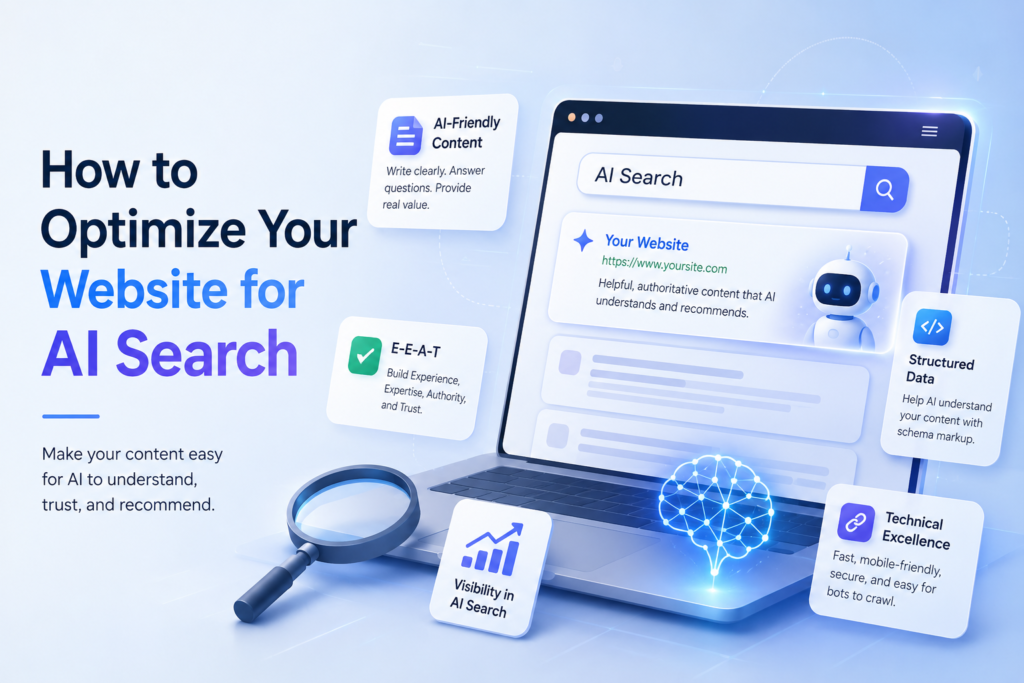
AI Search Optimization doesn’t require building a separate version of your website for AI. In most cases, the best starting point is improving the information and pages you already have.
The goal is to make important information easier to find, understand, and connect.
Give Important Questions Direct Answers
When someone asks a specific question, they shouldn’t have to read several paragraphs before finding the answer.
If a page discusses how long a service takes, provide a clear answer before explaining what can affect the timeframe. If customers regularly ask about pricing, explain how pricing works where possible. If a service is available only in certain locations, make that clear.
This doesn’t mean turning every page into a collection of short FAQs. A useful approach is simply to answer first, then explain. Readers get the information they need quickly while still having access to additional context.
Build Content Around Topics, Not Just Keywords
Keyword research remains useful, but every keyword variation doesn’t need its own page.
Consider an HVAC company offering heat pump installation. Customers might want to understand installation costs, suitability, energy efficiency, maintenance, available systems, installation timelines, and how heat pumps perform in their climate.
Covering those related questions creates a much clearer picture of the company’s knowledge than publishing several thin pages targeting slight variations of “heat pump installation.”
Think about the broader subjects your business wants to be known for, then make sure your website provides genuinely useful information around them.
Make Expertise Visible
A company may have decades of experience without communicating much of that experience online.
Professional qualifications, author information, project examples, case studies, original photographs, detailed service explanations, and first-hand observations can help demonstrate that knowledgeable people are behind the content.
The same applies to company pages. An About page can do more than say a business is passionate about customer service. It can explain the company’s background, specialization, team, experience, service area, and approach.
These details help customers evaluate the business while providing clearer context about who created the information they’re reading.
Technical SEO Still Matters in an AI-Driven Search Environment
Useful content can only do so much if search systems struggle to access the website.
Technical SEO therefore remains part of a strong AI Search Optimization strategy. Websites should be easy to crawl, logically organized, mobile-friendly, reasonably fast, and free from major indexing problems.
Website structure matters too. Important pages shouldn’t be buried several levels deep or isolated from related information. Clear navigation and logical connections between pages make it easier for visitors to explore a subject and for search systems to understand how the site’s content fits together.
Structured data can provide additional machine-readable context for certain types of information, but it shouldn’t be treated as a shortcut to AI visibility. It works best when it accurately represents information already available to visitors.
The principle is straightforward: make your website technically accessible, then give search systems high-quality information to understand.
Why Your Broader Brand Presence Matters
Your website isn’t the only place customers may encounter information about your business.
Depending on the company, people might also find reviews, professional profiles, business listings, industry coverage, local organizations, partnerships, or other credible references. Together, these sources contribute to the broader digital presence surrounding the brand.
Businesses should therefore pay attention to consistency. Important details such as the company name, services, expertise, and locations shouldn’t tell completely different stories depending on where someone finds them.
This isn’t about creating profiles everywhere or collecting as many mentions as possible. The goal is to establish a clear and credible presence in the places that genuinely matter to your industry, market, and customers.
How Small Businesses Can Prepare for AI-Driven Search
Preparing for AI search doesn’t require transforming your entire website at once. Start by reviewing what you already have.
Can someone unfamiliar with the company quickly understand what you do, who you serve, where you operate, and what makes your expertise relevant? Are important customer questions answered? Do your strongest pages demonstrate genuine experience rather than relying mainly on broad marketing claims?
Then prioritize the biggest gaps. Improving an underdeveloped service page, clarifying an important specialization, adding evidence of experience, or correcting inconsistent business information may deliver more value than publishing another ten generic articles.
AI Search Optimization doesn’t always begin with more content. Sometimes it begins with better information.
Common AI Search Optimization Mistakes
One of the biggest mistakes is assuming AI visibility can be achieved through a handful of technical tricks.
There is no single keyword density, schema type, page format, or publishing frequency that guarantees inclusion in AI-generated answers. Businesses should be particularly cautious about promises of guaranteed AI rankings or permanent placement in generated recommendations. AI-generated responses can vary according to the platform, question, context, location, and information available.
Publishing large amounts of generic AI-generated content can create another problem. AI can support research, planning, drafting, and editing, but faster production doesn’t automatically create greater expertise.
Content still needs to contribute something useful, whether that’s genuine knowledge, first-hand experience, an original example, or simply a better explanation of a customer’s problem.
Most importantly, don’t optimize so aggressively for AI systems that the content becomes awkward for people. The primary reader is still the customer.
How Do You Measure AI Search Visibility?
AI visibility is more difficult to measure than checking whether a page ranks first, fifth, or tenth for a particular keyword.
Businesses can monitor whether their brands appear for strategically important questions, whether their information is referenced in generated responses, whether AI platforms send referral traffic, and whether branded interest changes over time.
But mentions alone aren’t necessarily meaningful.
Being surfaced while a potential customer is researching a relevant service, comparing providers, or trying to solve a problem is considerably more valuable than appearing in an unrelated AI-generated response.
Traditional business outcomes therefore remain important. Qualified inquiries, organic discovery, branded searches, leads, conversions, and revenue provide much more useful context than counting AI mentions alone.
How Long Does AI Search Optimization Take?
There is no universal timeline for AISO.
Some improvements can happen relatively quickly. A confusing service page can be rewritten, missing information can be added, website structure can be improved, and important customer questions can be answered.
Building authority usually takes longer. Developing genuinely useful resources, earning credible recognition, collecting authentic customer reviews, demonstrating expertise, and establishing a reputation within an industry or local market are gradual processes.
This is why AI Search Optimization is better viewed as an ongoing strategy than a one-time project. Search technology will continue changing, but clear expertise and credible authority are much less likely to become obsolete.
When Does Working With an AI Search Optimization Specialist Make Sense?
Businesses with experienced SEO professionals, developers, writers, and digital marketers may already have many of the capabilities required to incorporate AISO into their existing strategy.
For smaller organizations, resources can become the bigger constraint. The same person may already be responsible for content, advertising, social media, email, analytics, and website updates, making it difficult to add technical SEO, local search, authority development, and AI visibility to the workload.
Outside support can make sense when a business needs help bringing these areas together. The important consideration is whether the provider treats AISO as part of a broader search strategy rather than promising shortcuts into AI-generated answers.
FreshMove Media follows this broader approach, combining proven SEO foundations with forward-looking AI visibility optimization for businesses across Virginia. Its AI Search Optimization services focus on strengthening how businesses are understood across traditional and emerging search experiences rather than treating AI visibility as a replacement for SEO.
Whether AISO is managed internally or with specialist support, the principle remains the same: strengthen the overall search presence rather than chasing temporary AI shortcuts.
Frequently Asked Questions
What is AI Search Optimization?
AI Search Optimization is the process of improving how clearly AI-powered search systems can understand, evaluate, and potentially reference information about a business when generating answers. It is also commonly referred to as AISO, AI SEO, or Generative Engine Optimization.
Is AI Search Optimization different from traditional SEO?
Yes, although there is considerable overlap. Traditional SEO primarily focuses on improving visibility in search results, while AISO also considers how clearly AI-powered systems can interpret a company’s expertise, services, authority, and relevance when generating responses.
Does AISO replace SEO?
No. AI Search Optimization works best when it builds on established SEO fundamentals, including technical accessibility, useful content, clear site structure, authority, and local relevance.
Can small and local businesses benefit from AI Search Optimization?
Yes. Small businesses often have specialized knowledge of a particular service, customer problem, industry, or geographic market. Making that expertise clear can help establish relevance for increasingly detailed and conversational searches.
Is AI Search Optimization important for local businesses?
Yes. Conversational searches can combine location with specific services, customer needs, and other requirements. Local businesses can strengthen their relevance by clearly communicating where they operate, what they specialize in, and the experience they have within their market.
Do I need to publish more content for AISO?
Not necessarily. Improving existing service pages, clarifying expertise, answering important customer questions, strengthening authority, and correcting inconsistent business information may be more valuable than simply increasing publishing volume.
Final Thoughts
AI-powered search is changing how people discover information and evaluate businesses, but it hasn’t made the fundamentals of online visibility irrelevant.
Businesses still need technically sound websites, useful content, clearly communicated services, demonstrable expertise, credible authority, and accurate information. What is changing is the number of search experiences in which those qualities can influence discovery.
The most sustainable response isn’t to chase every new AI optimization tactic. It’s to make your business easier to understand, easier to trust, and genuinely useful to the people searching for the expertise you provide.
Ultimately, the businesses best positioned for AI search will be those building something much harder to manufacture than optimized copy: clear expertise, genuine authority, and information worth finding.