Whistleblower reward programs have changed how companies handle misconduct. By paying a share of monetary sanctions to individuals who report violations, they give insiders a financial reason to disclose things they would otherwise keep quiet. The consequence for employers is that misconduct now has a route out of the building that does not pass through your compliance team.
Key points, with the sources:
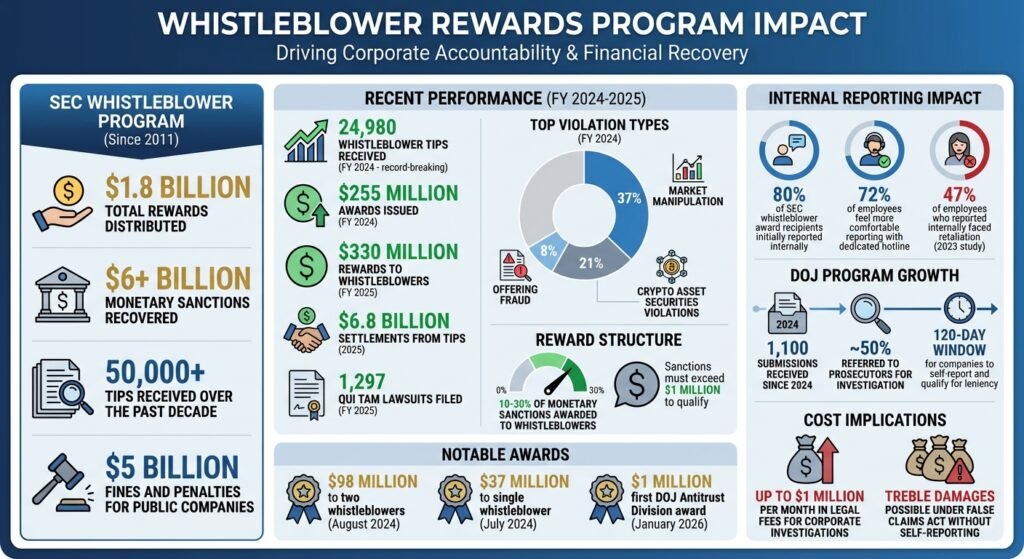
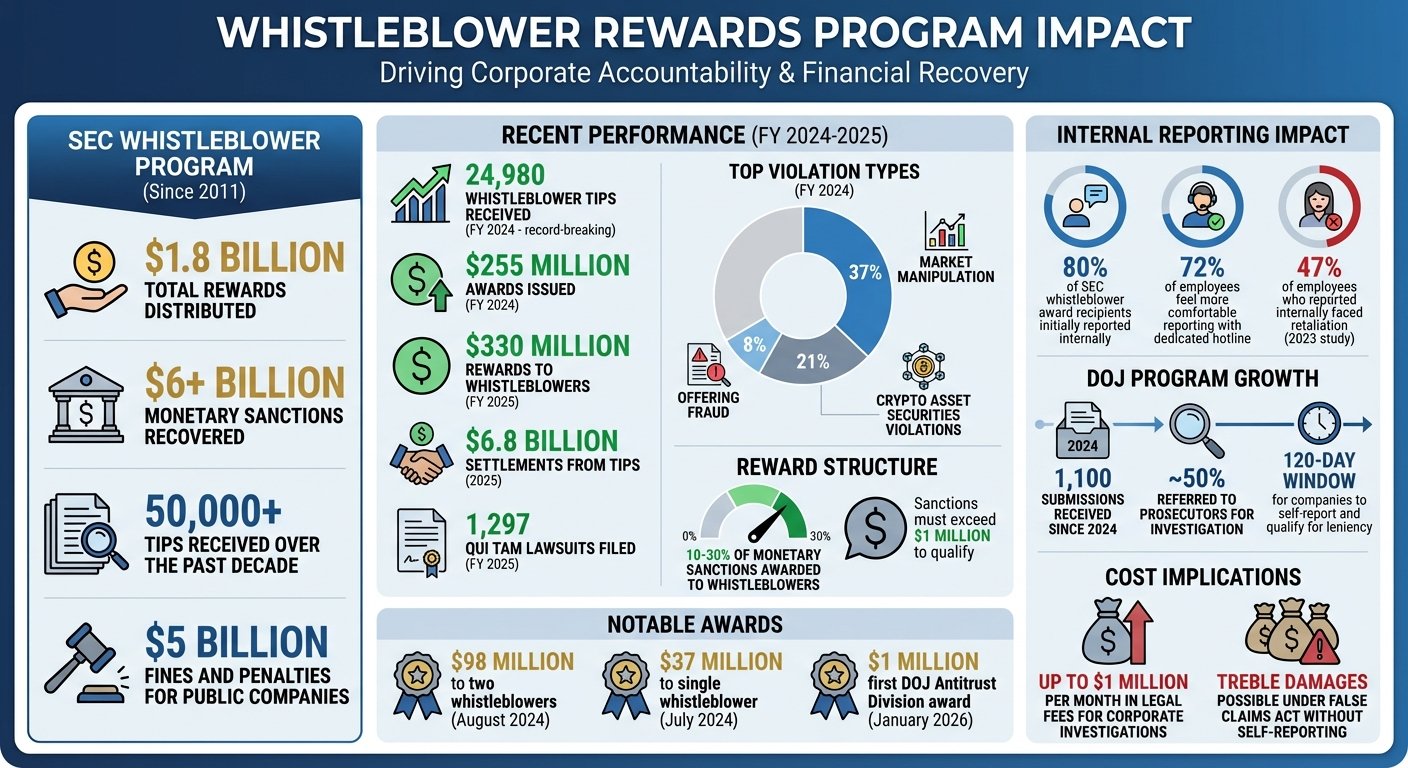
- The award range is statutory: the SEC states that “the range for awards is between 10% and 30% of the money collected” in cases where over $1 million in sanctions is ordered.
- The sums are large: the same page reports the programme has paid nearly $2 billion to approximately 400 whistleblowers as of the end of fiscal year 2023.
- Tip volume is high, but read it carefully: see the SEC’s own fiscal 2024 figures below, which are more interesting than the headline.
What we removed. An earlier version of this article carried around twenty statistics on tip volumes, retaliation rates, award totals, survey findings and legal costs, plus five quotations attributed to named individuals and organisations. We could verify a handful against the SEC and the Department of Justice. The rest could not be traced, and one set of figures for a fiscal year was more than double what the DOJ had published for the year before. Everything unverifiable has been removed rather than softened. What remains is linked.
Whistleblower Rewards Impact: Key Statistics and Financial Outcomes
Compliance Risks Without Whistleblower Reward Programs
Companies that leave a gap here are not choosing between reporting and no reporting. They are choosing between internal reporting and external reporting, because the external route pays and theirs does not. When employees go straight to a regulator, the company loses the chance to investigate first, to self-disclose, and to control the scope of what follows.
An external report also tends to produce a broader investigation than the original complaint, because a regulator with a credible tip will look at adjacent conduct. Legal costs during a live investigation are substantial. We have removed the specific monthly figure this article used to quote, because it appeared three times without a source; ask your own counsel for an estimate based on the matter type, which is the only number that will be accurate anyway.
Weak Internal Reporting Systems
Internal systems fail for a structural reason: unlike a report to the SEC or DOJ, an internal report generally carries no statutory protection and no guaranteed anonymity. The employee bears the career risk and receives nothing.
It gets worse when the investigation is really an exercise in identifying the reporter rather than examining the claim. Those investigations protect reputation in the short term and produce an external complaint in the medium term.
The clearest documented example involves Monsanto. In February 2016 the SEC announced that Monsanto agreed to an $80 million penalty for accounting violations relating to rebate programmes for Roundup, where rebate costs were not recorded in the correct periods and earnings were overstated. Separately, in August 2016 the SEC announced a $22 million-plus whistleblower award, then the second-largest it had made, to someone whose “detailed tip and extensive assistance helped the agency halt a well-hidden fraud at the company where the whistleblower worked”.
Note what the second source does not say: the SEC does not identify the employer in award announcements, as a matter of policy. The connection between the two announcements was drawn by press coverage, not by the SEC. The previous version of this article stated it as fact and added details about the whistleblower’s internal reporting that no public document supports. We have corrected it to what the two press releases actually say.
Financial and Legal Exposure
Under the False Claims Act, companies that do not self-report may face treble damages. The Department of Justice’s most recent published annual figures show settlements and judgments exceeding $2.9 billion in the fiscal year ending 30 September 2024, with whistleblowers filing 979 qui tam actions – the highest number in a single year – and relator shares exceeding $400 million.
Beyond fines, companies can end up under a court-appointed monitorship, which is expensive and intrusive for years. Attempting to suppress reporting through restrictive NDAs or intimidation creates separate liability for retaliation and for impeding communication with regulators, which is a category of case regulators pursue enthusiastically because it is easy to prove from documents.
How Whistleblower Rewards Improve Compliance
The mechanism is straightforward. A share of collected sanctions, in the 10% to 30% range for cases above the $1 million threshold, makes it rational for an insider to accept career risk in exchange for a possible payout. That changes the calculation for people who would otherwise stay silent, and it produces evidence regulators could not develop from the outside.
What the SEC’s Own Numbers Show
The SEC reported in its fiscal 2024 enforcement results:
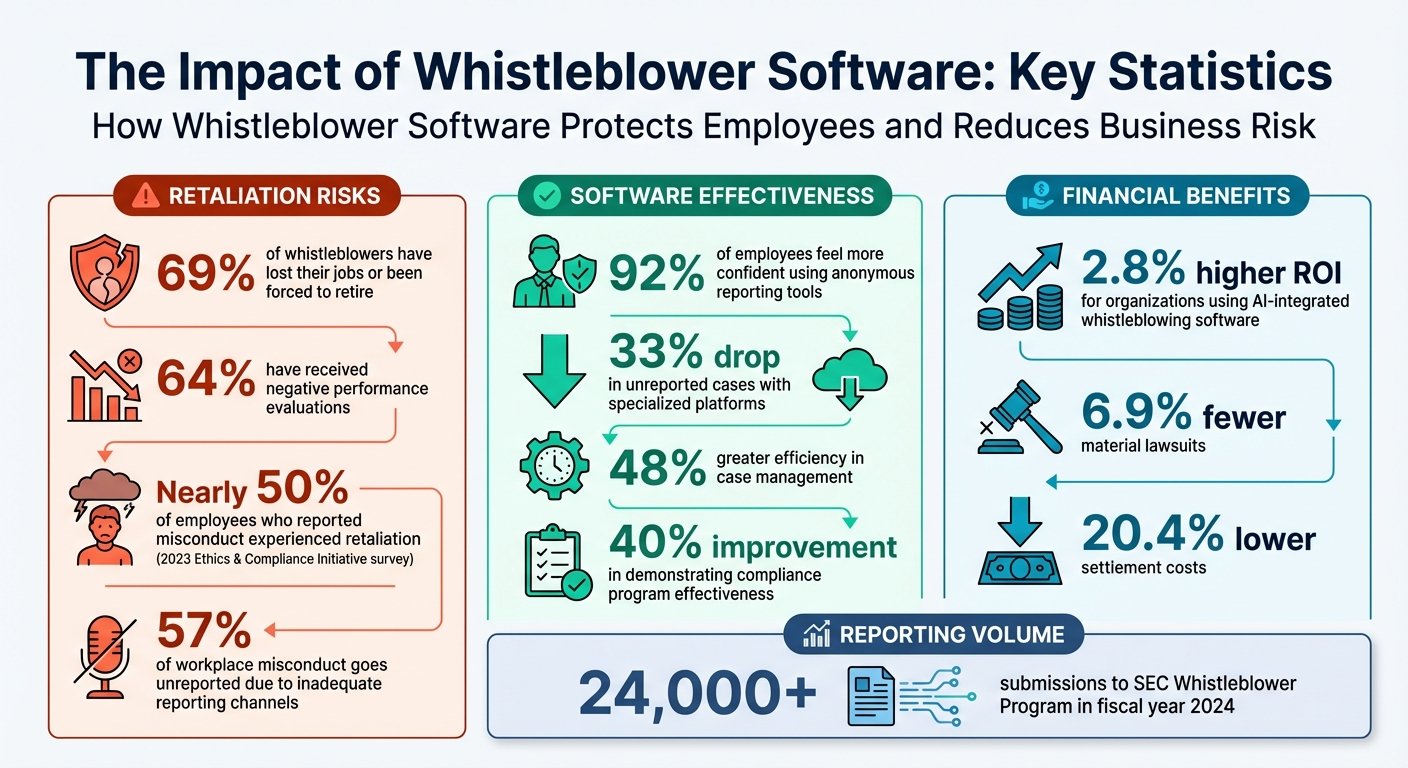
“The SEC also received 45,130 tips, complaints, and referrals in fiscal year 2024, the most ever received in one year, including more than 24,000 whistleblower tips, more than 14,000 of which were submitted by two individuals. The SEC issued whistleblower awards totaling $255 million.”
That last clause is the part worth pausing on, and the part the previous version of this article omitted. More than half the whistleblower tips in a record year came from two people. A headline about record tip volume, quoted without that qualifier, tells you something that is not true about how many insiders are actually coming forward. If you are building a compliance case internally on the strength of “record tips”, use the full sentence.
The programme’s cumulative scale is nonetheless real: nearly $2 billion paid to about 400 whistleblowers as of the end of fiscal 2023, according to the SEC’s programme page.
What We Could Not Verify
This section previously listed several individual award announcements with dates and amounts, a percentage breakdown of allegation types, tip counts for a DOJ pilot programme, and a first-of-its-kind antitrust award against a named company for bid rigging. We could not confirm any of them against SEC or DOJ sources, and we are not willing to assert an enforcement action against a named company on the strength of an unsourced sentence. They are removed.
If you need current figures, the SEC publishes an annual report to Congress on the whistleblower programme and the DOJ publishes annual False Claims Act statistics. Both are free, and both are more current than any article.
How to Implement Whistleblower Reward Programs
An effective programme needs a defined framework: who can report (employees, contractors, vendors), what can be reported (fraud, corruption, safety, ESG risks), and what happens to a report once it arrives.
The DOJ’s Corporate Enforcement and Voluntary Self-Disclosure Policy ties leniency to prompt self-disclosure after a company learns of misconduct, including through an internal whistleblower. The specific windows and conditions have been revised more than once, so read the current policy text on justice.gov rather than a summary – including this one – before designing your process around a number.
Whatever the current deadline, the operational implication is the same: you need to be able to move from “a report arrived” to “we know what happened” in weeks, not quarters. That requires auditable processes with timestamps at submission, assessment and resolution, so you can demonstrate when you knew what.
Setting Up Anonymous Reporting Channels
Protecting identity is a technical problem before it is a policy one. Systems that avoid logging IP addresses and encrypt submissions at rest are the baseline. Offer several routes – web portal, phone line, mobile, two-way anonymous messaging – because different people trust different channels.
Two-way anonymous messaging matters more than it sounds. Most reports are incomplete, and an investigator who cannot ask a follow-up question is working with one paragraph. A pseudonymous inbox with a case number lets the conversation continue without unmasking anyone.
Check vendor security claims against independent certification such as SOC 2 or ISO 27001.
If you operate in the EU, the Whistleblower Directive sets hard deadlines: acknowledge a report within seven days and provide feedback on follow-up within three months. Those are legal obligations, not targets, and meeting them consistently by hand is difficult above a small volume.
Training Employees and Managers
People who understand the process, the protections and the neutrality of the investigation are more likely to use it. People who do not, or who have seen what happened to the last person, will not.
Train by role. Employees need to know the channels exist and what protection they have. Managers need to recognise a protected disclosure and to understand that retaliation includes the subtle forms – dropping someone from a project, a delayed promotion, exclusion from meetings – which are what actually happens and what plaintiffs’ lawyers look for. Investigators need training in neutrality, evidence handling and interviewing, because their work will be read by a regulator.
We removed the retaliation statistics that used to sit in this section. They could not be sourced. The qualitative point stands without them, and any manager who has worked in a large organisation already knows it: employees watch what happens to the first person who speaks up, and act accordingly.
Using Digital Tools
Centralised platforms that integrate with HR and IT service management systems allow reports to be routed automatically by type and severity, so a safety issue reaches the right people immediately rather than sitting in a shared inbox.
BizBot lists compliance and HR tooling if you are assembling this from parts. For most organisations below a few hundred people, a monitored external mailbox with a documented procedure and a named owner outside HR will meet the obligation; buy a platform when your volume or your regulator requires it.
Run the process as a drill occasionally. Submit a test report and see how long it takes to reach an investigator. The answer is usually longer than anyone in the room expected.
Internal Reporting vs. Reward-Driven Reporting
Internal reporting aims to catch problems before they become regulatory matters, relying on culture and, sometimes, on performance incentives. Reward-driven external reporting relies on money, and the money can be very large.
The decisive differences are legal, not cultural. External programmes carry statutory anti-retaliation protection and confidentiality; most internal channels carry neither. An employee weighing the two is comparing a guaranteed career risk against a protected process with a possible payout, and the reason this is a difficult problem for employers is that the employee is reasoning correctly.
Why Rewards Work
Financial incentives surface complex fraud that internal controls miss, because the person who understands the scheme is usually inside it. No amount of transaction monitoring substitutes for someone who knows what the entries were meant to conceal.
Self-disclosure also buys real benefits under DOJ policy, up to and including a decision not to prosecute. Whether you qualify depends on how fast you move after learning of the conduct, which is why the internal investigation timeline is the part of your compliance programme with the most money attached to it.
Challenges
The obvious risk is that large payouts encourage employees to escalate minor issues externally, and to frame small matters as large ones. That is a real cost of the design, and it falls on companies that had done nothing wrong as well as on those that had.
The mitigations available to you are limited but genuine: pay something for internal reports, enforce anti-retaliation policy visibly rather than only in the handbook, permit reporting through counsel, and investigate quickly enough that going external offers no advantage in speed. None of that competes with a percentage of a nine-figure sanction. It does not have to. It only has to beat doing nothing, which is what most employees are currently choosing.
Conclusion
Whistleblower rewards have shifted the balance of information. Employees who know about misconduct now have a protected, paid route to a regulator, and your internal channel competes with it whether you designed it to or not.
The verified picture is this: awards run between 10% and 30% of money collected when sanctions exceed $1 million; the SEC has paid nearly $2 billion to about 400 people since the programme began; and in fiscal 2024 it issued $255 million in awards while receiving more than 24,000 whistleblower tips, over 14,000 of which came from just two individuals. On the civil side, the DOJ recovered more than $2.9 billion under the False Claims Act in fiscal 2024, with relator shares above $400 million.
What follows from that is unglamorous. Build a channel that offers anonymity and acts on what comes in, investigate fast enough to preserve your self-disclosure options, and make sure the first person who uses it is treated in a way the second person will hear about. That is the whole programme.
FAQs
How can a company keep employees reporting internally instead of going to regulators?
Make the internal route lower-risk and comparably fast. Confidential channels, a credible anti-retaliation policy that is actually enforced, and visible action on reports do most of the work.
Be realistic about the limit. You cannot outbid a statutory award, and you should not pretend to employees that you can. What you can offer is speed, discretion, and a process that does not end their career. For most issues, most of the time, that is enough.
What should an internal investigation process include to preserve self-disclosure options?
Prompt escalation, thorough documentation from the first day, a decision point with a named owner, and cooperation with the relevant agency once you disclose. Check the current DOJ policy for the applicable timing and conditions before you rely on any specific deadline; this area has been revised repeatedly.
How do you prevent retaliation while investigating anonymous reports?
Limit knowledge of the report to the people who need it, and record who was told and when. Most retaliation follows from the reporter’s identity leaking to the subject of the complaint, so access control is the primary defence rather than policy language.
Then monitor. If the reporter is identifiable, track their performance reviews, assignments and departure for the following year. Retaliation is usually visible in the record before anyone complains about it.
More on this topic
Browse all 79 articles on Security & Compliance.