
Want to keep your best customers coming back? A VIP membership program is a proven way to boost loyalty, increase profits, and protect your most important revenue sources. Here’s what you need to know:
- A small group carries the revenue: In most small businesses a minority of customers account for a large share of sales. Work out your own split before you design anything; the ratio varies wildly by trade.
- Retention is cheaper than acquisition: True almost everywhere, but the multiple depends on your channel costs, not on a figure from a blog post.
- What VIP programs actually do: They raise switching costs for people who already like you. They do not create demand where there is none.
This guide explains how to identify your top customers, design a cost-effective program, and build rewards that motivate. Whether you run a coffee shop, online store, or service business, you’ll find simple, actionable steps to create a VIP program that strengthens customer relationships and drives revenue.
Key Highlights:
- Use customer data (RFM analysis) to identify your top 5–10% of customers.
- Design tiered rewards like free shipping, early access, or exclusive perks.
- Launch with top subscription management software or free tools like LoyaltyLion or Smile.io.
- Track metrics like retention, lifetime value, and reward redemption to refine your program.
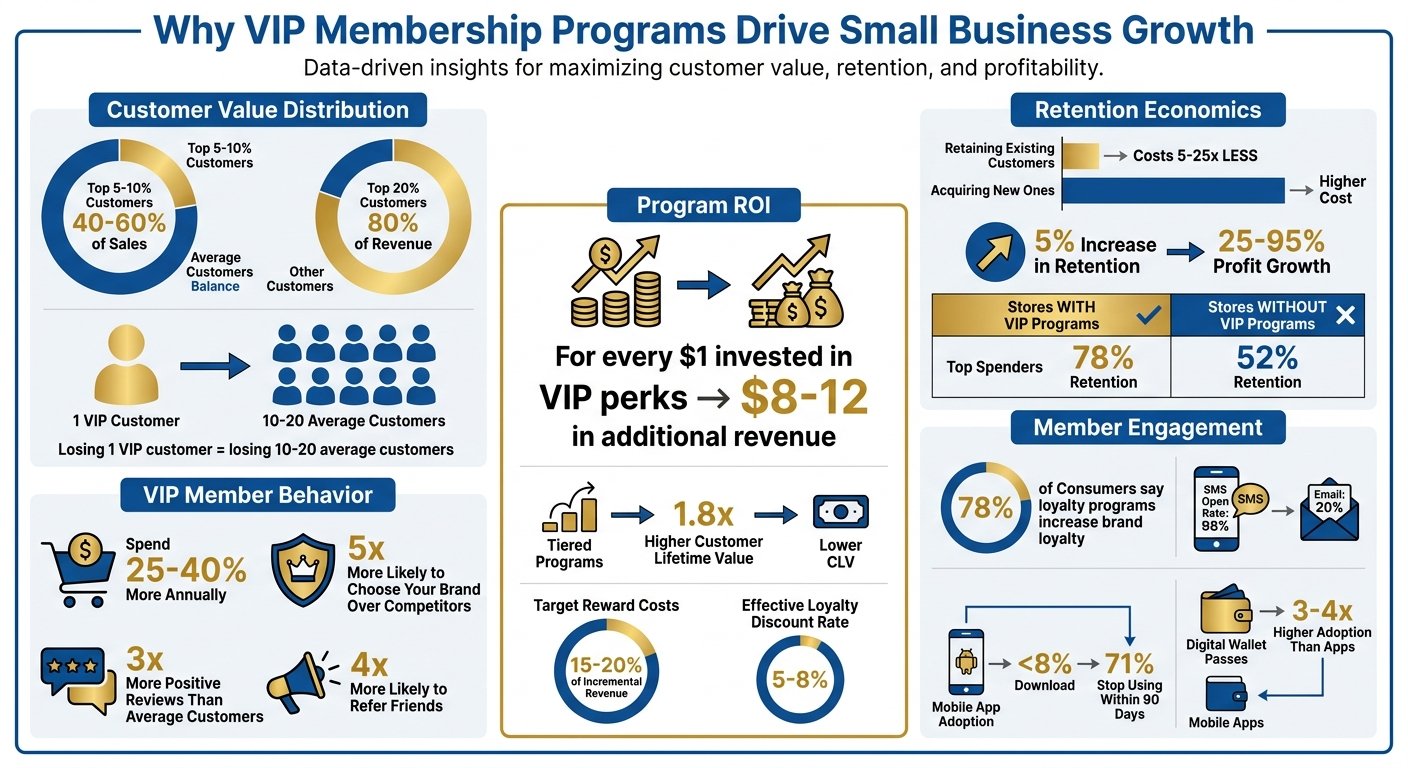
One note on the numbers below: we removed the loyalty statistics that could not be traced to a named source, and left the ones that can. Loyalty marketing is full of figures that get copied between articles until nobody can find the study.
VIP Membership Program Statistics and ROI for Small Businesses
Why VIP Programs Matter for Small Businesses
VIP programs do more than just reward your best customers – they protect your revenue and fend off competitors. The reason is concentration: in most small businesses a small group of customers accounts for a disproportionate share of sales, and losing one of them costs more than losing several average ones. Run the numbers on your own book rather than trusting a rule of thumb. A structured VIP program is a way to raise the cost of leaving for the people you can least afford to lose.
Be careful with return-on-investment claims here. Loyalty vendors publish revenue multiples for their own platforms, and those numbers are neither independent nor comparable across businesses. The only figure that matters is your own incremental revenue: what VIPs spent that they would not have spent anyway.
The Psychology Behind VIP Programs
VIP programs tap into some powerful psychological drivers, like loss aversion and the goal gradient effect. These triggers encourage customers to keep their elite status and spend more as they approach the next reward tier. For example, if a customer is 70% of the way to earning Gold status, they’ll feel motivated to close that gap. This is why tiered programs tend to work better than flat ones: they create milestones to aim at.
“A 10% discount gets a nod. A VIP experience gets remembered.” – Perkstar
Recognition and status are real motivators, and cheaper to supply than discounts. You are not just selling products; you are offering membership in a club people would rather not be dropped from. Designing benefits that tap into these psychological triggers is key to keeping your top customers engaged.
Main Benefits for Small Businesses
VIP programs don’t just boost retention – they give small businesses a competitive edge. One major advantage is predictable revenue. Knowing who your VIPs are and tracking their behavior helps you forecast cash flow more accurately. A paid membership with a flat annual fee turns some of that into subscription income you can budget against, though it also sets an expectation you then have to meet every year.
VIP members also tend to be the people who leave reviews and make referrals, because they are the ones with something to say. Their feedback is worth more than the referrals.
Small businesses have a unique ability to create personal connections that big chains can’t match. Think behind-the-scenes access, founder Q&A sessions, or handwritten thank-you notes. These small gestures often feel incredibly meaningful to customers while costing very little to deliver.
Ultimately, VIP programs let small businesses compete on relationships rather than price. While competitors race to the bottom with discounts, you’re building emotional loyalty that protects your margins. VIPs aren’t just buying products – they’re joining a community they want to stay part of.
Planning Your VIP Membership Program
Before diving into your VIP membership program, it’s crucial to have a detailed plan. The success of your program depends on how well you define its structure and criteria from the start. A well-thought-out program can boost revenue, while a poorly planned one may waste time and resources.
Defining Your Ideal VIP Customer
Start by analyzing your sales data from the past 12 months using an RFM analysis. This process evaluates three key factors:
- Recency: How recently a customer made a purchase.
- Frequency: How often they buy.
- Monetary Value: How much they spend.
For example, a customer who spends $1,000 across ten visits is more valuable than someone who spends the same amount in just one visit. Assign an RFM score (1–5 for each category) to each customer and focus on those scoring 13 or higher. These are your VIP candidates. Roughly the top tenth of your customer base is a common starting point, and keeping the group small is what makes the status worth having.
Don’t stop at spending habits. Consider other behaviors, like leaving positive reviews, engaging on social media, or referring new customers. Pay attention to “rising stars” – customers whose spending or purchase frequency is growing. These individuals could become your next top-tier VIPs.
Once you’ve identified your most valuable customers, you can create membership requirements tailored to them.
Setting Membership Requirements
Your requirements should encourage customers to increase their spending or engagement while still feeling achievable. For example, if the average customer spends $250 annually, set the first tier at $275 – just above their current level. Using specific numbers like $275 instead of $300 signals that your thresholds are based on data, not arbitrary decisions.
Align these thresholds with your business goals. If you want to increase order values, you might set annual spending requirements like $2,000 for entry-level, $5,000 for mid-tier, and $10,000 for top-tier VIPs. If purchase frequency is your focus, consider requiring six purchases per year or monthly orders. Alternatively, offer a paid membership option with a flat annual fee, priced so the benefits are obviously worth several times what you charge. If a member has to do arithmetic to work out whether it paid off, the price is too high.
To maintain fairness, allow a 60–90-day grace period before reassessing membership status. Avoid sudden status changes, as they can feel punitive. Use a rolling 12-month window to calculate eligibility, and automate this process by tagging customers in your e-commerce platform.
Building Membership Tiers
With clear thresholds in place, organize your program into tiers. For most small businesses, three tiers strike the right balance between simplicity and effectiveness. Aim for a distribution where 60% of VIPs fall into the entry tier, 25–30% into the mid-tier, and 10–15% into the top tier. This structure keeps the highest level exclusive while giving most customers a clear path to progress.
Each tier should offer unique perks that build upon the previous level. For example:
- Entry Tier: Birthday rewards and access to member-only sales.
- Mid-Tier: Free standard shipping and early access to new products.
- Top Tier: Premium benefits like free express shipping, exclusive products, and priority customer support.
Use visual progress indicators, like progress bars on customer account pages, to show how close they are to reaching the next tier. This taps into the goal gradient effect, where people are naturally motivated to work harder as they near a milestone. Progress that is visible gets chased; progress that is invisible does not.
Finally, keep your reward costs in check. Aim to spend no more than 15–20% of the additional revenue generated by VIP customers. Use your customer data to set thresholds – target the 60th percentile for mid-tier and the 85th percentile for top-tier. This ensures your tiers reflect actual customer behavior rather than guesswork.
Choosing Rewards and Member Benefits
Once your tier structure is set, the next step is picking rewards that make each level enticing while staying aligned with the membership requirements you’ve outlined. The success of your VIP program hinges on the rewards you offer. The right perks make customers feel appreciated and encourage them to spend more, while poorly chosen ones can drain resources without creating lasting loyalty. It’s all about finding the sweet spot between perceived value and cost.
Reward Options to Consider
There are four main types of VIP rewards to think about:
- Financial rewards: Discounts, cashback, and points multipliers are straightforward but can directly eat into your profit margins.
- Experiential rewards: Early access to products, exclusive events, or founder Q&A sessions offer a high sense of value at a relatively low cost.
- Convenience perks: Free express shipping, priority reservations, or extended return windows save customers time and effort.
- Recognition rewards: Personalized touches like birthday gifts, VIP badges, or handwritten notes make members feel appreciated without breaking the bank.
The most effective programs blend these categories across their tiers. This approach creates an emotional connection with members that competitors find hard to copy.
Zero-cost perks often do the most work. Early access to limited-edition items, priority booking, or “skip the waitlist” privileges cost you almost nothing and are hard for a competitor to match with a discount. The economics are simple: a perk that costs you inventory position rather than margin does not scale with usage the way a percentage discount does. We removed two brand examples that were previously in this section, because the figures attached to them could not be traced to any published source.
Once you’ve decided on your rewards, keeping their costs under control is key to maintaining profitability.
Managing Reward Costs
To ensure your program remains profitable, keep reward costs at 15–20% of the incremental revenue they generate. Calculate your effective loyalty discount rate – the portion of total customer spend that goes toward rewards – and aim for 5–8%.
Consider using high-margin products (those with 60%+ margins) as rewards. These can be offered as freebies or steeply discounted items without severely impacting profits. Instead of flat discounts, which immediately cut into margins, use points multipliers (like 1.5× or 2× points) for higher-tier members. Also account for “breakage”, the share of rewards that never gets redeemed. It flatters your cost model, and it is also a sign that the reward is not wanted.
Launching and Running Your VIP Program
Selecting Management Tools
Once you’ve outlined your program design, it’s time to choose the tools that will make your VIP program run smoothly. The right software can streamline operations and save you time. Start by selecting a platform that integrates with your existing systems, whether you’re using Shopify, Square, WooCommerce, or a POS system. These integrations allow for automated point tracking and tier assignments based on real-time transaction data.
For e-commerce businesses, Klaviyo is a great option for segmenting customers based on lifetime spending and purchase frequency. If you are just starting out, both Smile.io and LoyaltyLion have free tiers, and both price by monthly order volume rather than per user. Checked against their own pricing pages in August 2026: Smile.io is free up to 200 monthly orders, then $15/month for Essential (500 orders), $79/month for Standard (1,000 orders) and $199/month for Growth (2,500 orders). LoyaltyLion is free up to 400 monthly orders, with its Classic plan at $199/month for 500 orders and its VIP-tier and Plus plans quoted on request. Note what that means in practice: order volume, not features, is what moves you up a plan. Confirm current rates before budgeting.
Brick-and-mortar or hybrid stores can benefit from POS-connected solutions like Regulr or Loyalzoo, which automatically update member statuses during checkout. When it comes to communication, SMS platforms like SimpleTexting get read faster than email, which is why SMS suits time-limited perks and email suits everything else. Use it sparingly; the same directness that makes it effective makes it annoying.
Skip a custom mobile app. For a business of this size it is almost never worth the build and maintenance cost, because you are asking a customer to install software for a loyalty card. Use digital wallet passes instead – Apple Wallet and Google Pay – which need no download and sit next to the cards people already use. If you’re juggling multiple subscriptions for your business, tools like BizBot can help you track and manage those expenses efficiently.
With these tools in place, you’re ready to move on to the launch phase of your VIP program.
Program Launch Steps
Launching a VIP program requires a step-by-step approach to ensure success. Here’s a timeline to guide you:
- Weeks 1–2: Start by auditing key metrics like Customer Lifetime Value (CLTV), Average Order Value (AOV), and profit margins to confirm your reward structure works. Use RFM analysis (Recency, Frequency, Monetary) to identify your initial VIP group, and check what share of revenue that group actually accounts for in your own data.
- Weeks 3–4: Finalize your reward offerings and tech platform. Set a low reward threshold to encourage early participation. Automate triggers for monthly point updates and reward notifications.
- Weeks 5–6: Conduct a beta test with your top customers. This allows you to refine the program before launching it to a broader audience.
- Weeks 7–8: Go live with a public launch. Send an email blast featuring a sign-up bonus (e.g., 100 points) to drive initial enrollment. Add loyalty widgets to your homepage, product pages, and checkout process to increase visibility. Train your staff to recognize VIPs and let them offer spontaneous perks. A perk handed over by a person lands differently from the same perk arriving as an automated email.
Promote the program across multiple channels, including email, SMS, social media, and in-store signage. Encourage sign-ups immediately after a purchase by featuring the program on the order confirmation page, where conversion rates are highest. From start to finish, this process takes about eight weeks.
Tracking and Improving Your VIP Program
Metrics to Monitor
Keeping your VIP program in top shape means regularly checking its vital signs. Start with the retention rate – the percentage of VIPs who continue to shop with you over time. If retention is slipping, it might be time to rethink your perks or qualification criteria. Pay attention to the churn rate, as it can flag problems early on.
Financial indicators are key to understanding the program’s profitability. Metrics like Customer Lifetime Value (CLTV) and Average Order Value (AOV) show how much your VIPs are spending. Set your own target for average order value before launch, so you have something to measure against afterwards. Track incremental revenue to see how much of your sales growth is directly tied to the VIP program, rather than what customers would have spent anyway. This is the number that gets fudged most often: VIPs spend more than average customers by definition, because you selected them for spending more. The question is whether they spend more than they would have without the program.
Another critical metric is the reward redemption rate, which helps you gauge how appealing your perks are. Keep an eye on purchase frequency too. If a VIP’s buying habits start to wane, a timely and personal outreach could help re-engage them. To keep the program sustainable, ensure reward costs stay within 15–20% of the additional revenue generated by VIPs.
Once you’ve established these metrics, complement them with direct feedback from your VIP members to fine-tune the program.
Collecting Member Feedback
Data gives you the numbers, but feedback gives you the story behind them. Use quarterly surveys to gather input from your VIPs. Keep these surveys short – five minutes max – with 5–7 targeted questions. Ask what benefits they value most, what could be improved, and whether they feel appreciated. Send these surveys via email or SMS shortly after a purchase (within 48 hours) to catch members when they’re most engaged.
For deeper insights, schedule phone or video interviews once a year with your top 5–10 most active VIPs. These conversations can uncover emotional connections or unmet needs that surveys might miss. When you act on feedback, let your members know – this reinforces their sense of involvement and appreciation.
Don’t forget to test and tweak along the way. Regular A/B testing can help you refine rewards and messaging. Test one variable at a time – the reward, the threshold, or the message – so you know which change moved the number. We removed an unnamed customer example from this section because it could not be sourced.
Use what you learn to make smarter adjustments and grow your program.
Scaling Your Program
Once you’ve nailed the basics, it’s time to scale up. Start by automating routine tasks like tier updates, birthday rewards, and benefit delivery with tools like Shopify Flow or Klaviyo. Automation saves time while ensuring consistency.
For your most loyal VIPs, keep the personal touch alive. Consider handwritten notes or personal check-ins for your top 20–50 customers to maintain their sense of exclusivity. If a VIP doesn’t re-qualify for a tier, offer a “soft landing” by moving them down just one level instead of removing their status entirely.
Review your program every quarter to keep it fresh and effective. Reassess qualification criteria, redemption rates, and overall ROI. Adjust spending thresholds as needed, and consider defining tier requirements based on customer spending percentiles – such as the top 10–15% for your highest tier – rather than arbitrary numbers.
Conclusion
Start by identifying your top 5–10% of customers using RFM analysis (Recency, Frequency, Monetary) and build a simple three-tier program. Focus on offering experiential rewards like early product access or exclusive events instead of discounts. They cost less per member and are much harder for a competitor to copy.
Streamline your program by automating tier tracking, reward distribution, and customer communications through your POS or CRM system. This not only saves time but also reduces errors. Use SMS for genuinely time-sensitive alerts and email for everything else. Also, make enrollment hassle-free by only asking for basic details like a name and email.
Keep in mind that retaining customers is cheaper than acquiring them in most businesses, and that a VIP program is a retention tool, not a growth one. If your problem is that not enough people find you, this is the wrong project.
FAQs
Should my VIP program be free or paid?
Choosing between a free or paid VIP program comes down to what you’re aiming to achieve and who your audience is. Paid programs tend to strengthen customer loyalty by offering perks like exclusive discounts or early access, which can motivate members to spend more. On the flip side, free programs appeal to a broader audience, help build a sense of community, and can act as a gateway to upsell premium offerings down the road. The key is to match your choice with both your business goals and what your customers value most.
What perks feel exclusive without hurting margins?
Perks that strike the right balance between feeling exclusive and being budget-friendly often include personalized experiences, customer recognition, and status symbols like VIP tiers or access to special events. These kinds of benefits give customers a sense of being valued and part of something special, all without requiring a hefty financial investment. The key is to provide thoughtful, meaningful rewards that strengthen loyalty while keeping costs in check.
How do I prove my VIP program is profitable?
To show that your VIP program is bringing in profits, focus on tracking a few important metrics. Start with customer retention, repeat purchase rates, and the customer lifetime value (CLTV) of VIP members compared to non-VIPs. Additionally, measure the revenue generated by VIP members and look for shifts in behavior, like a higher average order value (AOV). These figures not only prove profitability but also provide insights for refining your program.
More on this topic
Browse all 44 articles on Marketing & Growth, or jump straight to our buying guide: Best Marketing and CRM Tools for Small Businesses.