Disclosure: This page contains commercial links. BizBot may earn a commission from qualifying purchases. Paid placements do not buy a better ranking. Read our affiliate disclosure.
Namecheap vs GoDaddy is a common comparison for small businesses looking for a domain registrar, but choosing between them involves more than checking which company has the cheapest introductory domain price. Both provide domain registration, hosting, email, website tools, security features, and other services businesses may need when establishing an online presence.
The main difference is in how the two platforms are structured. Namecheap remains strongly centered on domains and related web services, while GoDaddy offers a broader collection of tools around building and managing a business website.
For a small business, the better choice depends on what you actually need. If you’re mainly looking for somewhere to register and manage domains, your priorities may be very different from a business that wants its domain, website, hosting, and email managed through the same provider.
This Namecheap vs GoDaddy comparison looks at the practical differences that matter over the long term, including domain costs, privacy, hosting, email, website tools, support, and ease of management.
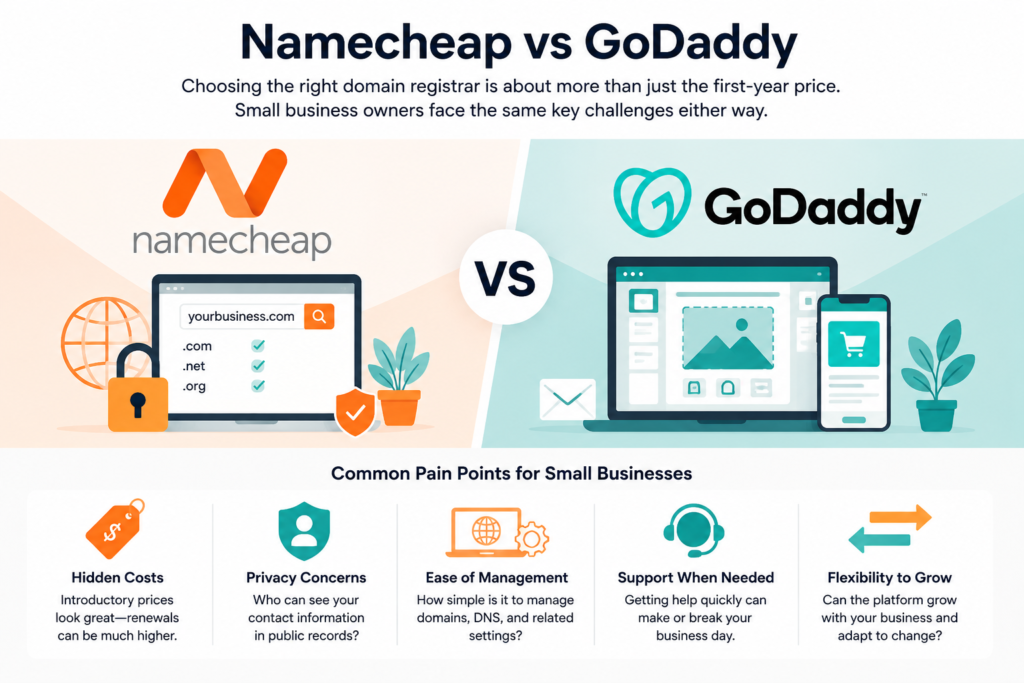
Namecheap vs GoDaddy: Quick Comparison
| Feature | Namecheap | GoDaddy |
|---|---|---|
| Main focus | Domains, hosting, email, and related web services | Domains, websites, hosting, email, and business services |
| .com renewal | $18.48/year | $22.99/year + $0.20 ICANN fee |
| Domain privacy | Included on eligible domains | Included on eligible domains |
| DNSSEC | Available with BasicDNS | Available |
| Web hosting | Available | Available |
| Business email | Namecheap Private Email | Microsoft 365 email plans |
| Website builder | Available | Available |
| Domain marketplace | Available | Available |
| Support options | Live chat and support tickets | Phone and live chat |
Prices and promotions can change. The figures above reflect published U.S. pricing checked in September 2026.
The table shows why it is worth looking beyond domain registration alone. Both companies cover many of the same basic needs, but there are differences in pricing, support, email, and the surrounding services that become more important depending on how you plan to use the domain.
What Is Namecheap?
Namecheap began as a domain registrar and has expanded into web hosting, business email, SSL certificates, website tools, and other web services.
Domain registration is still a major part of the platform. Businesses can register a domain with Namecheap while hosting their website elsewhere, or combine the domain with Namecheap’s own hosting and email services.
This flexibility can be useful if you prefer to choose different providers for different parts of your website rather than putting everything under one company.
For eligible domains, Namecheap also includes domain privacy. Its current .com information lists privacy protection alongside services such as BasicDNS and DNSSEC.
What Is GoDaddy?
GoDaddy is also widely known for domain registration, but its services extend considerably beyond domains.
Businesses can use GoDaddy for web hosting, managed WordPress, website building, ecommerce, business email, and other services connected with establishing and maintaining an online presence.
This creates a somewhat different experience from using a registrar primarily to manage domains. A small business building its first website may appreciate having several services available through the same provider, while another business may prefer to keep its registrar separate from its hosting, email, and website platform.
Neither approach is inherently better. It mainly affects how many services you want to manage through one account.
Namecheap vs GoDaddy Domain Pricing
Domain pricing deserves more attention than the introductory offer displayed on the homepage.
A business may keep the same domain for many years, which means renewal pricing can eventually matter more than the first-year discount.
At the time of this comparison, Namecheap lists standard .com registration at $14.98 and renewal at $18.48 per year, although introductory promotions can reduce the initial registration cost.
GoDaddy lists .com renewal at $22.99 plus a $0.20 annual ICANN fee. Its published pricing also advertises introductory offers that can substantially reduce the initial cost under particular registration terms.
For someone registering one domain, a difference of a few dollars each year may not be particularly important.
It becomes more noticeable for businesses managing a larger domain portfolio.
The more useful comparison, therefore, isn’t simply:
“How much does the domain cost today?”
It’s:
“What will this domain cost to maintain over the next several years?”
That approach also makes it easier to compare registrars when promotional prices change.
Namecheap vs GoDaddy Domain Privacy
Domain privacy helps prevent personal contact information associated with a domain registration from being unnecessarily exposed through public registration records where privacy services are permitted.
Namecheap provides free domain privacy for eligible domains and describes the service as included for the life of the domain.
GoDaddy also provides Domain Privacy for eligible domains. Its privacy service replaces certain registrant information shown through its public WHOIS directory with substitute information.
There can be exceptions depending on the domain extension and registry requirements, so businesses registering less common extensions should check the specific rules before purchasing.
For a typical small business registering an eligible .com domain, however, both providers now include privacy protection rather than requiring it to be treated as a major differentiating feature.
Namecheap vs GoDaddy for Domain Management
For routine domain management, both platforms provide the functionality most businesses are likely to need.
You can manage DNS records, renew domains, update contact information, configure nameservers, and transfer domains when necessary.
The larger difference is what surrounds those domain-management tools.
Namecheap’s broader services include hosting, email, SSL, and other web products, but domain management remains a central part of the platform.
GoDaddy places domain registration within a larger collection of website and business services. That can be convenient when the same company is also handling your hosting, website, or email.
On the other hand, businesses that already use separate providers for those services may not place much value on having everything available from their registrar.
This is one of those areas where how you operate your website matters more than which company has the longer feature list.
Don’t Overlook Who Owns the Domain
Whether you register with Namecheap, GoDaddy, or another provider, one issue matters considerably more than many feature differences: the business should retain control of its own domain.
A surprisingly avoidable problem occurs when a web developer, freelancer, employee, or marketing agency registers a company’s primary domain through an account that only they control.
Everything may work perfectly until that relationship ends.
ICANN explains that domain registrants have rights and responsibilities associated with managing, renewing, restoring, and transferring their registrations.
For a business domain, the registrar account should therefore use company-controlled information wherever practical, and more than one appropriate person should know how the account can be accessed or recovered.
That principle applies regardless of which registrar you choose.
Looking Beyond the Domain
If all you need is domain registration, the differences between Namecheap and GoDaddy are relatively straightforward.
But many small businesses need more.
You may also need somewhere to host the website, professional email addresses, SSL certificates, WordPress support, or a simple website builder. Once those requirements enter the picture, comparing the two companies purely on domain renewal prices doesn’t tell you very much.
That’s where the Namecheap vs GoDaddy comparison becomes more interesting.
Namecheap vs GoDaddy for Web Hosting
Both Namecheap and GoDaddy offer web hosting, so you can keep your domain and website with the same company if you prefer.
Namecheap offers shared hosting, WordPress hosting, VPS hosting, and dedicated servers. GoDaddy provides a similar range, including web hosting, managed WordPress, VPS hosting, and dedicated server options.
For a typical small business website, shared or managed WordPress hosting will usually be the more relevant comparison.
The advantage of keeping your domain and hosting together is mostly convenience. There are fewer accounts to manage, and connecting the domain to the website can be simpler.
But there is no requirement to do this. You can register a domain with Namecheap and host the website somewhere else, or register through GoDaddy and use another hosting provider.
For a business, hosting should ultimately be evaluated on factors such as reliability, performance, backups, security, support, and what happens when the website grows—not simply whether the registrar offers it.
Namecheap vs GoDaddy for Business Email
A professional email address using your own domain is one of the first things many businesses set up after registering a domain.
Namecheap offers its own Private Email service, with plans designed around domain-based email accounts. It can be purchased separately from hosting, so businesses don’t need to move their website to Namecheap simply to use its email service.
GoDaddy’s professional email offering is built around Microsoft 365, giving businesses access to Outlook-based email and, depending on the plan, additional Microsoft services.
This creates a meaningful difference between the two.
A small business that simply needs addresses such as name@yourcompany.com may find a straightforward hosted email service sufficient. A company already using Microsoft applications may place more value on Microsoft 365 integration.
Rather than choosing based on the number of included features, consider how employees actually work. Paying for a larger productivity ecosystem makes sense when the business uses it; otherwise, a simpler email service may be enough.
Namecheap vs GoDaddy for Building a Website
Both providers can help businesses move from owning a domain to having an actual website, but neither requires you to use its website-building tools.
Namecheap provides website-building options through its hosting services, including tools aimed at people who don’t want to build a site from scratch.
GoDaddy has invested heavily in combining domains with website creation. Its Website Builder includes templates and tools for creating business websites without requiring much technical knowledge.
For someone launching a first website, that convenience can be useful.
The trade-off is worth considering before committing to any proprietary website builder: how easily could the website move somewhere else later?
Domains are relatively portable. Websites can be more complicated.
A domain can generally be pointed toward another hosting provider or transferred to another registrar. Moving a website may involve migrating content, images, databases, plugins, email, and other configurations.
The broader lesson applies here too: convenience today shouldn’t make changing providers unnecessarily difficult tomorrow.
Security and Account Protection
A domain is a small digital asset with an unusually large amount of power.
If someone gains control of your registrar account, they may be able to redirect your website, interfere with email routing, change DNS records, or attempt to transfer the domain.
That makes account security more important than many of the additional features registrars advertise.
Both Namecheap and GoDaddy provide security controls for protecting accounts and domains. Regardless of provider, businesses should enable available multi-factor authentication, use strong unique credentials, and make sure account recovery information remains current.
Administrative access also deserves attention.
The employee who originally registered the domain may not be the person managing it five years later. Businesses should periodically review who has access to important online systems and remove access that is no longer required.
The same principle applies across cloud applications. Bizbot’s guide to setting up role-based permissions explains why access should follow people’s actual responsibilities rather than simply giving everyone broad administrative privileges.
What If You Want to Transfer Your Domain Later?
Choosing a registrar isn’t necessarily a permanent decision.
Domains can generally be transferred between registrars, subject to applicable registry and ICANN rules. There are circumstances where a transfer may temporarily be restricted, such as certain periods following a new registration, recent transfer, or changes to registrant information.
This means you don’t need to treat your first registrar choice as something your business will be stuck with forever.
However, transferring becomes much easier when the company controls the registrar account and keeps its administrative and contact information current.
Before moving a domain, also check what else is attached to the existing account. Hosting, email, SSL certificates, DNS services, and other products may need separate attention even though the domain itself is being transferred.
Namecheap vs GoDaddy Customer Support
Support is another area where the two companies take somewhat different approaches.
Namecheap provides 24/7 support primarily through live chat and support tickets.
GoDaddy provides chat support as well as phone support in many markets.
For some business owners, having the option to speak with someone by phone can be valuable, particularly when dealing with a website or domain problem they don’t fully understand.
Others may prefer live chat because conversations can be documented and technical information such as DNS records can be copied directly into the discussion.
This isn’t really a question of one support format being universally better. Consider how you normally want help when something goes wrong.
Namecheap or GoDaddy: Which Should a Small Business Choose?
The differences become easier to understand when you consider the type of business using the service.
Namecheap makes sense for businesses that primarily want straightforward domain management and are comfortable choosing separate providers for hosting, email, or other services when necessary. Its lower current .com renewal price may also become relevant when managing multiple domains.
GoDaddy makes sense for businesses that value having several website-related services available from the same provider, particularly if they want domains, website building, hosting, and Microsoft 365 email within a broader ecosystem.
Neither choice prevents you from using third-party services later.
A business could register its domain through Namecheap, host its website elsewhere, and use Google Workspace for email. Another could use GoDaddy for the domain and website while relying on completely separate CRM, accounting, and cloud-storage platforms.
The registrar doesn’t need to become your entire technology stack.
Frequently Asked Questions
Is Namecheap cheaper than GoDaddy?
It depends on the domain extension, promotion, and services you’re purchasing. For the standard .com renewal prices examined in this comparison, Namecheap’s published renewal price was lower. Introductory offers can change frequently, so compare the renewal cost rather than relying solely on the first-year price.
Can I move a GoDaddy domain to Namecheap later?
Generally, yes, provided the domain is eligible for transfer. Transfer restrictions can apply in certain circumstances, so check the domain’s status and applicable transfer rules before starting the process.
Can I use Namecheap for my domain and GoDaddy for hosting?
Yes. Your domain registrar and web host do not have to be the same company. You can update the domain’s DNS or nameservers to point it toward a different hosting provider.
Does Namecheap include domain privacy?
Namecheap includes its domain privacy service with eligible domains. Availability can depend on the domain extension.
Does GoDaddy include domain privacy?
GoDaddy also provides Domain Privacy with eligible domains. Certain domain extensions may have different privacy requirements.
Do I need hosting when I buy a domain?
No. Registering a domain gives you control of the web address, but you can purchase hosting separately or point the domain toward another service.
Final Thoughts
The Namecheap vs GoDaddy comparison ultimately comes down to how you plan to manage your business online.
If your main priority is registering and managing domains while keeping the flexibility to choose separate providers for hosting, email, and other services, Namecheap is worth considering. GoDaddy may suit businesses that prefer having domains, website building, hosting, and other web services available through a broader platform.
Whichever you choose, don’t base the decision entirely on the introductory domain price. Look at renewal costs, the services you’ll actually use, support options, and how easily you can manage or transfer your domain later.
Most importantly, make sure the domain remains under a company-controlled account. Providers can change, but your business should always retain control of the digital address customers use to find you.