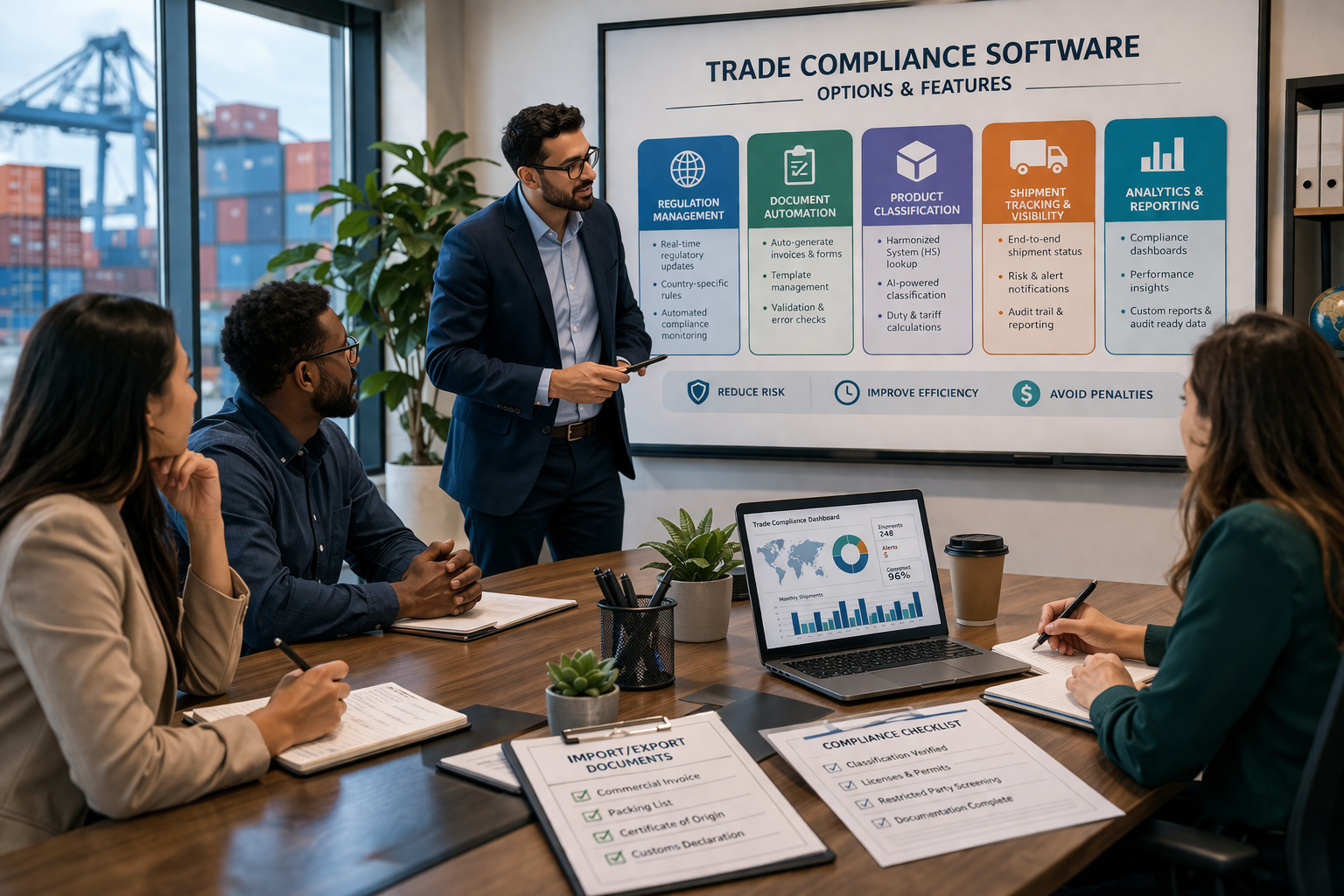
Global trade has never been more accessible, and it has also never been more complex. For businesses operating across borders, trade compliance is no longer just a regulatory requirement; it’s a critical part of day-to-day operations. From changing import and export laws to documentation requirements and tariff classifications, even small mistakes can lead to costly delays, penalties, or disrupted supply chains.
The awkward part is that most of these mistakes are administrative rather than logistical. Your freight can be on time and your shipment can still sit in a bonded warehouse because a code on a form was wrong, or because a name on the consignee line matched an entry on a sanctions list.
One point worth establishing before anything else: in most jurisdictions the legal responsibility for a correct declaration sits with the importer or exporter of record, not with the broker or the forwarder who filed it. You can outsource the filing. You cannot outsource the liability. That single fact is the reason compliance software exists, and it is also the limit of what it can do for you.
Here are five of the most common trade compliance challenges businesses face, and how the right software helps.
1. Keeping Up With Constantly Changing Regulations
Trade regulations are not static. Governments regularly update import and export rules, tariffs, sanctions, and documentation requirements.
For businesses, this creates a moving target. What was compliant last quarter may no longer be valid today. Relying on manual tracking or outdated information increases the risk of non-compliance. And even unintentional errors can lead to fines or shipment delays.
Two changes matter more than the rest, because they can invalidate work you have already done. Tariff schedules are revised on a cycle, and codes get split, merged or retired, so a classification you validated two years ago may now point at a code that no longer exists. And restricted party lists change without a schedule at all, which means a customer who screened clean when you onboarded them may not screen clean today.
How software helps:
Modern compliance platforms provide updates on regulatory changes across regions and, more importantly, re-apply them to your existing data. The feature to ask about by name is retroactive rescreening: when a list changes, does the system automatically re-run your entire customer and supplier master against it, or does it only screen new transactions? Only the first one protects you. A platform that screens at order entry and never looks back leaves you exposed to every designation made after onboarding.
2. Lack of Visibility Across the Compliance Process
One of the biggest challenges in trade compliance is the lack of visibility. When processes are spread across multiple teams, systems, or regions, it becomes difficult to:
● Track the status of shipments.
● Identify compliance gaps.
● Respond quickly to issues.
This lack of transparency often leads to reactive decision-making instead of proactive planning.
How software helps:
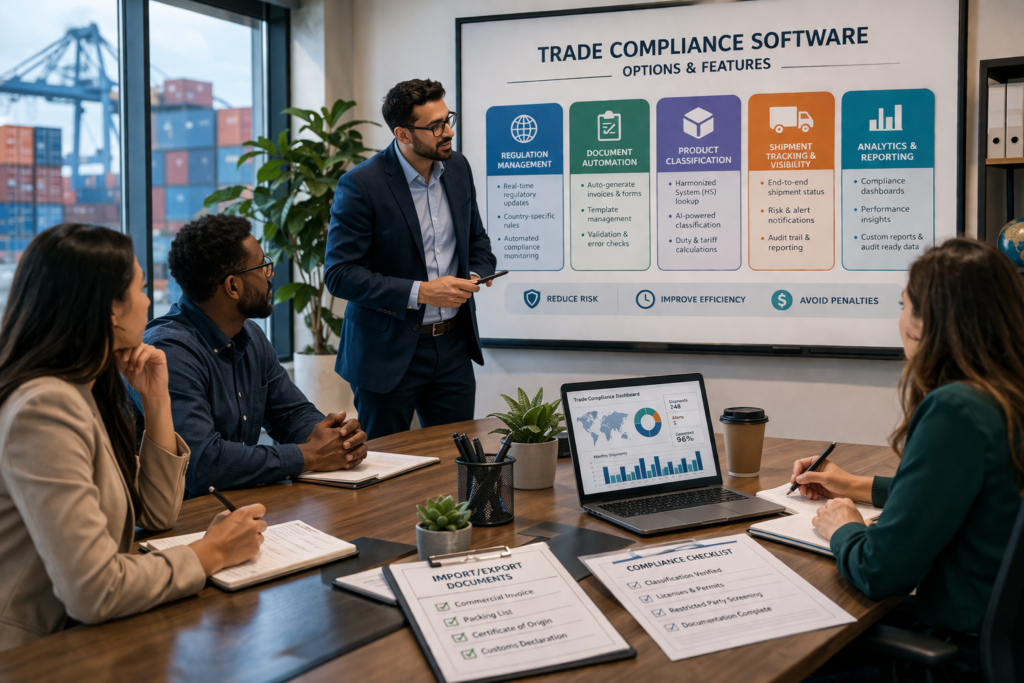
The right compliance software brings everything into a centralized system. With tools like Livingston trade compliance software, businesses gain better visibility into their compliance activities. They include:
● Real-time shipment tracking.
● Compliance status monitoring.
● Alerts for potential risks.
Visibility is also a recordkeeping problem, not just an operational one. US importers are required to keep entry records for five years from the date of entry under the customs recordkeeping rules in 19 CFR Part 163, and other jurisdictions have their own retention periods. If your commercial invoices sit in one inbox, your entry summaries with your broker, and your origin certificates in a shared drive, you technically have the records and practically cannot produce them. An audit request with a two-week deadline is where that difference becomes expensive.
3. Managing Complex and Error-Prone Documentation
Trade compliance involves a large volume of documentation:
● Commercial invoices.
● Certificates of origin.
● Customs declarations.
● Shipping documents.
Even a small error, like an incorrect product classification or a missing detail, can delay shipments or trigger inspections. Manual documentation processes are especially vulnerable to mistakes, particularly when dealing with high shipment volumes.
A few specific errors account for a disproportionate share of holds:
- Country of origin confused with country of export. Goods manufactured in one country and shipped from a warehouse in another have two different countries on the paperwork, and only one of them determines duty.
- Vague goods descriptions. “Parts”, “samples” and “gifts” are the descriptions most likely to attract an inspection. A description should let an officer arrive at your declared code without asking you.
- Incoterms that contradict the rest of the file. The term you agreed determines who is the importer of record and who clears the goods. If your invoice says DDP and your customer is filing the entry, something is wrong and it will surface at the border.
- Free trade agreement claims with no supporting evidence. Claiming preferential origin is easy. Producing the supplier declarations and bills of materials that support the claim, two years later, is what an audit actually asks for.
How software helps:
Automation significantly reduces human error. Compliance software can:
● Generate accurate documents.
● Validate information before submission.
● Standardize processes across shipments.
The validation step is where the value sits. A system that refuses to release a shipment when the origin field is blank, the description is under a certain length, or the declared value does not reconcile with the commercial invoice catches errors while they are still free to fix.
4. Classifying Products Correctly Across Markets
Product classification is one of the most critical and most challenging parts of trade compliance. Different countries may have different classification requirements, and incorrect classification can lead to:
● Incorrect duties and taxes.
● Regulatory violations.
● Shipment holds.
It helps to know why this is structurally hard. The Harmonized System is standardised internationally to six digits, and that much is the same everywhere. Beyond six digits, each territory extends the code for its own purposes: the United States uses a ten-digit HTS number, the EU uses an eight-digit Combined Nomenclature code and ten digits for TARIC. So a single product legitimately has one six-digit stem and a different full code in every market you sell into. Maintaining that mapping by hand across a catalogue of any size is where the errors come from.
How software helps:
Advanced platforms use centralized classification databases so a product is classified once and mapped to each destination’s national extension, rather than being reclassified per shipment by whoever is doing the paperwork that day. That consistency is worth more than speed: the most damaging classification errors are not one-off mistakes, they are a wrong code applied identically to two thousand entries before anyone notices.
For genuinely ambiguous products, software is not the answer. Both the US and the EU issue advance rulings that are legally binding on the customs authority: a CBP binding ruling in the United States, Binding Tariff Information in the EU. If a product is high volume, high duty, or sits between two plausible headings, a ruling is the only thing that converts an opinion into certainty, and past rulings are searchable, so someone may already have asked your question.
5. Scaling Compliance as the Business Grows
As businesses expand into new markets, compliance requirements multiply. What works for a small operation may not be sustainable for a growing global business. More markets mean:
● More regulations.
● More documentation.
● More complexity.
Without scalable systems, compliance can quickly become a bottleneck.
How software helps:
Scalable compliance platforms handle increasing volumes, support multiple regions, and adapt to new regulatory environments without a complete overhaul of existing processes. The practical form this takes is integration: the platform reads product, customer and order data from your ERP or order system rather than asking someone to key it in twice. If you are not yet at platform scale, a light integration layer using Zapier or Make to push order data into a screening step, with the classification master kept in a structured database such as Airtable, is a defensible interim setup. Our guide to the best automation and integration tools covers that layer in more detail.
What the Software Will Not Do
This is the part vendor material leaves out, and it matters before you sign anything.
It does not move liability. If the platform classifies a product wrongly and you file on that basis, the penalty is still yours. Read the contract for what the vendor actually warrants, which is usually the availability of the service rather than the accuracy of a classification.
It inherits your data quality. Screening depends on clean, consistent party names and addresses. If your customer master has the same company entered four ways, screening will miss matches and generate false ones in equal measure. Cleaning that data is a prerequisite, not something the implementation will fix for you.
Over-blocking has a cost too. Tune the fuzzy-matching threshold too tight and a common surname will halt legitimate orders every week. Someone has to own the false-positive queue and clear it within hours, or sales will find a way around the system. Budget the headcount, not just the licence.
Implementation is an integration project. The realistic effort is in mapping your product and party data to the platform’s model. Ask for a reference customer with a catalogue of similar size and ask them how long it took, rather than accepting the vendor’s estimate.
Do this if / do that if
| Your situation | Sensible setup |
|---|---|
| A handful of shipments a month, one or two destination markets, no controlled goods | A good customs broker, a written classification list, and a documented filing routine |
| Regular shipments, several markets, growing catalogue | Broker plus a central classification master and a screening step at order entry |
| Controlled or dual-use goods, or any sanctioned-country exposure | Dedicated screening software with retroactive rescreening, and named internal ownership |
| High volume across many markets, ERP already in place | Full platform integrated with the ERP, plus advance rulings on your top duty lines |
FAQ
Who is legally responsible if my customs broker files the wrong code?
The importer of record, in almost every case. Brokers act as your agent, and reasonable care is your obligation, not theirs. This is why keeping your own classification records and your own copies of entry documents matters even when you outsource the filing entirely.
How often should we screen customers against restricted party lists?
At onboarding, before each shipment, and again whenever the underlying lists are updated. The last one is the step most often skipped and the one that catches the real problems, because designations happen after you have already onboarded someone. If your system cannot rescreen the existing master automatically, that is a serious gap.
Do small businesses really need trade compliance software?
Often not. If you ship occasionally to a small number of markets and none of your goods are controlled, a competent broker and a maintained spreadsheet of your classifications will do the job for far less money. The threshold is less about revenue and more about exposure: controlled or dual-use goods, sanctioned-country risk, or preferential origin claims you would struggle to evidence are the triggers that justify buying software.
Conclusion
Trade compliance is often seen as a challenge, but with the right approach it becomes a manageable operating routine. The key is recognising which parts of it are genuinely a software problem. Classification consistency, screening at scale, document validation and record retrieval are things systems do well. Judgement calls on ambiguous goods, clean master data, and clearing the false-positive queue remain human work, and no platform removes the legal responsibility that sits with you.
By addressing the common failure points, regulatory change, documentation errors, classification complexity and visibility gaps, and by being clear about what the software does not cover, businesses can turn compliance from a source of surprise delays into a predictable process.
More on this topic
Browse all 79 articles on Security & Compliance.