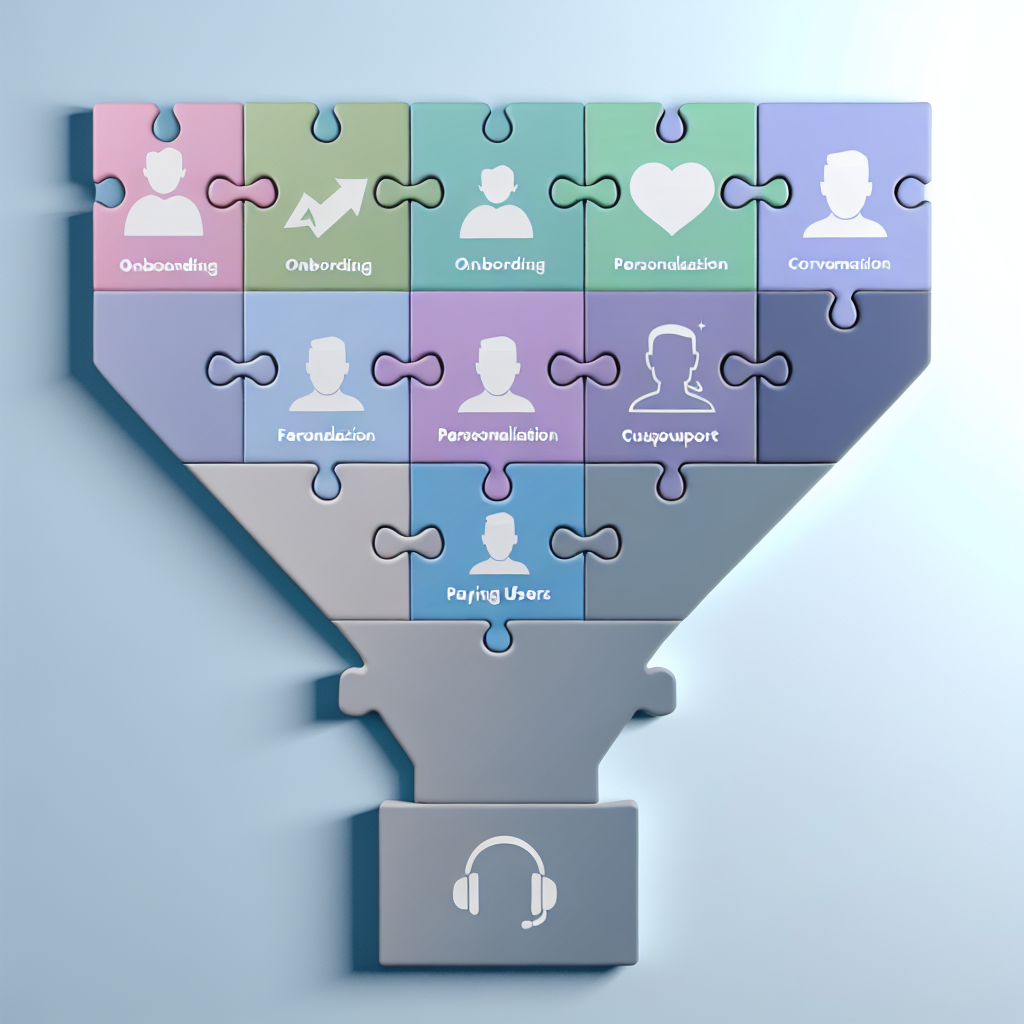
To convert free trial users into paying customers, focus on:
- Setting Clear Expectations: Outline trial duration, accessible features, pricing, and the transition process.
- Simplifying the Signup Process: Minimize form fields, allow social logins, and offer guest access.
- Smooth Onboarding: Implement guided product tours, personalize experiences, and provide onboarding checklists.
- Exceptional Customer Support: Respond quickly, offer multiple support channels, and create a helpful knowledge base.
- Personalization: Collect user information, segment users, and personalize offers.
- Trial Expiration Reminders: Send timely reminders to create a sense of urgency.
- Easy Upgrade Process: Provide clear upgrade calls-to-action, simplify the process, and offer flexible pricing.
- Gathering User Feedback: Ask open-ended questions, provide multiple feedback channels, and incentivize feedback.
- Retargeting Non-Converters: Use email campaigns, social media ads, and in-app notifications.
- Testing and Refining: Test different approaches, analyze results, and optimize the experience.
- Driving Users to ‘Aha Moments’: Identify user goals, simplify onboarding, and use interactive guides.
- Early Product Education: Offer interactive tutorials, personalized onboarding, and a comprehensive knowledge base.
- Easy Data Integration: Provide step-by-step walkthroughs, visual tutorials, and clear call-to-actions.
- Creating a Sense of Urgency: Use trial expiration reminders, limited-time offers, and social proof.
- Analyzing and Optimizing the Funnel: Track key metrics, identify drop-off points, and refine strategies.
A word about the word “proven”. This article calls these strategies proven, and we should be straight with you: it does not carry conversion data for any of them, and we could not find independent studies that measure them in isolation. They are standard practice, which is not the same thing as proof. The only evidence that will settle any of these for your product is a test you run on your own funnel, which is why strategy 10 is the one that makes the other fourteen worth anything.
1. Set Clear Expectations
Clearly outline what users can expect from your free trial to boost conversions. Provide a transparent description of the trial, including features, limitations, and what happens after the trial ends.
Be Transparent About the Trial
- Specify the trial duration: How many days does the trial last?
- List accessible and restricted features: What can users test, and what’s locked?
- Explain pricing and billing: What are the pricing plans, and are there any setup fees?
- Describe the transition process: What happens if users don’t convert, and can they export data?
Being open from the start builds trust and helps users understand the product’s capabilities during the trial, increasing their likelihood of converting.
Provide Clear Pricing Information
Pricing is a key factor in conversions, so be upfront about costs. Outline your pricing plans, including any differences between monthly and annual billing, and highlight limited-time offers or discounts for converting during the trial.
The table below is an illustration of the format, not the pricing of any real product. The numbers are made up: three tiers with a 20% discount for paying annually.
| Plan (illustrative) | Monthly | Annual |
|---|---|---|
| Basic | $19 | $182.40 |
| Pro | $49 | $470.40 |
| Enterprise | $99 | $950.40 |
Example only. Annual pricing billed upfront, 14-day trial included.
Whatever your real numbers are, showing them before the trial starts eliminates surprises and lets users decide whether the product fits their budget before they invest time in it.
2. Simplify the Signup Process
Make it easy for users to start their free trial by reducing friction during the signup process. The fewer barriers they face, the more likely they are to complete the signup and engage with your product.
Minimize Form Fields
Keep your signup form short. Only ask for essential information like email and password. You can gather additional details later.
Allow Social Logins
Add social login options like Google, Facebook, or LinkedIn to simplify the signup process. Users can quickly create an account without manually entering information.
Explain Why Information is Needed
If you need certain data upfront, explain why it’s required. For example, “We ask for your company size to personalize your experience.” This transparency builds trust.
Offer Guest Access
Consider allowing guest access for a limited trial period without requiring any signup. This low-friction approach lets users explore your product before committing to an account. The trade-off is real: you get more people in and less idea who they are.
Use Progress Indicators
Implement progress bars or step indicators during the signup flow. Showing users how close they are to completing the process can encourage them to finish signing up.
By making the signup process as smooth as possible, you’ll get more free trial users into the product itself, which is where conversion actually gets decided.
3. Offer a Smooth Onboarding Experience
A well-designed onboarding experience is crucial for converting free trial users into paying customers. It helps users quickly understand your product’s value and guides them through key features and functionalities.
Implement Guided Product Tours
Use interactive product tours or walkthroughs to improve the onboarding process. Tools like Appcues or Userguiding can help you create step-by-step guides that walk users through your product’s core features. Keep them skippable; a tour a user cannot dismiss is a tax on the people who already know what they want.
Use Behaviour Data to Personalize
Use user data to personalize the onboarding experience. Send targeted messages and guidance based on user actions and preferences, ensuring relevance and timeliness.
Provide Onboarding Checklists
Onboarding checklists with progress bars encourage users to complete essential tasks, which raises the odds they reach the point where the product does something useful for them.
Offer Exceptional Support
Provide responsive customer support during the free trial period. Address users’ questions or issues promptly, helping them overcome obstacles and feel supported throughout the onboarding process.
Highlight the “Aha Moment”
Identify the key behaviors or actions that correlate with user success and define your product’s “Aha moment” – the point where its value becomes clear. Craft your onboarding experience to guide users towards this moment.
A caution on that: the actions that correlate with conversion are not necessarily the actions that cause it. Users who were always going to buy will also do more things in the product. Test the intervention, not the correlation.
4. Provide Helpful Customer Support
During the free trial, users need support to successfully explore your product and experience its value. Providing helpful customer support showcases the level of service users can expect as paying customers.
To provide helpful customer support:
- Respond quickly: Answer users’ questions or issues promptly, helping them overcome obstacles.
- Offer multiple support channels: Provide live chat, email, or phone support to cater to different user preferences.
- Create a helpful knowledge base: Develop a comprehensive FAQ section that answers common questions and helps users find solutions on their own.
- Use user feedback: Improve the product and support experience by using user feedback, demonstrating a commitment to customer satisfaction.
The free trial is when a prospect finds out what your support is actually like. Trial-only support that vanishes after they pay is a good way to generate churn instead of renewals.
5. Use Personalization to Engage Users
Personalization is a useful way to engage free trial users. By tailoring the experience to individual users, you can build trust, demonstrate value, and create a sense of ownership.
Collect User Information
Start by collecting user information during the signup process. This can include details such as job title, company, and goals for using your product. Balance this against strategy 2: every extra field costs you signups, so only ask for what changes what the user sees next.
Segment Users and Trigger Onboarding Experiences
Use this data to segment users and trigger onboarding experiences tailored to their needs. For example, you can create a welcome survey that asks users about their jobs to be done with your product. Then, use the data to segment users and trigger onboarding experiences that help them achieve their goals quickly.
Personalize Offers
Use user behavior data to personalize offers when their free trial period is about to end. For instance, if a user has been regularly using a particular feature, highlight how they can get even more out of that feature if they upgrade to a paid subscription.
| Personalization Strategies | Description |
|---|---|
| Collect user information | Gather details such as job title, company, and goals during signup |
| Segment users and trigger onboarding experiences | Tailor onboarding to individual user needs based on collected data |
| Personalize offers | Use user behavior data to craft targeted offers when the free trial ends |
6. Set Reminders for Trial Expiration
Setting reminders for trial expiration is crucial to convert free trial users into paying customers. By sending timely reminders, you can create a sense of urgency and encourage users to upgrade to a paid subscription.
Why Reminders Matter
Reminders help keep your product top of mind for users, especially if they’ve been inactive or haven’t fully used your features. By sending reminders, you can:
- Create a sense of urgency, encouraging users to take action before their trial expires
- Provide users with a clear call-to-action, making it easy for them to upgrade or extend their trial
- Show users that you’re invested in their success and care about their experience with your product
Best Practices for Trial Expiration Reminders
When crafting your reminders, keep the following in mind. The 3-5 day timing below is a common convention rather than a tested optimum, so treat it as a starting point for your own test.
| Best Practice | Description |
|---|---|
| Timing | Send reminders at strategic intervals, such as 3-5 days before trial expiration, to create a sense of urgency |
| Personalize your messages | Address users by name and tailor your reminders to their specific needs and interests |
| Keep it concise | Keep your reminders brief and to the point, avoiding lengthy emails or messages |
| Provide clear next steps | Make it easy for users to upgrade or extend their trial by including a clear call-to-action |
7. Make it Easy to Upgrade
Make the upgrade process quick and hassle-free. Users who have a positive experience during the trial are more likely to become paying customers if the upgrade path is clear and straightforward.
Provide a Clear Upgrade Call-to-Action
As users approach the end of their free trial, ensure that the option to upgrade to a paid plan is prominently displayed and easily accessible. This can be achieved through:
- In-app notifications or banners
- Dedicated upgrade pages or modals
- Prominent buttons or links in the user interface
The upgrade call-to-action should be visually clear, concise, and communicate what the paid plan actually gives them.
Simplify the Upgrade Process
Minimize the number of steps and reduce friction in the upgrade process. Consider implementing features like:
| Feature | Description |
|---|---|
| One-click upgrade buttons | Streamline the upgrade process with a single click |
| Autofill of user information | Autofill user information to reduce manual input |
| Integration with popular payment gateways | Simplify checkout with popular payment gateways |
Make the upgrade as effortless as you can, but keep cancellation just as easy. A one-click upgrade paired with a three-email cancellation process is the kind of thing customers remember.
Offer Flexible Pricing and Payment Options
Cater to the diverse needs and preferences of your users by providing flexible pricing and payment options. Consider offering:
| Option | Description |
|---|---|
| Monthly and annual billing cycles | Offer users a choice of billing cycles |
| Discounts for annual subscriptions | Provide incentives for annual subscriptions |
| Multiple pricing tiers | Offer different pricing tiers based on features or usage |
| Support for various payment methods | Accept various payment methods for user convenience |
By offering choices, you increase the chances of users finding a plan that fits their budget and requirements.
Highlight the Benefits of Upgrading
Throughout the free trial experience, reinforce what upgrading actually gets them. This can be achieved through:
- In-app messaging or tooltips showcasing premium features
- Comparison tables highlighting the differences between free and paid plans
- Case studies or testimonials from real, named paid customers who agreed to be quoted
A quick, low-friction upgrade experience helps. It will not rescue a product that has not shown the user anything useful during the trial.
8. Gather Feedback from Free Trial Users
Collecting feedback from free trial users is essential to understanding their needs and pain points. This feedback helps you identify areas for improvement, optimize the free trial experience, and increase conversion rates. Here’s how to gather feedback:
Ask Open-Ended Questions
Send a survey or email with open-ended questions to free trial users, asking about their experience with your product. This helps gather qualitative feedback and gain insight into their thought process.
| Example Questions | Description |
|---|---|
| What did you like most about our product? | Understand what users liked about your product |
| What did you find confusing or difficult to use? | Identify areas for improvement |
| How did our product meet or fail to meet your expectations? | Gather feedback on user expectations |
Provide Multiple Feedback Channels
Offer various feedback channels, such as email, in-app messaging, or phone calls, to cater to different user preferences. This encourages more users to provide feedback.
Incentivize Feedback
Consider offering incentives, like discounts or free trials, to users who provide feedback. Be aware this skews who answers, and it skews friendly.
Analyze and Act on Feedback
Analyze the feedback you receive and act on it promptly. The most useful feedback usually comes from the people who did not convert, and they are the hardest to get hold of, so make that group your priority.
9. Retarget Users Who Didn’t Convert
Not every user who signs up for a free trial will become a paying customer. That doesn’t mean you should give up on them. Retargeting users who didn’t convert can re-engage them and encourage them to reconsider your product.
Why Retargeting Works
Retargeting works because it reaches users who have already shown interest in your product. They may have forgotten about it or not seen the value at the time, and a reminder can bring them back.
How to Retarget
To retarget users who didn’t convert, segment your email list or ad targeting to focus on users who signed up for a free trial but didn’t convert. You can then create targeted campaigns that speak directly to their needs and pain points.
| Retargeting Strategies | Description |
|---|---|
| Email campaigns | Send targeted email campaigns highlighting the benefits of your product |
| Social media ads | Use social media ads to reach users and encourage them to reconsider your product |
| In-app notifications | Send in-app notifications to users who didn’t convert, reminding them of your product’s value |
Best Practices
When retargeting users who didn’t convert, follow these:
- Personalize your messages: Address users by name and tailor your messages to their specific needs and interests.
- Keep it concise: Keep your messages brief and to the point, focusing on the key benefits and value of your product.
- Use multiple channels: Use a combination of email, social media, and in-app notifications.
- Know when to stop: Respect unsubscribes and cap the sequence. Someone who ignored six emails is not going to be won over by the seventh.
- Track and analyze: Track the performance of your retargeting campaigns and refine your approach.
10. Test and Refine Your Free Trial Experience
This is the strategy that decides whether any of the other fourteen are worth doing for your product. Everything above is a hypothesis until you have measured it on your own funnel.
Why Test and Refine?
Testing and refining your free trial experience helps you:
- Identify areas where users struggle
- Optimize your onboarding process
- Improve your email campaigns and in-app messaging
- Enhance the overall user experience
Examples of Tests
Here are some examples of tests you can run to refine your free trial experience:
| Test | Description |
|---|---|
| Product tour vs. interactive demo | Compare the effectiveness of a product tour and an interactive demo in helping users understand your product’s value |
| Email campaign A vs. email campaign B | Test two different email campaigns to see which one is more effective in engaging users and encouraging conversion |
| In-app messaging A vs. in-app messaging B | Compare two different in-app messaging approaches to see which one is more effective in guiding users towards key moments |
Best Practices
When testing and refining your free trial experience, follow these:
- Test one variable at a time: To ensure accurate results, test only one variable at a time.
- Use a control group: Use a control group to compare your test results.
- Decide the sample size in advance: Work out how long the test must run before you start, and do not stop early because the numbers look good. Stopping when you like the result is the most common way small teams fool themselves.
- Analyze and refine: Analyze your test results and refine your approach based on what you learn.
If your trial volume is too low for a meaningful A/B test, say so rather than pretending. At low volumes, talking to ten non-converters will teach you more than a test that will never reach significance.
11. Drive Users Towards ‘Aha Moments’
An ‘Aha moment’ is a point in the user journey where they understand the value of your product. It’s a moment of clarity that can increase the chances of converting free trial users into paying customers.
To guide users towards their ‘Aha moment’, follow these tips:
Identify Users’ Goals
Understand what your users are trying to achieve with your product. What are their pain points, and how can your product solve them?
Simplify Onboarding
Make it easy for users to get started with your product. Provide an onboarding experience that guides them towards their ‘Aha moment’.
Use Interactive Guides
Use interactive guides, such as tooltips, hotspots, and sliders, to help users understand your product’s features and capabilities.
Provide Personalized Experiences
Personalize the onboarding experience based on your users’ goals and behavior. This will help them reach their ‘Aha moment’ faster.
Minimize Friction
Identify and remove any friction points that may prevent users from reaching their ‘Aha moment’.
| Tips to Drive Users Towards ‘Aha Moments’ | Description |
|---|---|
| Identify users’ goals | Understand what users are trying to achieve with your product |
| Simplify onboarding | Provide a smooth onboarding experience |
| Use interactive guides | Help users understand your product’s features and capabilities |
| Provide personalized experiences | Personalize the onboarding experience based on users’ goals and behavior |
| Minimize friction | Remove any friction points that may prevent users from reaching their ‘Aha moment’ |
12. Educate Users About Your Product Earlier
Educating users about your product earlier in the free trial process can increase the chances of conversion. When users understand what the product does, they are more likely to keep using it after the trial ends.
How to Educate Users
Here are some strategies to educate users about your product:
Interactive Tutorials
Interactive tutorials can help users learn about your product’s features and capabilities in a hands-on way.
Personalized Onboarding
Personalized onboarding experiences can help users understand how your product can solve their specific pain points and goals.
In-App Messaging
In-app messaging can provide users with contextual and timely information about your product’s features and capabilities.
Comprehensive Knowledge Base
A comprehensive knowledge base gives users one place to look things up, which also cuts your support load.
| Education Strategies | Description |
|---|---|
| Interactive Tutorials | Hands-on learning experiences |
| Personalized Onboarding | Tailored onboarding experiences based on user goals and behavior |
| In-App Messaging | Contextual and timely messages to educate users |
| Comprehensive Knowledge Base | Centralized resource for learning about your product |
13. Make Data Integration Easy
Make it easy for users to integrate their data with your product during the free trial. For most business software, this is the real gate: a user who never gets their data in never sees the product work.
Effective Integration Resources
Here are some examples of effective integration resources:
| Resource | Description |
|---|---|
| Step-by-step walkthroughs | Detailed guides that help users set up integrations |
| Visual tutorials | Screenshots and videos that demonstrate the integration process |
| Clear call-to-actions | Prominent buttons or links that encourage users to set up integrations |
Benefits of Easy Integration
- Increased user engagement: Users are more likely to explore your product’s features and capabilities.
- Reduced friction: Easy integration reduces the likelihood of support requests and user frustration.
- Demonstrated value: Users can see the product working on their own data rather than on a demo set.
Make data export just as easy as import. Locking a trial user’s data in is a short-term win and a long-term reputation problem.
14. Create a Sense of Urgency to Encourage Conversion
Encourage free trial users to convert by creating a sense of urgency. Reminding them of the trial expiration nudges them towards a decision.
Use Trial Expiration Reminders
Send reminders about what they will lose access to if they don’t upgrade as the trial draws to a close. Use in-app messages, emails, or both. For example, an email with a subject line like “Only 2 days left on your free trial”.
Use Urgency Honestly
Limited-time offers can improve conversions. Countdown timers and time-limited discounts work, with one condition: the deadline has to be real. A countdown that resets when the page reloads is a lie your customers can see, and some jurisdictions treat fake urgency as a consumer protection issue.
| Urgency Strategies | Description |
|---|---|
| Trial expiration reminders | Remind users when access to their work is about to end |
| Limited-time offers | Use countdown timers or limited-time discounts, with genuine deadlines |
| Social proof | Show real named customers, not invented ones |
Keep your messaging helpful rather than pushy. Pressure converts a few extra trials and costs you the goodwill of everyone it annoys.
15. Analyze and Optimize Your Funnel
To turn trial users into paying customers, you need to understand your SaaS free trial conversion funnel. A well-structured funnel helps you identify drop-off points, so you can work on the stage that is actually losing people.
Track Key Metrics
Create a set of metrics to track at each stage of the user journey:
| Stage | Metrics |
|---|---|
| Acquisition | Sign-up rate, Demo requests rate, PQLs (Product-Qualified Leads) |
| Activation | Onboarding completion rate, Customer activation rate, Time to Value |
| Adoption | Time to adopt, Feature adoption rate, Breadth of use, Depth of use |
| Retention | Customer retention rate, Customer churn rate |
| Referral | Customer satisfaction score, Net Promoter Score |
| Revenue | Customer lifetime value, Average revenue per user, Annual recurring revenue |
Identify Drop-Off Points
Analyze your funnel to identify where users are dropping off. This could be during onboarding, payment processing, or at any other stage. Once you’ve identified the drop-off points, develop strategies to address them.
Fix the biggest leak first. Improving a stage that only 5% of users reach is a good way to spend a quarter and move nothing.
Conclusion
Here’s a recap of the 15 strategies. Remember the caveat at the top: these are standard practice, not measured results, and the only proof that counts is your own.
Set Clear Expectations
Clearly outline what users can expect from your free trial, including features, limitations, and value.
Simplify the Signup Process
Make it easy for users to get started by keeping the signup process simple and straightforward.
Offer a Smooth Onboarding Experience
Guide users through your product with a well-designed onboarding process, highlighting key features and providing personalized support.
Provide Exceptional Customer Support
Be proactive in assisting trial users, offering multiple support channels and responding promptly to their questions and issues.
Use Personalization to Engage Users
Tailor the trial experience to each user’s needs and preferences, using personalized onboarding, targeted messaging, and relevant feature recommendations.
Set Reminders for Trial Expiration
Remind users when their trial is about to expire, prompting them to take action and consider upgrading to a paid plan.
Make it Easy to Upgrade
Streamline the upgrade process by pre-populating user information and offering a fast checkout experience.
Gather Feedback from Free Trial Users
Actively seek feedback from trial users, both those who converted and those who didn’t, to identify areas for improvement.
Retarget Users Who Didn’t Convert
Don’t give up on users who didn’t convert during their initial trial. Implement retargeting campaigns to re-engage them and highlight the benefits of your paid plans.
Test and Refine
Continuously test and optimize your free trial experience, running A/B tests on various elements to identify the most effective approach.
Drive Users Towards ‘Aha Moments’
Guide users to experience the key features and benefits that will create those “aha moments” where they understand the value of your SaaS.
Educate Users on Your Product Earlier
Provide educational resources, such as webinars, tutorials, and case studies, early in the trial process to help users understand your product’s capabilities.
Make it Easy to Integrate Your Data
Offer straightforward data integration and migration, and make export just as easy.
Use Urgency to Encourage Conversion
Create a sense of urgency with genuine time-sensitive offers, motivating users to upgrade before the trial ends.
Analyze and Optimize Your Funnel
Continuously track and analyze key metrics throughout the user journey, identifying drop-off points and working on the stage losing the most people.
FAQs
How can I improve my free trial conversion?
Focus on providing a smooth user experience and showing what your product does. Identify and remove any unnecessary friction in the free trial user journey. Personalize the experience, cater to different learning styles, and add a human touch. Send behavior-based onboarding emails and contextualize your upgrade prompts.
What are strategies to convert free users to paying customers?
Identify and remove any unnecessary friction in the free trial user journey. Personalize the user experience, cater to different learning styles, and add a human touch. Send behavior-based onboarding emails and contextualize your upgrade prompts. Focus on users who are genuinely evaluating your product.
How do I increase my free trial signups?
Create marketing campaigns that reflect what your customers are actually trying to do. Develop a buyer persona that represents your ideal customer and use content to attract the right users. Show what your product does and create landing pages with clear CTAs.
How do you position a free trial?
Know your customers and focus on users who are genuinely evaluating your product. Use content to attract the right users, show your product’s value, and create landing pages with clear CTAs. Personalize the user experience, cater to different learning styles, and add a human touch to build trust.
| Free Trial Strategies | Description |
|---|---|
| Identify and remove friction | Streamline the free trial user journey |
| Personalize the experience | Cater to different learning styles and add a human touch |
| Showcase product value | Highlight the benefits and features of your product |
| Contextualize upgrade prompts | Send behavior-based onboarding emails and upgrade prompts |
| Focus on true evaluators | Target users who are genuinely evaluating your product |
| Create high-converting landing pages | Use clear CTAs and show your product’s value |
More on this topic
Browse all 44 articles on Marketing & Growth, or jump straight to our buying guide: Best Marketing and CRM Tools for Small Businesses.
![E-commerce Personalization: Complete Guide [2024]](https://bizbot.com/wp-content/uploads/2026/08/662e9e5db17fd355c0be37e7-6b9799a37e5bf25bac30efcc2c0f1eed.png "E-commerce Personalization: Complete Guide [2026]")