Real-time personalization is transforming how businesses interact with customers by delivering tailored experiences instantly, based on live behavior and preferences. Paired with omnichannel engagement, it aims at a single continuous customer journey across websites, apps, emails, and physical stores. This article has been re-edited: a long list of consumer statistics that appeared here originally could not be traced to any primary source, so they were removed rather than left standing with a vague attribution. What remains is cited.
Key Takeaways:
- What It Is: Real-time personalization adjusts experiences in milliseconds using live data, unlike traditional methods relying solely on past behavior.
- Why It Matters: McKinsey found that 71% of consumers expect companies to deliver personalized interactions, and 76% get frustrated when this doesn’t happen.
- How It Works: Combines real-time data collection, AI for decision-making, and dynamic content delivery across multiple channels.
- Documented Results: KFC Spain‘s “Fries Compensation” campaign reported a 679% increase in app downloads, and Panera Bread reported a 5% retention lift among at-risk guests. Both figures come from their vendor’s own case studies, which is worth knowing when you read them.
- What Gets in the Way: Data silos, integration complexity, privacy compliance, and poor data quality are the obstacles that derail most programs.
- Steps to Start: Audit your data systems, select AI tools for fast decision-making, and test strategies like e-commerce personalization for cart recovery or tailored messaging.
By aligning data, AI, and delivery systems, companies can meet customer expectations for personalized experiences while producing results they can actually measure.
How Real-Time Personalization Works
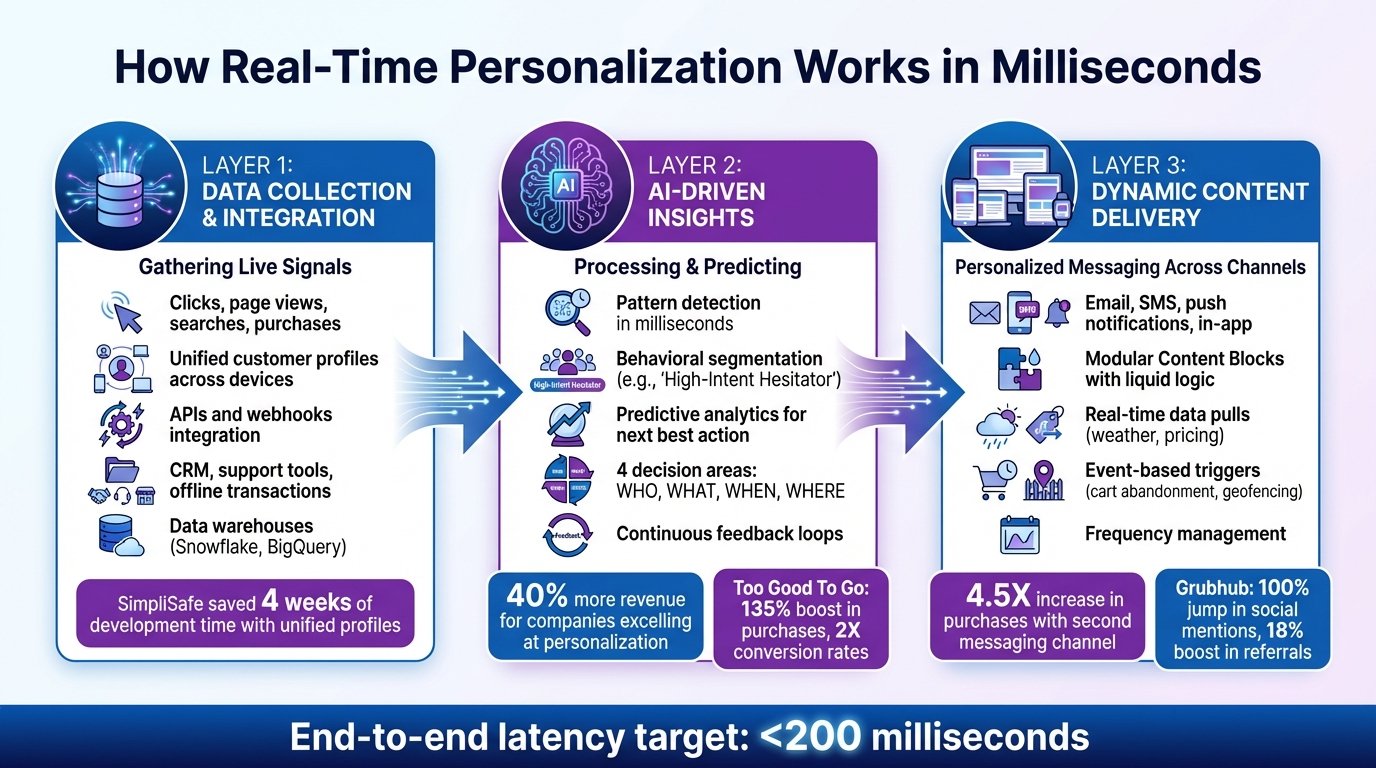
How Real-Time Personalization Works: 3-Layer System Architecture
Real-time personalization runs on three connected systems: a data layer that gathers and organizes customer interactions, a decisioning layer powered by AI to determine the best next step, and a delivery layer that sends tailored messages across various channels. Together, these components turn raw data into personalized experiences.
Data Collection and Integration
It all starts with collecting live signals – things like clicks, page views, searches, and purchases – across websites, apps, and other interactions. But just collecting data isn’t enough. Systems must piece together these actions into a single, cohesive customer profile. For instance, browsing on your phone during lunch and checking an email on your laptop later should be recognized as part of the same journey.
Both structured data (purchase history, demographics) and unstructured data (support transcripts, social posts) feed these profiles. The more complete the picture, the better the decisions built on top of it.
To achieve this, platforms link CRMs, support tools, and even offline transactions through APIs and webhooks. SimpliSafe is one worked example: according to Braze, it used Data Transformation and webhooks to pull survey responses and call data into unified user profiles, saving roughly one week of development time per system connected – about four weeks in total. Many platforms also connect directly to data warehouses like Snowflake or BigQuery, so historical data and live activity sit in the same profile. That unified profile is what lets algorithms act instantly – suppressing or triggering an email or SMS based on an action taken in an app.
Build privacy in at this layer rather than bolting it on later. Systems handling U.S. customer data need to satisfy the California Consumer Privacy Act (CCPA) and, for international audiences, GDPR. That means encryption, anonymization where possible, transparent consent capture, and a working process for customers who want to see or delete what you hold.
AI-Driven Insights and Predictive Analytics
AI serves as the brain behind personalization, processing live data to detect patterns and intent in milliseconds. Machine learning models group users based on their behavior. For example, someone scrolling intensely and clicking rapidly might be flagged as a “High-Intent Hesitator”. Predictive analytics then determine the best way to engage them – whether that’s a discount code, product recommendation, or technical info to help them decide.
This is a real departure from traditional demographic segmentation. Instead of static buckets like “women, 25-34, urban”, segments form dynamically from real-time actions and update themselves as behavior shifts. A customer who consistently ignores email but opens every SMS gets routed accordingly, without anyone rewriting a rule.
Take Too Good To Go as an example. Braze reports that it used behavioral segments to send API-triggered notifications when “Surprise Bags” became available nearby, and saw a 135% increase in purchases attributed to its CRM efforts along with a doubled conversion rate on those messages.
AI automates decisions across four key areas: who gets the message, what content they see, when it’s sent (using predictive timing), and where it’s delivered (choosing the right channel). Feedback loops ensure that every interaction refines the user profile, making future messages more precise.
Dynamic Content Delivery Across Channels
After AI identifies the best action, the delivery layer steps in to send messages through email, SMS, push notifications, or in-app channels. Dynamic content uses modular content blocks and template logic, so marketers can build one template that adjusts with user-specific details – names, loyalty points, recently viewed items. Connected content tools can even pull in live data, such as local weather or up-to-the-minute pricing.
Grubhub’s “Taste of 2020” campaign is a documented example. Braze reports that the personalized “year in review” emails produced a 100% increase in social media mentions and an 18% lift in word-of-mouth referrals. An earlier version of this article added precise counts for the attributes pulled and the diners reached; those specifics could not be found in the source and have been dropped.
Delivery often kicks off with event-based triggers, like a user abandoning their cart, hitting a usage milestone, or entering a geofenced location near a store. Adding a second channel generally lifts engagement, but manage frequency – bombarding users with too many messages backfires.
How to Implement Real-Time Personalization
Bringing real-time personalization to life means upgrading your systems, picking the right tools, and constantly fine-tuning your approach. Here’s a breakdown of how to implement it effectively.
Step 1: Evaluate Your Data Infrastructure
Start by taking a hard look at your current data setup. Your data, decision-making processes, and delivery systems need to work together. Before diving into AI tools, ensure your data can handle real-time decision-making.
Audit every source you have: transaction records, website analytics, mobile app interactions, email metrics, social media activity, and customer service logs. You’re looking for three things – gaps, quality problems, and whether the data is actually accessible to the systems that need it.
One common issue is fragmented data. Are customer interactions scattered across systems like your CRM, email platform, and web analytics? If so, you’re likely missing key insights. A unified Single Customer View (SCV) is essential for spotting these interactions.
Clean and standardize before you automate. AI systems are only as good as the data underneath them, and a model working from a purchase history with no demographic context will produce segments you can’t act on.
Next, focus on processing speed. Batch processing is too slow for real-time personalization; you want streaming data that reacts while the user is still on the page. Set a latency target with your vendor and hold them to it, but be sceptical of round numbers quoted without a measurement method behind them. A previous version of this section quoted specific millisecond thresholds that had no source, and a case study crediting The Vitamin Shoppe‘s results to sub-0.1-second response times. What Bloomreach’s case study actually reports is an 11% increase in add-to-cart rate on category pages. It says nothing about latency.
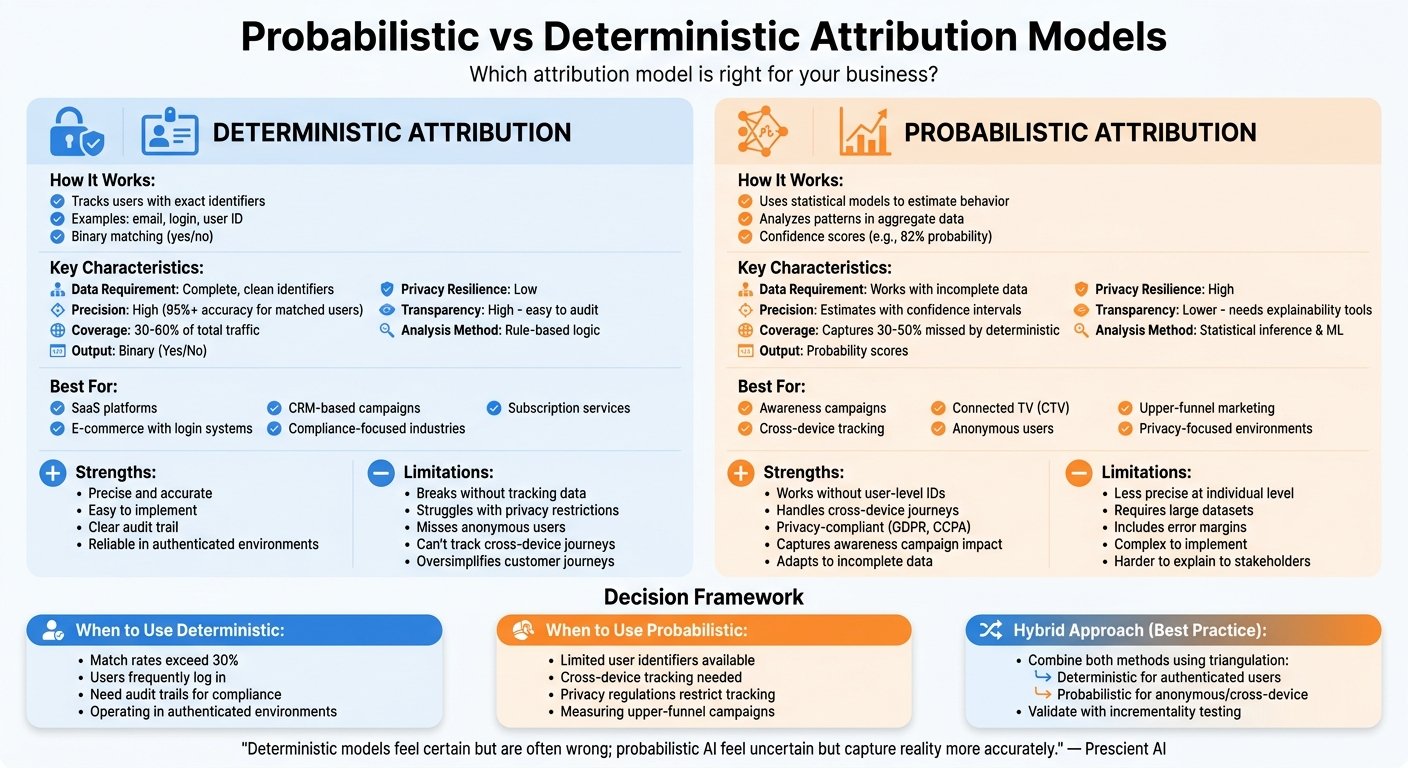
Lastly, check your ability to resolve identities across devices. Can you connect a user’s activity on mobile with their actions on desktop? Use deterministic methods like logins and emails, along with probabilistic techniques like behavioral patterns, to link these interactions. Also, standardize how you track events – clicks, scrolls, and hovers should be recorded consistently across all platforms.
Step 2: Select the Right AI Tools
Once your data infrastructure is solid, choose AI tools that can process and act on data fast enough to matter for your use case. Look for platforms with predictive analytics to determine the next best experience: who gets the message, what content they see, when they see it, and through which channel.
Braze’s own case study for Panera Bread describes an AI-powered decision engine generating personalized offers, with a reported 5% retention lift among at-risk guests and a twofold increase in purchase conversions. Read vendor case studies as vendor case studies – they are marketing documents, and the comparison group is rarely described.
On pricing: this article previously quoted a range of roughly $1,000 to $100,000 per month with no basis for either end. It is gone. Real quotes for this category depend on traffic volume, data volume, contracted channels, and how much professional services the vendor insists on, and the only reliable way to find your number is to run a scoped RFP with two or three vendors. Focus your evaluation on in-memory read/write performance and how cleanly the platform integrates with the data warehouse you already have.
Step 3: Test and Monitor Strategies
Real-time personalization isn’t a one-and-done deal – it thrives on constant iteration. Start small by testing AI on a high-traffic journey, such as abandoned carts. Try to prove ROI within 30-60 days using randomized holdout groups before expanding.
Run continuous A/B tests to gauge how well personalization performs. Keep an eye on behavioral signals like rapid clicking, back-and-forth navigation, or exit-intent actions. These cues let you act quickly, whether it’s offering a discount code or launching a live chat to keep users engaged. For a sense of what tight targeting can do to open rates, German retailer baby-walz tailored email content to pregnancy stage and reported a 53.8% average open rate on those emails, according to Bloomreach. That is an absolute open rate for one narrow audience, not a lift figure – a distinction vendors often blur.
Track metrics like Click-Through Rate (CTR), Average Order Value (AOV), and Customer Lifetime Value (LTV). At the same time, monitor user fatigue to adjust your messaging and protect your sender reputation. McKinsey’s finding is the one to keep in mind: 71% of consumers expect personalized interactions, and 76% get frustrated when they don’t get them. Getting it wrong is not neutral.
Common Challenges and How to Solve Them
Most personalization programs don’t fail on ambition. They fail on plumbing. Here are the four obstacles that come up again and again.
Data silos. Customer information sits in disconnected systems – website activity in one platform, in-store purchases in another, support history in a third. Without a centralized data platform and APIs tying them together, your AI is reasoning from a fraction of the picture. Strong data governance keeps things consistent once they’re connected, so teams aren’t quietly maintaining three conflicting definitions of “active customer”.
Integration complexity. Legacy systems, incompatible data formats, and technical debt make multi-channel deployment harder than vendors suggest. Companies routinely underestimate what it takes to connect older platforms. Middleware tools help, as does choosing AI platforms with genuinely strong integration capabilities rather than a long logo wall. Standardizing your data formats before rollout saves considerable pain later.
Privacy and trust. Consumers expect personalized content but are uneasy about how their data gets collected, and CCPA and GDPR add real compliance weight. The workable answer is clear consent, transparency about use, anonymization wherever it doesn’t break the use case, and regular audits of your models for fairness and accuracy.
Data quality. Poor data produces irrelevant recommendations, which damage customer relationships rather than strengthening them. A misfired recommendation is worse than no recommendation at all. Ongoing quality checks and clear protocols for collection and maintenance are unglamorous but decisive.
Business Benefits and Use Cases
Key Benefits for Businesses
A note on what used to be here. This section previously carried around a dozen consumer statistics – percentages for how many shoppers buy more, expect instant relevance, or want to be remembered – none of them attributed to anything checkable. They have been removed. Several turned out to be distortions of real research rather than inventions: a McKinsey finding that companies excelling at personalization generate 40% more revenue from those activities than average players had been restated here five separate times as a 40% increase in total company revenue. Those are not the same claim.
What can be said with a source behind it: McKinsey reports that 71% of consumers expect personalized interactions and 76% are frustrated when they don’t get them, and that the revenue advantage sits in the personalization activities themselves rather than in the whole P&L. A frequently quoted retention figure – 89% customer retention for companies with the strongest omnichannel engagement versus 33% for the weakest – comes from Aberdeen Group research reported in 2013. It is still repeated as though it were current; it is thirteen years old and should be treated as such.
Ornella Urso, research director at IDC Retail Insights, framed the gap this way in research published by Amperity:
“There is a growing gap between customer expectations and retail execution. Traditional systems are built for historical insight, not in-the-moment decisioning, while many real-time tools lack the customer context needed to be relevant. Retailers that unify identity, historical data, and live behavioral signals can close that gap and turn personalization into measurable business impact.”
Beyond revenue, the operational argument is simpler and less contested: AI-driven systems handle content selection and timing decisions that marketing teams would otherwise make by hand, which frees up time. That benefit is real whether or not the headline revenue numbers hold up for your business.
Use Cases in Different Industries
The impact of real-time personalization shows up differently by sector.
- Retail: Cart recovery and real-time intervention. Browsing behavior – lingering on a shipping page, for instance – can signal hesitation, and an immediate incentive like free express shipping is a standard response. Whether it pays for itself depends entirely on how many of those customers would have converted anyway, which is what holdout testing is for.
- Food Service: KFC Spain’s “Fries Compensation” campaign sent personalized apologies and free offers to customers who had previously complained. Braze’s case study reports a 95% email open rate and a 679% increase in app downloads. A previous version of this article dated the campaign to 2025; the source gives no year, so the date has been removed.
- Travel and Hospitality: Luxury Escapes used Braze to send messages based on membership status and, per Braze, hit 142% of its membership signup goal in the first month. Note the wording: that is 142% of target, not 142% above it, which is how this article previously reported it.
- Financial Services: Real-time eligibility checks and repayment breakdowns surfaced at the moment a user hesitates in a mortgage calculator. Low-risk, easy to measure, rarely oversold.
- Healthcare: Wearables feed live biometric data into coaching applications. This is the least mature of the five and the one where privacy exposure is highest.
Tools and Platforms Worth Knowing
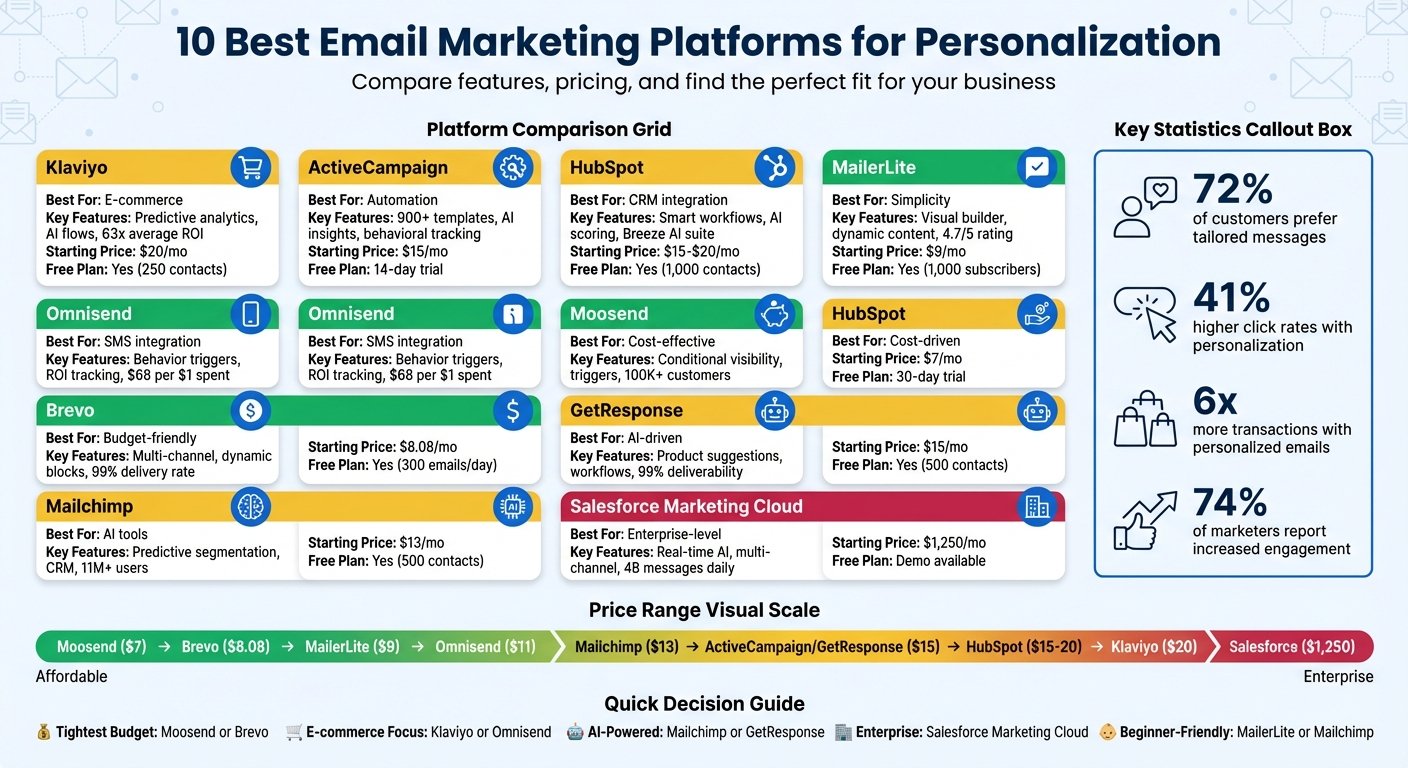
The right stack depends on your channels, your data maturity, and your budget. A few platforms come up repeatedly for omnichannel work in the U.S. market:
- Salesforce Marketing Cloud: Strong AI-driven segmentation and automation, best suited to complex, multi-stage customer journeys. Integrates cleanly with systems most U.S. businesses already run.
- Adobe Experience Platform: Built around real-time customer profiles and predictive analytics, unifying web, mobile, email, and in-store data into a single view.
- Braze: Real-time orchestration, popular in media and finance where timing matters. It is also the vendor behind most of the case studies cited above, which you should weigh accordingly.
- LivePerson: Conversational AI. A reasonable fit if customer service is your primary personalization surface, and a poor one if it isn’t.
| Platform | Key Strengths | Best For | US Compliance |
|---|---|---|---|
| Salesforce Marketing Cloud | Advanced segmentation, automation | Complex customer journeys | CCPA, strong integration |
| Adobe Experience Platform | Real-time profiles, predictive analytics | Unified customer views | Full US compliance |
| Braze | Real-time orchestration | Fast-paced industries | Yes, with audit trails |
| LivePerson | Conversational AI, large dataset | Customer service focus | Comprehensive security |
Whichever you shortlist, evaluate the unglamorous features: data encryption, audit trails, consent management, and granular user access controls. These determine whether you can actually operate the platform under CCPA and GDPR.
Keeping the Back Office Out of the Way
Personalization tools sit on top of a business that still has to run. For smaller teams, BizBot offers a directory of business administration tools – accounting, HR, legal, and management – so the operational foundation doesn’t eat the time you’d rather spend on customer experience.
Its subscription management tool is particularly relevant here. Running a personalization program often means paying for several overlapping platforms at once. Consolidating subscription tracking makes it easier to spot redundant tools and redirect that budget toward the ones actually moving your metrics. It’s aimed at freelancers, small businesses, and growing companies that don’t have a dedicated IT team to lean on.
Measuring the Success of Real-Time Personalization
Engagement and Conversion Rates
Measure how customers interact with personalized content. Click-through rates on personalized elements tell you whether your recommendations are landing. This article previously quoted several email benchmark figures – open-rate and click-rate lifts for personalized and triggered sends – with no source attached to any of them. They have been removed. Industry benchmark averages are a poor substitute for your own baseline anyway.
Outside of email campaigns, track bounce rates and how long visitors engage with dynamic content. A/B testing personalized experiences against non-personalized versions is the only way to separate the effect of personalization from the customers who were going to convert regardless.
Additionally, watch for behavioral cues like rapid clicking or back-and-forth navigation. These actions can signal frustration or indecision – moments to introduce a comparison guide or live chat.
Customer Lifetime Value and ROI
Engagement metrics give you a fast read; long-term financial indicators tell you whether the program is worth its licence fee. Track repeat purchase rate, churn, and Average Order Value against a holdout group, not against last year.
Be careful with published ROI figures for this category. This section originally carried several – a return multiple per dollar spent, a share of marketers reporting positive ROI, a lift in customer lifetime value, and a figure for how many companies measure personalization properly. None could be traced to a primary source, and all have been removed. Vendor-published ROI numbers are self-selected by definition: the companies whose programs failed do not appear in the case study library.
Whatever you track, track it in one place. A unified customer data platform (CDP) keeps measurement consistent as customers move between channels, which is otherwise where attribution quietly falls apart.
Monitoring Customer Feedback
Quantitative metrics don’t tell the whole story. In-app surveys, polls, and feedback loops surface preferences your behavioral data misses, and that input improves the models as well as the messaging.
Kevin Wang, Chief Product Officer at Braze, describes the risk of getting personalization wrong:
“What makes these [cases of mistaken personalization] so jarring is that they undercut the customer relationship, revealing to people that your brand doesn’t know them as well as they’d thought. It’s like waking up one day and finding out your best friend doesn’t know your last name.”
SimpliSafe is the useful counter-example on the plumbing side: routing survey responses and call data into unified profiles via webhooks saved its team about a week of development per system connected, roughly four weeks in total, which let marketing ship personalized experiences sooner. Braze publishes those figures; SimpliSafe has not published its own accounting of them.
Conclusion and Next Steps
Summary of Key Insights
Real-time personalization has moved from competitive edge to baseline expectation. McKinsey’s numbers are the ones worth remembering: 71% of consumers expect personalized interactions, and 76% get frustrated when they don’t get them. The revenue case is narrower than it is usually presented – the 40% figure that circulates describes revenue generated from personalization activities by the companies best at them, not a 40% lift to the business as a whole.
Success depends on three elements working together: unified data that provides a single view of the customer, AI-driven decision-making that identifies the next best action quickly, and cross-channel delivery so a customer is recognized wherever they turn up. Real-time synchronization between web platforms, marketing automation, and CRM is what makes that recognition possible.
Privacy is not a footnote. Consent, transparency, frequency capping and clear data policies are what keep personalization on the right side of the line between useful and intrusive.
The direction of travel is toward hyper-personalization: systems that move past segmentation entirely and treat each customer as a segment of one, blending browsing habits, purchase history, sentiment analysis, and live signals. Agentic AI extends this further. Whether it delivers proportionate returns for a small business is still an open question, and anyone telling you otherwise is selling something.
Steps to Get Started
To implement real-time personalization effectively, consider the following steps:
- Audit your data infrastructure: Identify any data silos and evaluate the time it takes for data to move from collection to activation. This is crucial for creating unified customer profiles and enabling real-time data streaming.
- Map key customer moments: Pinpoint high-impact opportunities, like cart abandonment or subscription renewals, where real-time triggers can maximize ROI.
- Adopt flexible tools: Opt for tools that use modular content systems instead of static templates. This flexibility allows you to adapt quickly to customer behavior without rebuilding entire experiences.
- Close the loop with attribution: Use attribution systems to feed performance data back into your AI engine. This creates a feedback loop that continuously improves your personalization strategies.
Start small with a phased approach. Connect two channels – email and in-app messaging, say – to recover abandoned carts, and use A/B testing with a holdout group to measure the result. Scale only once you have a number you trust.
FAQs
What data do I need for real-time personalization?
To make real-time personalization possible, you need detailed customer data that captures up-to-the-minute behaviors, preferences, and interactions across every channel. This means creating unified profiles that merge data from websites, mobile apps, social media, in-store visits, and customer service interactions. Key elements include real-time signals such as browsing patterns, clicks, and purchase histories. Tools like Customer Data Platforms (CDPs) play a crucial role in ensuring this data is accurate, centralized, and ready for use – all while maintaining strict privacy compliance.
How do I stay compliant with privacy rules while personalizing?
Start from the regulations that apply to you – typically CCPA in the U.S. and GDPR if you have European customers. Be upfront about how data will be used and secure consent before collecting personal details.
From there, the practical measures matter: encryption and strict access controls on sensitive information, regular audits of your AI systems to confirm processing stays ethical and accurate, and anonymization or pseudonymization anywhere it doesn’t break the use case. Keep up with regulatory changes and stay transparent about your practices – it avoids legal exposure and, more usefully, builds the trust that makes personalization welcome rather than creepy.
How do I break down data silos?
Bring your data together in a single unified platform so interactions from every channel are accessible to the same systems. Where platforms don’t naturally talk to each other, APIs or middleware can create the connective tissue.
Then audit the infrastructure routinely. Tools drift, integrations break quietly, and a pipeline that worked six months ago may be silently dropping records today. Regular checks keep your customer profiles trustworthy – which is the whole point.
How do I keep personalization consistent across channels?
Start by building a unified customer data profile that brings together both online and offline interactions. Use AI-powered tools to anticipate customer needs and deliver tailored content, then connect data across all platforms and apply AI to journey orchestration. The goal is simple: the customer gets a consistent experience whichever door they come through.
How can I personalize in real time without creeping users out?
Keep the content genuinely relevant to what the customer is doing right now, and cap how often you contact them. Be transparent about what you collect and why. The line between helpful and intrusive is mostly about frequency and about whether the personalization reflects something the customer knowingly told you.
More on this topic
Browse all 44 articles on Marketing & Growth, or jump straight to our buying guide: Best Marketing and CRM Tools for Small Businesses.

![E-commerce Personalization: Complete Guide [2024]](https://bizbot.com/wp-content/uploads/2026/08/662e9e5db17fd355c0be37e7-6b9799a37e5bf25bac30efcc2c0f1eed.png "E-commerce Personalization: Complete Guide [2026]")