Rebalancing software handles financial data and executes transactions, which makes it a target and puts it inside the scope of your compliance obligations. Security tooling for it needs runtime monitoring, endpoint visibility, and alerting you will actually act on. This article looks at two platforms – Sysdig and Wazuh – and at how to evaluate the wider category.
A correction, stated plainly. This article previously compared three products: “Tool A”, “Tool B” and “Tool C”. Tool C did not exist. It was described as “a module within Sysdig” and credited with the same results already attributed to Sysdig itself – the same Forrester placement, the same customer recommendation figure, the same response-time improvement – which is how we caught it. There is no third product. That section has been removed rather than filled in with something else.
Several quotations attributed to named executives have gone too, because none could be traced to a published source, and one carried a link to another BizBot article as though that were its citation. It was not. Where figures survive below, they are the vendors’ own published marketing claims and are labelled as such.
Key Highlights:
- Sysdig: Cloud-native, using eBPF for real-time system monitoring, with runtime detection built on the Falco engine.
- Wazuh: Open-source SIEM and XDR with agent-based endpoint visibility and File Integrity Monitoring – directly useful for detecting changes to rebalancing logic.
1. Sysdig
Sysdig is a cloud-native platform for real-time threat detection and runtime protection. It uses eBPF to observe Linux kernel events, giving visibility into system activity, containers and Kubernetes without the overhead of older instrumentation approaches. For rebalancing software running at high frequency, that means system-call-level visibility into what the trade execution path is actually doing.
Security Monitoring Features
Sysdig monitors runtime activity rather than relying only on static scanning, and combines posture management, vulnerability assessment and workload protection.
The vendor’s published figures are worth quoting with that framing attached. Sysdig’s own marketing claims “95% time saved on vulnerability management” and a “98% reduction in vulnerability noise”, achieved by prioritising vulnerabilities in code that is actually loaded at runtime. That prioritisation mechanism is real and genuinely useful – a large share of packages in a typical container are never executed – but the percentages are the vendor’s, measured on their own customers, and not independently verified. Treat them as an indication of what the product is designed to do, not as a result you should expect.
Drift detection, built on the Falco engine, flags unexpected behaviour and configuration changes at runtime. For a rebalancing system, an unexpected process spawning inside the execution container is exactly the signal you want.
Threat Detection Capabilities
Sysdig advertises “2 second threat detection”. Again: vendor figure, on vendor benchmarks. What matters more for evaluation is what happens after detection – whether the alert reaches someone who can act, and whether your team can tune the rules without vendor help.
An earlier version of this article also claimed a 76% reduction in mean time to resolution from Sysdig’s AI features. That figure does not appear in Sysdig’s published material and could not be sourced, so it has been removed.
Compliance and Reporting Tools
Sysdig was named a Leader in the Forrester Wave for Cloud Native Application Protection Solutions, Q1 2026, and reports that 99% of customers recommend it based on Gartner Peer Insights. Analyst placements are a signal about market position and completeness of offering; they are not a statement that the product suits a small team, and Leader-quadrant products are frequently too heavy for one.
It integrates with AWS, GCP and Azure and with common SIEM platforms, and ships pre-configured rule sets aligned to regulated-industry requirements, which reduces the evidence-gathering work at audit time.
2. Wazuh
Where Sysdig is cloud-native and commercial, Wazuh is open-source and endpoint-centric. It uses agents on hosts rather than working from log data alone, which gives it visibility into what happened on the machine rather than only what the machine chose to report.
Security Monitoring Features
Wazuh’s File Integrity Monitoring tracks changes to file content, permissions, ownership and attributes, and records which user or process made the change. For rebalancing software this is the most directly relevant capability in either product: unauthorised modification of an allocation algorithm or a configuration file is precisely what FIM is for, and the attribution matters as much as the detection.
Its Security Configuration Assessment and log analysis surface misconfigurations and signs of compromise, and it correlates events across hosts to catch patterns like repeated authentication failures.
Threat Detection Capabilities
The agent-based architecture gives continuous endpoint monitoring in real time. The trade-off is the one that applies to all open-source security tooling: no licence cost, and a real cost in engineering time to deploy, tune and maintain. Below a certain team size, that cost exceeds the licence you avoided.
Evaluating the Wider Category
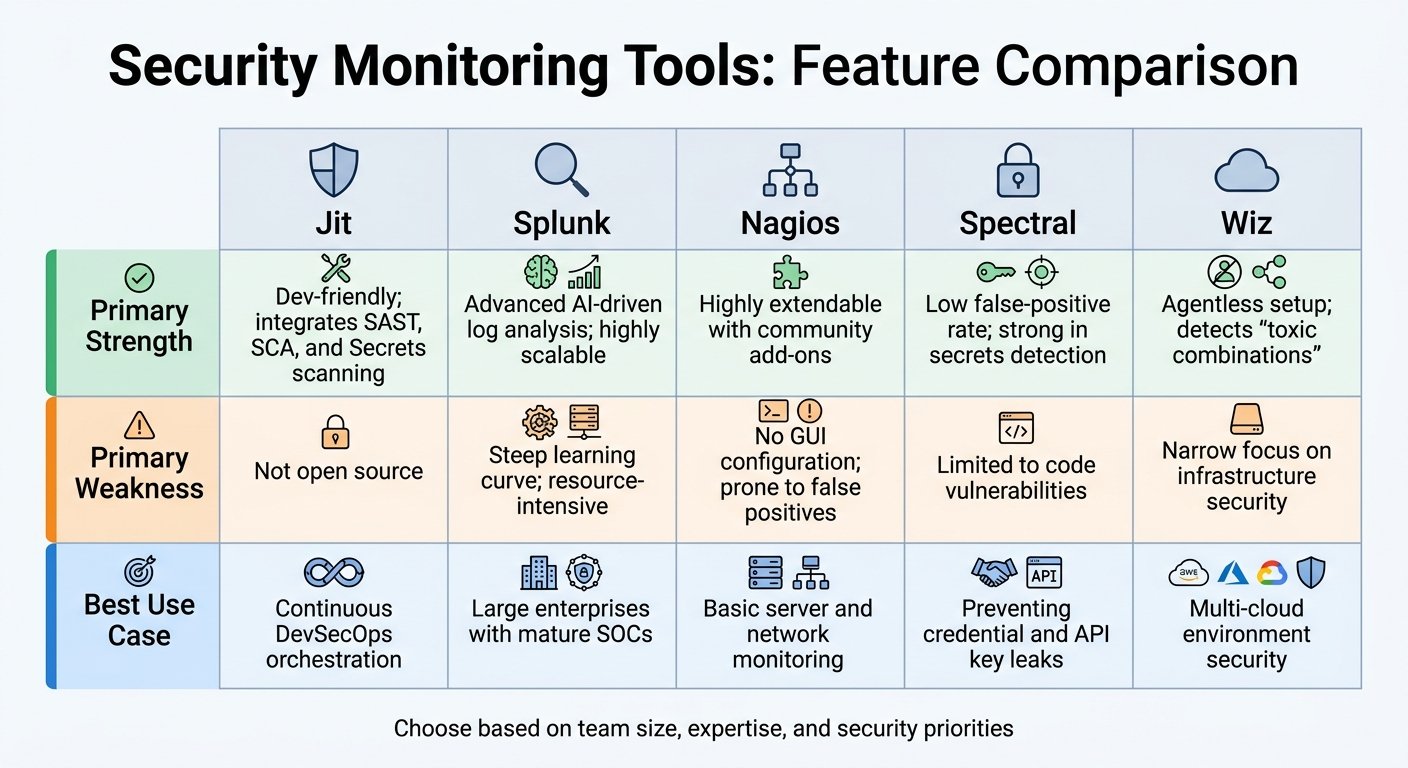
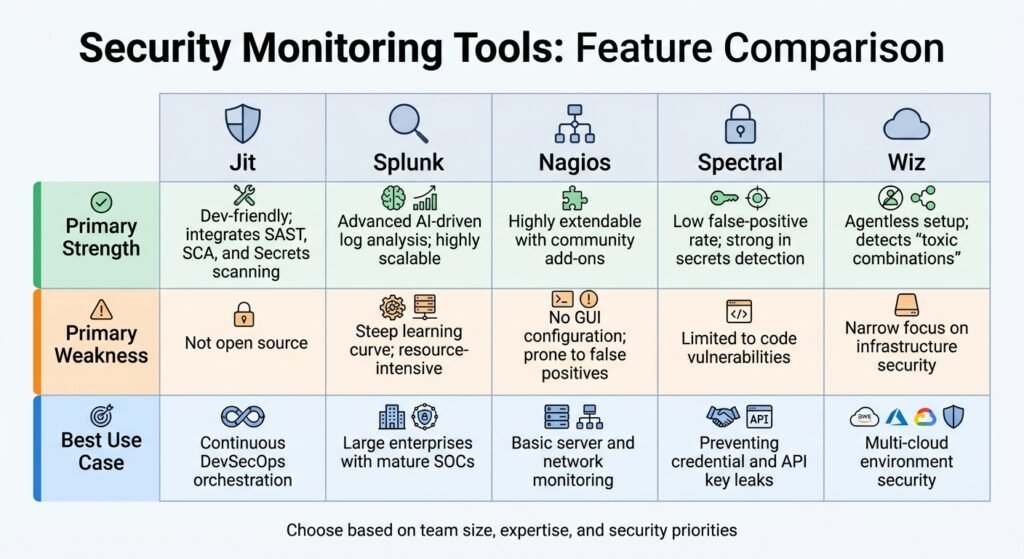
Security Monitoring Tools Comparison: Strengths, Weaknesses, and Best Use Cases
Beyond runtime protection, the tools around rebalancing software fall into a few groups. Developer-focused platforms like Jit and Spectral catch vulnerabilities and leaked secrets during development with little setup. Enterprise platforms like Splunk do deep log analysis and require the expertise to match.
The trade-off is usually between usability and control. Nagios remains popular for server monitoring on the strength of its extensibility and community plugins, at the cost of a dated interface and configuration that lives in text files. Cloud-native tools like Wiz scan agentlessly, which suits large multi-cloud estates, but they focus on infrastructure rather than the whole development lifecycle. Splunk’s capability comes with heavy resource consumption and an ingest bill that scales with your logging discipline.
| Tool | Primary Strength | Primary Weakness | Best Use Case |
|---|---|---|---|
| Jit | Dev-friendly; integrates SAST, SCA, and secrets scanning | Not open source | Continuous DevSecOps orchestration |
| Splunk | Deep log analysis; highly scalable | Steep learning curve; resource-intensive | Large enterprises with mature SOCs |
| Nagios | Highly extendable with community add-ons | No GUI configuration; prone to false positives | Basic server and network monitoring |
| Spectral | Strong secrets detection | Limited to code vulnerabilities | Preventing credential and API key leaks |
| Wiz | Agentless setup; surfaces attack paths | Narrow focus on infrastructure security | Multi-cloud environment security |
This table previously carried customer testimonials for several of these products, attributed to named executives at named companies. None could be verified, so they have gone. Vendor testimonials add little to a buying decision anyway; a reference call you make yourself adds a great deal.
Apiiro takes a different angle again, flagging material changes in software architecture rather than individual findings – useful when the risk you care about is someone quietly changing how allocation logic works.
Smaller teams generally do better with tools that automate by default. Larger organisations with a dedicated SOC can justify platforms that need configuration and can assign risk ownership back to the developers responsible.
Conclusion
The right tool depends on team structure, workflow and what you are actually protecting against.
For runtime protection of cloud-native rebalancing infrastructure, Sysdig is the more complete commercial option, with the caveat that its published performance figures are its own.
For endpoint visibility and file integrity monitoring on a budget, Wazuh is the strongest open-source choice. Expect to spend engineering time on deployment and tuning that a SaaS product would have absorbed.
For architectural risk mapping, Apiiro and Legit Security focus on material change rather than generic alerting.
Teams already running an observability platform should look at whether it covers enough of this ground before adding another vendor. Datadog, for instance, combines cloud security signals with the service and traffic data you are already collecting, which is a real advantage for a team with no dedicated security staff. This article previously quoted a user rating and review count for Datadog, and a figure for how many security monitoring tools offer free tiers; neither was sourced and both have been removed.
Before committing, run a two-week pilot, and cost the whole thing – licence, data ingest, and the staff hours spent triaging what it produces. Ingest and triage are where these products actually cost money.
FAQs
Which tool fits a small team vs a full SOC?
A small team wants managed detection with sensible defaults and few alerts: something that works on install and does not require a rules engineer. Wazuh is viable if you have the engineering capacity to run it; a hosted product is usually the better trade if you do not.
A full SOC can take on platforms that need configuration – Splunk, or a CNAPP like Sysdig or Wiz – because the tuning capacity exists to make them useful rather than noisy.
An earlier version of this answer recommended a specific product for small teams that we could not confirm is still operating. It has been removed. Check that any vendor you shortlist is currently trading before you build a process around it.
How do runtime tools avoid slowing trading systems?
Modern runtime tools use eBPF, which observes kernel events in place rather than intercepting them through a proxy or a kernel module. That keeps overhead low, but “low” is not “none”.
If latency matters to your execution path, measure the overhead on your own workload during the pilot rather than accepting a published figure. Benchmark the same trading workload with and without the agent, at realistic volume. This is the one number in this whole category you can generate yourself, and it is the one that matters most.
What should I measure in a 2-week pilot?
Measure the security tool, not the rebalancing tool – an earlier version of this answer confused the two and described portfolio metrics instead.
Four things worth recording: how many alerts the tool generates per day and what share turn out to be actionable; time from a simulated event to a usable alert; performance overhead on your trading workload; and hours of staff time spent operating it during the pilot. Then project the ingest cost at full deployment volume, which is normally several times the pilot’s.
More on this topic
Browse all 79 articles on Security & Compliance.