If your subscription box ships late, arrives damaged, or contains the wrong items, people cancel. That is the whole reason fulfillment discipline matters in this business model: you are not selling one order, you are selling the next twelve. An earlier version of this guide put a precise percentage on how many cancellations trace back to fulfillment. We could not source it, so it is gone. The mechanism stands on its own.
The category is growing. Data Bridge Market Research projects the global subscription box market at USD 124.36 billion by 2032, from USD 36.15 billion in 2024, a 16.70% compound rate. Treat that like any commercial market-sizing report: one firm’s model, and other firms publish materially different numbers for the same category.
Here’s the short version:
- I forecast demand from subscriber count, churn, and growth
- I buy and receive stock early, then verify counts, lots, and dates
- I stage inventory before the run and lock the subscriber list 3 to 7 days before shipping
- I use clear pack-out rules, barcode scans, weight checks, and sample audits
- I watch packaging costs, especially box size and DIM weight
- I connect billing, OMS, WMS, and shipping tools so order changes reach the warehouse fast
- I set internal targets for on-time ship rate, pick accuracy, and inventory variance, and review them every cycle
- I compare in-house, hybrid, and 3PL options based on box volume and labor load
A note on numbers in this guide. The operational targets below are working rules of thumb from running batch cycles, not research findings, and they are labelled as such. Several specific cost figures that used to appear here – packaging cost per order, 3PL pick and kit rates, all-in cost per box – had no source behind them and have been removed. Fulfillment pricing is quoted per contract and varies with volume, SKU count and location. Get three quotes; that will beat any published range.
| Area | What I focus on | Main risk if missed |
|---|---|---|
| Forecasting | Subscriber count, churn, buffer stock | Stockouts or extra inventory |
| Receiving | ASN, BOL, SKU counts, expiration dates | Wrong counts ripple across the batch |
| Kitting | BOM, staging, assembly steps | Wrong items, missing inserts, broken goods |
| Shipping | Address checks, carrier timing, box size | Missed windows and high postage |
| Review | Accuracy, cost by zone, churn after delivery | Same mistakes next cycle |
Put simply: subscription fulfillment is not about shipping one order at a time. It’s about planning one clean batch from start to finish, then tightening the process every cycle.
How the Fulfillment Process Works
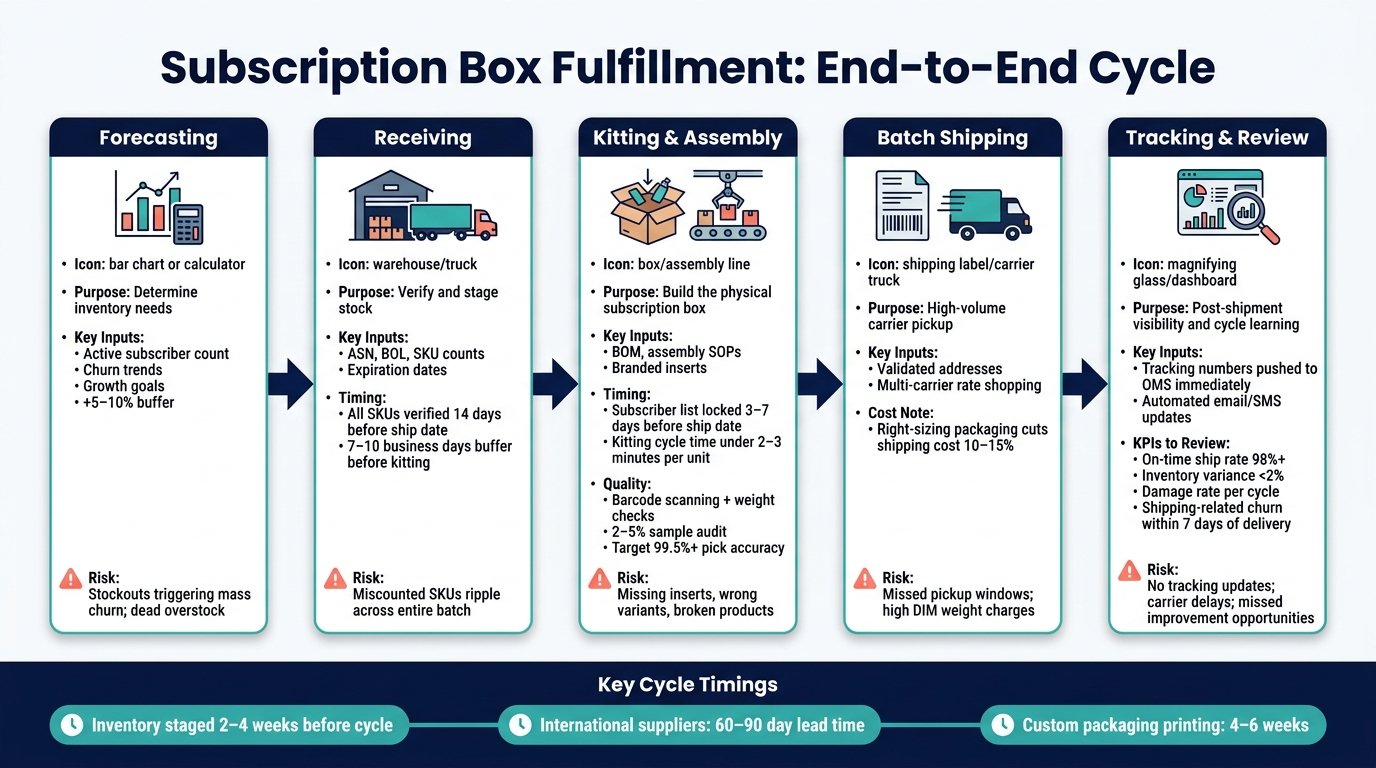
Subscription Box Fulfillment Process: 5 Stages from Forecast to Review
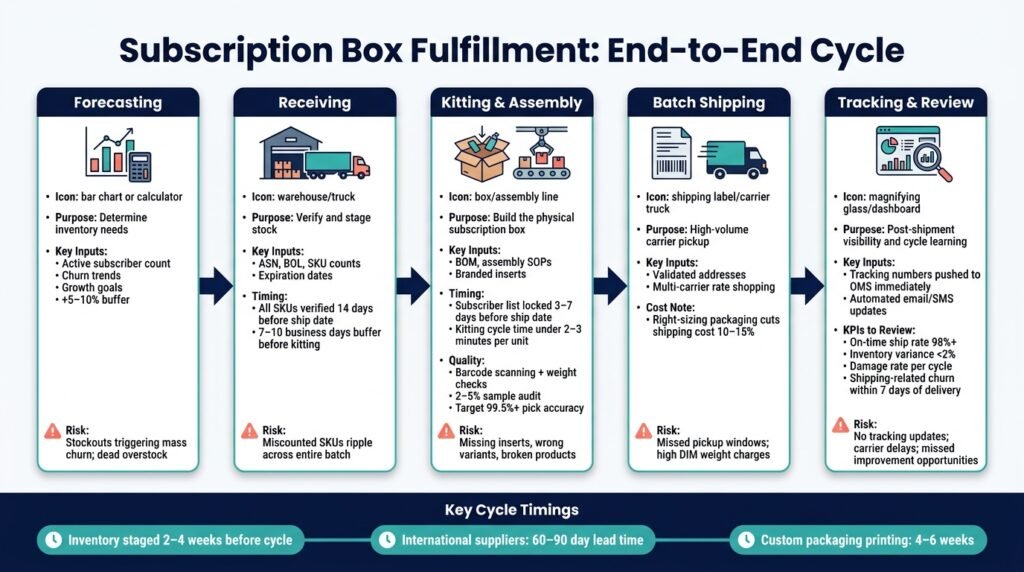
Subscription fulfillment runs in fixed batches. That means each stage leans on the stage before it. If receiving slips, kitting can stall, and shipping gets pushed back.
Knowing how each stage works makes it easier to catch problems early, before they ripple through the whole cycle. Packaging is the next place things can go wrong, because it decides whether the box makes it through shipping in one piece.
| Stage | Purpose | Key Inputs | Common Risks |
|---|---|---|---|
| Forecasting | Determine inventory needs | Active subscriber count, churn trends, growth goals | Stockouts that trigger mass churn; overstocked dead inventory |
| Receiving | Verify and stage stock | ASN, BOL, SKU counts, expiration dates | Missing ASN causing dock delays; miscounted SKUs |
| Kitting/Assembly | Build the physical box | BOM, assembly SOPs, branded inserts | Missing inserts; wrong item variants; broken products |
| Batch Shipping | High-volume carrier pickup | Validated addresses, carrier rates | Missed pickup windows; high DIM weight costs |
| Tracking/Review | Post-shipment visibility and learning | Tracking numbers, CSAT/NPS scores | No tracking updates; carrier delays; inventory variances |
Forecasting, Purchasing, and Receiving Inventory
Start your forecast with active subscriber count, expected churn, growth, and a small buffer for damages and assembly errors. Size the buffer from your own damage rate once you have one; before then, err slightly high, because a stockout mid-cycle is far more expensive than a few spare units.
Lead times drive the purchasing calendar more than anything else, and they are the one input you can pin down exactly: ask your suppliers. International sourcing, domestic sourcing and custom print runs all have very different clocks, and the printer is usually the constraint nobody plans for. All required SKUs should be stocked and verified well before the planned ship date.
When inventory arrives, receiving is more than unloading trucks. Each shipment should be checked against an Advance Shipping Notice (ASN) and bill of lading (BOL). Then verify SKU counts, lot numbers, and expiration dates. One miscounted SKU here can lead to hundreds of wrong orders during the batch run.
Leave a gap between receiving and kitting – a week or more if you can – so problems surface before assembly starts rather than during it.
Staging, Kitting, Quality Checks, and Batch Shipping
After inventory clears receiving, stage components by SKU so kitting teams can move without stopping to hunt for items. Finalize the Bill of Materials (BOM) and assembly instructions well before kitting starts so shortages show up early.
Keep prep work separate from the main kitting run. That includes tasks like:
- labeling
- folding tissue
- bundling inserts
When those jobs get mixed into one station, mistake rates go up. Time your own kitting cycle per unit in the first run and use that as the baseline; a documented line will beat an undocumented one, but by how much depends entirely on your box.
Quality control should happen at more than one point. Don’t wait until the end and hope for the best. Use barcode scanning, weight checks, and a sample audit before pickup. Weight checking is the highest-value single control: a box missing an item almost always weighs wrong.
The active subscriber list should be locked 3 to 7 days before the ship date. That gives billing teams time to fix failed payments before final assembly is approved. It also helps avoid an expensive mistake: kitting boxes for subscribers whose orders should no longer ship.
Once boxes clear quality checks, tracking needs to carry that same level of precision through delivery.
Tracking, Delivery Updates, and Post-Shipment Review
Push tracking numbers into your order or subscription system as soon as labels are created. Send automated email or SMS updates at label creation to cut support tickets. If scans show a delay or exception, reach out to affected subscribers before frustration turns into churn.
Post-shipment review is where many brands miss easy gains. After each cycle, review:
- order accuracy
- shipping cost by zone
- return-to-sender rates
- shipping-related churn within seven days of delivery
Track churn within seven days of delivery because it shows how fulfillment affects retention. That review loop feeds the next cycle.
Packaging and Kitting Requirements
Once inventory is staged and kitting begins, packaging drives cost, durability, and pack speed. It affects shipping cost, damage rates, and how the box feels when it lands on a subscriber’s doorstep. Yes, packaging shapes the unboxing moment. But first, it has to protect margin and cut down mistakes.
Box Size, Protective Materials, and Shipping Durability
Oversized boxes trigger dimensional-weight charges, so right-sizing is one of the few reliable ways to cut carrier cost without changing anything a subscriber sees. Review box dimensions every quarter against your SKU mix. Carriers publish their DIM divisors, so you can calculate your own saving exactly rather than trusting a percentage.
The main container options:
- Custom-printed corrugated mailers protect well and present well, but add weight and take longer to fold and seal.
- Poly mailers with padded inserts are cheapest to ship and fastest to pack, and suit apparel and soft goods where presentation matters less.
- Kraft shippers with tissue or crinkle fill sit between the two on both cost and presentation.
- Rigid presentation boxes are for premium and gift tiers, and are the most expensive option by a wide margin.
This section previously gave the exact share of subscription shipments using each format, along with per-order cost figures for standard and premium packaging. Those numbers had no source and have been removed. Your packaging quote depends on run size, print method and material, and any printer will give you one.
Protective materials like crinkle fill, foam inserts, and dividers help prevent damage, but they also add labor and make assembly more involved. Tamper-evident tape adds another checkpoint. It secures the box in transit and shows that it was sealed the right way.
Once box size and materials are set, pack-out rules are what keep every shipment the same.
Brand Presentation, Inserts, and Pack-Out Standards
Packaging only works at scale when every insert, fold, and filler item follows the same pack-out order. When tissue, promo cards, and inserts go in the same sequence every cycle, the line moves faster and boxes come out with fewer errors.
That starts with a documented Bill of Materials (BOM) and visual assembly SOPs for each cycle. These should spell out exactly what goes into the box, the order it goes in, and how each item should sit inside. This matters even more when temporary staff or a warehouse partner is handling batch runs. Clear documentation cuts variation, keeps training simple, and gives everyone the same target to follow.
There is a labor payoff too, though we have removed the throughput multiple this article used to quote because it had no basis. Time your own line before and after documenting it; that is a one-cycle experiment and it gives you a real number.
Pre-kitting during off-peak hours is more cost-effective than picking kits during the active shipping cycle. Welcome Boxes need their own BOM and staging instructions so they don’t get mixed into standard runs.
| Packaging Component | Labor Time Impact | Durability | Unboxing Experience |
|---|---|---|---|
| Custom Corrugated Mailer | High (folding/taping) | High | High (premium feel) |
| Poly Mailer | Low (fast to pack) | Low | Low (utilitarian) |
| Custom Tissue Paper | Medium (neat folding) | Low | High (gift-like feel) |
| Crinkle/Void Fill | Low (easy to stuff) | Medium (prevents shifting) | Medium |
| Dividers | High (complex setup) | High (protects items) | High (curated look) |
| Printed Inserts | Low (simple placement) | N/A | High (brand story/promo) |
| Tamper-Evident Tape | Medium (precision needed) | Low (security) | High (signals quality) |
Technology, Inventory Control, and Customer Visibility
Once packaging is set, system control decides whether the whole cycle stays on schedule.
Inventory Tracking, Reorder Points, and Order Flow Automation
Subscription fulfillment plays by different rules than standard ecommerce. Your inventory system has to track both the component level – every item, insert, and packaging piece – and the kit level, which is the finished box.
That means your WMS should link to the BOM so each kit pulls the correct components in real time. It also helps to batch identical orders, so pickers can move through clean batch paths instead of packing boxes one at a time. If even one component runs short, the entire batch can stop.
Reorder points should come from your active subscriber count plus expected new sign-ups, with a small buffer for damages and late growth. We removed the percentage improvements this article previously claimed for automated forecasting versus manual planning; they were unsourced, and the honest version is that automation helps most when your SKU count is high and your cycle is short. You’ll also want a billing resolution window before kitting begins, so only paid and confirmed orders move forward.
Lock the subscriber list 3 to 7 days before the ship date. That gives the WMS time to finalize inventory allocation and labor planning. Any changes after that cutoff should roll into the next cycle.
Integrations for Subscriptions, Shipping, and Operations
Smooth fulfillment depends on four connected layers: a Subscription Billing Platform, an Order Management System (OMS), a Warehouse Management System (WMS), and Carrier/Shipping Software.
These systems need to pass order changes, inventory updates, and shipping data without delay.
| Technology Layer | Primary Function | Key Subscription Feature |
|---|---|---|
| Billing Platform | Payment and renewal | Handles skips, pauses, and dunning logic |
| OMS | Order aggregation | Routes exceptions and validates addresses |
| WMS | Warehouse operations | Manages kitting BOMs and batch pick paths |
| Shipping Software | Carrier management | Multi-carrier rate shopping and bulk labeling |
Nightly batch syncs put a lag between a billing event and the warehouse getting the order, which is how boxes get built for people who cancelled yesterday. API-first webhooks resolve pauses, skips, and gift orders before they hit the warehouse floor. The OMS should also check addresses against USPS databases and flag SKU shortages before they disrupt the batch.
Branded tracking pages and exception alerts cut support volume and keep subscribers informed.
KPIs That Show Whether Fulfillment Is Improving
Track each cycle against a small set of operational metrics, then use what you learn to tune the next run. The targets below are the ones we work to; they are internal standards, not industry benchmarks, and your own first-cycle numbers are the baseline that matters.
| Metric | Working target | What to Do With It |
|---|---|---|
| On-Time Ship Rate | 98%+ | Use it to spot timing or capacity issues early. |
| Pick/Kitting Accuracy | 99.5%+ | Add barcode scanning and weight-checks at each pack stage. |
| Inventory Fill Rate | 99%+ (pre-cycle) | Any gap before kitting starts means a substitution or delay is coming. |
| Inventory Variance Rate | <2% | Audit cycle counts when physical and system counts drift apart. |
| Damage Rate | Track per cycle | Recheck box size, protective materials, and carrier handling. |
Each metric should lead to a direct action.
- If on-time ship rate drops, look at staffing or capacity for the next cycle.
- If damage rate climbs, check box sizing and protective fill.
- If inventory variance drifts, run a cycle count audit.
In other words, these numbers aren’t just for reporting. They point to the next decision on staffing, box sizing, inventory allocation, or carrier choice.
Cost Drivers, Service Models, and Conclusion
What Drives Subscription Box Fulfillment Costs
Once your process is steady, the next step is simple: figure out what each box actually costs.
Fulfillment costs come from the same set of moving parts, and they stack up fast as volume grows: storage, receiving, kitting, packaging, postage, address checks, returns, and reporting.
Kitting labor is usually the biggest controllable cost, and the pricing model matters more than the headline rate. A generic 3PL that charges per item picked will bill a multi-item subscription box several times over before you have paid for a single piece of packaging. A subscription-focused 3PL that charges a flat rate per assembled kit makes recurring batch work far easier to budget. Ask for both quotes on your actual box and compare the totals, not the unit rates.
We have removed the specific per-pick and per-kit rates, and the all-in cost per box, that this section used to quote. They had no source, and fulfillment pricing is negotiated per contract against your volume, SKU count and storage footprint. Any 3PL will quote you in a week.
Postage is usually the largest variable cost overall, and bad addresses make it worse. One return-to-sender means you pay the original shipping fee, the return charge, and the reship on top.
In-House vs. Hybrid vs. Outsourced Fulfillment
The right setup depends on your monthly volume, team capacity, and how much day-to-day complexity you’re dealing with. The volume ranges below are rough guidance, not thresholds.
| Model | Rough volume range | Cost Structure | Best For |
|---|---|---|---|
| In-House | Low hundreds of boxes/month | High fixed (lease, staff) | Early-stage brands needing full control |
| Outsourced (3PL) | Hundreds to several thousand/month | Variable (per-box fees) | Growing brands with standard kits |
| Hybrid | Several thousand+/month | Mixed | Brands with international subscribers or custom inserts |
In-house fulfillment gives you full control. But there’s a catch: warehouse, staff, and equipment costs don’t go down just because volume dips. You still carry them.
Outsourcing shifts those fixed costs into variable per-box fees. It also gives you access to kitting systems built for recurring box assembly, without taking on that overhead yourself.
A switch to a 3PL usually makes sense when kitting starts taking more than two staff days per cycle or when error rates start creeping up. And when you compare contracts, per-box pricing is usually the better deal than hourly billing. It rewards efficiency instead of slow work.
Conclusion: Build a Repeatable Process Before You Scale
Once costs and service models are clear, the last job is making the process repeatable.
The main rule is straightforward: run recurring cycles with fixed cutoffs, staged inventory, and post-shipment reviews.
Packaging standards affect both your cost structure and the customer experience. The links between your billing platform, order management systems, WMS, and shipping software shape whether your team spends its time putting out fires or stopping issues before they start.
And the service model you choose should fit your current volume and operating needs.
Tighten the process at your current scale, and the next jump in volume gets a lot easier to handle.
FAQs
When should I switch to a 3PL?
Consider moving to a 3PL when fulfillment starts stealing time from the work that actually grows your business, like subscriber acquisition, product curation, and retention.
There is no universal volume threshold, and we removed the one this article used to give because it was invented. The signals are behavioural rather than numerical: you are managing orders by hand, packing days have turned into all-day sessions, shipping mistakes keep recurring, or you need rates and delivery speeds you cannot get on your own account.
When those problems stop being occasional headaches and start becoming the norm, a 3PL is often the next step.
How much buffer stock should I keep?
Enough to cover your projected subscriber count plus your own observed damage and assembly-error rate, which you will not know until you have run a couple of cycles. Until then, err on the high side: leftover units cost you their purchase price, while a mid-cycle stockout costs you subscribers.
Build a time buffer as well as a stock buffer. Set vendor deadlines several business days ahead of your shipping cutoff, so a late shipment eats slack instead of eating your ship date.
What KPIs matter most each cycle?
The most important KPIs to watch each cycle are subscriber churn rate, on-time shipment percentage, pick and kitting accuracy, inventory fill rate, cost per fulfilled box, and cycle on-time completion rate.
Together, these numbers show you how the operation is doing day to day. They help you track fulfillment health, shipping reliability, inventory readiness, unit economics, and whether the full batch gets finished by the ship deadline.
More on this topic
Browse all 86 articles on Business Operations, or jump straight to our buying guide: Best Productivity Tools for Small Teams.