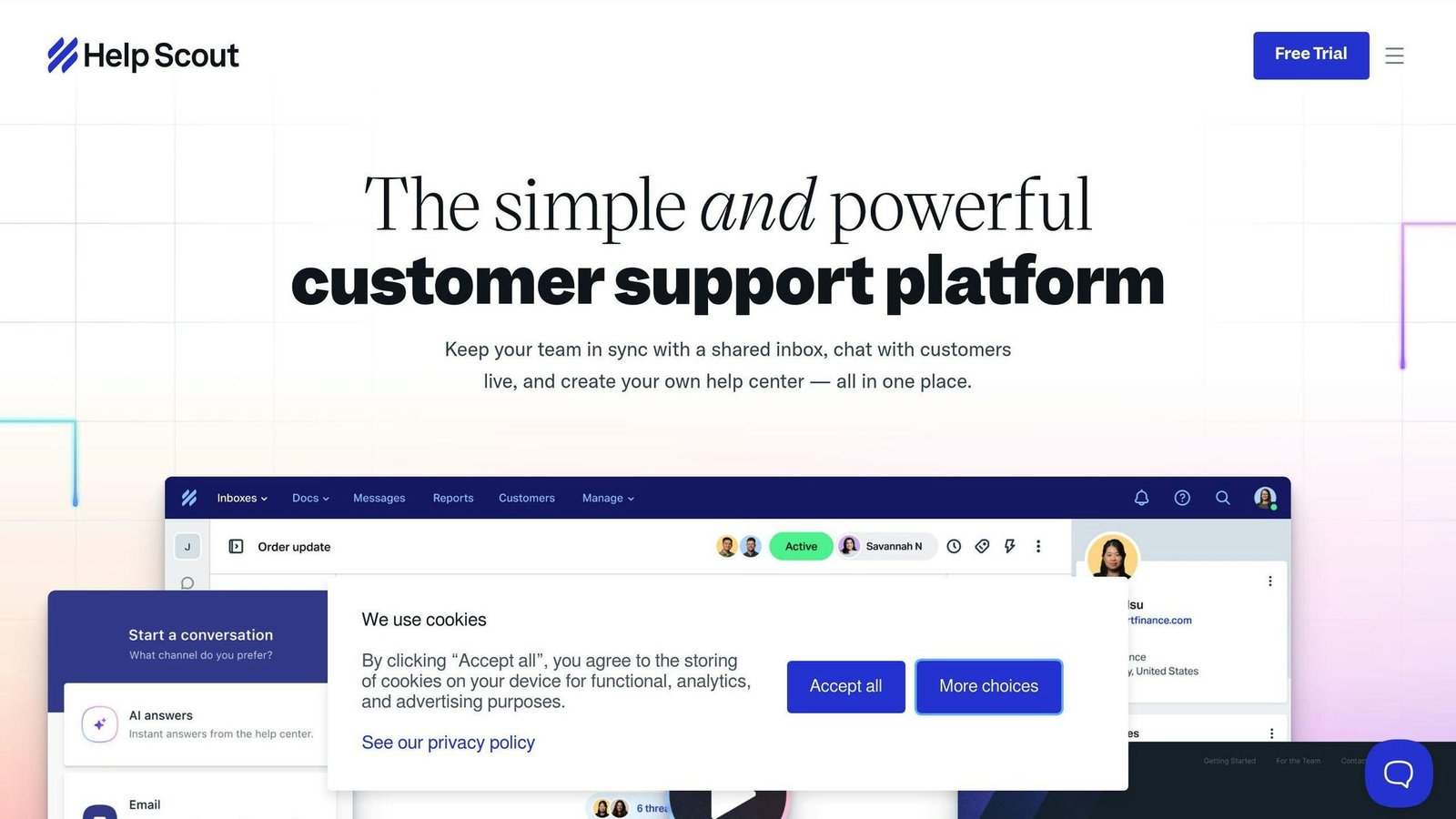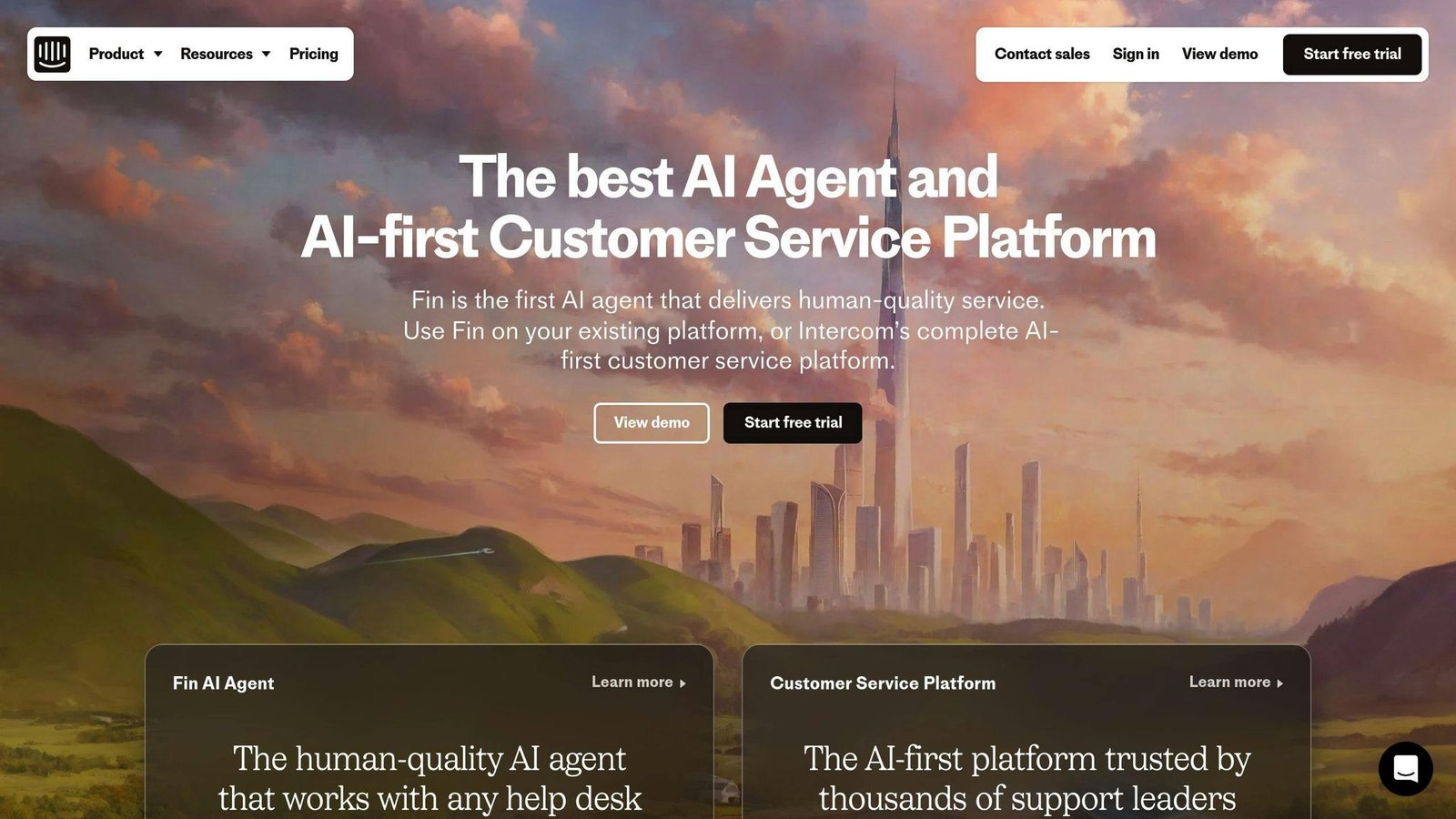
Help Scout is for the team that wants support to feel like a person replying to an email, with structure behind it: a shared inbox, assignment, saved replies and a knowledge base, priced per seat and predictable at the end of the month. Intercom is for the software business that wants an AI agent answering most incoming questions inside the product, with humans picking up what it cannot resolve.
These are not two versions of the same thing. One sells a better inbox. The other sells deflection, and charges for it by the resolution.
The short answer
- Pick Help Scout if two to thirty people answer customer email, the tone of the reply matters, and you want to know what the bill will be.
- Pick Intercom if you have a product to embed a messenger in, enough repetitive volume that an AI agent can absorb it, and help content good enough to answer from.
- Pick Help Scout if your support is email-shaped: considered replies, attachments, back-and-forth over days.
- Pick Intercom if onboarding messages, product tours and in-app announcements are part of the job, because that is the same platform rather than another purchase.
When neither is the right answer
Under about twenty conversations a week with two people answering, a Google Group configured as a collaborative inbox or a shared Outlook mailbox handles it. Support tooling earns its keep when you lose track of who replied, not when volume feels annoying. Buy it at the point where two people have answered the same customer twice.
If you already pay for a suite with a support module, use it before adding a subscription. HubSpot and Zoho CRM customers frequently buy a help desk they were already entitled to, badly.
And if your customers mainly phone you, or you dispatch engineers to sites, both products are the wrong shape. Intercom in particular is built around a messenger you embed in software. With no product to embed it in, you are paying for the expensive half and using the cheap half.
One more honest case: if you are choosing mainly on ticketing depth, SLAs and routing rules rather than on tone or AI, look at Zendesk and Freshdesk instead. That is a different argument with different winners.
What Help Scout is genuinely better at
Not looking like a help desk. Customers get an email, not a case number and a template. For a small brand where support is part of the product experience, that is the entire reason to buy it.
Cost you can forecast. Seats times price, plus a knowable AI line if you switch it on. Finance can budget it.
Getting started without engineering. Founders, office managers and success leads set it up themselves. Docs and the Beacon widget go live in an afternoon.
The trade-off: structural limits sit on the plan tiers. The number of inboxes, Docs sites, workflows and SLA policies is tied to your tier, so you can be pushed to upgrade for reasons unrelated to headcount. Extra inboxes and Docs sites are billed as add-ons. Reporting answers the obvious questions and not much more; teams wanting unusual cuts export the data. And it is not an ITSM tool: no asset management, no change control, no approval chains.
What Intercom is genuinely better at
Removing tickets rather than organising them. Fin answers from your help centre and connected content, and hands over with context when it cannot. If your inbound is dominated by twenty questions asked a thousand ways, that changes headcount maths in a way a better inbox never will.
Supporting people inside the product. The messenger, product tours, checklists, tooltips and banners run off the same customer record as support. Onboarding and support stop being two systems that disagree about who a user is.
Channel coverage. Chat, email, phone, WhatsApp and social land in one omnichannel inbox.
The trade-off: the pricing model transfers volume risk to you. Seats are predictable; resolutions are not, and a busy month raises the bill. Add-ons stack — proactive messaging, phone, advanced reporting and some AI capabilities are separate line items, so the working configuration usually costs more than the entry price implies. Fin’s performance depends on help content somebody has to maintain; neglect it and you pay for seats and an AI that underperforms. The messenger also adds JavaScript to your product, which matters if page speed does.
Pricing, checked August 2026
All figures are US list, USD, taken from each vendor’s own pricing page.
Help Scout lists Standard at $25 per user per month, Plus at $45 per user per month and Pro at $75 per user per month, all billed monthly, with a 16% discount for annual billing. There is a free plan: up to 5 users, 1 inbox, 1 Docs site, 100 contacts per month, 10 saved replies and 10 tags. AI Answers is usage-based at $0.75 per resolution, with a three-month free trial and a monthly spending cap you can set. Additional inboxes are $10 per month on annual billing ($12 monthly), and additional Docs sites $20 per month on annual billing ($24 monthly).
Intercom lists Essential at $29 per seat per month, Advanced at $85 per seat per month and Expert at $132 per seat per month, billed monthly, with annual billing available. Fin is priced from $0.99 per resolution and can be deployed without seats. Add-ons listed include Copilot at $29 per agent per month, Proactive Support Plus at $99 per month, and a Pro add-on from $99 per month.
Do the arithmetic before you fall in love with either. Five agents on Help Scout Standard is $125 a month before AI. Five seats on Intercom Essential is $145 a month before a single Fin resolution. At 500 AI resolutions a month, Intercom’s usage line alone is about $495 at the entry rate, and Help Scout’s about $375 at $0.75 each. Deflection is worth it when a resolution costs less than the agent minutes it replaces — which depends on your salaries, not on the vendor’s chart.
This comparison is compiled from both vendors’ published documentation and pricing pages. We have not tested either product hands-on.
Migration and lock-in
Both vendors offer APIs and export routes for conversations and contacts, so your history is retrievable. That is the easy part, and it is not where the cost is.
The expensive things do not port: saved replies and macros, workflow and routing rules, tags built up over years, SLA policies, satisfaction history, and reporting baselines. Rebuilding those is a project measured in weeks, plus retraining everyone who lives in the inbox all day.
Help Scout’s specific tie is the help centre. If your Docs site ranks in search and is hosted by Help Scout, moving means republishing articles and managing redirects. Get your Docs content out as a structured export before you cancel, and check the URL structure of wherever you land.
Intercom’s specific tie runs deeper. The messenger is code inside your product, so removing it is an engineering release, not a settings change. Product tours, checklists and outbound campaigns are configured in Intercom and rebuild nowhere. And Fin is tuned against your help centre — the content is yours, the tuning is not. Teams that adopt Intercom’s proactive messaging alongside support end up with two departments dependent on one vendor, which is the most durable lock-in in this category.
Neither product locks a contract in a way that surprises small teams, but check annual commitments and seat minimums at renewal rather than at signup.
Side by side
| Decision criterion | Help Scout | Intercom |
|---|---|---|
| Entry price (US list, Aug 2026) | $25 per user/month (Standard, billed monthly) | $29 per seat/month (Essential, billed monthly) |
| Top published tier | Pro, $75 per user/month | Expert, $132 per seat/month |
| Free plan | Yes — 5 users, 1 inbox, 100 contacts/month | No |
| AI charging | AI Answers, $0.75 per resolution, capped if you set a cap | Fin, from $0.99 per resolution, no seat required |
| In-app messenger | Beacon widget for search, chat and messages | Core to the product, with tours and checklists |
| Proactive and outbound messaging | Limited | Yes — Proactive Support Plus listed at $99/month |
| Phone as a channel | No | Yes, within the omnichannel inbox |
| Extra inbox cost | $10/month annual, $12 monthly | Not charged this way; tiers gate capability |
| Reporting | Functional; export for anything unusual | Deeper, with advanced reporting on higher tiers or add-on |
| Cost predictability | High — seats plus a capped AI line | Variable — rises with resolution volume |
| Typical team size | 2–30 support staff | 5–100 support and success staff |
The recommendation
Ecommerce brand or agency, three to ten people answering email: Help Scout Standard. Turn AI Answers on with a spending cap after a month, once you can see which questions repeat.
SaaS company with a product, 500+ conversations a month and a maintained help centre: Intercom. The deflection is the product, and you have the two ingredients it needs. Run Fin on a subset first and measure resolution quality before rolling it across everything.
SaaS company with a product and a neglected help centre: not yet. Spend a month writing the twenty articles that answer your top twenty questions. Then buy Intercom, or discover you no longer need to.
Team under three people, under twenty conversations a week: neither. A shared mailbox and a rule about who answers what.
Support that is mostly phone or field work: neither. You are looking at the wrong category.
FAQs
Can Help Scout do AI deflection like Intercom?
It has AI Answers, billed at $0.75 per resolution, plus AI drafting and summarising for agents. It is a genuine deflection feature, but Intercom has built its whole platform and roadmap around the AI agent. If deflection percentage is the number your business case rests on, Intercom is the more serious bet.
Is Intercom’s per-resolution pricing risky for a small company?
It is variable, which is a different thing from expensive. Model your monthly conversation volume against the resolution price and compare it with agent cost. The risk is a spike — a launch or an outage — landing on a usage-based bill. Ask about caps and commitments before signing.
Can you run both?
Some teams do, using one for support email and another for in-product messaging, but you then maintain two customer records and two sets of content. It is rarely worth it below fifty staff. Pick the one that matches where your customers actually contact you.
Seat prices, AI resolution rates, add-on packaging and plan limits change regularly in both products. The figures above were checked on each vendor’s own pricing page in August 2026 — confirm current terms before committing.