Disclosure: This page contains commercial links. BizBot may earn a commission from qualifying purchases. Paid placements do not buy a better ranking. Read our affiliate disclosure.
Businesses rely on a steady flow of supplies to keep daily operations running smoothly. From office materials and cleaning products to technology and workplace equipment, these resources support productivity and help maintain organized work environments. However, not every supplier offers the same level of reliability, inventory availability, or service quality.
Choosing the right supplier can significantly impact efficiency, purchasing costs, and operational consistency. Understanding what sets dependable supply providers apart helps businesses build stronger procurement partnerships and avoid disruptions.
It also helps to be honest about where the money actually goes. For most small businesses, workplace supplies are not a large line in the accounts, but they are a high-frequency one: many small orders, placed by several people, arriving on different days, each generating an invoice someone has to code. The cost of that administration is often larger than the difference between two suppliers’ prices. Keep that in mind while reading the factors below, because the ones that reduce transaction count usually matter more than the ones that reduce unit price.
1. Wide Product Selection and One-Stop Purchasing
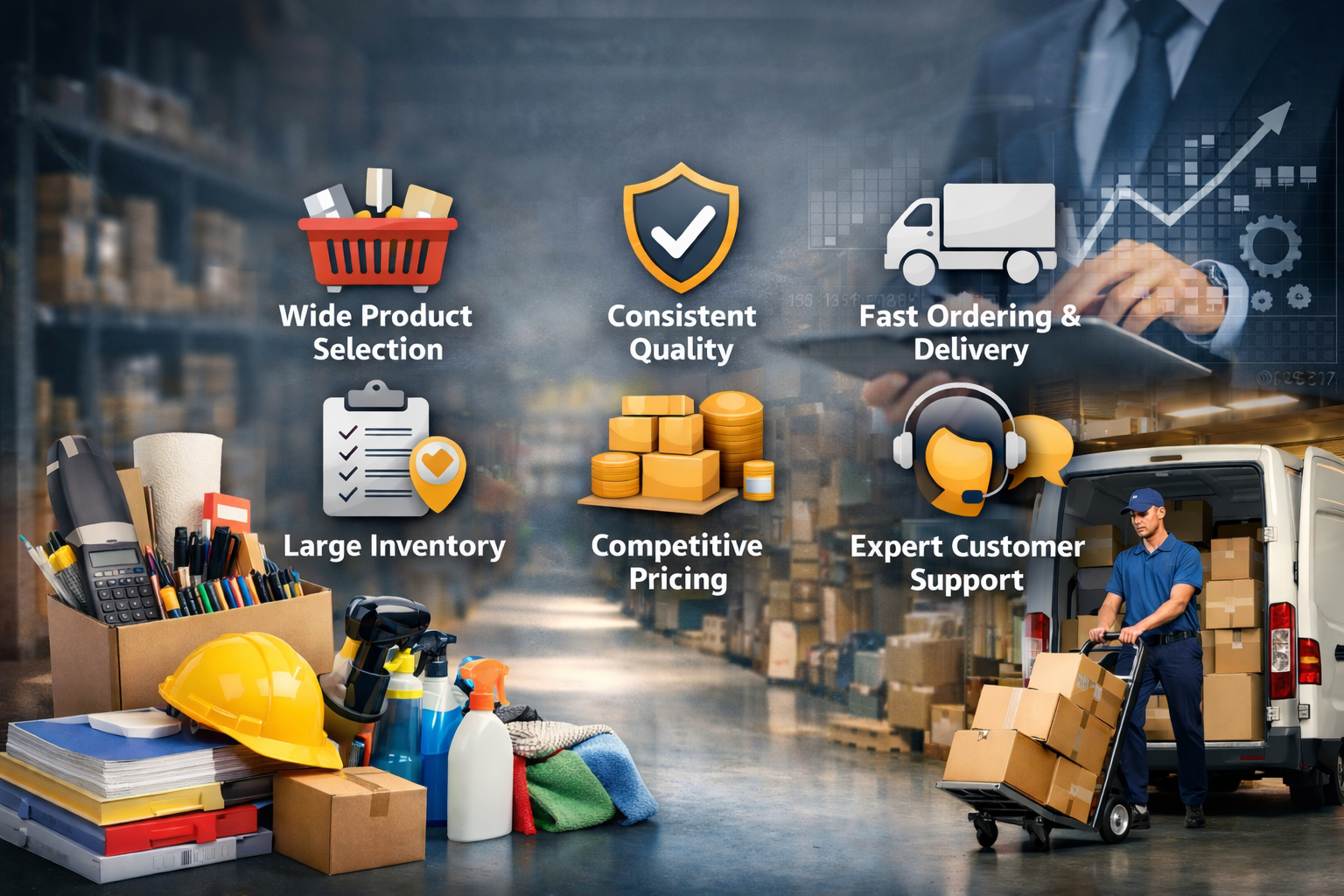
One of the most important characteristics of a dependable supply provider is a broad product catalog. Businesses often require a variety of supplies, from office stationery and technology products to cleaning equipment and furniture. In many cases, companies prefer working with a centralized business supply center that can handle a wide range of workplace needs.
For example, some suppliers provide extensive catalogs covering office materials, janitorial supplies, safety equipment, food service products, and workplace technology in a single location. A comprehensive inventory like this allows businesses to consolidate orders, reduce administrative workload, and maintain consistency in purchasing.
Platforms such as Bestwork Supply Center provide access to thousands of workplace essentials. Their catalog includes writing supplies, paper products, packaging materials, ink and toner, desk accessories, and breakroom items, allowing businesses to manage procurement through a single source.
The measurable benefit is fewer transactions, not lower prices. Three suppliers with four orders a month each is twelve deliveries, twelve invoices and twelve chances for a coding error. One supplier with four orders is four of each. If your bookkeeper is spending an hour a week on supply invoices, consolidation buys that hour back, and that is usually worth more than the two percent you might save by splitting the order.
The trade-off of consolidating
Single-sourcing has two real costs and both are worth naming. The first is price drift: a supplier with no competition on the account has no reason to sharpen a quote, and list prices tend to creep between reviews. The second is concentration risk, where one stock-out or one delivery problem affects everything you order rather than a third of it.
The usual mitigation is cheap. Keep one alternative supplier live with a small monthly order so the account stays open, and benchmark your top twenty items by spend against them once a year. Twenty items is normally most of your supply spend, so a short comparison tells you almost everything a full tender would, in an afternoon rather than a month.
2. Consistent Product Quality
Quality is another factor that distinguishes reliable suppliers from inconsistent ones. Businesses depend on equipment and materials that perform consistently, whether it’s office furniture, cleaning products, or safety supplies.
A dependable supplier typically works with recognized brands and maintains quality standards across its inventory. This helps ensure that customers receive products that meet workplace safety requirements and operational expectations. Reliable suppliers also maintain clear product descriptions, specifications, and support information to help customers make informed purchasing decisions.
Where quality quietly costs money is substitution. Most suppliers reserve the right to ship an equivalent item when something is out of stock, and “equivalent” is doing a lot of work in that sentence. Own-brand toner that voids a printer warranty, or a cleaning product that turns out not to be approved for a food-prep surface, is a substitution that costs far more than the item. Ask what the substitution policy is, and for the handful of items where it matters, ask for them to be flagged no-substitute on the account.
3. Inventory Availability and Large Catalogs
Supply shortages can disrupt business operations. When essential items suddenly become unavailable, teams may struggle to maintain productivity or meet customer demands.
Reliable supply centers prioritize maintaining large inventories and diverse product selections. Some suppliers provide access to tens of thousands of items covering office supplies, industrial tools, janitorial equipment, and technology accessories.
Large catalogs reduce the likelihood of stock shortages and allow businesses to quickly locate alternatives if specific items are unavailable. In addition, suppliers with robust inventory systems can fulfill orders more quickly, ensuring businesses receive the products they need without unnecessary delays.
Catalogue size is easy to advertise and tells you little on its own. What you actually want to know is how the supplier behaves when an item you need is not there. Two questions separate suppliers quickly: does the site show live stock at the warehouse that serves you, rather than a generic “in stock” flag, and what happens to the rest of the order when one line is short? A supplier that ships complete only, holding everything until the last item arrives, will cause you more disruption than one with a smaller catalogue that ships what it has and backorders the rest.
4. Efficient Ordering and Delivery Processes
The efficiency of the ordering process is another factor that sets reliable suppliers apart. Businesses often need supplies quickly, particularly when they are restocking essential items such as paper, cleaning products, or packaging materials.
Reliable supply centers typically offer streamlined ordering systems that allow businesses to place orders easily and track deliveries. Some suppliers also offer recurring order options or bulk-purchasing programs to help companies maintain consistent stock levels.
Efficient logistics and dependable delivery schedules help reduce downtime and ensure businesses always have the supplies necessary to keep operations running smoothly.
Turn ordering into a control, not just a convenience
The account features that look administrative are the ones that stop supply spend leaking. Look for four specifically:
- Multiple users with spend limits. Anyone can order up to a set value; above it, the order routes to one approver. This is far better than the common alternative, where one person places every order and becomes a bottleneck, or everyone uses a shared login and nobody owns anything.
- A curated list, not the full catalogue. Restrict the account to an approved list of items your business actually buys. It removes the choice paralysis, standardises what arrives, and stops someone ordering a premium version of a commodity item.
- Purchase order references on every order. If a PO number or cost code travels through to the invoice, your bookkeeper can match without asking anyone what a delivery was for. This is the single change that most reduces month-end friction.
- Scheduled standing orders for predictable consumables. Paper, hand towels and coffee do not need a decision every month. Set a recurring order at a realistic quantity and review it quarterly.
On the accounting side, the goal is that a supply invoice arrives already coded. Most small businesses handle this through their accounting system, whether that is QuickBooks, Xero or something lighter; our guide to the best accounting software for small businesses covers the options. If you are not yet at that stage, a simple business expense tracker template is enough to see what you are actually spending by category.
5. Competitive Pricing and Bulk Purchasing Options
Cost management plays a major role in business procurement decisions. Reliable suppliers often offer competitive pricing, bulk-purchasing discounts, and promotional offers to help businesses control expenses.
Bulk purchasing programs can significantly reduce per-unit costs and simplify supply management. Instead of placing frequent small orders, businesses can purchase larger quantities at discounted rates and maintain a steady inventory of essential materials.
Additionally, consolidated shipments can lower transportation costs and reduce the administrative effort associated with multiple orders. These pricing advantages help organizations maintain efficient purchasing strategies while controlling operational expenses.
Bulk buying is not free, though, and the costs are easy to miss. You are paying now for something you will use over months, which is working capital tied up in a stockroom. Some items degrade: printer ink, batteries, disinfectant and anything with an expiry date do not reward a twelve-month buy. And a large delivery needs somewhere to live, which in a small office usually means a corner that was doing something else.
A reasonable rule is to bulk-buy only items that are non-perishable, that you consume at a predictable rate, and where the discount is meaningful rather than nominal. For everything else, order to a reorder point instead. Two other pricing details are worth checking before you compare quotes at all: whether the price you are shown is your contracted account price or the public list price, and where the free-delivery threshold sits. A low threshold encourages small frequent orders; a high one quietly pushes you to over-order to avoid a delivery charge.
6. Industry Knowledge and Customer Support
A dependable supply provider doesn’t simply deliver products; it also offers guidance and support when customers need assistance. Knowledgeable staff can help businesses identify the right products for their operational requirements.
For example, some workplaces require specialized cleaning supplies, industrial safety equipment, or ergonomic furniture. Experienced suppliers can recommend products that meet these needs while ensuring compliance with workplace standards.
Strong customer support also helps resolve issues quickly. Whether customers have questions about product specifications, shipping timelines, or order adjustments, responsive service can make the purchasing experience far more efficient.
The honest test of support is not the sales call, it is the returns process. Ask three questions before you commit: how long is the return window, is there a restocking fee and on what, and who pays the return shipping when the fault is theirs. Furniture and technology are where this bites, because those are the items most likely to be wrong and the most expensive to send back.
Before You Switch Supplier
A short checklist that takes about an hour and prevents most of the regret:
- Pull twelve months of supply invoices and list your top twenty items by total spend. That list, not the catalogue, is what you compare.
- Get quoted account pricing on those twenty items from both the incumbent and the challenger. List prices are not a comparison.
- Confirm delivery lead time to your actual address, the free-delivery threshold, and the cut-off time for next-day.
- Get the substitution, backorder and returns policies in writing.
- Check payment terms and whether they affect price. Net terms have value; a discount for paying immediately may or may not beat it.
- Run a parallel month with a small share of your orders before moving everything.
FAQ
Is it better to use one supplier or several?
One primary supplier for the bulk of your spend, plus one alternative account kept warm, suits most small businesses. Consolidation cuts administration, which is where the real cost sits, while the second account preserves both a fallback and enough competitive tension to keep pricing honest. Splitting spend evenly across three suppliers usually costs more in handling than it saves in price.
How do we stop supply spend creeping up?
Restrict the account to an approved item list, set per-user spend limits with one approver above a threshold, and require a cost code on every order so purchases can be attributed to a team. Then review the top twenty items by spend once a year. Most creep comes from unmanaged item choice rather than from unit prices rising.
When is bulk buying actually worth it?
When the item does not perish, you consume it at a predictable rate, you have somewhere to store it, and the discount is meaningful rather than a token. Paper and packaging usually qualify. Ink, batteries, cleaning chemicals and anything dated usually do not, because the shelf-life risk and the cash tied up outweigh the saving.
Conclusion
Choosing the right supply partner involves more than comparing prices. Reliable suppliers offer broad product selections, consistent quality, dependable inventory availability, and efficient ordering systems. The parts that matter most for a small business, though, are the unglamorous ones: how the account handles approvals and cost codes, what happens when a line is out of stock, and how easy it is to send something back. Get those right and supply management stops being a recurring distraction.
More on this topic
Browse all 86 articles on Business Operations, or jump straight to our buying guide: Best Productivity Tools for Small Teams.