Rebalancing your portfolio ensures your investments stay aligned with your financial goals and risk tolerance, even as markets fluctuate. Without it, your asset allocation can drift, exposing you to unintended risks. For example, a 60/40 stock-to-bond portfolio could shift to 65/35 during a bull market, increasing your exposure to equities.
Here’s what you need to know:
- What is Rebalancing? It’s the process of selling overperforming assets and buying underperforming ones to maintain your target allocation.
- Why Customize? Tailored strategies consider your goals, risk tolerance, tax impact, and account types.
- Methods to Use:
- Time-Based: Adjust on a fixed schedule (e.g., annually).
- Threshold-Based: Rebalance only when allocations deviate by a set percentage (e.g., ±5%).
- Hybrid: Combine scheduled reviews with deviation triggers.
- Cost Control: Use natural cash flows (like dividends) to minimize trading and tax costs.
A hybrid approach – such as annual reviews with a ±5% tolerance band – balances simplicity and cost efficiency. Use tools like automated platforms to streamline monitoring and execution. Regularly review your strategy to adjust for market changes or major life events.
A note on sources. Earlier versions of this article attributed specific research findings to Wellington Management, Vanguard, Russell Investments and T. Rowe Price, without linking to any of them. We could not locate the underlying research for any of those claims, including a figure putting the after-tax benefit of combining tax-loss harvesting with threshold rebalancing at 0.5 to 1% a year. That is exactly the sort of number a reader might act on, so it has been removed rather than softened. The tax rules cited below are linked to the IRS, and the rest of the reasoning stands on its own.
Setting Investment Goals and Target Allocations
To rebalance your portfolio effectively, you need a clear understanding of your financial goals and how much risk you’re willing to take. Your target allocation – the specific mix of stocks, bonds, and other assets – acts as a roadmap for all your rebalancing decisions. Without defined goals and a clear allocation strategy, rebalancing becomes aimless. Start by identifying your financial objectives and risk tolerance to establish specific target allocations.
Identifying Your Long-Term Financial Goals
What are you saving for? Is it retirement in a few decades, a college fund for your children, or simply preserving the wealth you’ve built? Each goal comes with its own time horizon and priorities, which directly influence your asset allocation.
For example, younger investors often lean toward higher equity exposure to maximize growth potential. On the other hand, older investors may shift toward safer assets, like bonds, to protect their accumulated wealth. If you’re 35 and focused on aggressive growth for retirement, you might target something like 80% stocks, 15% bonds, and 5% alternatives. If you’re 60 and prioritizing stability, a more conservative allocation – such as 50% stocks, 40% bonds, and 10% cash – could help reduce volatility as retirement nears. Treat those as illustrations of the shape of the decision, not as recommendations: your own numbers depend on facts this article does not know.
It’s crucial to document your financial goals, including specific targets and deadlines. Revisit these annually or after major life changes like marriage, inheritance, or career shifts to ensure your allocations remain aligned with your objectives. Once your goals are in place, the next step is determining how much market fluctuation you can handle.
Determining Your Risk Tolerance
Risk tolerance – your ability to handle market ups and downs without selling at the bottom – directly influences how much of your portfolio is allocated to equities versus fixed-income assets. Conservative investors with low tolerance often stick to 30-50% equities to limit potential losses, while moderate investors might aim for 50-70%. Aggressive investors, comfortable with higher volatility, could allocate 70-90% to equities.
To gauge your risk tolerance, consider using standardized questionnaires. These assess factors like your reaction to a 20% portfolio loss, your income stability, and your investing experience. Be aware of their main weakness: people answer questions about a hypothetical 20% loss quite differently from how they behave during a real one. If you have lived through a market fall with money invested, your own behaviour then is better evidence than any questionnaire.
Age also plays a role, mostly because it proxies for time horizon. Younger investors generally have longer to recover from a drawdown, which supports higher equity allocations. Investors closer to drawing on the money often shift toward preservation along a “glide path”. Once you’ve settled on an allocation, set clear tolerance bands – ±5% from target is a common choice – to determine when rebalancing is necessary.
Choosing Your Rebalancing Method
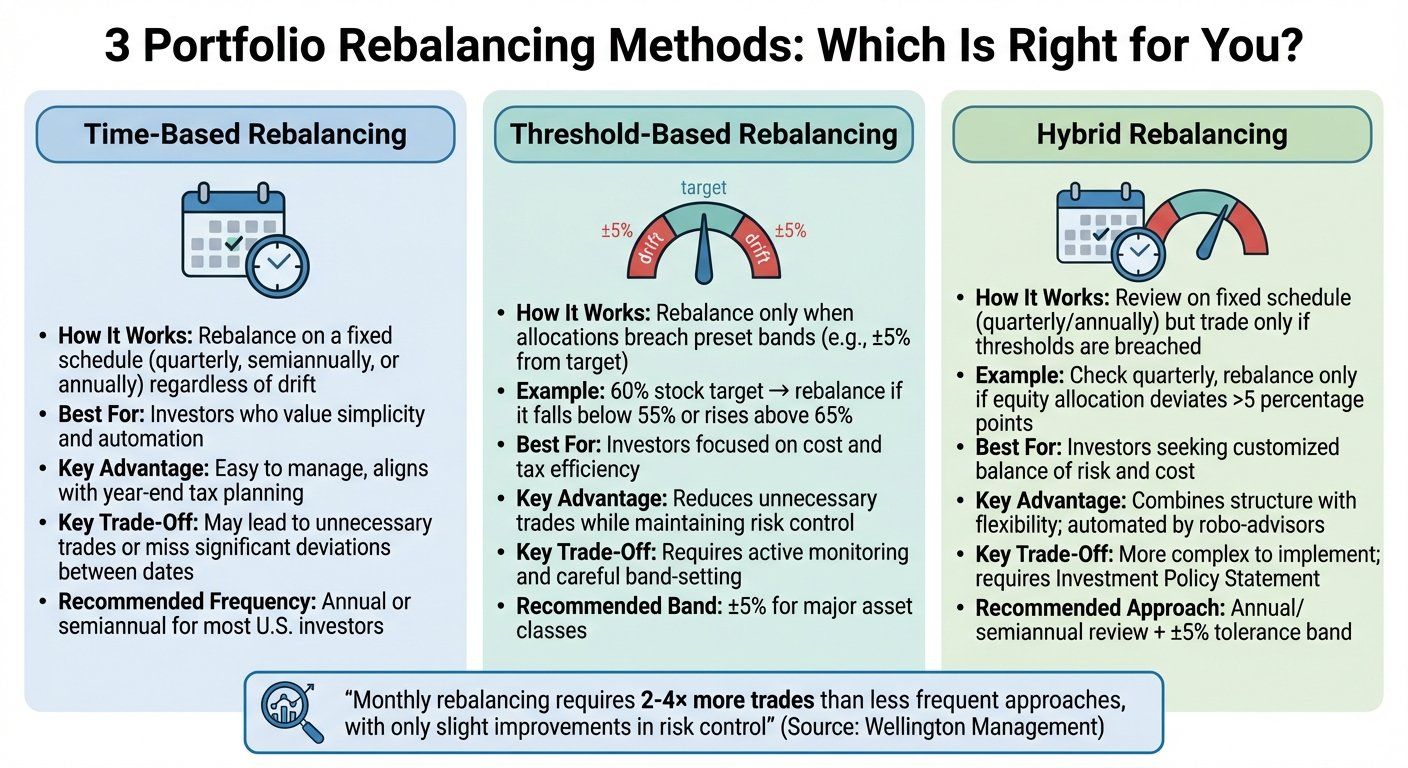
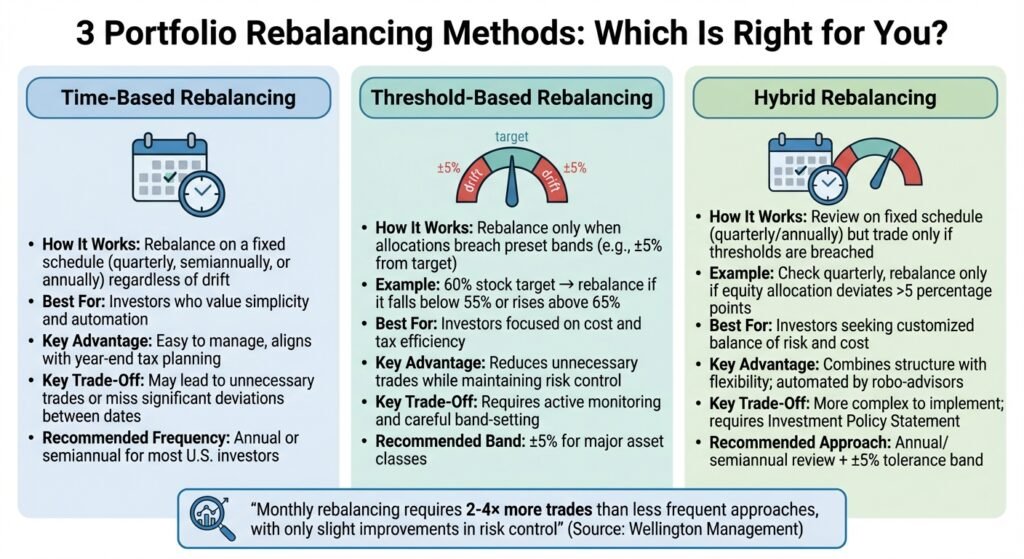
Portfolio Rebalancing Methods Comparison: Time-Based vs Threshold-Based vs Hybrid
Once you’ve established your target allocation and assessed your risk tolerance, the next step is deciding how to rebalance. The right method keeps you aligned with your goals while managing trading costs and taxes. There are three main approaches: time-based, threshold-based, and hybrid.
The general trade-off between them is not controversial and does not need a study to state: the more often you rebalance, the closer you track your target allocation, and the more you pay in trading costs and realised taxes. Frequent rebalancing buys tighter risk control at rising cost, and the improvement in risk control tails off quickly while the costs do not.
Time-Based Rebalancing
Time-based rebalancing, also known as calendar rebalancing, involves resetting your portfolio to its target allocations on a fixed schedule – such as quarterly, semiannually, or annually – regardless of how much your allocations have drifted. This method is popular for its simplicity and predictability. Annual or semiannual rebalancing is easy to manage, aligns with year-end tax planning, and keeps trading costs under control. In tax-advantaged accounts like 401(k)s or IRAs, more frequent rebalancing carries no capital gains consequence.
However, one drawback of this approach is that it doesn’t account for the degree of drift. This means you might end up making trades when adjustments are unnecessary, or you could miss significant deviations that occur between rebalancing dates.
Threshold-Based Rebalancing
Threshold-based rebalancing, or tolerance-band rebalancing, takes a different approach. Instead of following a fixed schedule, this method adjusts your portfolio only when an asset class moves beyond a specified percentage range from its target. For example, if your target allocation for stocks is 60% with a ±5% tolerance band, you would rebalance only if stocks fall below 55% or rise above 65%. This strategy reduces unnecessary trades while keeping your risk levels closer to your intended targets.
Narrow bands track the target more tightly and trade more; wide bands do the opposite. Around ±5% is a common compromise, particularly in taxable accounts, and it is a choice rather than a finding. Some investors use narrower bands for higher-risk holdings and wider ones for stable ones, or asymmetric bands that let equities run further on the upside than the downside. All of these are defensible; none is optimal in any provable sense.
Hybrid Rebalancing Approaches
Hybrid rebalancing combines the fixed structure of time-based methods with the flexibility of threshold-based strategies. Under this approach, portfolios are reviewed on a regular schedule, but trades are executed only if allocations breach predefined thresholds. For instance, you might review quarterly and rebalance only if the equity allocation deviates by more than 5 percentage points from its target (dropping below 55% or rising above 65% in a 60/40 portfolio). This gives you a defined review rhythm without trading for the sake of the calendar.
Its practical advantage is that it is a written rule you can follow when markets are frightening, which is precisely when discretion fails. Write it down before you need it.
Many digital platforms and robo-advisors automate hybrid rebalancing, making it easier to maintain target allocations.
| Method | How It Works | Best For | Key Trade-Off |
|---|---|---|---|
| Time-Based | Rebalance on a fixed schedule, regardless of drift. | Investors who value simplicity and automation. | May lead to unnecessary trades. |
| Threshold-Based | Rebalance only when allocations breach preset bands. | Investors focused on cost and tax efficiency. | Requires monitoring and setting bands. |
| Hybrid | Combine regular reviews with threshold-based trades. | Investors seeking a customized balance of risk and cost. | More complex to implement. |
For most investors, annual or semiannual review combined with a ±5% tolerance band on major asset classes is a reasonable default. In tax-advantaged accounts, rebalance more freely, since there is no tax cost. In taxable accounts, pair the thresholds with cash flow adjustments so that contributions and withdrawals do as much of the work as possible.
Reducing Costs and Improving Tax Efficiency
Rebalancing your portfolio comes with transaction costs and taxes, both of which reduce your returns. With careful planning, you can manage these while keeping your portfolio aligned with your goals.
Minimizing Transaction Costs
Transaction costs include trading commissions, bid-ask spreads, and market impact. Many US brokerages now offer commission-free trading, but bid-ask spreads still apply, and they are wider on thinly traded funds than on major index ETFs. The straightforward way to lower these expenses is to trade less often.
Wider tolerance bands, such as ±5%, help avoid unnecessary trades. Better still, use natural cash flows – new contributions, dividends, or withdrawals – to correct imbalances by directing money toward whichever asset class is underweight. This rebalances without selling anything, which means no spread and, in a taxable account, no realised gain. For anyone still contributing regularly, this alone will handle most drift.
Tax-Loss Harvesting and Tax Efficiency
In taxable accounts, rebalancing can trigger capital gains taxes. According to the IRS’s Topic 409 on capital gains and losses, net long-term capital gains are generally taxed at 0%, 15%, or 20% depending on income, while short-term gains on assets held a year or less are taxed as ordinary income. Holding an asset past the one-year mark before selling is therefore often worth more than any refinement of your rebalancing rule.
Tax-loss harvesting can help. This involves selling securities at a loss to offset gains elsewhere in your portfolio, then reinvesting in similar (but not substantially identical) assets to maintain your allocation. If a 60/40 portfolio has drifted to 65/35, selling the overweight stock positions that happen to carry losses lets you correct the drift and bank a deduction at the same time.
Two IRS rules govern this. Capital losses offset capital gains, and if losses exceed gains you may deduct up to $3,000 against ordinary income per year ($1,500 if married filing separately), carrying any excess forward to future years. And the wash-sale rule disallows the loss if you buy a substantially identical security within 30 days before or after the sale – a window that catches automatic dividend reinvestment and purchases in your IRA, which is how most people trip over it. Both rules are set out in Topic 409 and IRS Publication 550.
In tax-advantaged accounts such as 401(k)s or IRAs, none of this applies: there are no capital gains to manage and no losses to harvest, so rebalance on whatever schedule you like. That asymmetry is worth exploiting deliberately. If you hold both account types, doing your rebalancing inside the sheltered account and leaving the taxable one alone is usually cheaper than treating each account separately.
Tools and Platforms for Custom Rebalancing
Automated Rebalancing Technology
Digital platforms monitor target allocations continuously, flag deviations outside set tolerance bands, and either place trades automatically or generate a trade list for you to approve. Better ones integrate rebalancing with tax-loss harvesting, cash flows, and withdrawals.
The useful design pattern is threshold monitoring on a frequent schedule: check often, trade rarely. Checking monthly against a 5% band gives you prompt notice of a real breach without generating a trade every month. This is the same hybrid logic described above, just executed by software.
Direct indexing and custom indexing platforms extend this by holding individual securities rather than funds, which creates more opportunities to harvest losses at the security level even when the overall index is up. That flexibility is real, and so is the cost and complexity, which is why it tends to make sense only on larger taxable accounts. Check the fee against the tax benefit you would actually realise given your own gains, rather than against an illustration.
Whatever platform you use, confirm it monitors wash sales across all your linked accounts. A tool that harvests a loss in your brokerage account while your IRA quietly repurchases the same fund has cost you the deduction.
BizBot for Financial Management

BizBot is a directory of business administration tools, including subscription management to cut down on unnecessary fees and digital CFO services for financial operations. That is useful for small business owners and freelancers who are managing business cash flow alongside personal investments, since the two compete for the same money.
BizBot’s categories include accounting tools like QuickBooks, Xero, and FreshBooks, as well as platforms for tracking expenses and generating financial reports. Knowing what surplus cash you actually have, and when, is what makes cash-flow rebalancing possible in the first place. To be clear about what this is and is not: none of these are investment tools and none of them rebalance anything.
Monitoring and Adjusting Your Rebalancing Strategy
Evaluating Performance and Adjusting Goals
Rebalancing isn’t something you can set and forget. Review your allocations at least annually, and quarterly for more active strategies. Track how often your portfolio breaches its tolerance bands, assess portfolio volatility and maximum drawdown against what a no-rebalancing approach would have produced, and evaluate after-tax, after-fee returns.
That last one matters most and is the one people skip. A strategy that improves pre-tax tracking while realising gains every year can leave you worse off, and you will not see it unless you measure after tax.
Life changes are the strongest reason to revisit the whole plan rather than just the bands. Retirement, an inheritance, selling a business, or a change in income or risk tolerance all call for updating your target allocations and rebalancing parameters. If you are five years from retirement rather than ten, you may want lower equity exposure or tighter bands. If a business sale produces a windfall, reassess whether your asset mix still matches your liquidity needs and timeline.
Responding to Market Changes
Market conditions affect how often your rules fire. In volatile periods your portfolio will breach thresholds more frequently; in a long bull market equities drift steadily upward, and rebalancing means repeatedly selling the thing that has been going up, which is psychologically harder than it sounds. That difficulty is the main argument for having written rules.
Wider bands (±5%) and asymmetric bands, which allow equities more room to drift up than down, are both reasonable responses to volatility. So is doing your rebalancing with new contributions, dividends and withdrawals rather than with sales, which avoids realising gains at all.
What is not reasonable is abandoning the rule because conditions feel exceptional. Conditions always feel exceptional.
Conclusion
Custom rebalancing is about managing your portfolio’s risk while staying aligned with your financial goals, at a cost you are willing to pay.
Start by setting clear, written goals and target allocations that reflect your time horizon and risk tolerance. A hybrid approach – annual or semiannual review with threshold triggers for significant drift – is a sensible default, because it puts a floor under how often you trade without ignoring genuine moves.
Whenever possible, use new contributions and dividends to buy underweight assets rather than selling overweight ones. During market falls, consider harvesting losses to offset gains, within the IRS rules set out above. And keep an eye on the cumulative drag of costs and realised taxes, which compounds against you exactly as returns compound for you.
Review quarterly or semiannually, and hold a proper strategy review once a year or after any major life change. Automation handles the monitoring and the arithmetic. It does not decide what your money is for.
One closing caveat. This is general information about how rebalancing works, not investment or tax advice, and your circumstances will change the answer. For anything with a meaningful tax consequence, check with a professional who can see your actual position.
FAQs
What’s the best way to choose a rebalancing strategy for my portfolio?
Choosing how to rebalance comes down to your goals, how much risk you’re comfortable with, and your investment timeline. Two widely used strategies are calendar rebalancing and threshold-based rebalancing:
- Calendar rebalancing means adjusting on a set schedule – quarterly or annually. It’s simple, predictable, and easy to build into your planning.
- Threshold-based rebalancing triggers when your allocation drifts beyond a set percentage, such as 5%. It responds to market movements rather than the calendar, and generally trades less.
Most people end up somewhere between the two. The best strategy is the one you will actually follow when the market is down 20% and rebalancing means buying more of what just fell.
What should I know about the tax impacts of rebalancing my portfolio?
Rebalancing in a taxable account realises gains, and how often you do it changes your tax bill. Rebalancing frequently triggers more taxable events; rebalancing less often defers tax but lets the portfolio drift further from target.
Two things reduce the bill without changing your allocation: rebalancing with new contributions instead of sales, and doing your selling inside tax-advantaged accounts where gains are not taxed. Tax-loss harvesting can offset gains, subject to the $3,000 annual deduction limit and the wash-sale rule. For anything substantial, get advice specific to your situation.
What’s the best way to use automated tools for improving my portfolio rebalancing?
Automated tools handle the parts that reward consistency rather than judgement: tracking allocations continuously, applying your rules, and reducing manual errors. That keeps your portfolio aligned without needing constant attention.
What they do not do is set your targets or tell you when your circumstances have changed. Choose the rules yourself, write them down, and let the software enforce them. Check that any tool you use monitors wash sales across every account you hold, since that is the most common way an automated harvesting strategy quietly loses its own benefit.
More on this topic
Browse all 53 articles on Finance & Accounting, or jump straight to our buying guide: Best Accounting Software for Small Businesses.