Harvest is for firms that already have a project tool they like and need one narrow thing done well: hours in, invoice out. Paymo is for firms who would rather collapse the project board, the timesheet and the invoice into a single system and stop reconciling three of them.
Before anything else, be clear that these are not the same purchase. Harvest deliberately does no project management — no task boards, no dependencies — so the honest comparison is Harvest plus Asana or Trello, versus Paymo on its own. Compare the two totals, not the two price pages.
The short answer
- Pick Harvest if your team already lives in a project tool and moving them would cost more goodwill than the saving is worth.
- Pick Paymo if the same person often plans, does and bills the work, because that handoff is where a combined system saves real effort.
- Pick Harvest if your accounts run on QuickBooks Online or Xero and you want tracked time reaching them with the fewest moving parts.
- Pick Paymo if you need client-facing extras — a portal, guest access, file proofing with versions — without buying a fourth product.
When neither is the right answer
If you do not bill by the hour, do not buy either. Fixed-fee retainers invoiced on the first of the month need an invoicing tool and a calendar reminder, not a timer on every desk. Time tracking is only worth its friction when the hours either become the invoice or become the profitability number — if they do neither, you are asking people to do admin for a report nobody reads.
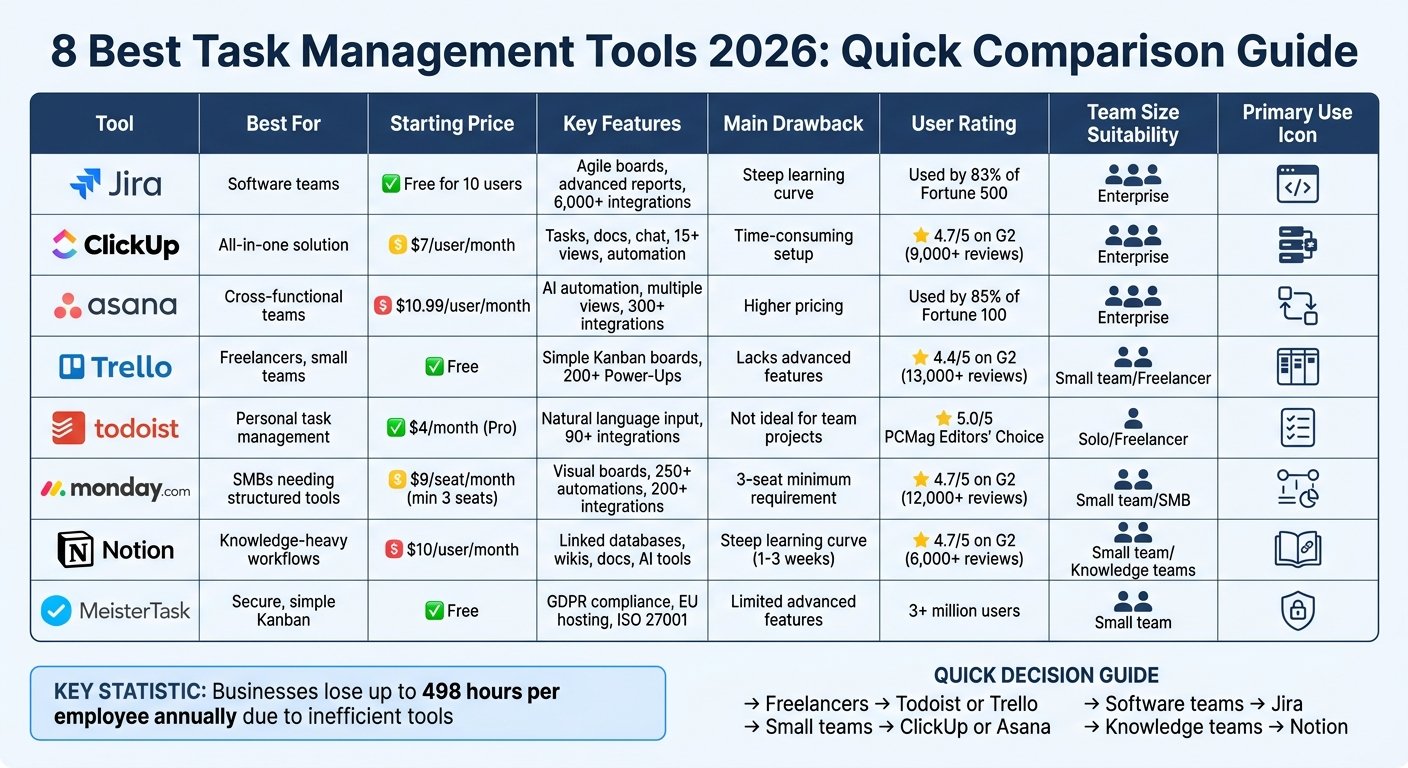
If you already run a project tool and only need hours, the cheapest honest answer is a dedicated tracker. Toggl Track and Clockify both have free tiers that will cover a small team indefinitely; our Toggl Track vs Clockify comparison covers that choice. Add billing later, if the spreadsheet you use for invoicing actually breaks.
And if the underlying problem is that your team does not log time honestly or promptly, no product on this page fixes it. Every profitability report either of these produces is built on entries people typed. If the culture will not sustain daily logging, you will get confident numbers that are quietly wrong — more dangerous than having no numbers at all.
What Harvest is genuinely better at
Doing one job without asking questions. Set up clients and projects, get people logging hours, bill from those hours. There is very little to configure and very little to ignore, which is why adoption tends to stick. For a team that resents software, that restraint is the feature.
Budget alerts that arrive in time. Projects can be hourly or fixed fee, with alerts that warn before a job quietly goes over. Reports cover project profitability, team capacity, uninvoiced hours and cost by client, and can be scheduled to land in your inbox without anyone running them.
Fitting into an existing stack. Integrations with Asana, Trello and Slack mean tracking can start from a task you already created, and QuickBooks Online and Xero connections mean the invoice ends up in your accounts rather than in a second system.
The trade-off: it is not a project management tool, so you are running two subscriptions and two adoption conversations. Resource planning is a separate product — Forecast integrates with Harvest but is bought and managed on its own. Pricing is per seat, so cost scales with headcount rather than usage, and the free tier is one seat and two projects. Invoicing is straightforward rather than powerful: complex retainers, multi-currency arrangements and detailed accounting rules will push you toward dedicated billing software.
What Paymo is genuinely better at
Removing the seam. Hours are logged against tasks that exist inside the project that becomes the invoice. Nothing has to be matched up afterwards, which is where most agencies lose billable time — not in the tracking, in the reconciliation.
Planning views that are actually there. Task lists, kanban, a spreadsheet-style table, calendar and Gantt charts read from the same tasks, with subtasks, dependencies and milestones. Harvest has none of this by design.
Client-facing work. Guest access, a client portal, comments and file proofing with versioning keep feedback attached to the work instead of scattered across email. For a design studio, proofing alone can displace a separate subscription.
Catching time people forget. Alongside normal timers there is an automatic desktop tracker that records application activity for you to assign later, which recovers the hours nobody remembers on Friday afternoon.
The trade-off: the free and Solo tiers are single-user and capped at one client and two projects. Key features are tier-gated in a way that matters: Gantt charts appear on Plus and Pro, while employee scheduling and timesheet approvals are Pro only. Reporting is solid but not analytical — unusual questions still mean exporting data. And there are fewer integrations than the large platforms, so confirm your accounting package, calendar and file storage connect the way you need before migrating.
Pricing, checked August 2026
Harvest lists a Free plan at $0 forever with 1 seat and 2 projects. Teams is shown as starting from $11 per seat per month billed monthly, falling to $9 per seat per month if you pay for a year up front — $108 per seat, billed annually. Enterprise is shown as starting from $17.50 per seat per month billed monthly, or $14 per seat per month billed annually — $168 per seat, billed annually. Enterprise Plus is custom-priced. Paid plans come with a 30-day free trial and no credit card. The page advertises a 20% annual discount, and that is exactly what the two sets of figures represent: $9 and $14 are the annual-billing rates, not the monthly ones. An earlier version of this comparison read the lower figures as the monthly prices; they are not.
Paymo is running an introductory offer, and the promotional figures are the ones on the cards. The page states “Get up to 40% OFF for the first 3 months” and that the offer applies to monthly plans for the first three months. So the numbers to budget on are the post-promotion ones: Solo at $9.90 per month for a single user, Plus at $15.90 per user per month, and Pro at $23.90 per user per month. The introductory rates are $5.90, $10.90 and $16.90 respectively. Free is $0 per month with 1 user, 1 client and 2 projects. Paymo also states that paying for a year at once carries a discount of up to 40%, though the specific annual figures were not displayed on the cards we read.
Now the comparison that matters. Harvest at $9 per seat per month on annual billing — $11 if you pay monthly — buys time and billing only; add a project tool and your real per-head cost is that plus whatever Asana, Trello or ClickUp charges. Paymo Plus at $15.90 per user per month covers both. For a ten-person studio, Paymo is likely the cheaper total. For a fifty-person firm already standardised on a project platform, Harvest bolted onto it is usually cheaper than migrating fifty people and re-teaching them where their work lives.
This comparison is compiled from both vendors’ published documentation and pricing pages. We have not tested either product hands-on.
Migration and lock-in
Harvest is the easier one to leave, for a structural reason rather than a generous one. If your invoices sync to Xero or QuickBooks Online, your billing record already lives outside Harvest in a system you are not leaving. What remains inside is the time entry history and the expense receipts, which is a smaller hostage than most SaaS products hold.
Paymo holds more because it does more. Leaving means moving tasks, project structures, time entries, invoices, expenses, client portal history and proofing comments with their versions — and the proofing threads in particular are the kind of record that turns into a dispute six months later. Before you commit, ask Paymo specifically what an export contains, whether attachments and proofing comments are included, and in what format. Ask Harvest the same about expense receipt images.
The genuine lock-in in both is historical rate data. Two years of hours at known rates against known clients is the only evidence you have of what a job actually costs, and it is what you price the next proposal from. Export it annually and keep a copy in your own storage.
One more, specific to Paymo: because the promotional pricing runs for three months, set a calendar reminder for month four. Teams routinely budget from the introductory rate and then treat the increase as a price rise.
Side by side
| Decision criterion | Harvest | Paymo |
|---|---|---|
| Primary job | Hours in, invoice out | Brief to invoice in one system |
| Task management | None by design | Lists, kanban, table, calendar, Gantt |
| Free plan | $0, 1 seat, 2 projects | $0, 1 user, 1 client, 2 projects |
| Entry paid tier (Aug 2026) | Teams, from $9 per seat/month billed annually ($11 billed monthly) | Solo, $9.90/month, single user |
| Team tier | Teams, $108 per seat billed annually | Plus, $15.90 per user/month after the intro period |
| Upper tier | Enterprise, from $14 per seat/month billed annually ($17.50 billed monthly) | Pro, $23.90 per user/month after the intro period |
| Timesheet approvals | Included | Pro tier only |
| Resource scheduling | Separate product (Forecast) | Pro tier only |
| Client portal and proofing | No | Yes, with file versioning |
| Main failure mode | Paying for two systems that half-overlap | Buying Pro for one feature you use monthly |
The recommendation
Design or marketing studio of five to fifteen people, no project tool they love: Paymo Plus. One system, client proofing included, and cheaper in total than Harvest plus a project platform.
Consultancy already standardised on Asana or Jira: Harvest. Do not migrate a working team to save a subscription. Track time where they already work and let it flow into Xero or QuickBooks.
Firm that needs timesheet approvals before anything reaches a client: Harvest, unless you are willing to buy Paymo Pro. Approvals are included in Harvest’s paid tier and gated to Paymo’s top plan, and that gap is worth real money at scale.
Solo freelancer billing a handful of clients: Harvest’s free tier if two projects is enough, otherwise Paymo Solo at $9.90 a month. Do not buy a per-user plan for one person.
Agency that needs to know who is booked next month before accepting work: Paymo Pro. Harvest sends you to a second product for resource scheduling, and two subscriptions plus an integration is a worse answer than one plan.
Internal team that bills nobody: neither. You want a project tool and, at most, a free time tracker.
FAQs
Does Harvest do project management?
No, and that is deliberate. There are no task boards, dependencies or sprints. It integrates with Asana, Trello and similar so tracking can start from a task, but the task itself lives elsewhere. If you want one system, that rules Harvest out before any feature comparison.
What happens to Paymo’s price after three months?
The card prices are introductory. The page states the offer covers the first three months on monthly plans, after which Solo is $9.90 per month, Plus is $15.90 per user per month and Pro is $23.90 per user per month. Budget from those figures, not the promotional ones.
Plan tiers, promotional periods, seat pricing and which features sit on which plan change regularly in both products. Harvest’s figures above were taken from its own pricing page in August 2026 and re-checked against its monthly and annual billing toggle; Paymo’s were taken from its own pricing page on the same date, including the stated introductory discount. Confirm both before you buy.