Tidio is for small online shops that get the same twenty questions every week and would like a machine to answer most of them. LiveChat is for teams where a human conversation at the right moment is what closes the sale, and who want a proper agent workspace to have it in.
They are close substitutes in what they do and opposites in how they charge. LiveChat bills per agent seat and does not care how many chats you handle. Tidio bills by conversation volume and does not much care how many people answer. Get that backwards and your bill will surprise you in the second month.
The short answer
- Pick Tidio if you run a Shopify or WooCommerce store and most enquiries are delivery, returns and stock.
- Pick LiveChat if you have several agents and predictable volume, because per-seat pricing means the bill does not move when a campaign lands.
- Pick Tidio if one person answers chat between other jobs and you want AI to absorb the routine questions first.
- Pick LiveChat if the conversation is a sales conversation and you want the agent to see the page, the cart and the history before replying.
When neither is the right answer
If nobody can reliably be online during your posted hours, do not install a chat widget. An unattended bubble is worse than no bubble: it advertises immediacy and then delivers silence, and customers who would have used a contact form leave instead. A form with a stated response time beats a chat widget nobody is behind.
If most of your support arrives by email and takes real thought to answer, chat is the wrong shape entirely. A shared inbox handles that better — our Help Scout vs Intercom comparison covers that decision. And if you already pay for a help desk, turn on its own chat before buying a third-party widget; one queue for email, phone and chat is worth more than a slightly better bubble bolted on beside it.
If what you actually want is fewer questions rather than faster answers, write the pages. A clear delivery page, a plain returns policy and honest stock information deflect more contacts than any AI agent, cost nothing per month, and are also what an AI agent would be reading from. That work is unavoidable either way — you may as well see how far it gets you on its own.
What Tidio is genuinely better at
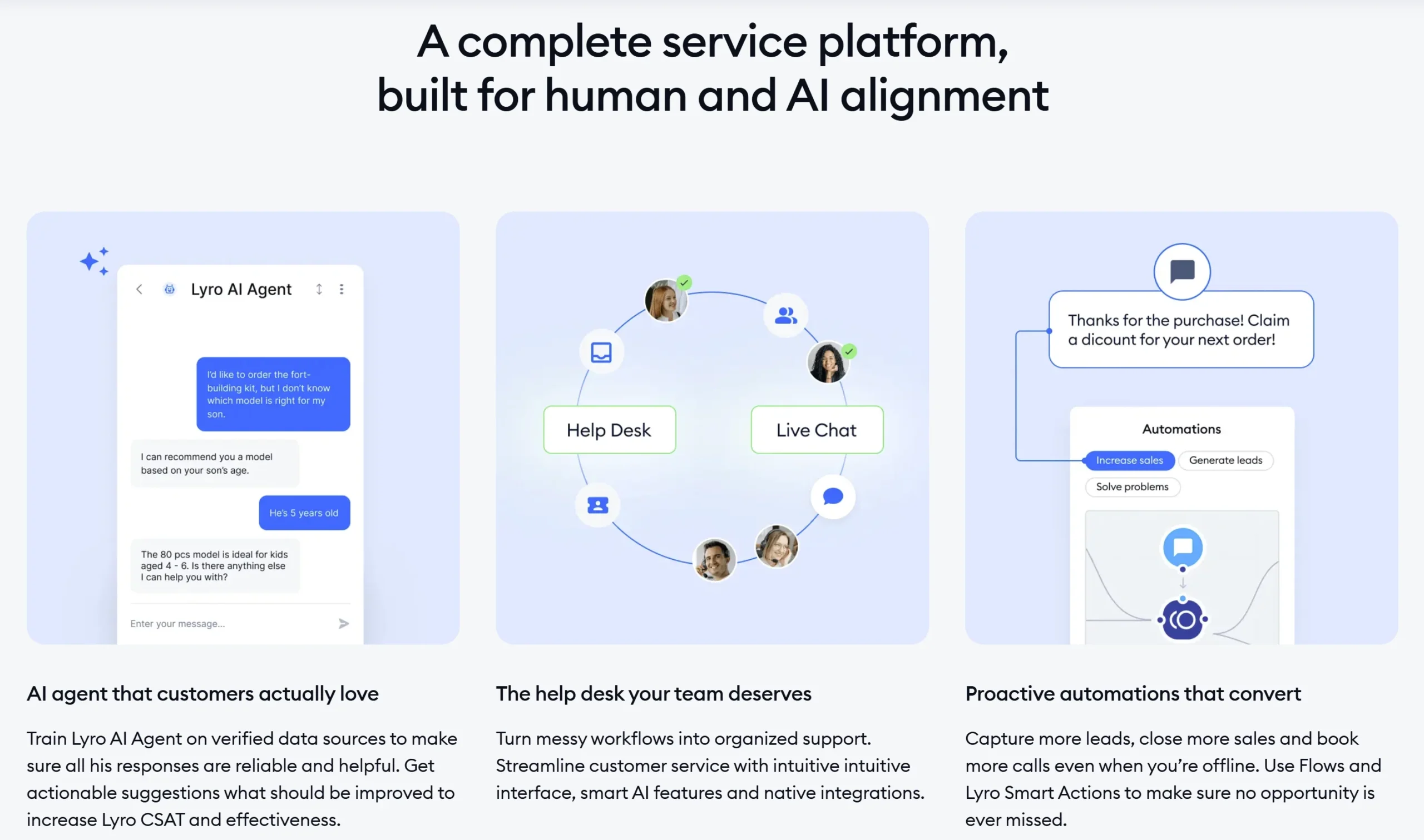
Answering before a human does. Lyro, its AI agent, draws on your help articles and product information to resolve repeat questions — delivery times, returns, stock — and hands over when it cannot. For a shop where one person is doing support between packing orders, that is the entire value proposition.
Ecommerce context. Shopify and WooCommerce integrations surface order and customer details inside the chat, so “where is my order” gets a real answer rather than a request for an order number. A visual flow editor handles lead capture, discount offers and abandoned-cart nudges without code.
A free plan that works. Fifty billable conversations a month is small, but it is enough to find out whether chat changes anything for you before you commit money.
The trade-off: the bill follows usage, not seats, which makes it less predictable than a flat per-agent fee — model your busiest month, not your average one. The AI is only as good as the content you feed it, so thin or stale help pages produce weak answers. Features are packaged separately, so the useful combination of live chat, AI agent and automation can cost more than the headline entry point. And ticketing exists but is basic; deep workflow, knowledge base and reporting needs will outgrow it.
What LiveChat is genuinely better at
The agent’s view. Agents see which page the visitor is on, their location, referral source and past conversations before they type. For pre-sales that context is the difference between a generic greeting and a useful one, and it is why LiveChat sits on B2B sites as much as on shops.
Proactive targeting. Messages fire on behaviour — time on a page, cart value, repeat visits — rather than waiting for a click. Used carefully this is the feature that pays for the licence; used carelessly it is the reason people hate chat widgets.
A bill that does not move. Per-agent pricing means a viral week costs you nothing extra. If your traffic is spiky, that predictability is worth real money.
The trade-off: there is no free plan, so evaluation is a 14-day trial. The suite is modular — the chatbot, help desk and knowledge base are separate products with their own subscriptions, so a complete setup costs noticeably more than the widget. Higher tiers mostly add reporting and security rather than capacity, so you cannot buy your way out of a seat count. Ticketing is not its strength. And test the widget on mobile and on your slowest pages before rolling it out sitewide, including how it behaves alongside a cookie banner.
Pricing, checked August 2026
LiveChat states that all prices are in USD and prices per person. Starter is $19 per person per month billed annually, or $25 per person per month billed monthly. Team is $49 per person per month billed annually, or $59 monthly. Business is $79 per person per month billed annually, or $89 monthly. Enterprise is quoted on request. There is a 14-day free trial and no free plan. The companion ChatBot.com product is a separate subscription, listing Essential at $19 per user per month and Growth at $79 per user per month, both billed annually, with an Enterprise tier on enquiry. Note that ChatBot.com has moved to per-user pricing since we first published this comparison, so older figures quoting a flat monthly rate no longer apply.
Tidio meters three things: billable conversations, which are conversations where a human agent replies; Lyro AI conversations, which are customer interactions with the AI agent; and Flows visitors reached. Free is $0 per month with 50 billable conversations a month, 50 Lyro AI conversations as a one-off rather than a monthly refresh, and 100 Flows visitors a month. Starter is displayed at $24.17 per month with 100 billable conversations a month. Growth starts at $49.17 per month from 250 billable conversations a month. Plus starts at $300 per month plus monthly usage. Premium is quoted on request. The page carries a “Monthly” and “Annually (2 months free)” toggle, so check which one is selected before you write a figure down — those cents are the kind of detail that turns into a budgeting error.
The units do not compare directly, so do the arithmetic on your own numbers. Three agents on LiveChat Team is roughly $147 per month billed annually, whatever volume arrives. Tidio at similar volume could be far less or considerably more depending on how many conversations a human touches and how much of the load Lyro takes. The rule of thumb: high volume with few agents favours LiveChat, low volume with several occasional responders favours Tidio, and heavy AI deflection favours Tidio only if your help content is genuinely good.
This comparison is compiled from both vendors’ published documentation and pricing pages. We have not tested either product hands-on.
Migration and lock-in
The asset is the transcripts, and almost nobody thinks about them until they are leaving.
Two years of chat history is your best record of what customers actually ask, in their own words. It is the source material for your help centre, the input any AI agent would train on, and occasionally the evidence in a dispute about what was promised. Before you commit to either vendor, ask a specific question: what does an export of chat transcripts contain, in what format, and how long are they retained after cancellation. Then export annually while you are still paying.
The switching cost people underestimate is the widget itself. Both run a third-party script on every page of your site. Replacing one means a deployment, a fresh look at page performance, and re-testing against your cookie banner and mobile layout. Canned responses, routing rules and chatbot flows do not transfer between vendors at all; budget a rebuild.
The Tidio-specific risk is the meter: a good month for the business is an expensive month for support, which is a strange incentive to carry into a busy season. Lyro answers from your help content, which you own, so the content survives a move — but the tuning, the flows and the accumulated corrections do not.
The LiveChat-specific lock-in is the suite. If you have bought ChatBot.com alongside the chat product, leaving is two migrations and two renegotiations. Price the pieces separately at renewal rather than treating the bundle as one decision.
Side by side
| Decision criterion | Tidio | LiveChat |
|---|---|---|
| Primary job | Deflecting repeat questions on a shop | Real-time conversations that convert |
| Billing unit | Conversations, AI conversations, Flows visitors | Per agent seat |
| Free plan | Yes — 50 billable conversations/month | No — 14-day trial only |
| Entry paid tier (Aug 2026) | Starter, $24.17/month, 100 billable conversations | Starter, $19 per person/month billed annually ($25 monthly) |
| Mid tier | Growth, from $49.17/month, from 250 conversations | Team, $49 per person/month billed annually ($59 monthly) |
| Upper published tier | Plus, from $300/month plus usage | Business, $79 per person/month billed annually ($89 monthly) |
| AI agent | Lyro, core to the product and metered | ChatBot.com, separate subscription from $19 per user/month billed annually |
| Ecommerce order lookup | Shopify and WooCommerce built in | Via integration directory |
| Cost of a traffic spike | Rises with conversation volume | No change |
| Main failure mode | A busy month producing an unbudgeted invoice | Paying for seats that sit idle off-peak |
The recommendation
Shopify or WooCommerce store with one or two people on support: Tidio. Built-in order lookup and an AI agent that absorbs the routine questions is exactly the shape of the problem, and per-seat pricing would be poor value for people who answer chat between other tasks.
B2B site with a three-person sales team: LiveChat Team. The visitor context is worth more in a sales conversation than deflection is, and $49 per person per month billed annually buys a bill that does not move when a campaign lands.
Business with spiky, seasonal traffic: LiveChat. A conversation meter turns your best trading week into your most expensive support week. Predictability is the feature you are buying.
Company with a genuinely good help centre and high repeat-question volume: Tidio, and pay attention to the Lyro allowance. This is the only scenario where AI deflection reliably pays for itself, because the content is already there.
Anyone testing whether chat works at all: Tidio’s free plan. Fifty conversations will tell you whether people use it, at no cost and no trial deadline.
Team already running Zendesk or Freshdesk: neither. Turn on the chat you are already paying for and keep one queue.
FAQs
What counts as a billable conversation in Tidio?
A conversation where a human agent replies, whether it started in live chat, a ticket or a social channel. Lyro AI conversations and Flows visitors are metered separately. That is three dials rather than one, so read the current definitions on the pricing page before estimating — they are the numbers your invoice is built from.
Does LiveChat include a chatbot?
Not in the chat subscription. ChatBot.com is a separate product from the same company, with Essential listed at $19 per user per month billed annually, and the help desk and knowledge base products are separate again. If you want chat plus deflection, price both before comparing against Tidio’s bundled AI.
Plan tiers, conversation and AI allowances, add-on products and which features sit on which plan change regularly in both products. Both sets of figures above were taken from the vendors’ own pricing pages in August 2026 and re-checked on Tidio’s and LiveChat’s pages. Tidio’s page carries a monthly and annual toggle, so confirm which rate you are reading before you budget.