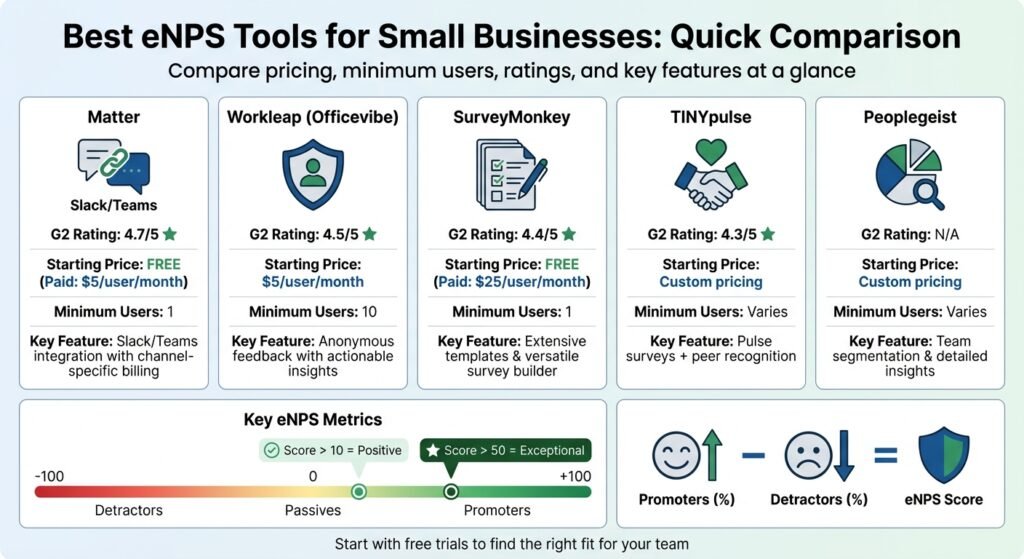
Employee Net Promoter Score (eNPS) helps small businesses measure team satisfaction and engagement with a simple, cost-effective approach. It categorizes employees into Promoters (loyal advocates), Passives (neutral), and Detractors (unhappy team members). Calculating eNPS is straightforward: subtract the percentage of Detractors from Promoters to get a score between -100 and +100. Anything above zero means you have more promoters than detractors. Published benchmarks for what counts as a good score vary widely between sources, so treat any single threshold you read as a rough guide rather than a target.
For small businesses, eNPS tools offer affordable, easy-to-use solutions that save time and resources. The best tools are budget-friendly, quick to set up, and scalable for growing teams. Some top options include:
- Matter: runs inside Slack and Teams. Free kudos plan; eNPS needs the Pro plan plus the Surveys add-on, which is $5 per user a month on annual billing.
- Workleap (formerly Officevibe): anonymous feedback and manager insights, but no longer priced per user. Plans start at $4,999 a year.
- SurveyMonkey: general survey builder. Free Basic plan; Team Advantage is $30 per user a month billed annually, minimum three users.
- TINYpulse by WebMD Health Services: short pulse surveys plus peer recognition. Priced on request.
Each tool simplifies feedback collection, integrates with existing workflows, and supports growing teams. Choose one based on your team’s size, budget, and communication style.
Quick Comparison
| Tool | Starting Price | Minimum Users | Key Feature |
|---|---|---|---|
| Matter | Free kudos plan; $5/user/month for Pro plus the Surveys add-on, billed annually | 1 | Slack and Teams integration |
| Workleap (formerly Officevibe) | From $4,999/year, billed annually. No per-user rate published | Not published | Anonymous feedback, insights |
| SurveyMonkey | Free Basic; Team Advantage $30/user/month billed annually | 3 on team plans | Extensive templates, general surveys |
| TINYpulse by WebMD Health Services | Not published | Not published | Peer recognition + pulse surveys |
Prices here were checked against each vendor’s own pricing page in August 2026. Confirm them before you budget. Two things changed since this article was first written: Officevibe no longer exists as a separately priced product, and TINYpulse is now sold by WebMD Health Services. A fifth tool, Peoplegeist, has been removed because we could not confirm it is sold as an employee survey product.
Start with free trials to find the right fit for your team’s needs.
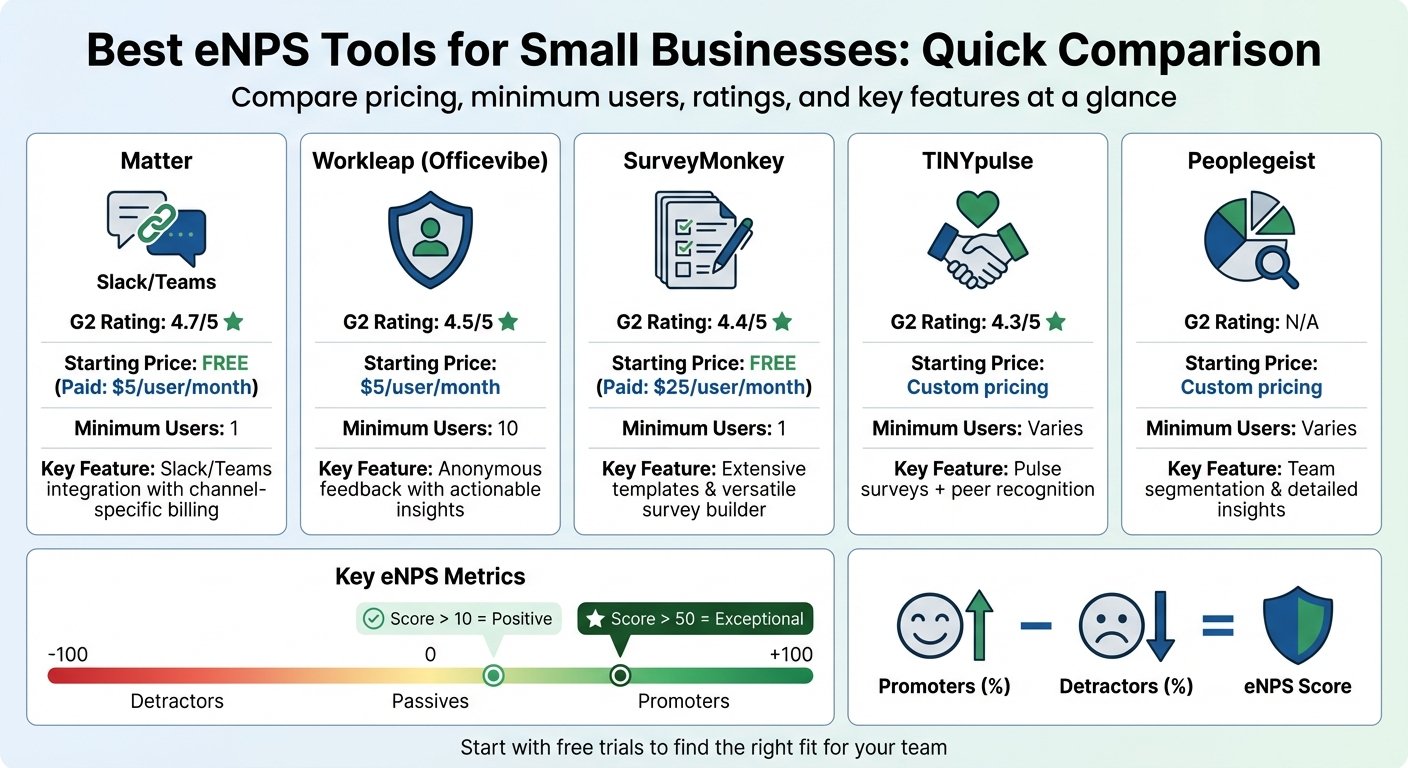
eNPS Tools Comparison: Pricing, Features, and Ratings for Small Businesses
What to Look for in eNPS Tools
Finding the right eNPS tool involves weighing affordability, ease of use, and the ability to handle data effectively. For small businesses, especially those with limited HR resources, it’s essential to focus on tools that are cost-efficient, simple to implement, and capable of growing alongside your team.
Budget-Friendly Pricing
Cost matters, and the pricing models differ more than the headline numbers suggest. Some are per user per month. Some are a flat annual contract. Some charge for the recognition product and put the survey behind a paid add-on, which is what Matter does. A previous version of this section cited a one-off lifetime price for NPSpack; that figure was wrong, the current packs are $49 and $99 one-time, and NPSpack is a customer NPS widget rather than an employee survey tool, so it does not belong on this list. Free options are worth a look: Wellbee offers a Slack-integrated platform free, and tools like Simplesat run 14-day trials with no credit card.
It’s also smart to choose tools that allow unlimited survey responses on free plans to avoid extra charges as your participation grows. And don’t overlook native integrations; they can save you money by reducing the need for additional software licenses and training. Beyond pricing, check the tool is easy to launch and fits your existing workflows.
Simple Setup and Use
An effective eNPS tool should let you launch surveys quickly. For example, FeedbackPulse boasts a setup time of under two minutes, while Wellbee users report being able to run their first survey in under 10 minutes. Pre-built templates and question libraries – sometimes offering more than 50 templates and 150 sample questions – can make deployment even faster. Automated scheduling features, complete with recurring survey cycles and reminders, ensure consistent feedback collection without adding to your workload.
Ease of use is just the beginning; scalability is also key as your business expands.
Growth Capacity and Data Analysis
As your company grows, your eNPS tool should grow with it. Look for tools that can handle teams ranging from just a few employees to over 200. Features like HRIS integrations, API access, and bulk CSV uploads can make managing larger employee lists much easier. Additionally, tools that offer segmentation by department, location, or tenure allow you to pinpoint specific areas of concern.
Advanced analytics, such as AI-powered insights, can turn open-ended feedback into recommendations. That matters for spotting trends before they turn into resignations. Regular pulse surveys, run every three weeks or monthly, give you a trend line rather than a single annual snapshot, and a trend line is the only thing an eNPS number is actually good for.
Best eNPS Tools for Small Businesses
Here’s a look at some top eNPS tools that are budget-friendly, easy to use, and adaptable to small business needs. Each tool is tailored to help you gather feedback effectively, no matter your team size or workflow.
Matter
Matter runs inside Slack and Microsoft Teams, so employees give feedback without opening another tab. Setup is quick and needs no technical expertise, which suits small businesses without IT support.
Read the pricing carefully, because the eNPS part is not in the free plan and it is not in the cheapest paid plan either. Free covers unlimited users with a capped number of kudos a week. Pro is $3 per user a month billed annually, or $4 billed monthly. Pulse and eNPS surveys are a separate add-on at $2 per user a month annually, or $3 monthly, and the add-on requires Pro. So the real cost of running eNPS on Matter is $5 per user a month on annual billing, or $7 on monthly. An earlier version of this article said paid plans start at $1 per user a month, which was wrong.
Matter markets its in-chat surveys as producing far higher response rates than email surveys. That is the vendor’s claim, not a measured result, and it is the sort of number worth testing on your own team before it goes in a business case. An earlier version of this article also described a channel-specific billing model under which you pay only for users in the channels you install Matter in. Matter’s pricing page does not say that, so we have removed it; assume you are billed per user and ask the vendor which users count.
This section previously carried a customer quotation and a two-month before-and-after with kudos counts and an engagement percentage. We could not source either, so both have been removed.
Workleap (formerly Officevibe)
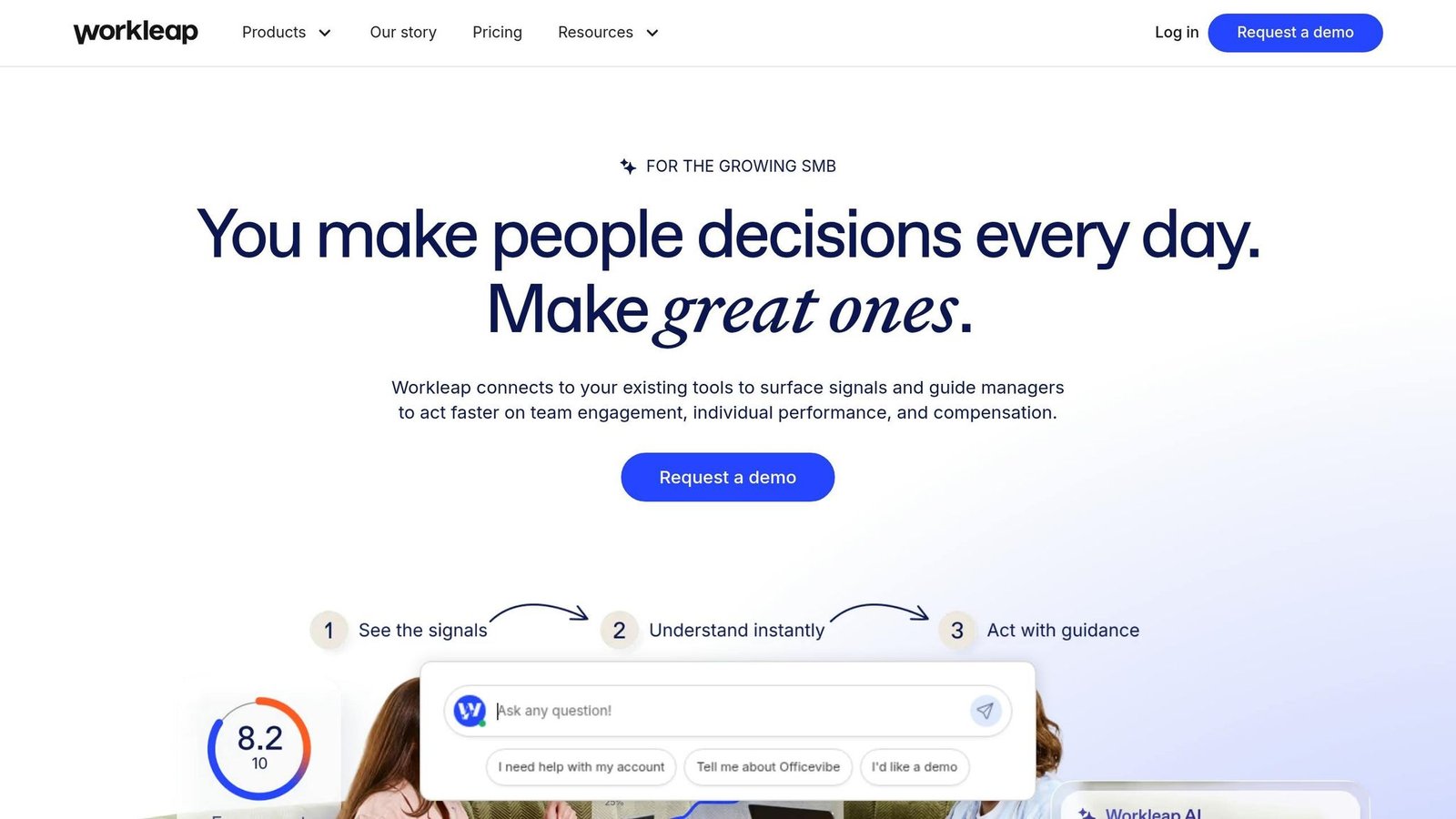
Officevibe is no longer sold under that name. It has been folded into the Workleap platform, alongside Workleap’s performance and onboarding products. If you are working from an old shortlist that says Officevibe, this is where it went.
The pricing changed with it. Workleap no longer publishes a per-user rate. As of August 2026 the pricing page lists Standard from $4,999 a year and Pro from $11,999 a year, both billed annually, with Enterprise quoted for organisations over 250 employees. There is no free plan. The $5 per user per month and 10-user minimum this article used to quote no longer exist, so they have been removed. For a ten-person company that is a jump from roughly $600 a year to a five-figure contract, and it takes Workleap off the small-business shortlist entirely.
The product itself is well regarded and the interface is clean. It connects eNPS scores to suggested manager actions rather than leaving you with a number. That is genuinely useful. The problem is the entry price, not the software.
SurveyMonkey
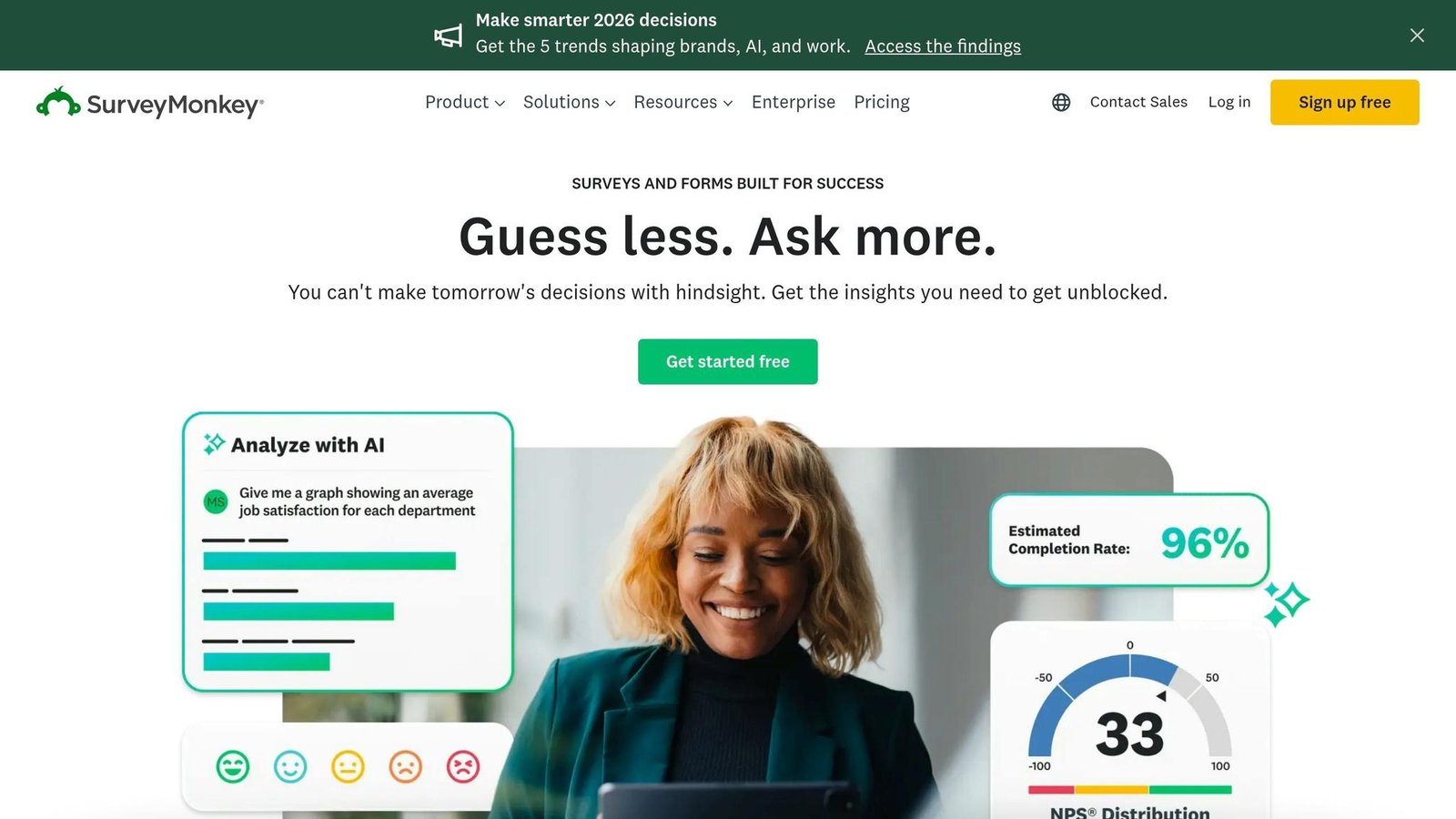
SurveyMonkey is a general survey builder with pre-built templates and basic analytics. There is a free Basic plan, though SurveyMonkey no longer states the response and question caps on its pricing page – it says the limits appear once you sign up. Team Advantage is $30 per user a month billed annually and starts at three users, so the practical floor is about $1,080 a year. Team Premier is $92 per user a month. The $25 per user figure this article used to quote is out of date.
SurveyMonkey handles customer satisfaction, product feedback and employee engagement in one place, which is the argument for it. The argument against is that nothing here is built for eNPS specifically: no automatic survey cadence, no chat delivery, no promoter and detractor breakdown unless you build it. If eNPS is the only thing you want to measure, you are paying team-plan money for a general-purpose tool.
TINYpulse by WebMD Health Services
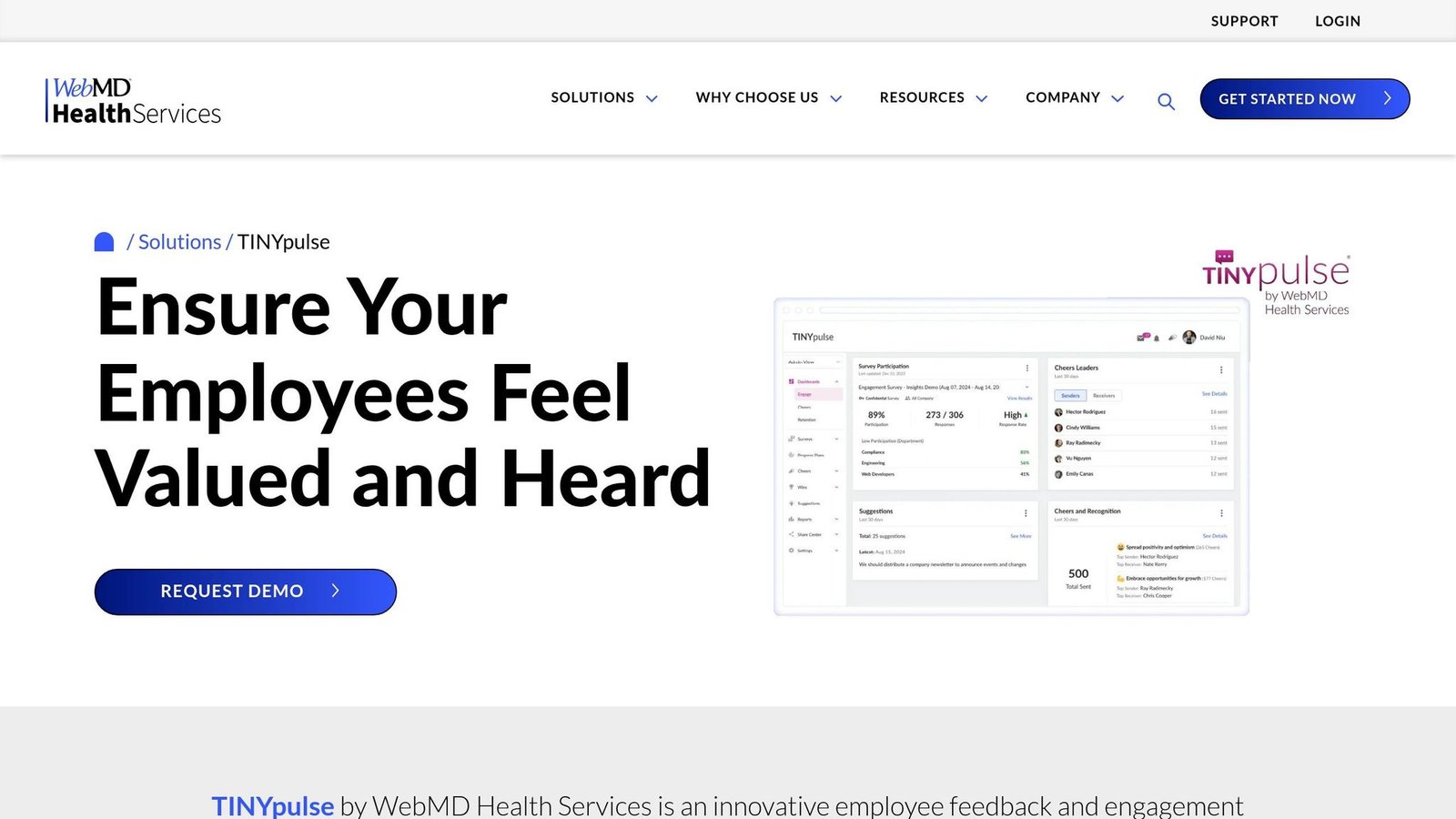
TINYpulse is still sold, but not by TINYpulse. It is now TINYpulse by WebMD Health Services, part of that company’s employee well-being portfolio. The product pairs short pulse surveys with recognition, so feedback and acknowledgement sit in the same loop rather than in two separate tools.
WebMD Health Services does not publish a price for it. That is the main reason it is hard to recommend to a five- or ten-person company: you cannot compare it with Matter without going through a sales call, and a vendor whose other products are sold to large employers is unlikely to price a small team keenly. Ask for the per-employee rate and any platform minimum in writing.
A note on Peoplegeist
This article used to list Peoplegeist as a fifth option with customizable pulse surveys and team segmentation. We could not find a Peoplegeist product sold as employee survey software, and the company’s own site did not describe one, so the entry has been removed rather than left in with a caveat. If you are looking for the features it was credited with – segmentation by department, location or tenure, and results aggregated at team level to protect anonymity – those are standard on Workleap and on TINYpulse, and available on Matter through the Surveys add-on.
eNPS Tools Comparison
Here’s a quick comparison of some popular eNPS tools to help you decide which one aligns best with your budget and team size.
| Tool | Cost to run eNPS | Minimum Users | Key Differentiator |
|---|---|---|---|
| Matter | $5/user/month (Pro $3 + Surveys add-on $2), billed annually; $7 billed monthly | 1 | Surveys delivered inside Slack and Microsoft Teams |
| Workleap (formerly Officevibe) | From $4,999/year, billed annually. No per-user rate published | Not published | Anonymous feedback with suggested manager actions |
| SurveyMonkey | Free Basic; Team Advantage $30/user/month billed annually | 3 on team plans | Extensive template library; general-purpose survey builder |
| TINYpulse by WebMD Health Services | Not published | Not published | Combines pulse surveys with peer recognition |
The star ratings that used to sit in this table have been removed. They were presented as G2 scores but we could not confirm any of them against G2, and a review score you cannot check is worse than no score at all.
On price, the gap is now stark. Matter is the only one of the four with a published per-user rate a small team can actually work with. Workleap is a five-figure annual commitment. SurveyMonkey is affordable only if you want a general survey tool anyway. TINYpulse will not tell you until you talk to sales.
Note that the pricing structures are not equally flexible. Matter and SurveyMonkey scale with headcount. Workleap does not: the entry contract is the entry contract whether you have twelve people or a hundred.
How to Choose the Right eNPS Tool
Before picking an eNPS tool, start by estimating how many survey responses you’ll gather each month. This step helps you sidestep unexpected costs like hard limits or overage fees that could throw off your budget. For instance, a team of 20 employees surveyed monthly could generate around 240 responses a year. If you’re eyeing a free plan, make sure it can handle your anticipated volume.
Next, think about how your team communicates. Choose a tool that fits their daily workflow. Delivering a survey where people already are – Slack, Teams, or email – rather than in a separate portal is the single biggest lever on response rate, though we have not found a published, independent figure for how big the effect is. If your team lives in Slack, Matter is the obvious starting point.
Look for automation that handles follow-ups. Some platforms notify you when a detractor responds, or prompt you to follow up with promoters. That saves real time if you have no dedicated HR person, though the specific percentage this article used to quote had no source behind it and has been cut. Focus on tools that go beyond drawing charts and actually help you close the loop.
Steer clear of platforms loaded with features you will not use. Engagement suites aimed at large employers bundle well-being, performance and comms into the price, and a ten-person company uses almost none of it. Start with a free tier or a trial and see whether anyone answers the survey twice before you sign anything.
Lastly, ensure the tool can grow with your business. As your team expands, you’ll want a platform that supports higher headcounts, department-level segmentation, and integrations with systems like your HRIS or CRM. This prevents the hassle and expense of switching tools down the line.
Conclusion
This guide has covered budget-conscious business applications that fit into everyday workflows. Of the four that survived checking – Matter, Workleap, SurveyMonkey and TINYpulse by WebMD Health Services – only Matter publishes a price a small team can act on without a sales call.
Pick a tool that fits your team’s existing communication channels. Platforms that work through Slack, Microsoft Teams or email get better participation because they meet employees where they already are. For a business with no dedicated HR person, quick setup and automated survey cycles matter more than any feature on a comparison grid.
To get anything out of eNPS data, pick a tool that helps you act on it quickly. Automated alerts for negative responses and a dashboard you will actually open are worth more than a bigger question library. The score itself is close to meaningless in isolation; what you do in the fortnight after each survey is the whole point.
Start with free trials to test compatibility with your team’s communication habits and overall workflow. These trials are a great way for small teams to assess whether a platform aligns with their needs. As your team grows, ensure the platform you choose offers scalable pricing plans and advanced features like department-level segmentation to keep up with your organization’s changing demands.
FAQs
How often should we run eNPS surveys?
eNPS surveys work best when conducted quarterly or biannually. This schedule allows you to track trends over time and see how any workplace changes are influencing employee sentiment. By sticking to regular intervals, you can gather consistent feedback while avoiding survey fatigue among employees.
What’s a good eNPS score for a small business?
Commonly cited ranges put a decent small-business score somewhere between 10 and 30, but these benchmarks are not standardised and different sources give different numbers. Your own trend line is worth more than any external benchmark: what matters is whether the score is moving and what you did between surveys.
How can we act on detractor feedback without breaking anonymity?
To handle feedback from detractors while ensuring anonymity, consider using tools designed for secure, confidential communication. These platforms allow individuals to voice their concerns without exposing their identities, creating a safe space for honest input. Businesses can then address issues effectively by focusing on general follow-ups or implementing broader initiatives that tackle common concerns – all while safeguarding the privacy of the feedback provider.
More on this topic
Browse all 52 articles on HR & People Ops.