Disclosure: This page contains commercial links. BizBot may earn a commission from qualifying purchases. Paid placements do not buy a better ranking. Read our affiliate disclosure.
AI is changing beauty subscription services by matching products to individual preferences. Through data analysis – quizzes, purchase history, and sometimes local conditions – brands recommend items that suit skin type, lifestyle, and stated goals, usually alongside subscription management software that handles the billing and logistics.
Key points:
- Data-driven personalization: quizzes, purchase behaviour, and post-delivery ratings build a profile that updates over time.
- Recommendation techniques: collaborative filtering, content-based filtering, and predictive analytics each solve a different part of the matching problem.
- Business results: harder to pin down than the marketing suggests. See the note below.
- Customer benefits: less decision fatigue and fewer boxes full of things you will not use.
AI-powered personalization is now standard in this category, which makes the claims about it worth checking.
A note on the figures we removed. An earlier version of this article carried more than twenty performance statistics: 30% higher order values, 50% better conversion, a 30% reduction in unwanted products repeated five separate times, a 200% conversion increase at MAC, a 108% conversion increase at JCPenney, a 3.6x conversion lift at No7, an 80% “delight rate” at Scentbird, 62% of shoppers preferring customization, 80% of business leaders on loyalty, a $8.9 billion market projection, and several quotations attributed to named executives. Almost none of it could be traced to a published source. One quotation was attributed to a person whose name was spelled two different ways in the same article. The Scentbird link pointed at a domain that is not Scentbird’s. It has all been removed. What follows keeps the mechanism, which is genuinely useful, and the two examples we could actually verify.
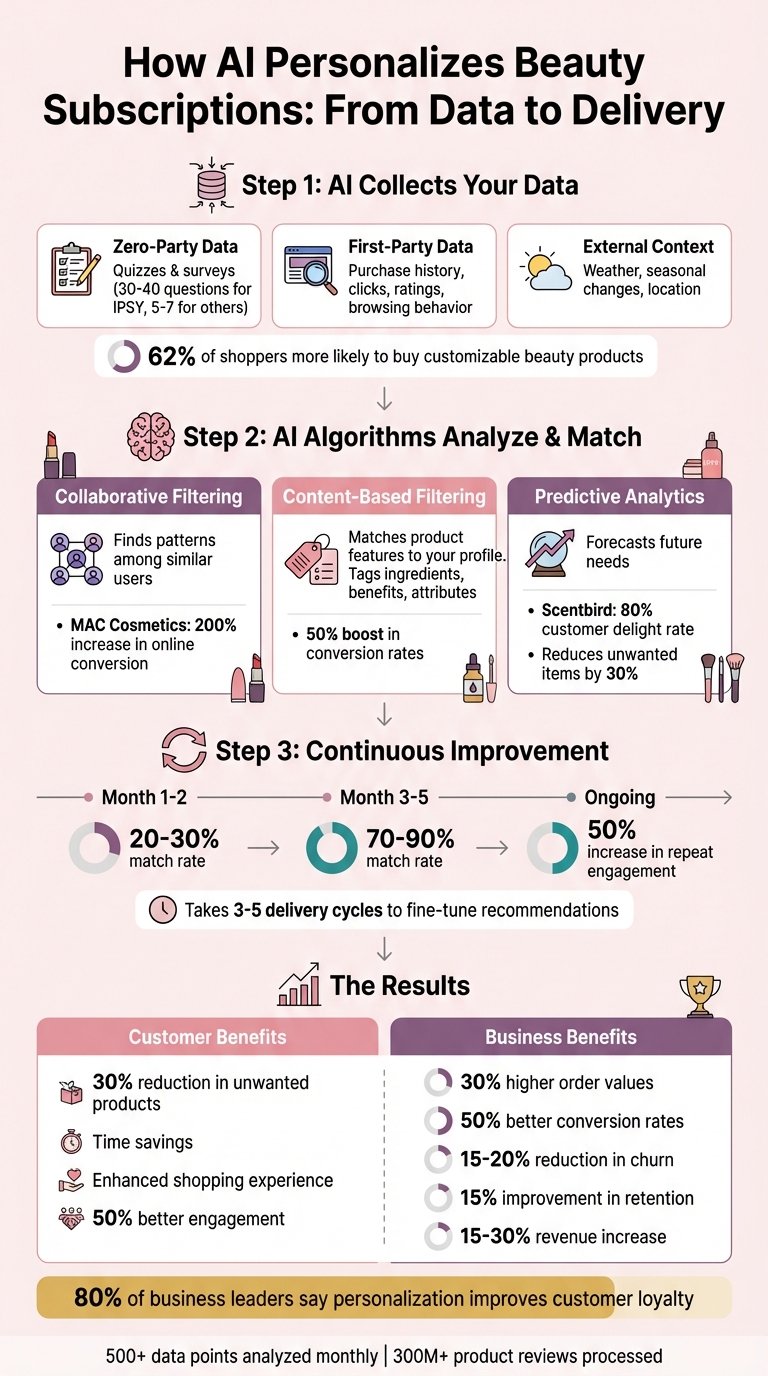
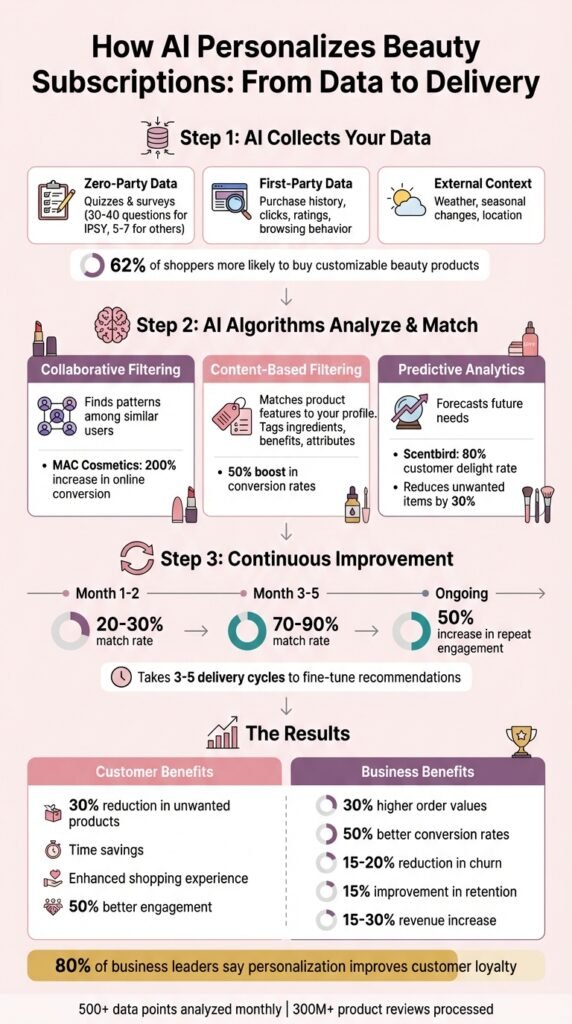
How AI Personalizes Beauty Subscriptions: Data Collection to Product Delivery
How AI Collects and Analyzes Customer Data
These services draw on three kinds of data. Zero-party data is what customers volunteer in quizzes and surveys. First-party data is behavioural: what they buy, click, keep, and rate. External context covers things like local climate and season. Together they feed personalized product recommendations.
Customer Preference Surveys and Quizzes
Signing up usually starts with a quiz covering skin type, hair concerns, ingredient preferences, and goals. That becomes the initial profile. Quiz length varies a lot between services, from a handful of questions to several dozen.
There is a real trade-off in that length. Longer quizzes produce better initial matches and worse completion rates. Services that ask forty questions lose people at question fifteen, which is why several have shortened theirs after testing.
Machine learning then links stated concerns – redness, acne, dryness – to ingredients associated with them. Some systems add selfie analysis to assess texture, pigmentation and hydration. Worth knowing: self-reported skin type is frequently wrong, which is the main argument for image analysis, and image analysis is itself sensitive to lighting and camera quality.
Tracking Purchase Behavior and Feedback
After the quiz, the system watches what you actually do: browsing, clicks, purchases, and returns. Behavioural data is more reliable than stated preference, because people describe the routine they intend to have rather than the one they have.
Loyalty programmes are the largest source of this data at retail scale. Ulta Beauty’s programme reached 44.4 million active members in the third quarter of 2024, up about 5% year on year. An earlier version of this article put the figure at over 64 million; that was wrong and has been corrected to the reported number.
Post-delivery ratings are the highest-value signal in a subscription box. A simple like or dislike on a delivered product tells the system more than any amount of browsing, because the customer has used the thing. Sentiment analysis on written reviews adds nuance but is noisier.
Using Feedback Loops for Continuous Improvement
Recommendations improve over successive deliveries as the profile accumulates real outcomes rather than stated intentions. How many cycles that takes depends on box frequency, catalogue size, and how much the customer engages with rating.
We previously gave precise match-rate figures by month. There was no source for them, and they have gone. If you run one of these services, measure your own: the rating rate and the repeat-purchase rate by cohort month will tell you what you need to know.
Some systems let customers upload photos over time to track changes, which lets the model adjust as skin does. This works better for measurable properties like hydration than for subjective ones like whether someone likes a fragrance.
AI Algorithms That Power Personalization
Collaborative Filtering
Collaborative filtering finds patterns across users rather than within one. If you and another subscriber both rate a vitamin C serum highly, and they rate a retinol cream highly, the system suggests that cream to you.
Its strength is discovering combinations nobody encoded. Its weakness is the cold start: a new subscriber with no history gets recommendations based on whoever they resemble on the quiz, which is a rough approximation. It also tends toward popularity, recommending what sells to everyone, which is the opposite of personalization if left unchecked.
Content-Based Filtering
Content-based filtering matches product attributes to your profile. Products are tagged with ingredients, claimed benefits, and attributes like cruelty-free or fragrance-free, and the system matches those tags to your stated concerns.
This handles new subscribers and new products better than collaborative filtering, because it needs no other users’ data. Its weakness is the opposite one: it recommends more of what you already said you wanted, so it never surprises you. Most services run both and blend the outputs.
External factors slot in here naturally. Drier climate, richer moisturizer. Winter, heavier formulation. This is simple rules-based logic more than machine learning, and it is often the part customers notice most.
Predictive Analytics
Predictive analytics forecasts what you will need next: how fast you go through a product, when to prompt a reorder, when your preferences appear to be shifting seasonally.
Replenishment timing is where this pays off. Getting a refill prompt the week before you run out is genuinely useful; getting it three weeks early reads as a sales push and trains people to ignore the messages. The model is predicting consumption rate, which is estimable from repeat purchase intervals and not much else.
Churn prediction works on the same data. A subscriber whose ratings are trending down, or who has stopped rating at all, is signalling before they cancel. Whether the intervention works is a separate question from whether the prediction is accurate, and vendors tend to report the second as if it were the first.
Examples of Personalized Beauty Subscriptions
FabFitFun‘s Seasonal Box Customization
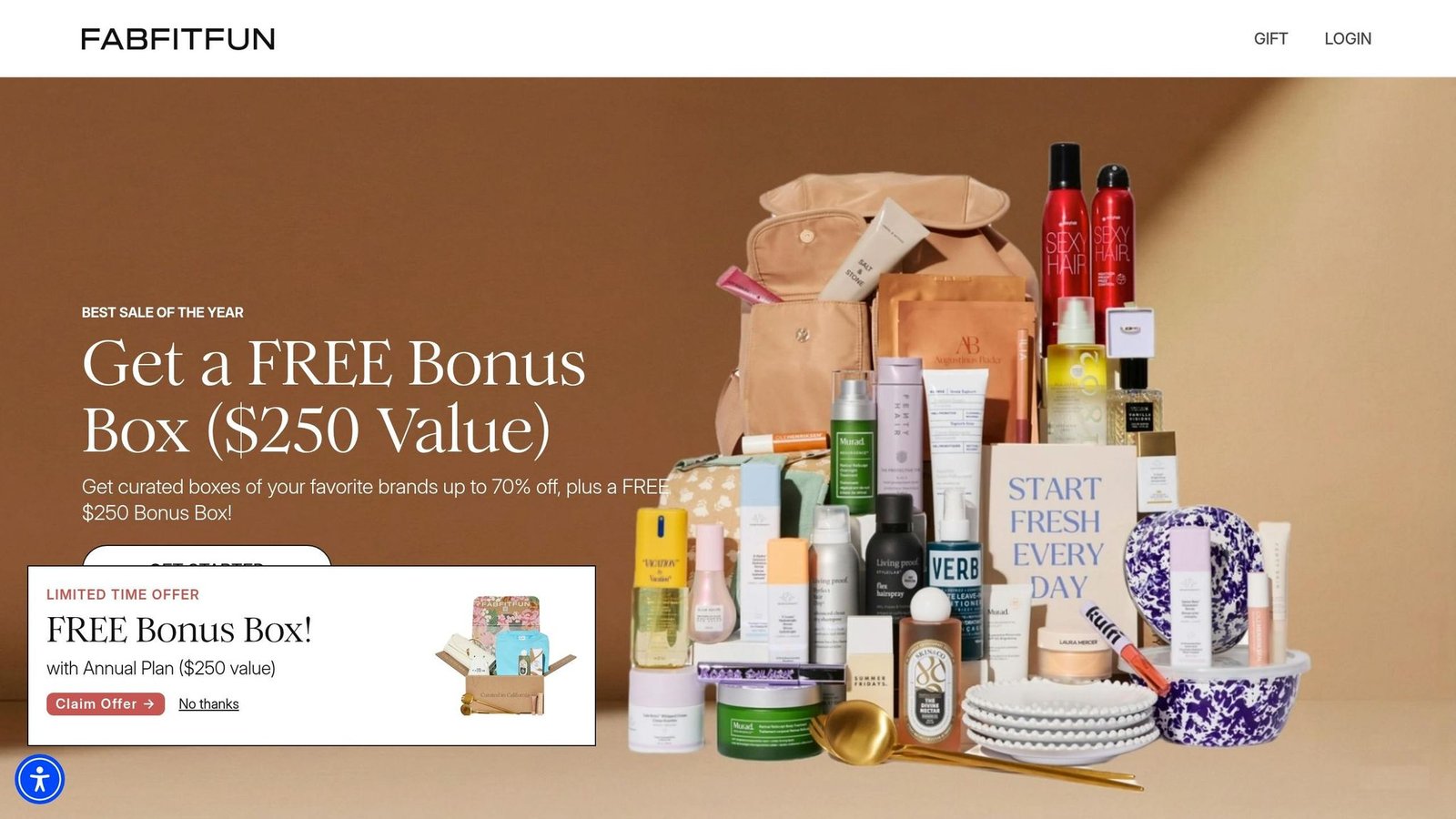
FabFitFun sells seasonal boxes with customization windows in which members choose between options for several slots, then fills the remaining slots algorithmically. The interesting engineering problem is fulfilment rather than recommendation: allowing members to pick combinations produces an enormous number of distinct box configurations, which a conventional warehouse process cannot pick efficiently.
We previously quoted membership, revenue and valuation figures for FabFitFun, along with a quotation from a co-founder whose surname the article spelled two different ways. None of it was sourced, so it has been removed. The company does not publish these numbers.
The transferable lesson stands without them. Letting customers choose some items and algorithmically selecting the rest is a hedge: choice covers the cases where the model is wrong, and the algorithm covers the cases where the customer does not want to decide.
IPSY‘s Beauty Quizzes
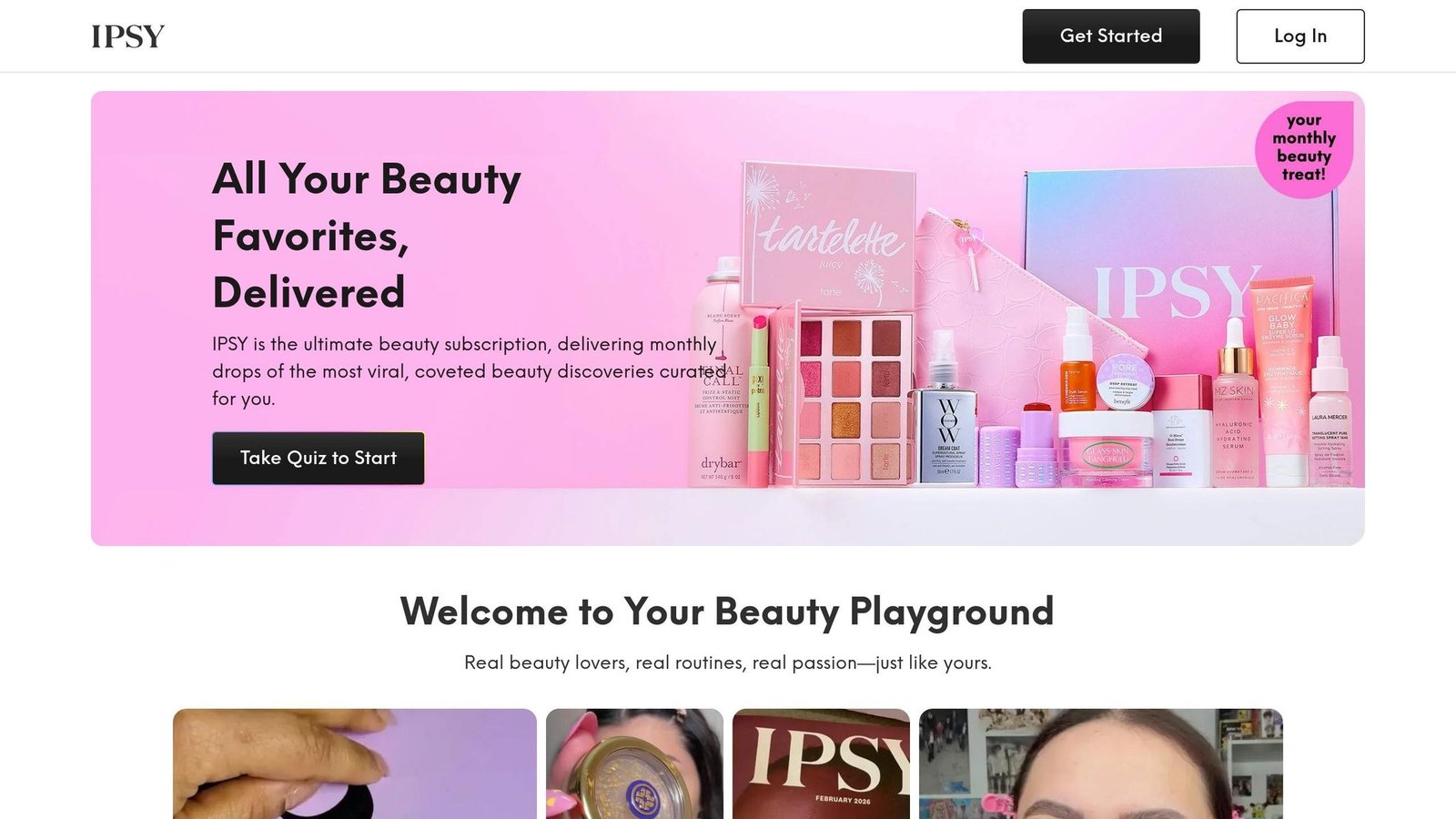
IPSY’s personalization starts with a beauty quiz covering skin type and tone, hair colour, makeup preferences, and product categories, weighted into a model that predicts affinity. Higher subscription tiers let members choose some items from a shortlist the model has narrowed.
The specific data-point counts, review volumes, quote and pricing that used to appear here were unsourced and have been removed. Prices change, and the internal metrics were never published.
What is worth noting structurally is that the quiz is editable. A profile that a customer can update themselves solves a problem the model handles badly – preferences that change for reasons no behavioural data captures, like a pregnancy, a new job, or a house move to a different climate.
Madison Reed‘s Shade-Matching AI
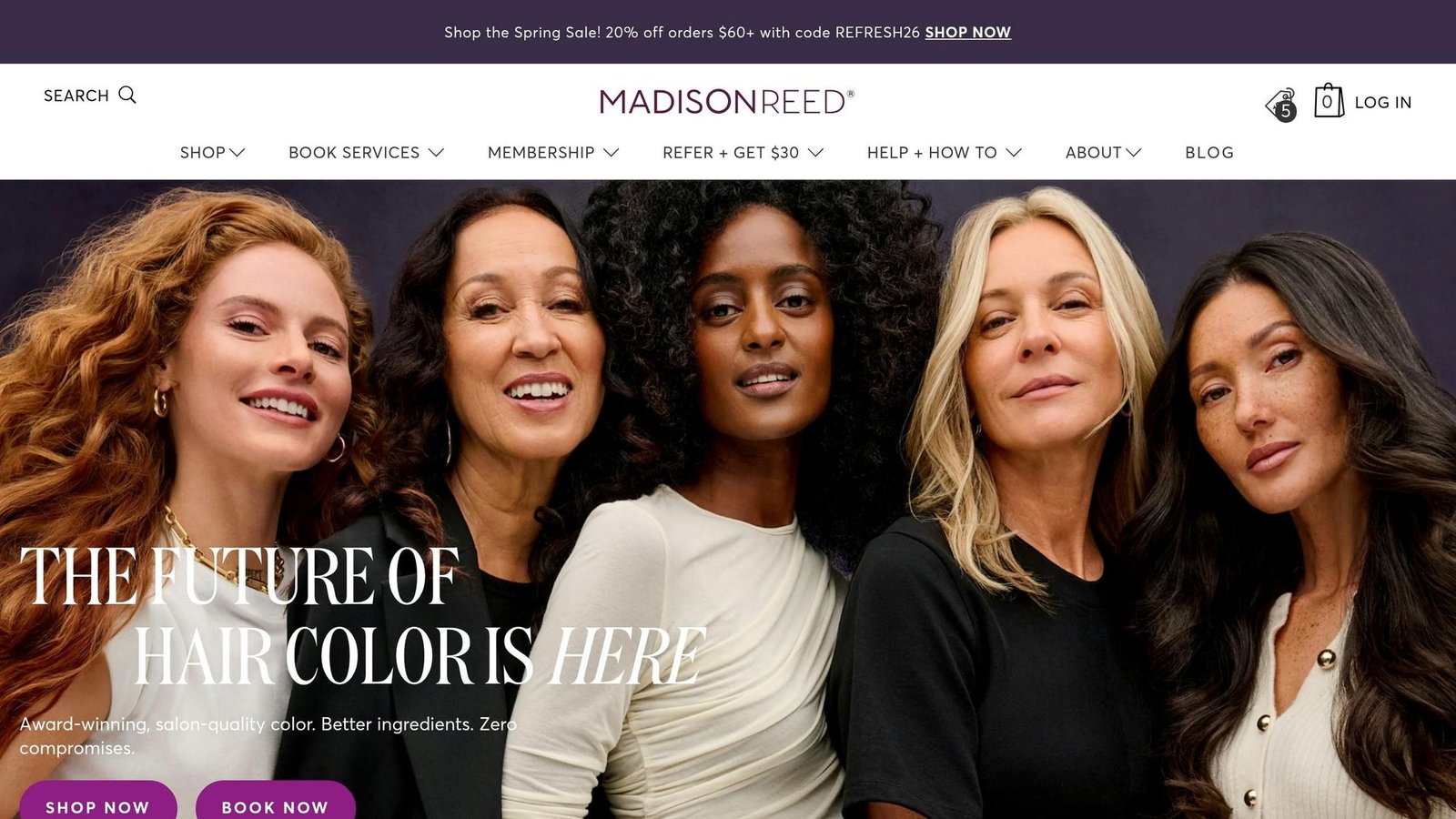
This is the best-documented example here. Madison Reed uses visual analysis for hair colour recommendation through an AI agent called Madi, built with Sierra and launched on 8 October 2025. Customers upload a selfie, which is analysed for primary and secondary hair tones and combined with quiz answers to recommend a shade.
According to that trade report, Madison Reed has compiled around 20 million unique hair profiles, roughly 70% of its revenue comes from memberships, and it operates 97 hair colour bars. On results, the reported effect is that Madi doubled the likelihood that a guest would go on to book an appointment, and chair utilization at the colour bars moved from the low 70s to the mid 80s in percentage terms.
Note the precision of that first claim, because this article previously got it wrong. “Doubled the likelihood a guest books” is a conversion-rate statement about people who interacted with Madi. It is not the same as total bookings doubling, which is what we previously published. We also previously claimed cancellations halved and chat interactions rose thirtyfold; neither appears in any source we could find, and both have been removed.
CEO and founder Amy Errett’s actual published comment is more restrained than the one we had attributed to her:
“The thing about AI is that it isn’t effective as a general strategy.”
One detail worth copying: the company found that a much shorter quiz predicted shade about as well as its original long one once photo analysis was in the mix. Adding a good signal let them remove a lot of friction.
How to Implement AI for Beauty Subscription Personalization
Step 1: Set Up Data Collection Tools
Start with quizzes and surveys capturing explicit preferences: skin type, hair concerns, makeup choices, ingredient avoidances. No-code tools exist for building these question flows; check current pricing directly with the vendor, since the figures previously quoted here were out of date and unsourced.
Add image capture if your category supports it. Shade matching and skin analysis benefit; fragrance does not.
Track behaviour: purchases, browsing, time on product pages, wishlist activity. And build in a rating prompt after delivery. If you collect only one behavioural signal, collect that one.
Step 2: Choose the Right AI Platforms
Beauty-specific platforms come pre-trained on diverse skin tones, facial structures and hair types, which matters: general-purpose vision models have well-documented accuracy gaps across skin tones, and in this category that is a product failure, not an edge case. Ask any vendor directly how their model performs across the full tone range, and treat a vague answer as an answer.
Match the tooling to the channel. E-commerce needs quiz engines, virtual try-on and CRM integration. Retail needs in-store hardware. Check for SDKs and APIs that fit your existing stack – Shopify, WooCommerce or custom – because integration work is where these projects overrun.
Pilot on one product page or one category before committing. A pilot with a measurable control group is the only way you will get a number you can trust, which is precisely what the case studies circulating in this industry do not provide.
Step 3: Use Subscription Management Tools
Subscription platforms handle billing, plan changes, pauses and dunning, and they feed order history back into the recommendation model. That connection is the one to check during procurement: a subscription system that cannot export clean per-item order history leaves your model guessing.
Smaller brands can find options through BizBot‘s directory rather than building custom infrastructure.
Look for automated payment retry, since a meaningful share of subscription churn is failed cards rather than dissatisfied customers. Fixing involuntary churn is cheaper than any personalization work and nobody writes case studies about it.
How to Measure AI Personalization Success
Retention Rates and Customer Satisfaction
Track subscriber retention at 3, 6 and 12 months, and separate voluntary churn from involuntary churn. They have different causes and different fixes, and combining them hides which one you have.
Product returns are the sharpest measure of match quality in this category. If personalization works, returns fall. If it does not, they do not, and no amount of engagement metrics will disguise that.
We removed several published churn-reduction percentages from this section because we could not source them. Measure the delta on your own cohorts against a holdout group that gets non-personalized boxes. Without a holdout you cannot separate the effect of your model from the effect of everything else you changed that quarter.
Subscription Revenue Growth
Customer Lifetime Value is the metric that matters, since personalization is supposed to extend the relationship rather than lift a single order. Compare it against Customer Acquisition Cost; a ratio around 3:1 is the conventional benchmark for a sustainable subscription business.
Gross margin per box is the reality check. Revenue minus cost of goods, shipping and packaging, per box. Personalization that raises satisfaction while raising pick-and-pack cost more can lose money while every dashboard turns green.
Engagement Metrics and Feedback Analysis
Useful engagement signals: quiz completion rate, rating submission rate, and click-through on personalized recommendations versus generic ones.
Rating submission rate deserves particular attention. It is both an engagement measure and the input your model depends on, so a fall in ratings degrades recommendations with a lag. Watch it as a leading indicator.
Ask customers directly whether the box matched them. A single post-delivery question outperforms most inferred metrics, and it is the only one that tells you why.
Conclusion
AI has made beauty subscription boxes genuinely more relevant than the generic sampler boxes that preceded them. The mechanism is real: a quiz establishes a starting profile, delivery ratings correct it, and a blend of collaborative and content-based filtering narrows a large catalogue to a handful of plausible items.
The claimed results are another matter. This category produces an unusual volume of impressive-sounding percentages with no methodology attached, which is why more than twenty of them have been removed from this article. When you see a conversion lift quoted for an AI personalization tool, ask three questions: compared with what, measured over what period, and published by whom. Vendor case studies almost never answer the first.
If you are building one of these services, the practical sequence is unglamorous. Collect a rating after every delivery. Fix involuntary churn first. Run a holdout group so you can tell whether any of it worked. Then worry about which filtering technique to use.
Tools for the operational side are listed in BizBot‘s directory, alongside our guide to subscription lifecycle management.
FAQs
What data does AI use to personalize my beauty box?
Quiz answers about skin type, concerns and preferences; purchase and browsing history; ratings on what you have already received; and sometimes local climate or season. Some services analyse an uploaded selfie for skin or hair characteristics.
The ratings matter most. If you never rate what arrives, the service is working from your original quiz and little else, and the box will drift out of date with you.
How is my personal data kept private and secure?
These services hold a fair amount about you: preferences, purchase history, and in some cases photographs of your face. Photographs are the part worth thinking about, since biometric data is regulated separately in several states and is not something you can un-share.
Read what the privacy policy says about retention and about sharing with brand partners, and check whether deleting your account deletes your images. Do not assume it does.
How long does it take for recommendations to get accurate?
It improves over several delivery cycles as the system accumulates ratings on things you have actually used. How fast depends on delivery frequency and on how much you engage with rating.
We previously gave specific match-rate percentages by month here. They had no source and have been removed. If a service quotes you one, ask what they are measuring.
More on this topic
Browse all 44 articles on Marketing & Growth, or jump straight to our buying guide: Best Marketing and CRM Tools for Small Businesses.
![E-commerce Personalization: Complete Guide [2024]](https://bizbot.com/wp-content/uploads/2026/08/662e9e5db17fd355c0be37e7-6b9799a37e5bf25bac30efcc2c0f1eed.png "E-commerce Personalization: Complete Guide [2026]")