Inclusion training helps small businesses attract untapped talent, improve employee retention, and boost overall performance. Vendors and consultancies quote striking revenue and retention multipliers for this kind of training; we could not trace the figures previously cited here back to a primary study, so they have been removed. Modern HR management solutions make training accessible, with features like self-paced modules and mobile compatibility ensuring minimal disruption to operations. Many companies use digital HR software to integrate these modules into their existing workflows. Here’s a breakdown of the top options:
- Affirmity: Action-oriented learning with separate tracks for leaders and staff.
- Cornell University DEI Program: Certificate-based training for managers and HR professionals.
- Coursera: Flexible, self-paced courses from top institutions.
- eCornell: Practical lessons for small business leaders to drive immediate change.
- Udemy: Budget-friendly courses with revisitable materials.
- CultureAlly: Expert-led live sessions with branded content options, and the only tool here that publishes its rates.
- Traliant: Mobile-friendly, short-format training for deskless workers.
Quick Comparison
| Tool | Best For | Pricing | Format |
|---|---|---|---|
| Affirmity | Role-specific training | Contact for quote | Live & self-paced |
| Cornell DEI | HR professionals, managers | Contact for quote | Structured program |
| Coursera | Flexible team schedules | Free or low-cost | Self-paced |
| eCornell | Leaders needing quick impact | Contact for quote | Self-paced |
| Udemy | Budget-conscious businesses | Affordable | Revisitable, self-paced modules |
| CultureAlly | Expert-led, interactive sessions | $2,500 per virtual session; in-person from $8,950 | Virtual & in-person |
| Traliant | Deskless, mobile-friendly teams | Not published – quote only | Self-paced |
Choose a tool based on your team’s needs, budget, and preferred training format. Investing in inclusion training not only improves workplace morale but also strengthens your ability to serve diverse customer bases.
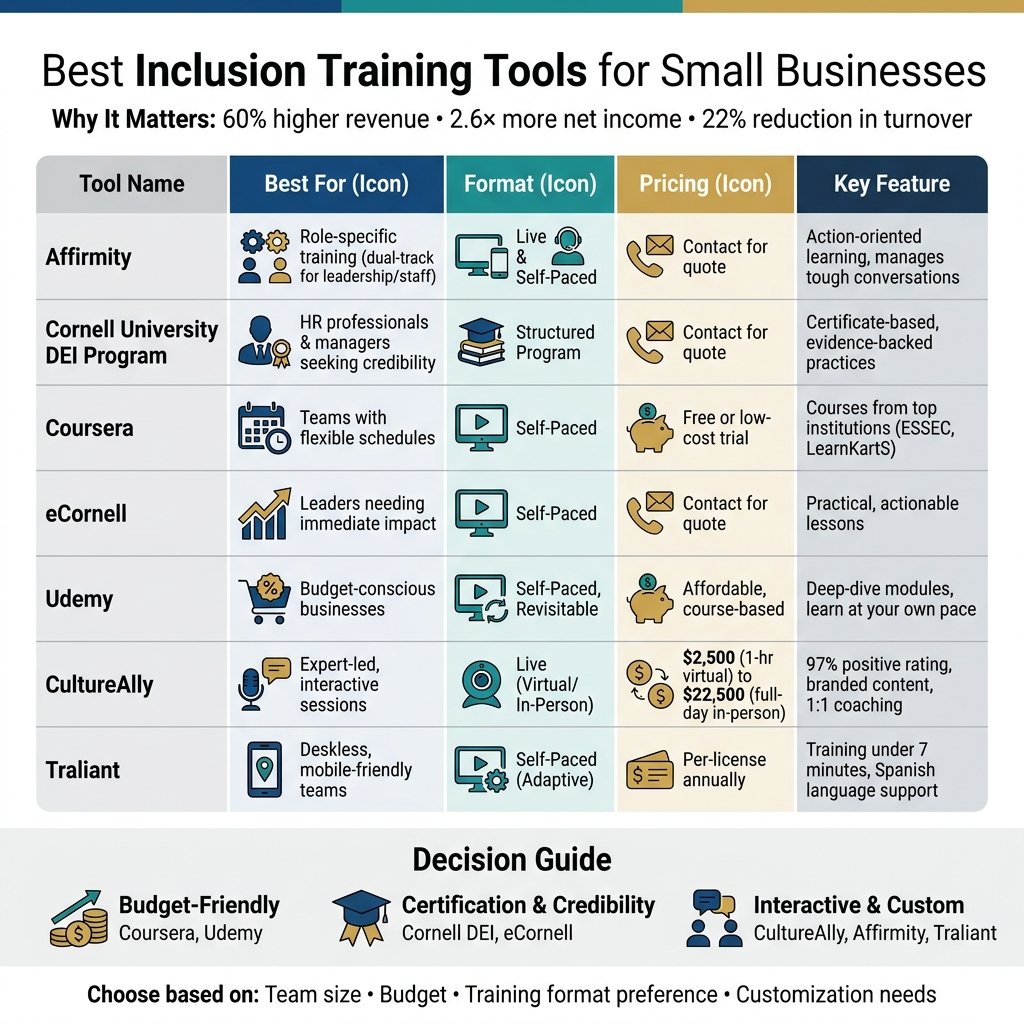
Inclusion Training Tools Comparison: Features, Pricing and Best Use Cases for Small Businesses
Best Inclusion Training Tools for Small Businesses
Choosing the right training tool can reshape how small teams approach diversity and inclusion. These tools mix academic depth with flexible, budget-friendly options that suit the unique needs of small businesses. Here are some standout options, each bringing something different to the table.
Affirmity Inclusion Training
Affirmity takes a hands-on approach to diversity and inclusion (DEI) training. Its programs focus on building inclusive workplaces through action-oriented learning. Key skills include managing tough conversations and addressing microaggressions. Affirmity offers tailored learning paths: one for leadership and another for general staff. This dual-track system is especially helpful for small businesses where leaders often wear multiple hats and need targeted guidance to foster inclusivity. Affirmity is now part of Learning Technologies Group and publishes no rates; you have to talk to sales.
Cornell University DEI Training Program
Cornell University’s DEI certification programs are designed for managers, HR professionals, and small business owners. The curriculum tackles key areas like boosting employee engagement, addressing unconscious bias, and using evidence-based practices to create inclusive environments. Participants receive certificates of completion, adding a layer of professional credibility. This structured program equips small business leaders with the tools and insights to drive lasting change.
Coursera Diversity and Inclusion Courses
Coursera offers a variety of self-paced courses from institutions like ESSEC Business School and LearnKartS. These are ideal for small teams with packed schedules. ESSEC’s course examines the “paradox of diversity”, showing how diverse teams can spark innovation while facing unique challenges. LearnKartS, on the other hand, provides practical lessons on topics such as microaggressions and D&I audits, giving businesses actionable tools to evaluate and improve workplace culture.
eCornell Diversity and Inclusion Courses
eCornell, Cornell University’s online platform, specializes in DEI courses tailored for small business leaders. These courses focus on practical applications, helping managers enhance employee engagement and implement inclusive practices. The training is designed for immediate impact, with actionable lessons on hiring strategies and inclusive leadership that can be applied right away.
Udemy Diversity Deep-Dive
Udemy stands out for its affordable, in-depth diversity modules. Its marketplace model allows employees to learn at their own pace and revisit materials whenever needed. This flexibility ensures that the knowledge sticks over time, making it a smart choice for small businesses looking to maximize their training investment.
Feature Comparison of Inclusion Training Tools
Comparison Table
Here’s a snapshot of the key factors to help you choose the right inclusion training tool, much like selecting top HR management software for small businesses. Pricing, format, and customization are critical elements to consider, as they determine how well the tool fits into your team’s workflow and budget.
Most providers in this category do not publish rates at all. CultureAlly is the exception. Its published prices are $2,500 per virtual session with unlimited participants, custom training from $5,950, and its eLearning platform sold per seat at $25 per user per year (ConnectED Select) or $50 per user per year (All Access). Standalone LMS-ready courses are $9,500 per course. All figures checked against the vendor’s own pricing page in August 2026; confirm them before you budget. If you’re working with a smaller budget, Coursera and Udemy provide self-paced courses that are either free or available through low-cost trial options. Traliant builds its catalogue around short formats, including micro-videos it describes as under two to four minutes each, which suits staff who cannot sit through an hour-long module.
Live training costs more, and what you pay for is real-time interaction. CultureAlly’s in-person workshops start at $8,950. It does not publish separate half-day and full-day rates, so treat that as a floor rather than a quote. Its Leadership Development Experience starts at $25,000 and executive 1:1 coaching at $9,725. One correction for anyone working from an older shortlist: PowerToFly no longer sells DEI training or on-demand learning memberships. It now runs a job board and an AI-training marketplace, so it does not belong on this list any more.
| Tool | Pricing (USD) | Format | Customization | Best For |
|---|---|---|---|---|
| Affirmity | Contact for quote | Live & Self-Paced | Dual-track (leadership/staff) | Small teams needing role-specific training |
| Cornell University DEI | Contact for quote | Structured Program | Certificate-based, evidence-backed | HR professionals seeking credibility |
| Coursera | Free or trial-based | Self-Paced | Course variety from institutions | Teams with flexible schedules |
| eCornell | Contact for quote | Self-Paced | Practical, actionable lessons | Managers needing immediate impact |
| Udemy | Affordable, course-based | Self-Paced | Deep-dive modules, revisitable | Budget-conscious small businesses |
| CultureAlly | $2,500 per virtual session; custom from $5,950; in-person from $8,950; eLearning $25–$50 per user per year | Live (Virtual/In-Person) | Branded content, 1:1 coaching available | Teams wanting expert-led, interactive sessions |
| Traliant | Not published – quote only | Self-Paced | Language options, short-format video | Deskless workers, mobile-friendly needs |
This table highlights the strengths of each tool, making it easier to align their features with your team’s needs. CultureAlly reports that 97% of teams rated its sessions “Highly Engaging” and 92% of learners would recommend them to a colleague; those are vendor-reported numbers, not independent ones. Traliant excels with its mobile-friendly design, ideal for deskless workers who rely on smartphones or tablets. Meanwhile, Coursera’s self-paced structure is perfect for teams juggling tight schedules. Choose the tool that best matches your team’s size, availability, and inclusion goals.
BizBot: Find HR and Inclusion Tools
Tracking down the perfect inclusion training tool doesn’t have to be a time-consuming chore. BizBot is here to make your search easier. This directory is tailored for small business owners, offering a centralized hub to discover and compare business administration tools – including HR and inclusion solutions. It’s the brainchild of serial startup founders John Rush and Didrik Martens, who bring experience from launching over 20 startup products. Their goal is to provide tools that truly meet the needs of small teams. By including HR solutions focused on inclusion, BizBot serves as a helpful complement to the training tools mentioned earlier.
“Our platform is designed to streamline your business operations by offering a one-stop directory for business applications for small business growth.” – BizBot
BizBot lists well-known HR platforms like Gusto, BambooHR, and HiBob, which are invaluable for managing diverse teams and promoting inclusive practices. Instead of diving into separate research for each tool, you can compare features, pricing, and user reviews side-by-side – all in one place. This saves you time and ensures you find tools that align with both your HR needs and your inclusion goals.
Want to stay ahead of the curve? Subscribe to the BizBot newsletter for updates on new tools and trends in business administration. And if you’ve created your own inclusion or HR tool, you can submit it for review and potential inclusion in the directory.
How to Choose the Right Inclusion Training Tool
Selecting the right inclusion training tool starts with understanding your small business’s specific needs. Ask yourself: Are you aiming to meet legal requirements, such as compliance with DOJ and EEOC standards, or are you focused on building a culture of belonging and daily awareness? This distinction is important because compliance-focused tools often differ significantly from those designed to promote long-term behavioral change among employees. For small businesses with limited HR resources, it’s smart to focus on platforms that are simple to implement and manage, even without a dedicated DEI specialist.
Budget considerations are also crucial. If your funds are tight, free resources like those offered by Microsoft or Coursera can be a good starting point. However, for businesses ready to invest, pricing will vary based on the format of the training. Decide whether your team would benefit most from self-paced online modules, live virtual seminars, or interactive workshops – each option comes with its own cost and time requirements.
Customization and accessibility are key to ensuring the tool works for your workforce. For example, if your team includes non-desk workers, make sure the tool is mobile-friendly so everyone can participate, even without constant computer access. For diverse teams, look for multilingual options – Spanish support, for instance, can help make the training more inclusive. Additionally, short-format modules can make a big difference for busy teams.
Another critical factor is the provider’s expertise. Check their credentials and experience to ensure the training will have a lasting impact. Ask for client references and look for certifications from trusted industry organizations. Be sceptical of the engagement and performance multipliers that get quoted at this stage of a sales conversation – the ones we tried to chase led back to marketing pages rather than published research, so we have removed them from this article. Ask instead what the provider measured, on whose staff, and over what period. The right training tool should also provide post-training evaluations and engagement reports to measure its effectiveness on your team culture.
Lastly, focus on interactivity. Tools that incorporate simulations, role-playing, and exercises are far more engaging than passive video lectures. Don’t overlook training that addresses areas like disability inclusion, which affects a substantial share of the U.S. workforce. By choosing a tool that actively promotes inclusion, you’re also setting the stage for better business outcomes.
FAQs
Which inclusion training tool is easiest to roll out with no HR team?
EasyLlama provides a simple platform for compliance and workplace training, including courses on DEI (Diversity, Equity, and Inclusion). With features like real-time reporting, certificates, and mobile-friendly access, it’s designed for easy implementation – even without direct HR involvement.
Other alternatives include Diversity Resources, which offers an inclusion calendar paired with microlearning tools, and Traliant, whose DEI catalogue is led by its “Creating Inclusive Workplaces” course. What sets EasyLlama apart is its ease of use and minimal reliance on HR teams for setup.
How can I measure whether inclusion training is actually working?
To gauge how well inclusion training is working, keep an eye on metrics such as employee retention rates, productivity levels, and belonging scores. Surveys can be a powerful tool here – use them to gather feedback and assess shifts in workplace culture. Pair this with data analysis to uncover patterns and trends.
However, don’t fall into the trap of focusing only on demographic statistics. Instead, aim for a mix of qualitative insights (like personal stories or employee feedback) and quantitative data to get a well-rounded understanding of your progress. This balanced approach provides a clearer picture of how inclusion training is shaping your organization.
What’s the best option for deskless or mobile-only employees?
TalentCards is a smart solution tailored for deskless or mobile-only employees. This microlearning platform focuses on delivering short, impactful training sessions straight to mobile devices. With offline access included, it’s especially handy for frontline workers who are constantly on the move.
More on this topic
Browse all 52 articles on HR & People Ops.