
Looking for the best customer journey tools in 2024? Here’s a quick rundown of the top 5:
- Adobe Experience Cloud – Best for large enterprises
- UXCam – Ideal for mobile app analytics
- Quantum Metric – Fast insights for big companies
- Mixpanel – Great for product teams
- Glassbox – Captures every digital interaction
These tools help businesses understand and improve how customers interact with their brand across touchpoints. Key features to look for:
- Cloud-based for team collaboration
- Easy-to-use interface
- Integrations with other software
- Coverage of online and offline touchpoints
- Advanced analytics and predictive capabilities
The right tool depends on your specific needs, budget, and technical capabilities. Most offer free trials so you can test before committing.
One thing to know before you read on: four of these five vendors do not publish a price at all. This article previously printed dollar figures for all of them. Every one of those figures was either wrong or unsourceable, so they have been removed and replaced with what the vendors actually publish. Checked in August 2026.
Quick Comparison:
| Tool | Ease of Use | Price Range | Best For | Key Feature |
|---|---|---|---|---|
| Adobe Experience Cloud | Complex | Quote only | Enterprises | AI-powered insights |
| UXCam | Easy | Free tier; paid quoted on session volume | Mobile apps | Auto-capture |
| Quantum Metric | Moderate | Quote only | Fortune 1000 | Fast session insights |
| Mixpanel | Easy to moderate | Free to 1M events/mo; Growth starts at $0 | Product teams | User behavior tracking |
| Glassbox | Complex | Quote only | Large companies | Complete interaction capture |
1. Adobe Experience Cloud
Adobe Experience Cloud is a powerhouse in customer journey mapping for 2024. It’s a comprehensive suite that gives businesses deep insights into customer interactions across multiple touchpoints.
What makes it stand out? Real-time, cross-channel insights. You can track and analyze customer behavior as it happens, letting you make quick decisions and intervene when needed. It pulls data from various sources – your CRM, offline systems, you name it – to create a unified view of the customer journey.
The star of the show? Adobe Customer Journey Analytics. It brings together data from pretty much every online and offline channel, showing you the customer’s journey in sequential order. You get to see every touchpoint on their path to conversion.
And it’s flexible. Adobe Experience Analytics lets you collect unlimited variables, events, and unique values without rigid data schemas. Your analytics can grow and change as your business does.
Now, it’s not all smooth sailing. Some users find it a bit tricky to navigate at first. As one user put it:
“It is a good tool to check on the customer journey. Involving them directly and provision of support.”
But that initial complexity? It’s balanced out by the platform’s powerful capabilities and the depth of insights you get.
Here’s where Adobe Experience Cloud really shines:
- Personalization: AI-driven insights help you create super personalized customer interactions.
- Data Governance: It’s got built-in support for GDPR and CCPA regulations.
- Predictive Analytics: Machine learning algorithms help forecast future customer behavior.
- Integration: It plays well with other Adobe products and third-party apps.
What about pricing? Adobe keeps that close to the chest. You’ll need to reach out to their sales team for specifics, but expect it to be based on the services you need and how many users you have.
Who’s it best for? Enterprise-level businesses dealing with complex, multi-channel customer interactions. If you’re handling large datasets and need advanced analytics to gain a competitive edge, Adobe Experience Cloud could be your go-to for data-driven customer experience strategies in 2024.
2. UXCam
UXCam is a big deal in mobile app analytics. It is focused specifically on mobile, which is the reason to consider it over a general web analytics tool. A monthly data-point figure previously quoted here has been removed as unsourced.
What’s cool about UXCam? They’re all about qualitative mobile app analytics. Their platform is packed with features to help you understand how users interact with your app:
- Session replay
- Heatmaps
- User analytics
- Offline recordings
- Screen analytics
- Crash recording
- Funnel analytics
One of their best features? Auto-capture. It grabs and processes complete user journeys from multiple sources without you having to mess with your code. That’s why big names like Nissan, OLX, and NBC are using UXCam.
Here’s what a retail industry user had to say:
“Overall this tool is great for user tracking on mobile apps. I use it for a React Native e-commerce app and it helps provide us great insights as well as identify pain points or issues (like crashes).”
UXCam does not publish prices. Its pricing page states only that pricing is based on your monthly session volume, and offers a free trial with full feature access plus a custom quote. The session and licence allowances this article previously tabulated could not be confirmed, and the comparison table above previously listed UXCam’s price range as “Free – $250k+/mo”, which appears to have been a garbled reading of a 250,000-session allowance rather than a dollar figure. Both have been removed. Ask UXCam for a quote at your actual session volume.
This setup lets businesses start small and grow with UXCam.
But it’s not all perfect. Some users say there are limits on the number of recordings, which can cause quota issues. And a few found the interface a bit tricky at first, but the insights usually make up for it.
UXCam’s real strength? It lets businesses see their app through their customers’ eyes. By watching those tiny interactions, companies can spot problems, boost conversions, and make the whole user experience better.
A healthcare industry user put it this way:
“Simple to navigate which gives us thorough understanding of session replays that are crucial to our work.”
If you’re looking to make your mobile app better and really understand your customer journey, UXCam is worth checking out. It’s got detailed analytics, user-friendly features, and flexible pricing – making it a strong player in the 2024 customer journey tool game.
3. Quantum Metric
Quantum Metric is a top-tier customer journey tool that helps businesses build better digital products faster. It’s popular among Fortune 1000 companies for good reasons.
This tool gives you a clear view of your customer’s journey. It’s like having x-ray vision for your digital products, showing you exactly how customers interact with them from start to finish.
Key Features:
- Session Replay: Watch customer journeys in real-time. It’s like being invisible and following your customers around.
- Heatmaps: See where customers click, scroll, and spend time. It’s data you can actually see.
- Funnel Analysis: Find out where customers drop off in your conversion process.
- “Rage Click” Detection: Spot when customers get frustrated and click repeatedly on something that’s not working.
Speed is what Quantum Metric sells. A specific time-to-insight figure previously quoted here has been removed as unsourced; ask the vendor to demonstrate it on your own traffic during an evaluation.
Integration and Ease of Use:
This tool plays nice with others like Splunk, Adobe Analytics, and Google Analytics. You can boost your existing tech stack without starting over.
But heads up: Quantum Metric takes some time to master. As one user said:
“Quantum Metric is a true professional, and I love the level of insight and industry knowledge they bring to the table.”
They also mentioned it takes time to learn all its features. So, be ready to invest time in learning if you choose Quantum Metric.
Pricing:
Quantum Metric aims at large organisations and does not publish a price. Its pricing page says plans are custom, and that the figure depends on annual session volume, the number of digital properties covered, product add-ons and how much professional services you buy. The “$25,000 per year” and “$5,500 per month Premium” figures this article previously gave are not published anywhere by Quantum Metric, and they contradicted each other besides: $5,500 a month is $66,000 a year. Both are gone. Expect a five-figure annual commitment and get it in writing. One user, Ted S., an IT professional, said:
“QM’s reputation with Fortune 1000 companies is excellent, and validates the ease of integration, positive return on investment within a reasonable timeframe, and the advanced skillset of its deployment and Bizdev teams.”
Real-World Impact:
An unnamed “Fortune 500 retailer” example, claiming a specific dollar value of abandoned carts recovered in three hours, has been removed from this article: we could not trace it to Quantum Metric or to any published case study. The mechanism it was meant to illustrate is real and easy to state without inventing a number. Session replay plus alerting means you find out that a checkout step broke from your monitoring rather than from your support queue two days later. Whether that is worth a five-figure contract depends entirely on what an hour of broken checkout costs you, which is a number you already have.
Quantum Metric is a serious tool for organisations that already know what a broken funnel costs them. If you’re ready to dive deep into customer analytics and have the budget for it, Quantum Metric could be your key to digital product excellence in 2024.
4. Mixpanel
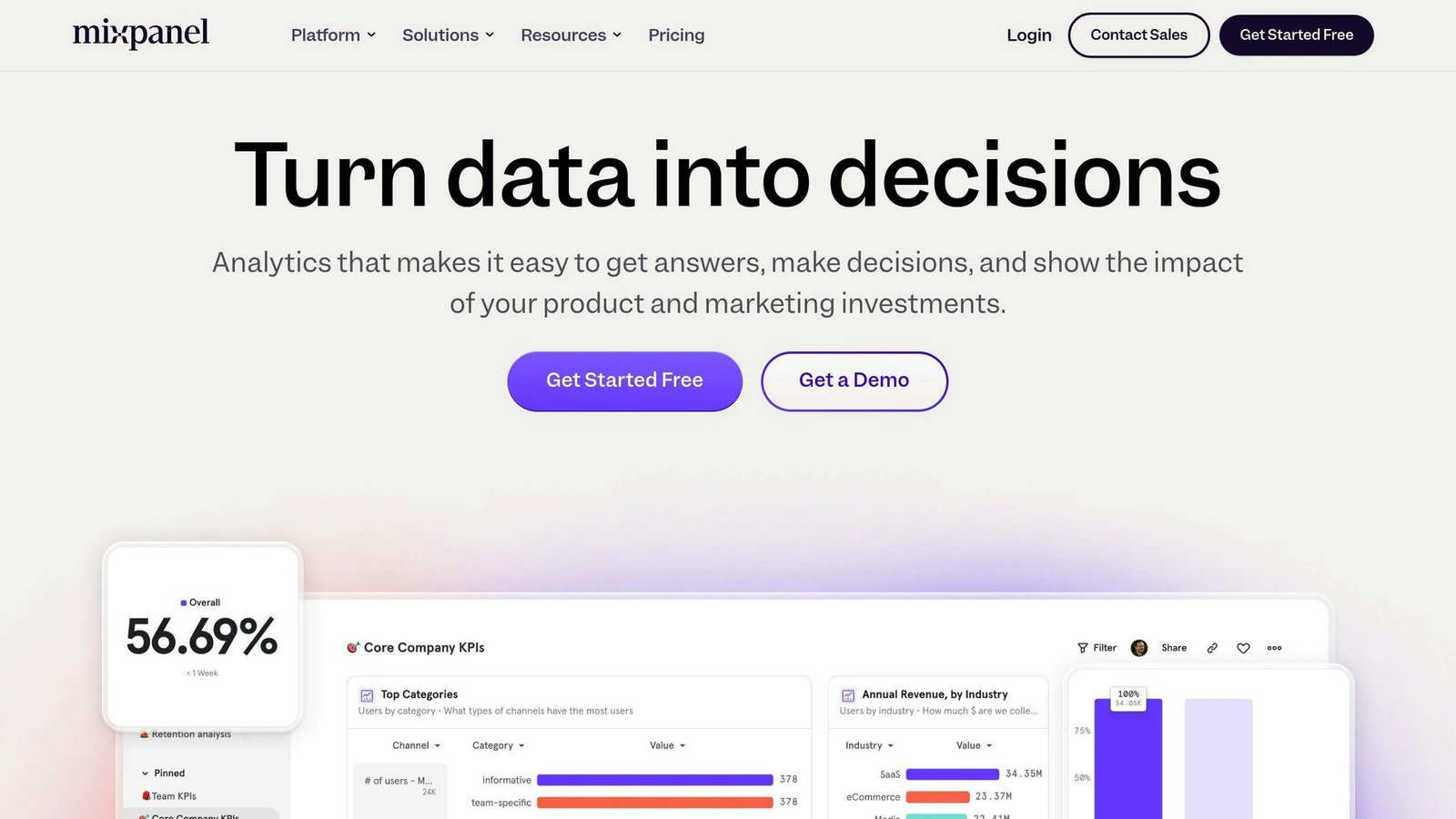
Mixpanel is a product analytics powerhouse that’s making waves in 2024. It’s the go-to tool for businesses that want to get up close and personal with their users’ in-app behavior.
What’s Mixpanel all about?
Mixpanel lets you:
- Track user paths and see where they drop off
- Measure the impact of new features
- Build custom dashboards
- Watch user activity in real-time
- Slice and dice your user base
- Analyze funnels and retention
- Run A/B tests
But here’s the kicker: Mixpanel gives you a microscopic view of individual user actions. It’s like having a superpower that lets product teams make smart decisions at lightning speed.
Mixpanel in action
A claim about an early Uber deployment previously appeared here without a source and has been removed. What Mixpanel is genuinely good at is event-level analysis: you define the events that matter to your product and then ask questions of them, rather than reading pageview reports.
What’ll it cost you?
Mixpanel is the only tool here with a published price, and this article had all three tiers wrong. Checked on mixpanel.com in August 2026:
| Plan | Price | Events Tracked |
|---|---|---|
| Free | Free forever | Up to 1M events/month |
| Growth | Starts at $0, then scales with volume | Up to 20M events/month |
| Enterprise | Contact sales | Up to 1T events/month |
Note the correction: the free tier is 1M events a month, not 20M — 20M is the Growth ceiling. Growth starts at $0 rather than $20 a month, and Enterprise is quoted, not $1,667 a month.
The free plan is genuinely useful for small businesses and startups: 1 million events a month is enough to instrument a small product properly. It is the Growth tier, at up to 20 million, where the volume-based pricing starts to bite.
The user experience
Mixpanel’s got muscle, but it takes some time to master. As one user put it:
“You get a ton of value on the free tier but the jump to paid can be steep.”
Translation: The free version is packed with goodies, but upgrading might make your wallet sweat a little.
Who’s it for?
Mixpanel shines for product teams that need to:
- Dig deep into user segments
- Decode complex product interactions
- Boost engagement and keep users coming back
It’s a perfect fit for SaaS companies, mobile app creators, and web-based services where understanding user behavior is make-or-break.
Getting started
Mixpanel plays nice with lots of other business tools, so you can bring all your data together. But heads up: setting it up can be a bit of a puzzle. You might need to rope in your engineering team. Is it worth the effort? If you’re serious about data-driven decisions, absolutely.
For businesses that want to crack the code of their customer journey, Mixpanel is a top contender. It’s got the brains, the flexibility, and the analytical muscle to help you make smarter product decisions. Just be ready to invest some time in learning its ins and outs.
5. Glassbox
Glassbox is a beast in the customer journey tool world. It’s not just another analytics platform – it’s a Digital Experience Intelligence powerhouse that captures EVERY digital interaction.
Why should you care? Because Glassbox helps you boost customer growth and loyalty by showing you exactly what your users are doing.
Here’s the cool part: Glassbox uses AI to give you insights. It spots struggles, errors, and opportunities on your website and mobile apps in real-time. You’re not just drowning in data – you’re getting actionable intel you can use right away.
One of Glassbox’s killer features? Augmented Journey Maps™. These aren’t your grandma’s customer journey maps. They show you the journey AND how it impacts your revenue. So you know exactly where to focus to make the most money.
But Glassbox isn’t just about cold, hard numbers. It mixes Voice of Customer feedback with real-time data. You get the full picture of your customer experience, helping you make decisions your users will love.
Why is Glassbox a top dog in 2024? Three big reasons:
- Tagless data capture: No need for complex tagging. Glassbox captures everything accurately.
- Plays well with others: It integrates smoothly with tools like Salesforce CRM and Adobe Marketo Engage.
- Flexible deployment: Cloud, SaaS, web-based, on-premise – you name it, Glassbox does it.
Don’t just take our word for it. Here’s what Luigi Saracino, an Analyst at Nespresso, says:
“We use Glassbox to understand where and why our customers are leaving our site due to experience issues or technical ones. The AI features that Glassbox has makes it very easy for us to quickly access the data and get insights on where we need to focus.”
On money: Glassbox does not publish a price. It sells three packages — Production Operation, Marketing/Business, and Product — and quotes on the package you pick, your data retention period, and your web or app session volume. The “$15,000 a year” figure this article previously gave does not appear on Glassbox’s pricing page and could not be sourced, so it has been removed.
Want to try before you buy? Ask about a trial. Glassbox is sold through sales rather than self-serve signup, so an evaluation will involve a scoping call; a claim that it offers a free version has been removed as unverified.
Glassbox really shines when it comes to micro user insights. As one car industry user put it:
“Glassbox is a world-class UX, BX & CX tool – one of the most robust tools available today.”
But heads up: Glassbox has a TON of features. It can be a bit much at first. There’s a learning curve, but the company helps you get up to speed.
Bottom line: In 2024, Glassbox is a top-notch customer journey tool. It’s perfect for big companies that want to really understand their digital customer experience. If you’re ready to invest in a tool that’ll transform how you see customer behavior, Glassbox is worth a serious look.
What Works and What Doesn’t
Let’s break down the pros and cons of the top 5 customer journey tools:
Adobe Experience Cloud
Pros:
- Real-time, cross-channel insights
- Deep customer journey analysis
- AI-driven personalization
Cons:
- Tough to learn
- Complex setup
- Pricey (better for big companies)
UXCam
Pros:
- Great for mobile app analytics
- Auto-captures full user journeys
- Easy to use
Cons:
- Limited recordings
- Quota issues reported
- Interface can be tricky at first
Quantum Metric
Pros:
- Fast time from session to insight
- Spots “Rage Clicks” (user frustration)
- Plays well with other tools
Cons:
- Takes time to master
- Quote-only pricing; expect a five-figure annual commitment
- Some visual loading issues
Mixpanel
Pros:
- Tracks individual user actions
- Flexible pricing (good free plan)
- Strong A/B testing
Cons:
- Can be complex for newbies
- Costs scale with event volume, which can climb quickly
- Some data accuracy concerns
Glassbox
Pros:
- Captures every digital interaction
- AI spots issues in real-time
- Maps revenue impact
Cons:
- Quote-only pricing, and the quote depends on session volume and retention
- Steep learning curve
- Some find the interface clunky
Here’s a quick comparison:
| Tool | Easy to Use? | Price | Best For | Cool Feature |
|---|---|---|---|---|
| Adobe Experience Cloud | No | Quote only | Big businesses | AI insights |
| UXCam | Yes | Free tier; paid quoted on session volume | Mobile apps | Auto-capture |
| Quantum Metric | So-so | Quote only | Fortune 1000 | Fast insights |
| Mixpanel | Yes (basics) | Free to 1M events/mo; Growth from $0 | Product teams | User tracking |
| Glassbox | No | Quote only | Big companies | Captures everything |
When picking a tool, think about what you need, your budget, and your tech skills. If you’re all about mobile apps, UXCam might be your jam. Here’s what Luigi Saracino from Nespresso said about Glassbox:
“We use Glassbox to see where and why customers leave our site. Its AI makes it easy to get data and focus on what matters.”
For big companies wanting deep analytics, Adobe Experience Cloud or Quantum Metric might fit better. An unnamed retailer example with a specific dollar recovery has been removed from this paragraph as unsourceable.
The best tool depends on what you need, your budget, and how much complexity you can handle. Try free trials to get a feel for each platform before you decide.
Final Thoughts
Picking the right customer journey tool in 2024 can make a huge difference in how well you understand and serve your customers. Let’s break down what we’ve learned about these top 5 tools:
- Adobe Experience Cloud: Best for big companies that want AI-powered insights
- UXCam: Perfect for mobile app analytics
- Quantum Metric: Gives quick insights for Fortune 1000 companies
- Mixpanel: Great for product analytics
- Glassbox: Captures every digital interaction for a full picture
When you’re choosing a tool, think about:
- What you need: Mobile apps? Web? Both?
- Your budget: Mixpanel has a genuinely usable free tier; the other four are quote-only and priced for organisations with a procurement process
- How easy it is to use: Some tools are tricky but powerful
- How it fits with your other tech: Make sure it plays nice with what you already have
A second copy of the same unnamed retailer example has been removed here. If you want a number to justify one of these tools, calculate your own: your conversion rate multiplied by your traffic multiplied by your average order value, for the hours a broken funnel would go unnoticed today.
But remember, tools are just part of the picture. As Eric Schurke from Moneypenny says:
“Understanding those will enable managers to foresee future touchpoints, meet any currently unmet needs, and provide a superior customer experience.”
To get the most out of these tools:
- Set clear goals for customer satisfaction
- Keep your customer journey maps up-to-date
- Use both direct feedback (like surveys) and indirect data (like purchase history)
Three statistics about the results of customer journey work previously appeared here — on marketing return, service costs and referral revenue. None was attributed to a study we could find, so all three have been removed.
In today’s market, understanding your customer’s journey isn’t optional – it’s a must. Choose a tool that fits your needs, budget, and goals. With the right tool and plan, you’ll be set to create amazing customer experiences that grow your business and keep customers coming back in 2024 and beyond.
FAQs
What is the customer journey of SaaS?
The SaaS customer journey is how users interact with a product from start to finish. It’s not just about getting people to sign up – it’s about keeping them happy and coming back for more.
Here’s what it looks like:
1. Awareness
Someone realizes they have a problem. They start looking for a fix.
2. Acquisition
They find your SaaS product. It looks promising, so they decide to give it a shot.
3. Adoption
This is where the rubber meets the road. Your new user is learning the ropes. A smooth onboarding process here is CRUCIAL.
4. Renewal
Decision time. Will they stick around or jump ship?
5. Expansion
If you’ve played your cards right, they might upgrade or buy extra features.
6. Advocacy
The holy grail: happy customers telling others about your product.
Why does this matter? Because understanding this journey helps you make your product better. As the folks at Efficy (a CRM company) put it:
“The customer journey hones in on the individual experiences (touchpoints) a customer has through these stages.”
Get these touchpoints right, and you’re golden. A percentage figure for the revenue effect of customer journey mapping previously appeared here and has been removed as unsourced.
Here’s the kicker: each stage is a chance to wow your users. Take onboarding, for example. Nail that, and you’re way more likely to keep customers around for the long haul.
Want to make your SaaS customer journey top-notch? Try this:
- Map out detailed journeys for different types of users
- Figure out where users interact with your product and where they might hit snags
- Use feedback and data to keep tweaking and improving
More on this topic
Browse all 53 articles on Data & Analytics.