Disclosure: This page contains commercial links. BizBot may earn a commission from qualifying purchases. Paid placements do not buy a better ranking. Read our affiliate disclosure.
Revenue forecasting platforms are tools that predict future income by analyzing historical data, live metrics, and market trends. Unlike sales forecasting, which focuses on immediate deals, these platforms provide a broader view, including renewals, churn, and upsells. Businesses using these tools can improve budget planning, hiring strategies, and overall financial health.
Key insights from the guide include:
- AI accuracy: AI-driven platforms claim large accuracy gains over spreadsheets. The numbers come from vendors and are not independently audited, so treat them as a starting point for your own test.
- Integration: Syncing with CRMs and accounting software tools ensures real-time data updates.
- Customization: Tailored models support different revenue streams like SaaS ARR or usage-based income.
- Published results: Siemens rolled forecasting out to 4,000 sellers with Outreach and reports submission rates above 70%. That figure is from the vendor’s case study.
If you’re looking to improve forecasting and align teams, these platforms are essential for accurate decision-making. The guide dives deeper into features, case studies, and how to select the right tool for your business.
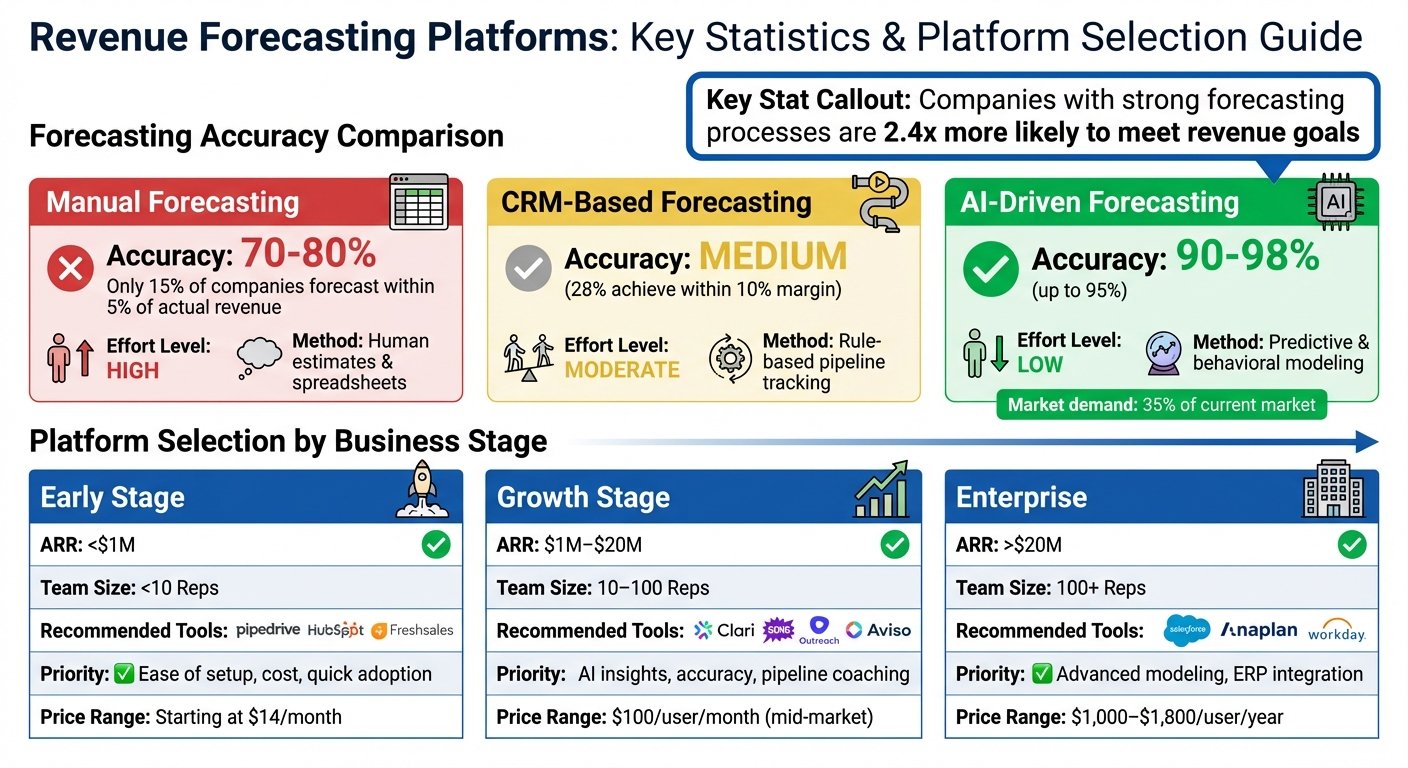
AI vs Manual Revenue Forecasting: Accuracy Comparison and Platform Selection Guide
Key Features of Revenue Forecasting Platforms
AI-Driven Insights and Predictive Analytics
Modern forecasting platforms are reshaping how businesses predict revenue by removing human bias. Sales reps often downplay their projections to avoid overpromising, while managers might inflate numbers to show confidence. AI bypasses these tendencies by analyzing data like email sentiment, call transcripts, calendar activity, and even Slack messages to measure actual buyer engagement.
These platforms go beyond just predicting whether a deal will close – they also estimate when it’s likely to close. This dual focus helps prevent revenue delays, where deals expected in one quarter slip into the next. Vendors publish accuracy percentages for all of this. We have removed the ones on this page that could not be traced to a primary source, because comparing a vendor’s number with a spreadsheet number nobody measured is not a comparison.
“AI is increasingly handling the human judgment adjustments that managers used to make manually… now it’s the AI that’s maybe doing that rather than the manager.” – Dr. Amy Cook, CMO & Co-Founder, Fullcast
Another standout feature is how these platforms identify “red-flag” deals – those that have stalled, show declining buyer interest, or have gone unresponsive. This allows managers to intervene before it’s too late. Unlike traditional systems that rely on weekly updates, AI-driven platforms continuously refresh forecasts as new data flows in.
Next up: the importance of integration with essential business tools.
Integration with Business Tools and CRMs
For accurate, real-time forecasting, integration with key business systems is a must. Platforms that sync with CRMs like Salesforce, HubSpot, and Pipedrive automatically pull live deal data. Meanwhile, connections to accounting tools like QuickBooks, Xero, and NetSuite align sales forecasts with actual cash flow, cutting down on errors and saving time. The point is not the time saved on data entry; it is that the forecast and the cash position stop disagreeing.
One documented example: in 2025 Siemens rebuilt its forecasting process on Outreach across 4,000 sellers in 190 countries, and Outreach’s own case study reports forecast submission rates above 70% and a unified opportunity process. Note what is being measured there: submission rates, not accuracy. The case study does not publish an accuracy figure.
Bi-directional syncing matters more than it sounds. Platforms not only pull data from CRMs but also push updates back, ensuring teams don’t have to juggle multiple systems. Integration with tools like Slack, Teams, and Gmail adds another layer by capturing hidden engagement signals from emails and meetings. Sales engagement tools like Gong and Salesloft further enhance accuracy by analyzing conversations and linking rep activity to deal outcomes.
Customization is the next step in making these insights even more actionable.
Customizable Forecasting Models
Every business operates differently, and forecasting platforms cater to these differences with customizable models. For instance, SaaS companies might rely on an ARR-based model that factors in renewals and expansions, while professional services firms may prioritize activity-based methods tied to billable hours. Platforms typically offer straight-line forecasts, moving averages, and regression analysis to pinpoint revenue drivers.
One standout feature is scenario planning, which allows businesses to test the impact of changes – like pricing adjustments, staffing shifts, or market fluctuations – before making decisions. For larger organizations, the ability to forecast by product lines, regions, or business units is crucial. This multi-layered approach ensures teams get the data they need without waiting on custom reports from finance.
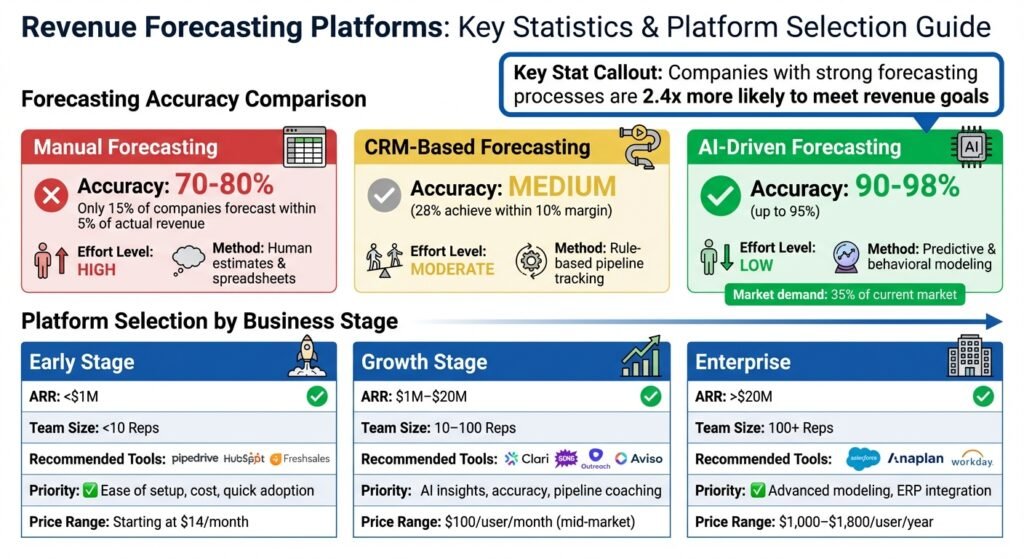
| Forecasting Type | Method | Accuracy | Effort |
|---|---|---|---|
| Manual | Human estimates & spreadsheets | Low | High |
| CRM-Based | Rule-based pipeline tracking | Medium | Moderate |
| AI Forecasting | Predictive & behavioral modeling | Higher, but vendor-claimed | Low |
For smaller businesses, it’s wise to start simple – try a 3-month forecast first to understand the platform’s logic before diving into multi-year models. But remember, even the best forecasting tools can’t fix a poorly designed plan. As the saying goes, a great tool applied to a flawed strategy will still yield the wrong results.
How to Choose the Right Revenue Forecasting Platform
Key Evaluation Criteria
Most forecasting problems are not effort problems. They are data problems that a new dashboard will not fix.
Start by ensuring bi-directional syncing between your CRM and accounting systems. This eliminates the need for manual data entry and reduces errors. The failure mode it fixes is mundane: sales updates a deal, finance never sees it, and the two forecasts drift until someone reconciles them by hand at quarter end. We removed a customer example that was previously here because we could not trace the figures to a published source.
Look for platforms with AI and predictive analytics. These advanced tools use machine learning to evaluate deals, spot risks, and identify patterns. A model fed from CRM, email and billing data has more to work with than one reading pipeline stages alone. How much more depends entirely on how clean your CRM is.
“Sales forecasts are never gonna be perfect. It’s human-entered data and it’s based on a lot of different things… personality types, optimism levels. You’ve historically had to rely on that human level adjustment… and now it’s the AI that’s maybe doing that rather than the manager.” – Dr. Amy Cook, CMO & Co-Founder, Fullcast
Scenario modeling is another must-have. When testing platforms, avoid relying on polished vendor demos. Instead, use your own historical data to see how the tool handles real-world challenges like seasonality or pricing shifts.
Ease of use is also critical. The best platform is useless if your team doesn’t adopt it. Intuitive interfaces and mobile access are key to ensuring accurate data input.
“The gap between median performance and elite forecasting isn’t about effort… It’s about foundation: the right platform architecture, clean data, and actual seller adoption.” – Nora Pantfoerder, Outreach
Here’s a quick breakdown of platform recommendations by business stage:
| Stage | ARR Range | Team Size | Recommended Tools | Priority Focus |
|---|---|---|---|---|
| Early Stage | <$1M | <10 Reps | Pipedrive, HubSpot, Freshsales | Ease of setup, cost, quick adoption |
| Growth Stage | $1M–$20M | 10–100 Reps | Clari, Gong, Outreach, Aviso | AI insights, accuracy, pipeline coaching |
| Enterprise | >$20M | 100+ Reps | Salesforce Sales Cloud with its AI add-ons, Anaplan, Workday | Advanced modeling, ERP integration |
These criteria help ensure the platform aligns with your revenue model and team needs.
Business-Specific Needs and Scenarios
Your revenue model will shape which features matter most. For SaaS companies with annual recurring revenue (ARR), tools need to track renewals, expansions, and churn separately from new business. If you operate on a usage-based model, look for platforms that handle variability with Monte Carlo simulations and dynamic adjustments. Project-based businesses, on the other hand, require milestone tracking tied to billable hours and deliverables.
Siemens is the scale example: 4,000 sellers, 190 countries, multi-currency support and role-based dashboards. Useful if that is your shape. Overkill, and expensive, if it is not.
Smaller businesses should start simple. Test a three-month forecast to evaluate the platform’s logic before committing to more complex, multi-year models. If your business combines subscription and usage-based models, choose a platform that can handle both separately. And remember, even the best software won’t help if your foundational processes – like balanced territories and realistic quotas – are flawed.
“If your territories are unbalanced, your quotas are unrealistic, and your capacity model is a best guess, even the most advanced sales forecasting software will accurately predict one thing: failure.” – Bala Balabaskaran, Fullcast
Pricing varies enormously, and the gap between tiers is wider than most shortlists suggest. Checked against each vendor’s own pricing page in August 2026: Upmetrics, an entry-level planning and forecasting tool, advertises plans from about $7 a month with 10% off annual billing. HubSpot Sales Hub Professional is $90 per seat per month billed annually, or $100 per seat per month billed monthly, plus a one-time $1,500 onboarding fee that is easy to miss. Salesforce sells AI as an add-on to Enterprise and above rather than as a separate “Einstein” edition, and does not publish the add-on price. Clari and Gong do not publish prices at all: Gong states that licences are priced per user with a platform fee based on seat count, and Clari quotes on request. Any per-seat figure you see quoted for those two came from someone else’s contract, not from the vendor. Confirm all of this before you budget.
Integrating Revenue Forecasting Platforms into Business Workflows
Onboarding and Implementation Best Practices
One of the biggest pitfalls in adopting a forecasting platform is skipping the crucial step of cleaning and reconciling your data. Before diving into implementation, take the time to review and reconcile 18 to 24 months of revenue and pipeline records across systems like your CRM, billing platforms, and internal databases. This historical data serves as the foundation for accurate forecasting.
Start with a “data detox.” Identify deals that have been pushed across multiple quarters – often referred to as “ghost deals” – and correct close dates to reflect realistic timelines instead of overly optimistic guesses. Additionally, ensure that terminology is standardized across teams. For instance, if sales refers to “committed revenue”, make sure finance interprets it the same way. Misaligned definitions are a common and entirely self-inflicted source of forecasting error.
To streamline workflows, connect your forecasting platform to key tools like Stripe, Salesforce, and Snowflake using APIs. This eliminates manual data entry and ensures data consistency across systems. Configure the platform to match your role hierarchy so forecasts roll up cleanly from individual reps to executives. Additionally, map CRM opportunity stages to appropriate forecast categories – for example, linking “Proposal Sent” to “Commit” – and, for milestone-based revenue, align forecasts with the start of delivery rather than close dates.
A great example of successful implementation comes from MasterControl, which integrated Clari to replace manual spreadsheets with a data-driven process. Dan Alvey, Director of Sales Operations, shared:
“I’m a huge fan of Clari… it helps me understand what’s going on, and I have much more confidence as I roll up numbers to management. Clari helps me turn the art of forecasting into a science”.
Their success stemmed from establishing a consistent cadence: weekly updates from reps, biweekly manager reviews to flag risks, and monthly RevOps meetings to align teams. Once the system is fully operational, use the platform’s insights to turn routine meetings into opportunities for diagnosing issues and making informed decisions.
Using Forecasting Insights for Decision-Making
Once your platform is up and running, the real value lies in how you use its insights to guide decisions. Shift meeting agendas from deal recaps to diagnostics. Let the platform do the heavy lifting by identifying risk signals and pressure-testing assumptions. Over time, monitor forecast patterns from managers to detect tendencies like sandbagging or over-optimism. To enhance accountability, require specific reason codes for any manual adjustments to deal close dates or commit categories.
Scenario modeling is another powerful tool. Use it to create best-case, worst-case, and most-likely projections to inform decisions about hiring, inventory, or cash flow. Algolia says it cut the time it spends on what-if analysis by 90% after moving that work into Pigment, according to Pigment’s customer story. That is a vendor-published figure about one company’s planning process, not a benchmark.
It’s also crucial to break down revenue streams. Subscription revenue, usage-based revenue, and professional services all behave differently, and lumping them together can obscure risks. A usage-based business forecast on subscription logic will be wrong in a specific way: it will miss the variance, because the thing that moves is consumption, not contract count. We removed an unnamed customer example that was previously here, as it could not be sourced.
To avoid blind spots, apply multiple forecasting techniques to the same dataset. Combining pipeline-based forecasting with AI-driven analysis can be especially effective. Teams that pair pipeline maths with AI-powered pipeline analysis tend to catch different problems with each, which is the point of running both.
Databricks offers a compelling case study. In 2024, they used Clari to identify at-risk deals earlier in the sales cycle. Jules Gsell, an RVP at Databricks, noted:
“We use Clari to have more intelligent forecast conversations, especially when we look farther out. By looking at historical trends, we can extrapolate where we’ll be going forward”.
Finally, tailor pipeline coverage ratios to the unique needs of each business segment instead of applying a one-size-fits-all approach. Track metrics like Forecast Variance and Mean Absolute Percentage Error (MAPE) to uncover systematic biases, such as regions that consistently over-forecast.
The Role of BizBot in Supporting Revenue Forecasting
Creating an effective revenue forecasting system involves much more than just picking a single platform – it requires connecting the right tools across your tech stack. That’s where BizBot steps in. Acting as a resource hub for business administration tools, BizBot helps companies identify and assess essential software like CRMs, accounting platforms, and top financial reporting software, all of which play a critical role in improving the accuracy of revenue forecasts.
BizBot simplifies the tool discovery process by categorizing platforms to align with forecasting workflows. It even allows users to compare top CRMs and accounting tools side by side. This cuts down scattered research and makes integration gaps obvious earlier. As BizBot’s team explains:
“We have carefully curated a comprehensive list of the best admin tools for companies, saving you valuable time and effort in finding the right tools to streamline your business operations and boost productivity”.
But BizBot doesn’t stop at discovery. It also tackles a key challenge in revenue forecasting: managing subscription costs. Forecasting tools can be expensive, and overlapping subscriptions can drain budgets. BizBot helps businesses track and optimize these costs, ensuring that resources are used efficiently without redundant spending.
Another standout feature is BizBot’s ability to manage equity and share data – an often overlooked yet critical factor for long-term financial planning. With BizBot, companies can maintain an accurate cap table, making it easier to predict the financial impact of future funding rounds or share sales. This is crucial for businesses planning multi-year revenue scenarios. BizBot was founded in Norway in 2017 and works with BDO Norway, an auditing and consulting firm.
To keep users informed, BizBot’s blog and newsletter highlight the latest AI trends and emerging forecasting tools. This ensures businesses stay ahead of the curve, discovering new solutions that could enhance forecasting accuracy or speed up implementation.
Conclusion
A forecasting platform is worth buying when the problem is that your data lives in four systems and nobody trusts the roll-up. It is not worth buying when the problem is that your quotas are fiction. The accuracy figures published throughout this article are vendor-reported; we removed the ones we could not trace, and labelled the ones that remain.
“Revenue predictability has become a competitive advantage.” – Alex Zlotko, CEO, Forecastio
Whether it is managing cash flow, sizing headcount, or answering an investor, an accurate forecast is worth more than a fast one. Start with the data, not the dashboard. If eighteen months of pipeline history is unreliable, fix that first, because no platform will infer what was never recorded.
FAQs
What data do I need before using a revenue forecasting platform?
To get the most out of a revenue forecasting platform, start by collecting essential data points. This includes historical revenue figures, sales pipeline details, deal probabilities, and sales activity metrics. Beyond that, having a clear grasp of your current sales performance, your team’s capacity, and the overall market conditions is crucial for producing accurate forecasts. When you feed the platform with dependable, real-time data on these factors, it can deliver precise and actionable revenue projections.
How do I connect a forecasting platform to my CRM and accounting tools?
To link a forecasting platform with your CRM and accounting tools, start by selecting a platform that supports integrations with systems like Salesforce or HubSpot. Once you’ve chosen the right platform, connect it using APIs or pre-built connectors. Make sure to grant the necessary permissions and map critical data fields, such as deals and revenue. Finally, configure the sync settings to enable either real-time updates or batch processing. This setup allows the platform to automatically pull current data, ensuring precise and reliable forecasts.
How can I tell if AI forecasts are accurate for my business?
To ensure AI forecasts are reliable, start by examining the quality of the data you’re feeding into the system. High-quality input data forms the backbone of accurate predictions. Next, evaluate how well the AI models align with your specific business goals – this alignment is crucial for meaningful results.
Regularly compare the AI’s predictions with actual outcomes over time. Use analytics tools to track any deviations and understand where adjustments may be needed. Additionally, reviewing industry benchmarks and case studies can help you gauge whether your expectations are realistic.
The key to dependable forecasts lies in consistently validating predictions and maintaining clean, accurate, and up-to-date data. Without these steps, even the most advanced AI models can fall short.
More on this topic
Browse all 53 articles on Finance & Accounting, or jump straight to our buying guide: Best Accounting Software for Small Businesses.